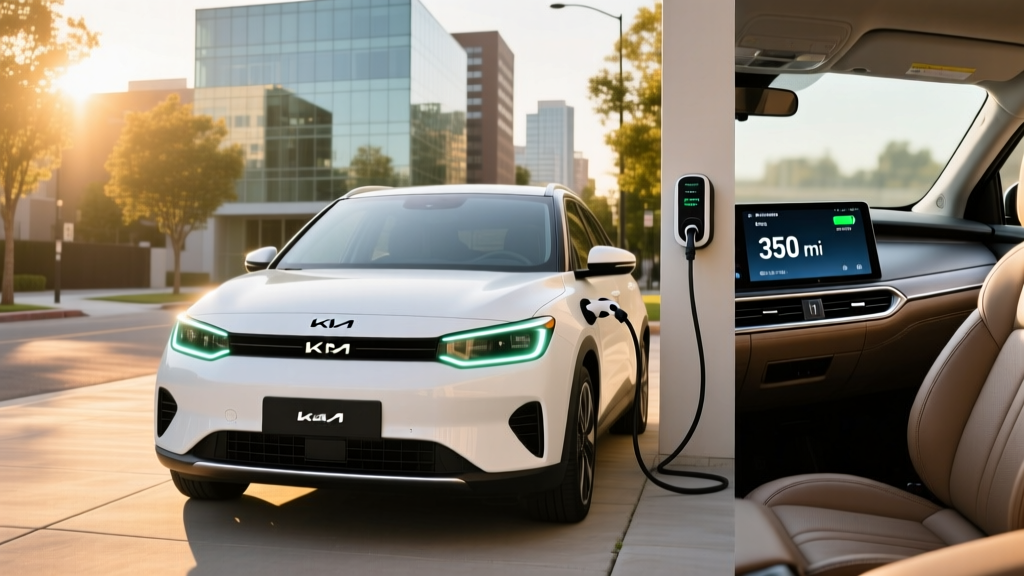
Quick Answer: The Kia Ray EV is a compact electric kei-class van sold exclusively in the South Korean market. The 2022-refresh model delivers an EPA-equivalent range of approximately 130 miles (210 km) on a 39.2 kWh NMC battery, with DC fast charging peaking at roughly 50 kW (10–80% in about 40 minutes). Base pricing in Korea starts around ₩27.7 million (~$20,500 USD before Korean subsidies). It is not officially sold in the United States, meaning no EPA certification, no federal §30D tax credit eligibility, and no U.S. dealer support or warranty coverage. For U.S. buyers, it serves best as a reference point for what compact urban EVs can achieve — or as an import curiosity for those willing to navigate gray-market ownership.
What the Kia Ray EV Actually Is
The Kia Ray EV is the electrified version of the Kia Ray, a boxy kei-class light commercial and passenger van designed for Korea's dense urban corridors. Think of it as the spiritual equivalent of a Japanese kei car — tall, narrow, and optimized for tight streets and short delivery routes. Kia originally launched a Ray EV in 2011 with a modest 16.4 kWh battery and roughly 58 miles of range. The significantly updated 2022 model — which is the version still in production and relevant for 2026 buyers — received the 39.2 kWh pack shared in concept with early Hyundai Kona Electric architectures.
It's critical to understand this vehicle's market positioning: the Ray EV is engineered for Korean city driving, where average daily commutes run under 25 miles and highway speeds rarely exceed 68 mph (110 km/h). It is not a highway cruiser, and it was never intended to be one.
Specs That Matter: Range, Battery, and Charging
| Specification | Kia Ray EV (2022-Refresh) |
|---|---|
| Battery Capacity (Usable) | ~39.2 kWh, NMC chemistry |
| Korean-Certified Range | 210 km (~130 miles) |
| Real-World Urban Range (est.) | 105–120 miles |
| Real-World Highway Range (est.) | 80–95 miles at 65 mph |
| Cold-Weather Range (est., 20°F) | 75–90 miles |
| Motor Output | 68 HP (50 kW) / 170 Nm torque |
| 0–60 mph (est.) | ~15.5 seconds |
| Top Speed | ~87 mph (140 km/h) |
| DC Fast Charge (Peak) | ~50 kW (CCS Combo 1 in Korea) |
| 10–80% DC Charge Time | ~40 minutes |
| Level 2 AC Charge Rate | ~7 kW (OBC) |
| Level 2 0–100% Time | ~6 hours |
| Connector (Korea Domestic) | DC: CCS1 / AC: Type 1 (J1772 equivalent) |
Real-World Range Reality: The 210 km Korean-certified range (tested under Korea's composite cycle, roughly comparable to WLTP) drops meaningfully in real-world use. Expect 105–120 miles in stop-and-go urban driving with regenerative braking doing heavy lifting. Highway driving at sustained 65 mph slashes that to 80–95 miles due to the Ray's brick-like aerodynamics. In sub-freezing temperatures without a heat pump (the Ray EV uses resistive cabin heating), plan for 75–90 miles of usable range.
The 50 kW peak DC charge rate is the Ray EV's most significant limitation for anyone considering road trips. While competitors like the Hyundai Ioniq 5 or Kia EV6 pull 200–350 kW at compatible chargers, the Ray tops out at 50 kW and sustains closer to 35–40 kW through most of the 10–80% window. This means a 40-minute charge session adds roughly 80–90 miles of range — fine for an urban delivery van, painful for intercity travel.
Cost Breakdown: Purchase, Charging, and Ownership
Because the Ray EV is not sold in the U.S., constructing a direct American ownership cost requires hypotheticals. Below, I've modeled what ownership would look like if this vehicle were available stateside, alongside what Korean buyers actually pay.
| Cost Factor | Kia Ray EV (Korean Market) | Hypothetical U.S. Equivalent | Comparable Gas Vehicle (Kia Morning/Picanto) |
|---|---|---|---|
| Base Price | ₩27.7M (~$20,500) | ~$24,000 (estimated with U.S. compliance) | ₩13.5M (~$10,000) |
| Government Incentive | ₩6.5–9M national+local subsidy | $0 (not §30D eligible) | None |
| Effective Price | ~₩18.7–21.2M ($14,000–$15,700) | ~$24,000 | ~$10,000 |
| Energy/Fuel Cost per Mile | ₩35–45/mi (~$0.026–$0.034) | $0.04–$0.06/mi (U.S. electricity) | $0.09–$0.11/mi (gasoline) |
| Annual Energy (10k mi/yr) | ~$260–$340 | ~$400–$600 | ~$900–$1,100 |
| Maintenance (Annual est.) | ~$150–$200 | ~$200–$300 | ~$500–$700 |
| Insurance (Annual est.) | ~$600–$800 | ~$1,200–$1,600 (gray-market premium) | ~$900–$1,100 |
The math in Korea is compelling: after subsidies, the Ray EV costs roughly $14,000–$15,700 and saves $600–$750 annually in energy costs versus a gasoline Kia Morning. The payback period against the gas variant is approximately 6–8 years for an average driver — longer than ideal, but viable for fleet operators who log predictable urban miles and benefit from Korea's commercial EV subsidies.
For a hypothetical U.S. buyer importing one, the story changes dramatically. Without §30D eligibility (the vehicle isn't EPA-certified or sold through U.S. dealers), with gray-market insurance premiums running 40–80% higher than standard EV insurance, and with no domestic service network, the total cost of ownership becomes punitive. This is a vehicle that only makes economic sense within its intended market.
Ray EV vs. Gas and Hybrid Alternatives
| Metric | Kia Ray EV | Kia Ray (Gas, 1.0L) | Comparable U.S. Option: Chevy Bolt EV |
|---|---|---|---|
| Powertrain | 68 HP electric motor | 76 HP 1.0L 3-cyl | 200 HP electric motor |
| Range / Tank | ~130 mi (130 mi real urban) | ~340 mi (10.1 gal tank) | 259 mi EPA |
| Energy Cost/Mile | ~$0.03 (Korea) / ~$0.05 (U.S.) | ~$0.10 | ~$0.04 (U.S.) |
| Cargo Volume | ~30 cu ft (rear seats folded) | ~30 cu ft | ~57 cu ft (rear folded) |
| DC Fast Charge | 50 kW / ~40 min (10–80%) | N/A | 55 kW / ~45 min (10–80%) |
| Best Use Case | Urban delivery, short commute | Mixed urban/suburban | Daily commuter, road trips possible |
| U.S. Availability | No | No | Yes (discontinued 2023, used market) |
The Ray EV's closest U.S.-available spiritual equivalent is the discontinued Chevrolet Bolt EV (2023 final model year, available on the used market) or the Nissan Leaf. Both offer substantially more range (259 and 212 EPA miles, respectively), more power, and full U.S. support. For buyers seeking a compact urban EV in America, these are the practical alternatives.
Who Should Consider the Ray EV (and Who Shouldn't)
Decision Framework:
- Choose the Ray EV if: You live in South Korea, drive under 60 miles daily in urban traffic, have access to home or depot Level 2 charging, and prioritize low operating costs and easy maneuverability in tight city streets. Fleet operators running last-mile delivery routes in Seoul or Busan will find the economics especially favorable with commercial subsidies.
- Choose a gas Kia Ray if: You need the Ray's cargo configuration but regularly drive routes exceeding 100 miles, operate in rural areas with limited charging infrastructure, or cannot install a Level 2 charger at home or your business.
- Look elsewhere if: You are a U.S. buyer. The Ray EV is not importable under standard EPA/NHTSA rules for vehicles under 25 years old, has no U.S. parts or service support, and offers less capability than readily available American-market EVs at comparable or lower effective prices.
Common Misconceptions About the Ray EV
| Myth | Fact |
|---|---|
| "The Ray EV can be imported and registered easily in the U.S." | The EPA and NHTSA restrict importation of non-conforming vehicles under 25 years old. The Ray EV lacks U.S. safety certification, emissions compliance documentation, and EPA range testing. Legal import is effectively impossible for individual buyers. |
| "130 miles of range is enough for anyone." | 130 miles (certified) translates to 80–95 real highway miles or 75–90 cold-weather miles. This works for predictable urban routes but creates genuine range limitations for any unplanned detour, climate extremes, or highway driving. |
| "It qualifies for the $7,500 U.S. tax credit." | The §30D credit requires the vehicle to be EPA-certified, sold through a U.S. dealer, meet MSRP caps, and satisfy battery-sourcing requirements per IRS guidelines. The Ray EV meets none of these criteria. |
| "Small battery means it charges super fast." | A 39.2 kWh battery with a 50 kW charge ceiling still takes ~40 minutes for a 10–80% DC session. The smaller battery doesn't overcome the low peak charge rate — it just means you're waiting 40 minutes for ~80 miles of range instead of 40 minutes for ~200 miles. |
| "Kia will bring it to the U.S. eventually." | Kia's U.S. EV strategy focuses on larger, higher-margin vehicles (EV6, EV9, GT-line variants). The kei-class Ray serves a uniquely Korean market segment with no American analog. There are no announced plans for U.S. introduction. |
Real-World Ownership Considerations
Home Charging Access: The Ray EV's 7 kW onboard charger means a full Level 2 charge takes about 6 hours — adequate for overnight replenishment. Korean apartment dwellers (the majority of the population) rely on shared parking garage chargers, which are increasingly common but often limited to 3–7 kW shared circuits. In the U.S., a dedicated Level 2 home installation typically costs $800–$2,500 including equipment and electrician labor, though this is moot given the vehicle's unavailability.
Climate Impact: The Ray EV lacks a heat pump, relying on resistive PTC heating for the cabin. In Korean winters (average January lows of 18–25°F in Seoul), this draws 2–4 kW continuously from the traction battery, cutting range by 25–35%. Preconditioning while plugged in mitigates some loss, but owners in cold climates should budget for significantly reduced winter utility.
Driving Patterns: The 68 HP motor and 15.5-second 0–60 time make the Ray EV adequate for urban traffic but genuinely underpowered for highway merging and hill climbing. The tall, narrow body generates substantial crosswind sensitivity above 55 mph. This is a vehicle that rewards owners who stay within its design envelope — city streets, low speeds, predictable routes.
Battery Longevity: The 39.2 kWh NMC pack carries Kia's Korean-market warranty of 10 years/160,000 km (100,000 miles) against capacity loss below 70%. NMC chemistry in this generation typically shows 8–12% degradation over 5 years of normal use, based on fleet data from Korean commercial operators. For a vehicle driven 10,000 miles annually, the battery should retain approximately 85–90% of original capacity at the 5-year mark — adequate for the vehicle's urban mission profile.
Frequently Asked Questions
Can I buy a Kia Ray EV in the United States?
No. The Kia Ray EV is manufactured for and sold exclusively in the South Korean domestic market. It lacks EPA certification, NHTSA safety compliance, and U.S.-spec emissions documentation. Federal import regulations prohibit bringing in non-conforming vehicles under 25 years old for personal use, making legal registration in any U.S. state effectively impossible.
How does the Ray EV's range compare to U.S.-market compact EVs?
The Ray EV's ~130-mile certified range (80–120 real-world miles) falls well below U.S. alternatives. The discontinued Chevrolet Bolt EV delivers 259 EPA miles, the Nissan Leaf SV Plus offers 212 EPA miles, and the Hyundai Kona Electric provides 261 EPA miles. Even the base Mini Cooper SE, one of the shortest-range EVs sold in America, achieves 114 EPA miles from a smaller 32.6 kWh battery, thanks to superior efficiency and a heat pump.
What is the battery warranty on the Kia Ray EV?
In the Korean market, Kia warranties the Ray EV's 39.2 kWh NMC battery for 10 years or 160,000 km (approximately 100,000 miles), whichever comes first. The warranty covers capacity degradation below 70% of original capacity. This warranty is valid only in South Korea and would not transfer to a gray-market import.
Does the Ray EV support fast charging on U.S. networks like Electrify America or Tesla Superchargers?
Hypothetically, the Korean-spec Ray EV uses a CCS Combo 1 DC inlet, which is physically compatible with U.S. CCS chargers (Electrify America, EVgo, ChargePoint DC stations). However, the vehicle's charging communication protocols are configured for Korean networks and may not handshake correctly with U.S. charging stations. It is not compatible with Tesla's NACS connector without an adapter, and even with one, the 50 kW peak rate would not benefit from Supercharger speeds.
Is the Ray EV a good first EV for someone in Korea?
For Korean urban residents with home or workplace charging access and daily drives under 50 miles, the Ray EV is a strong first EV — especially after subsidies bring the effective price to $14,000–$15,700. Its low operating costs, easy parking footprint, and Kia's domestic service network make it practical. However, buyers who regularly drive intercity routes (Seoul to Busan, for example) should consider the Kia EV6 or Hyundai Ioniq 5 for their superior range and 800V fast-charging capability.
How much does it cost to charge the Ray EV at home vs. public chargers?
In Korea, residential electricity runs approximately ₩120–140/kWh ($0.09–$0.10 USD). A full 39.2 kWh charge costs about ₩4,700–5,500 ($3.50–$4.10), yielding a per-mile energy cost of roughly $0.027–$0.032. Public DC fast chargers in Korea charge ₩250–350/kWh ($0.19–$0.26), raising the per-mile cost to approximately $0.06–$0.08 — still cheaper than gasoline but eroding the EV cost advantage if you rely exclusively on public charging.
Sources: Korean Ministry of Environment EV certification data, Kia Korea official specifications, IRS §30D Clean Vehicle Credit guidelines, U.S. EPA fueleconomy.gov for U.S.-market comparison data.