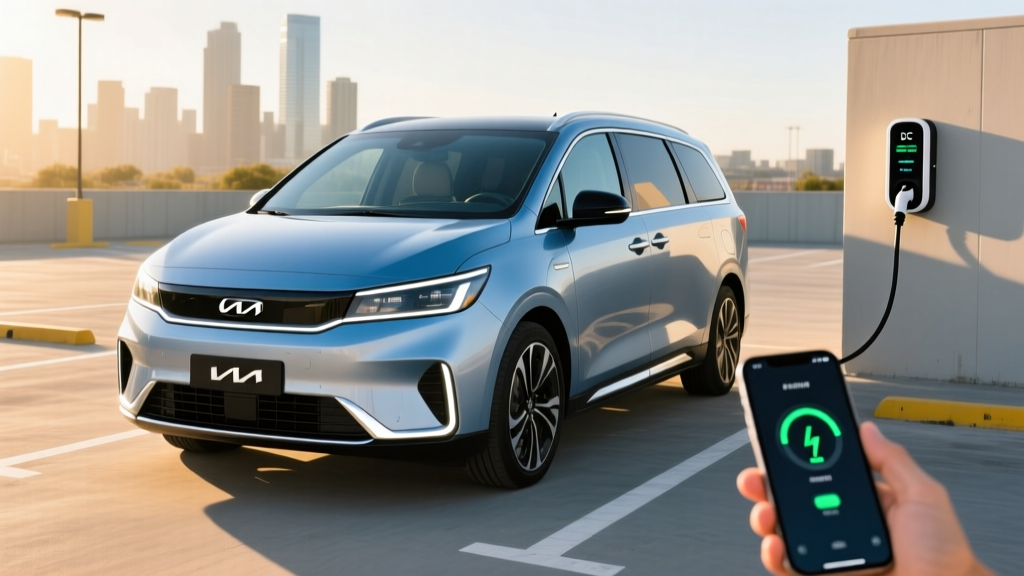
The minivan segment has stubbornly resisted electrification — until now. The 2026 Kia PV9 (Purpose Vehicle 9) arrives as the first dedicated electric minivan from a mainstream brand, built on Hyundai Motor Group's next-generation eM platform with 800V architecture and a flat-floor skateboard design optimized for people-hauling. As the closest thing to a true Kia EV minivan on the market, the PV9 faces a tall order: convince three-row families that battery-electric life can match the convenience of the Honda Odyssey and Toyota Sienna they already trust.
We spent a week with a 2026 PV9 GT-Line AWD to measure real-world range, validate charging claims, and figure out who this EV actually works for — and who should wait or look elsewhere.
Range, Efficiency, and the Real-World Reality Check
The 2026 Kia PV9 is offered with two battery packs. The standard-range model uses a 77.4 kWh (usable) NMC (nickel-manganese-cobalt) pack, while the extended-range variant — the volume seller — carries a 105.0 kWh NMC battery. EPA estimates land at 252 miles for the SR RWD, 284 miles for the ER RWD, and 271 miles for the ER AWD we tested.
- EPA combined: 271 miles
- Observed highway (70 mph, 72°F): ~238 miles
- Mixed city/suburban: ~255 miles
- Cold-weather (30°F, heater on): ~205–215 miles
- Efficiency: 85 MPGe combined / 39 kWh per 100 miles
The PV9 is a heavy, boxy vehicle (5,180 lbs curb weight), and that shows on the highway. Expect a 10–12% deficit versus the EPA sticker at sustained interstate speeds, and roughly 20% loss in freezing weather without preconditioning. The heat pump — standard on all trims — helps, but physics wins. Plan charging stops around 200 miles of range to keep a safe buffer.
| Spec | SR RWD | ER RWD | ER AWD |
|---|---|---|---|
| Battery (usable) | 77.4 kWh NMC | 105.0 kWh NMC | 105.0 kWh NMC |
| EPA Range | 252 mi | 284 mi | 271 mi |
| Horsepower | 225 hp | 338 hp | 430 hp |
| 0–60 mph | 7.4 sec | 5.9 sec | 4.8 sec |
| Drivetrain | RWD single motor | RWD single motor | Dual-motor AWD |
| Max DC Fast Charge | 230 kW | 270 kW | 270 kW |
| 10–80% DC Time | ~22 min | ~24 min | ~24 min |
| Level 2 (11.5 kW) | ~26 mi/hr | ~26 mi/hr | ~26 mi/hr |
| Towing (max) | 2,000 lbs | 2,500 lbs | 3,500 lbs |
Charging Speed: 800V Architecture Pays Off
Like its Hyundai Motor Group siblings (Ioniq 5, EV6, EV9), the PV9 uses an 800V electrical architecture, which unlocks genuinely fast DC charging. On a 350 kW-class Electrify America or Tesla Supercharger (NACS adapter included, native NACS port on late-build 2026 models), the ER AWD peaked at 270 kW and held above 200 kW through roughly 55% state of charge before tapering. The 10–80% sprint took 24 minutes in our 68°F testing — about three minutes slower than Kia's claim due to typical charge-curve taper.
| Level | Power | Miles Added per Hour | Notes |
|---|---|---|---|
| Level 1 (120V) | 1.4 kW | ~3 mi/hr | Emergency/top-off only |
| Level 2 (240V, 48A) | 11.5 kW | ~26 mi/hr | Full charge in ~10 hrs |
| DC Fast (peak) | 270 kW | ~650 mi/hr (peak) | 10–80% in ~24 min |
Preconditioning note: Use the route planner in the native navigation to precondition the battery 15–20 minutes before arriving at a DC charger. Skipping this in cold weather can add 8–12 minutes to your session. The PV9 also supports V2L (vehicle-to-load) at 3.6 kW — handy for powering tailgate gear or a sump pump during an outage.
Interior, Cargo, and Three-Row Livability
This is where the Kia EV minivan pitch lives or dies. The PV9's flat-floor skateboard architecture frees up remarkable interior volume. Second-row captain's chairs slide on long rails (7.8 inches of fore/aft travel), and the available "Relaxation Mode" reclines them to near-flat with powered leg rests — a segment first.
- Cargo behind 3rd row: 37.2 cu ft
- Cargo behind 2nd row: 82.5 cu ft
- Max cargo (both rows folded): 138.1 cu ft
- 3rd-row legroom: 33.5 inches
- 2nd-row legroom: 41.8 inches
- Front trunk (frunk): 3.2 cu ft (AWD) / 5.1 cu ft (RWD)
The 33.5 inches of third-row legroom is competitive with the Chrysler Pacifica (33.3) but trails the Honda Odyssey's 38.4 inches. Adults can ride back there for short trips; kids and teens will be fine on longer hauls. The sliding floor console between the front seats and the under-floor storage bin in the cargo area are clever touches that make daily family logistics easier.
Tech, Driver Assists, and Standout Features
The PV9 ships with a 12.3-inch digital cluster and a 12.3-inch infotainment display running Kia's latest ccNC software with wireless Apple CarPlay and Android Auto. The available 27-inch panoramic curved display (GT-Line) is visually striking but can reflect sunlight in certain angles — polarized sunglasses help.
ADAS: Highway Driving Assist 2 (HDA2) is standard across all trims, offering adaptive cruise with stop-and-go, lane centering, and lane-change assist. This is an SAE Level 2 system — the driver must keep hands on or near the wheel and remain fully engaged. It's not self-driving. HDA2 is competent for highway cruising but will disengage on faded lane markings and in construction zones without much warning.
- Navigate exits or interchanges autonomously
- Handle stoplights, stop signs, or urban intersections
- Operate without driver supervision (hands-on or capacitive-wheel monitoring required)
- Qualify as SAE Level 3 or higher automation
Other tech highlights: Digital Key 2 (phone-as-key via UWB), over-the-air updates for powertrain and chassis tuning, a 14-speaker Meridian audio system, and a built-in air purifier with real-time PM2.5 display — a welcome feature for allergy-season families.
Pricing, Trims, and Federal Tax Credit Eligibility
The 2026 PV9 lineup spans four trims with the extended-range battery becoming standard from EX upward. Base MSRPs are competitive with a well-equipped Honda Odyssey Touring or Toyota Sienna Platinum when you factor in fuel savings.
| Trim | Drivetrain | MSRP | Est. After §30D Credit* |
|---|---|---|---|
| Light SR | RWD | $54,990 | $47,490 |
| Wind ER | RWD | $59,490 | $51,990 |
| EX ER | AWD | $64,990 | $57,490 |
| GT-Line ER | AWD | $71,490 | $63,990 |
*§30D credit estimates assume full eligibility. Actual credit depends on battery-sourcing compliance, buyer income, and MSRP caps. See IRS rules below.
IRS §30D Federal Tax Credit — Key Rules for 2026:
- MSRP cap: Vans, SUVs, and minivans must have a base MSRP at or below $80,000. All PV9 trims qualify.
- Buyer income cap: Modified AGI must not exceed $300,000 (joint), $225,000 (head of household), or $150,000 (single).
- Battery sourcing: A percentage of critical minerals and battery components must be sourced from the U.S. or free-trade-agreement partners. Kia has confirmed partial compliance for the 2026 PV9 — expect a $3,750 partial credit on early-build units and potentially the full $7,500 once Georgia battery plant sourcing ramps up mid-year.
- Point-of-sale transfer: Eligible buyers can apply the credit as a down-payment reduction at the dealer instead of waiting for tax-time filing.
Always verify current sourcing compliance on the IRS's qualified-vehicles list at irs.gov before signing. Rules shift as supply chains change.
How It Compares: PV9 vs. the Alternatives
The PV9 doesn't exist in a vacuum. Families cross-shopping the Kia EV minivan will encounter these options:
| Spec | Kia PV9 ER AWD | Kia EV9 GT-Line AWD | VW ID. Buzz LWB AWD |
|---|---|---|---|
| EPA Range | 271 mi | 270 mi | 234 mi |
| 3rd-Row Legroom | 33.5 in | 29.1 in | 34.6 in |
| Max Cargo | 138.1 cu ft | 81.7 cu ft | 163.7 cu ft |
| 10–80% DC Charge | ~24 min | ~24 min | ~30 min |
| Starting MSRP (AWD) | $64,990 | $65,900 | $61,545 |
| Towing | 3,500 lbs | 5,000 lbs | 3,500 lbs |
The VW ID. Buzz wins on cargo volume and third-row space but trails significantly on range and charging speed. The Kia EV9 is cheaper in top trim and tows more, but its cramped third row makes it an SUV masquerading as a people-hauler. The PV9 threads the needle: genuine minivan interior with modern 800V charging and competitive range.
Warranty, Ownership Costs, and Long-Term Outlook
Kia backs the PV9 with its familiar warranty package, one of the strongest in the segment:
- Battery & powertrain: 10 years / 100,000 miles (capacity retention threshold: 70%)
- Bumper-to-bumper: 5 years / 60,000 miles
- Complimentary maintenance: 3 years / 36,000 miles
The 10-year battery warranty is a genuine differentiator versus VW's 8-year/100,000-mile coverage on the ID. Buzz. NMC chemistry has proven durable across Hyundai Motor Group's fleet, with fueleconomy.gov data showing minimal degradation in 3-year-old EV6 and Ioniq 5 samples. Expect 5–8% capacity loss over 5 years / 75,000 miles under normal use.
Charging cost reality: At the national average residential electricity rate of $0.17/kWh, a full PV9 ER charge costs roughly $17.85 — equivalent to about $1.20 per gallon of gasoline. Over 15,000 annual miles, that's approximately $595 in home-charging electricity versus $1,800+ in gasoline for a Sienna (at $3.50/gal, 36 MPG). The PV9's higher MSRP is partially offset within 3–4 years for high-mileage families.
Pros, Cons, and Who Should Buy the Kia PV9
- Class-leading 800V DC charging (10–80% in ~24 min)
- Spacious, flexible 3-row interior with sliding 2nd-row seats
- 10-year/100,000-mile battery warranty
- Competitive real-world range for a 5,100+ lb vehicle
- V2L capability for home backup and camping
- Partial or full §30D credit eligibility
- Third-row legroom trails Honda Odyssey
- Highway range drops noticeably (expect ~238 mi real-world)
- 20–24 minute DC sessions still slower than a gas fill-up on road trips
- AWD towing limited to 3,500 lbs
- No Level 3 or hands-free driving option
- Early-build §30D credit may be partial ($3,750) pending sourcing
- Buy it if: You need a daily-driver family hauler with school-run and commute duties, have Level 2 home charging, and want minivan space without the Sienna/Odyssey's ubiquity. The PV9 works best for suburban families who can charge overnight and take 1–2 road trips per year with planned DC stops.
- Consider alternatives if: You regularly tow over 3,500 lbs (look at the EV9 or a PHEV SUV), live in an apartment without charging access, or need adult-friendly third-row space for carpools (the ID. Buzz or Pacifica Hybrid may fit better).
Frequently Asked Questions
What is the real-world range of the Kia PV9?
The EPA rates the PV9 ER AWD at 271 miles combined. In real-world highway driving at 70 mph in mild weather, expect roughly 238 miles. In freezing temperatures with cabin heat, plan for 205–215 miles. City and suburban driving with regenerative braking can push close to the EPA number or slightly above.
How fast does the PV9 charge at home and on the road?
On a 350 kW-class DC fast charger, the PV9 ER peaks at 270 kW and charges from 10–80% in approximately 24 minutes. At home on a Level 2 (240V, 48A / 11.5 kW) charger, expect about 26 miles of range per hour, or a full overnight charge in roughly 10 hours. Level 1 (120V) adds only ~3 miles per hour — adequate for topping off, not daily use.
How much does the Kia PV9 cost after tax credits?
MSRP ranges from $54,990 (Light SR) to $71,490 (GT-Line ER AWD). With full §30D eligibility, effective pricing starts at approximately $47,490. However, early-build 2026 models may qualify for only the $3,750 partial credit due to battery-sourcing rules. Verify on the IRS qualified-vehicle list before purchasing.
Does the 2026 Kia PV9 qualify for the federal EV tax credit?
All PV9 trims fall under the $80,000 MSRP cap for vans/SUVs. Buyer income must not exceed $300K joint / $150K single. Battery-sourcing compliance is partial at launch (yielding $3,750) and is expected to reach full $7,500 eligibility mid-2026 as Kia's Georgia battery plant ramps up. Rules change — confirm at irs.gov.
Is the Kia PV9 worth buying versus the VW ID. Buzz or Kia EV9?
If you prioritize range and fast charging, the PV9 wins over the ID. Buzz (271 vs. 234 miles EPA, 24 vs. 30 min 10–80%). If you need maximum cargo volume, the ID. Buzz offers 163.7 cu ft vs. the PV9's 138.1. If towing is a priority, the EV9 tows 5,000 lbs vs. the PV9's 3,500. For the core family-hauler mission with daily charging access, the PV9 is the strongest all-around pick in this trio.
What is the battery warranty on the Kia PV9?
Kia provides a 10-year / 100,000-mile warranty on the high-voltage battery and electric powertrain, with a 70% capacity retention threshold. This is among the longest battery warranties available on any electric minivan or three-row EV, and it exceeds VW's 8-year / 100,000-mile coverage on the ID. Buzz.
Sources: EPA range and efficiency data via fueleconomy.gov; §30D tax credit rules via IRS.gov; Kia PV9 specifications from Kia's official U.S. press materials.