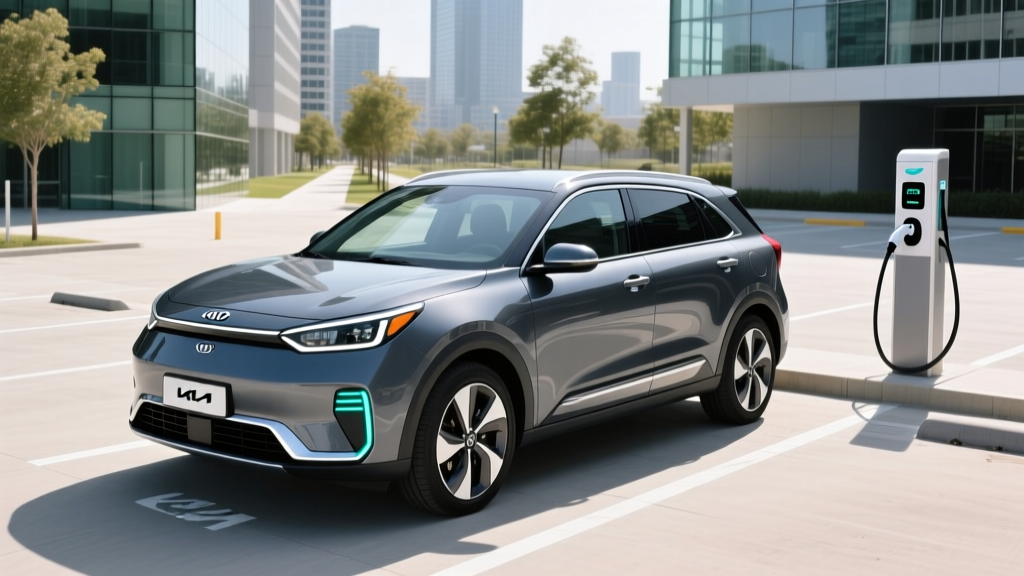
When shoppers search for a Kia Niro EV lease deal, they're usually looking at the monthly payment. But the real question isn't what you pay the dealer — it's what the vehicle costs you over five years of ownership. The 2026 Kia Niro EV sits in a competitive spot: a compact crossover with 239 miles of EPA range, a 64.8 kWh battery, and a starting MSRP that positions it against the Chevrolet Equinox EV, Hyundai Kona Electric, and Nissan Ariya.
This analysis dissects the full financial picture of leasing or buying a 2026 Niro EV — from federal tax credits and state rebates to charging costs, insurance premiums, maintenance savings, and the depreciation reality that EV buyers often overlook. Every figure here uses 2026 model-year data and current IRS §30D rules.
2026 Kia Niro EV: The Numbers That Matter
Before we get to ownership cost, here are the specifications that drive the economics. The 2026 Niro EV carries over the second-generation platform introduced for 2023, with a front-mounted permanent-magnet synchronous motor and a 64.8 kWh usable NMC (nickel-manganese-cobalt) lithium-ion battery pack.
| Specification | Value |
|---|---|
| EPA Range | 239 miles (Wind trim); 207 miles (GT-Line) |
| Battery Capacity | 64.8 kWh usable, NMC chemistry |
| Motor Output | 201 hp / 188 lb-ft torque |
| 0-60 mph | ~7.0 seconds |
| DC Fast Charge (Peak) | ~85 kW (CCS1 connector) |
| 10-80% DC Charge Time | ~44 minutes |
| Level 2 AC Charge Rate | 11 kW onboard charger |
| MPGe (Combined) | 113 MPGe (Wind trim) |
| Efficiency | 30 kWh/100 mi |
| Battery/Powertrain Warranty | 10 years / 100,000 miles |
| Base MSRP (Wind) | ~$40,875 (incl. destination) |
| GT-Line MSRP | ~$45,875 |
Federal Tax Credit: Do You Qualify Under §30D?
The IRS §30D Clean Vehicle Credit can reduce your tax burden by up to $7,500 — but eligibility in 2026 depends on a matrix of requirements that trip up many buyers. The credit has two $3,750 halves: one for critical-mineral sourcing and one for battery-component manufacturing. The Kia Niro EV is assembled in South Korea, which significantly complicates eligibility.
- MSRP Cap: Vehicle must be priced at or below $55,000 (SUVs/vans/pickups: $80,000). The Niro EV qualifies at both trims.
- Buyer Income Cap: Modified AGI must not exceed $150,000 (single), $225,000 (head of household), or $300,000 (married filing jointly).
- Final Assembly: Must occur in North America. The Niro EV is assembled in South Korea — this currently disqualifies it from the purchase credit under standard §30D rules.
- Battery Sourcing: Critical minerals and battery components must meet escalating percentage thresholds from qualified trade partners.
- Point-of-Sale Transfer: If eligible, the credit can be applied at purchase to reduce the sale price directly (requires dealer registration).
- Lease Loophole (§45W): Commercial lessors may claim the credit under §45W and pass savings to the lessee as a reduced lease payment — this is how many Niro EV lease deals include a "$7,500 lease cash" incentive.
This last point is critical for Niro EV shoppers. Because the vehicle doesn't meet the North American assembly requirement for §30D purchase credits, Kia Motors Finance (as the lessor) can claim the §45W commercial clean vehicle credit and apply it as lease cash. When you see a "Kia Niro EV lease deal" advertising $7,500 in lease cash, that's this mechanism at work. Always confirm with the dealer that the lease cash is being applied as a capitalized-cost reduction.
5-Year Total Cost of Ownership Breakdown
Below is a five-year projection for a 2026 Kia Niro EV Wind, assuming 12,000 miles driven annually (60,000 miles total), home Level 2 charging at a national-average electricity rate, and a mid-tier insurance policy. We compare it against a similarly priced gasoline compact crossover (28 MPG combined) at $3.40/gallon.
| Cost Category | 2026 Niro EV (Wind) | Gas Crossover (28 MPG) |
|---|---|---|
| Purchase/Lease (net of incentives) | $33,375 (after $7,500 lease cash) | $32,500 |
| Fuel / Electricity (60k mi) | $3,960 (home charging at $0.14/kWh) | $7,286 ($3.40/gal, 28 MPG) |
| Maintenance (5 years) | $1,200 | $3,500 |
| Insurance (5 years) | $9,600 ($160/mo avg) | $7,800 ($130/mo avg) |
| Depreciation (est. residual at 5 yr) | ~45% retained → $18,019 loss | ~50% retained → $16,250 loss |
| Total 5-Year Cost | ~$50,116 | ~$51,086 |
The Niro EV wins narrowly on total cost over five years, primarily through fuel and maintenance savings. However, the margin is tighter than many EV advocates suggest — higher insurance premiums and steeper depreciation eat into the advantage. Extend ownership to seven or eight years (where the powertrain warranty provides coverage and fuel savings compound) and the EV's economic case strengthens considerably.
Charging Cost vs. Gasoline: The Per-Mile Math
The Niro EV consumes approximately 30 kWh per 100 miles (EPA combined). Your actual cost per mile depends heavily on where and how you charge.
| Charging Scenario | Rate | Cost per Mile | vs. Gas (28 MPG @ $3.40/gal) |
|---|---|---|---|
| Home Level 2 (national avg) | $0.14/kWh | $0.042 | Gas: $0.121/mi → Save $0.079/mi |
| Home (off-peak TOU rate) | $0.08/kWh | $0.024 | Save $0.097/mi |
| Public DC Fast Charging | $0.40/kWh avg | $0.120 | Save $0.001/mi (essentially break-even) |
| Public Level 2 (network) | $0.25/kWh avg | $0.075 | Save $0.046/mi |
The takeaway: home charging is where the Niro EV delivers dramatic savings — roughly 65% cheaper per mile than gasoline. But if you rely exclusively on public DC fast charging at $0.40/kWh, your "fuel" cost nearly matches a gas car. This is why home charging access (or workplace Level 2) is the single biggest variable in EV economics. Before signing any Kia Niro EV lease deal, confirm you have reliable, affordable charging at home or work.
Maintenance Savings: Where EVs Quietly Win
The Niro EV eliminates the maintenance items that drain gas-car budgets. There's no engine oil, no transmission fluid, no spark plugs, no timing belt, and no exhaust system. Regenerative braking significantly reduces brake-pad wear — many EV owners report original brake pads lasting 80,000+ miles.
| Service Item | Niro EV Cost | Gas Crossover Cost |
|---|---|---|
| Oil Changes (6 over 5 yr) | $0 | $420 |
| Transmission Fluid | $0 | $180 |
| Brake Pads (front) | $0 (regen extends life) | $350 |
| Engine Air Filter | $0 | $120 |
| Coolant Flush | $150 | $200 |
| Cabin Air Filter | $120 | $120 |
| Tire Rotation & Replacement | $1,050 (EVs are heavier; tires wear faster) | $800 |
| Wiper Blades, Misc. | $80 | $80 |
| Total | ~$1,400 | ~$2,270 |
Net maintenance savings over five years: approximately $870. Note that EV tire costs tend to run higher — the Niro EV's 3,800-lb curb weight and instant torque accelerate tire wear, particularly on the front axle. Budget for a tire replacement around year four.
Insurance Reality: The Cost EV Buyers Underestimate
EV insurance premiums run 15–25% higher than equivalent gas vehicles, according to industry data. For the Niro EV, expect monthly premiums in the $140–$190 range depending on your state, driving record, and coverage level — compared to $115–$155 for a similarly priced gas crossover.
Why the premium? Three factors drive it:
- Repair cost: EV battery packs and power electronics are expensive to replace after collision damage. Insurers factor in higher total-loss thresholds.
- Parts availability: EV-specific components (inverter, onboard charger, battery modules) have longer lead times than commodity gas-car parts, increasing rental-car and labor costs.
- Specialized labor: High-voltage system repairs require certified technicians, which limits the repair-shop pool and drives up labor rates.
Shop insurance quotes before committing to a lease. Some carriers (Geico, Progressive, State Farm) have narrowed the EV premium gap, while others still apply significant surcharges. A multi-policy discount or bundling with homeowners insurance can offset much of the EV premium.
Depreciation and Resale Value Trends
EV depreciation has been volatile. Following the aggressive price cuts Tesla initiated in 2023 and broader market correction through 2024–2025, used EV values dropped significantly. The Niro EV, as a mainstream compact crossover, has held up better than luxury EVs but still depreciates faster than top-selling gas crossovers.
Current projections for a 2026 Niro EV Wind purchased at ~$40,875 MSRP (before incentives):
- Year 1: ~20% depreciation → ~$32,700
- Year 3: ~40% cumulative → ~$24,525
- Year 5: ~55% cumulative → ~$18,400
However, if you leased with $7,500 in lease cash reducing your capitalized cost to ~$33,375, your effective depreciation exposure is lower — you're absorbing loss on a smaller basis. Lease-end residual values are typically set at 45–50% of MSRP for the Niro EV, meaning you may have equity at lease-end if used EV values stabilize, or you can simply walk away.
One depreciation risk to watch: as battery technology advances (solid-state cells, faster charging), older-generation EVs with 85 kW peak charging — like the Niro EV — may face accelerated obsolescence compared to vehicles with 200+ kW charging architectures. If you plan to own beyond the lease term, this is a factor.
Evaluating a Kia Niro EV Lease Deal: Decision Framework
- You can confirm $7,500 in lease cash (§45W pass-through) is applied to your deal
- You have reliable home Level 2 charging (or workplace charging)
- You drive 10,000–15,000 miles annually (within standard lease mileage limits)
- You want to avoid long-term battery-depreciation risk
- Your state offers additional EV rebates that stack on top
- You rely entirely on public DC fast charging (your per-mile savings disappear)
- You drive more than 15,000 miles/year (lease overage penalties at $0.15–$0.25/mi add up fast)
- You want to own long-term and capture 8–10 years of fuel savings
- You need DC fast charging faster than 85 kW for frequent road trips — consider the Hyundai Ioniq 5 (peak 240 kW) or Tesla Model Y instead
Frequently Asked Questions
How much does it really cost to own a 2026 Kia Niro EV over 5 years?
Based on 60,000 miles of driving, home charging at $0.14/kWh, and current insurance averages, the 5-year total cost of ownership is approximately $50,100 — roughly $1,000 less than a comparable gas crossover over the same period. The savings widen if you have access to off-peak electricity rates or state rebates, and narrow if you rely on expensive public DC fast charging.
Do I qualify for the $7,500 federal tax credit on the Niro EV?
For a purchase, likely not — the Niro EV is assembled in South Korea, which fails the North American final-assembly requirement under §30D. However, when you lease through Kia Motors Finance, the lessor can claim the §45W commercial credit and pass it to you as lease cash. Confirm with your dealer that the advertised lease incentive reflects this credit being applied to your capitalized cost reduction.
How much do I save on fuel and maintenance vs. a gas car?
At the national average electricity rate of $0.14/kWh and gas at $3.40/gallon, the Niro EV saves approximately $3,326 on fuel and $870 on maintenance over five years / 60,000 miles — totaling roughly $4,200 in operational savings. These savings scale directly with how much you drive and how cheaply you can charge at home.
Are EVs more expensive to insure than gas cars?
Yes, typically 15–25% more. For the Niro EV, expect to pay roughly $20–$40/month more than a comparably priced gas crossover. The higher premiums reflect expensive battery-repair costs, specialized labor requirements, and limited parts availability. Always get insurance quotes before finalizing your lease or purchase.
How well does the Kia Niro EV hold its value?
The Niro EV retains approximately 45% of its MSRP after five years, which is below the ~50% retention of mainstream gas crossovers but better than luxury EVs that can lose 60%+ in the same period. Leasing transfers residual-value risk to the lessor, which is one reason a well-structured Niro EV lease deal can make financial sense in the current market.
Is the Niro EV's 85 kW DC fast charging fast enough?
It's adequate but not competitive for 2026. A 10–80% charge takes roughly 44 minutes at a DC fast charger — fine for planned road trips with meal or rest stops, but noticeably slower than rivals like the Hyundai Ioniq 5 (~18 min at 240 kW) or Tesla Model Y (~25 min at 250 kW). If you road-trip frequently, this is the Niro EV's most significant limitation.
The 2026 Kia Niro EV makes a compelling case as a practical, efficient daily driver — particularly when a strong lease deal with $7,500 in pass-through credit brings the effective monthly payment within reach. Just go in with eyes open about the charging speed, insurance costs, and the fact that your per-mile savings depend almost entirely on access to affordable home charging. Do the math for your specific commute, electricity rate, and insurance profile, and the right decision becomes clear.