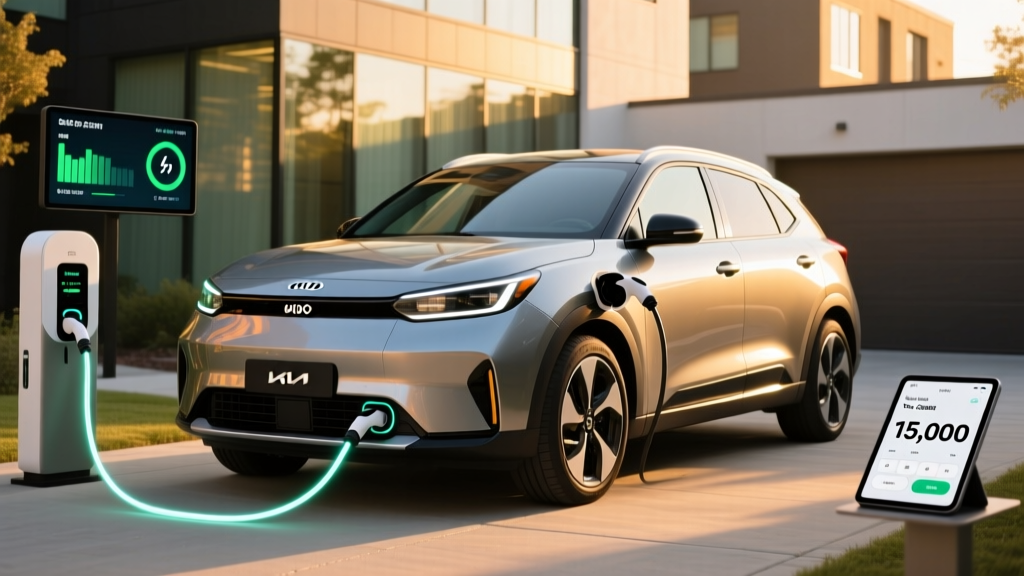
The 2026 Kia Niro EV remains one of the most practical entry points into battery-electric ownership. With an EPA-estimated 239 miles of range, a 64.8 kWh lithium-ion polymer battery, and a starting MSRP around $39,600, it undercuts many rivals while offering decent interior space and a comfortable ride. But the sticker price is only the beginning. Buyers searching for Kia Niro EV finance deals need to look beyond monthly payments to understand the true five-year cost of ownership — including tax credits, electricity costs, insurance premiums, maintenance savings, and the reality of EV depreciation.
This guide breaks down every major ownership expense for the 2026 Niro EV, explains the current federal §30D tax credit rules that can shave up to $7,500 off the purchase price at the point of sale, and shows you the math on where you save — and where you might pay more — compared to a gasoline compact crossover.
2026 Kia Niro EV: Quick Specs and Pricing Overview
Before we run the numbers, here are the figures that matter for any finance or lease calculation. The 2026 Niro EV carries over the second-generation platform introduced for 2023, with minor trim and feature updates.
| Spec | Value |
|---|---|
| Base MSRP (Wind trim) | $39,600 |
| Wave trim MSRP | $44,600 |
| EPA Range | 239 miles |
| Battery Capacity (usable) | 64.8 kWh |
| Battery Chemistry | NMC (Nickel Manganese Cobalt) |
| Motor Output | 201 HP / 291 lb-ft torque |
| 0-60 mph | ~7.2 seconds |
| EPA Efficiency | 113 MPGe combined |
| Max DC Fast Charge Rate | ~85 kW peak |
| 10-80% DC Fast Charge | ~43 minutes |
| Level 2 (240V) Charge Rate | ~11 kW |
| Level 2 Full Charge Time | ~7 hours |
| Charging Port | CCS1 (NACS adapter available) |
| Battery/Powertrain Warranty | 10 years / 100,000 miles |
| Basic Warranty | 5 years / 60,000 miles |
Federal Tax Credit: Do You Qualify for Up to $7,500?
The IRS §30D Clean Vehicle Credit can reduce your effective purchase price by up to $7,500, and as of 2024, buyers can transfer this credit to the dealer at the point of sale — meaning it functions as an immediate down payment reduction rather than a tax-time refund. However, the 2026 Kia Niro EV's eligibility is not guaranteed for every buyer, and the rules are strict.
- MSRP Cap: Vehicle must have an MSRP at or below $55,000 (SUVs/crossovers). Both Niro EV trims qualify.
- Buyer Income Cap: Modified Adjusted Gross Income (MAGI) must not exceed $150,000 (single), $225,000 (head of household), or $300,000 (married filing jointly).
- Battery Component Sourcing: A percentage of battery components must be manufactured or assembled in North America. This threshold increases annually. Verify current-year compliance at IRS.gov qualified vehicle list.
- Critical Minerals Requirement: A percentage of critical minerals must be sourced from the U.S. or a free-trade-agreement country. This threshold also increases yearly.
- Point-of-Sale Transfer: You can elect to transfer the credit to the dealer at purchase, reducing your out-of-pocket cost immediately. The dealer must be IRS-registered.
- Vehicle Assembly: Final assembly must occur in North America. The Niro EV is assembled in South Korea — this is the critical disqualifier that has historically affected Kia/Hyundai EVs.
Key caveat for the Niro EV: Because the Niro EV is manufactured in South Korea, it has historically failed the North American final assembly requirement under §30D. This means the new-vehicle federal tax credit may not apply. However, the used EV tax credit (§25E) — up to $4,000 or 30% of the sale price, whichever is less — may be available if you purchase a qualifying pre-owned Niro EV from a dealer, subject to income caps ($75,000 single / $150,000 joint) and a sale price cap of $25,000. Always verify current eligibility on the IRS used vehicle credit page before committing to a purchase.
Some Kia dealers offset the lack of a federal credit with manufacturer incentives, dealer discounts, or subsidized lease rates. Always ask for a breakdown of all available rebates, including any regional Kia Motors America offers, before finalizing financing.
State, Local, and Utility Incentives
State and utility rebates change frequently and depend on your ZIP code, utility provider, and vehicle eligibility. Examples include:
- California (CVRP): Up to $2,000 for income-eligible buyers (program funding dependent).
- Colorado: State tax credit of up to $5,000 for new EVs (income and price caps apply).
- New York (Drive Clean Rebate): Point-of-sale rebate up to $2,000, subject to program availability.
- Utility rebates: Many utilities (e.g., PG&E, Con Edison, Xcel Energy) offer $500-$1,500 rebates for EV purchase or home charger installation.
Five-Year Total Cost of Ownership: The Full Breakdown
Let's model five years and 75,000 miles of ownership for the 2026 Kia Niro EV (Wind trim, $39,600 MSRP) compared to a similarly priced gas crossover — the 2026 Kia Sportage EX AWD (MSRP ~$33,000, EPA 28 MPG combined). This comparison isolates the EV-specific costs and savings.
| Category | Niro EV (Wind) | Sportage EX AWD (Gas) |
|---|---|---|
| Purchase Price (MSRP) | $39,600 | $33,000 |
| Federal Tax Credit Applied | $0 (foreign assembly)* | $0 |
| Estimated State/Utility Rebates | -$1,000 (avg.) | $0 |
| Effective Purchase Price | $38,600 | $33,000 |
| Fuel/Energy (75k mi) | $4,050** | $8,930*** |
| Maintenance (5 years) | $1,500 | $3,800 |
| Insurance (5 years) | $9,500 | $7,800 |
| Estimated Depreciation | $18,500 | $13,200 |
| Total 5-Year Cost | $72,150 | $66,730 |
| Cost Per Mile | $0.96 | $0.89 |
* Niro EV does not currently qualify for the §30D new-vehicle credit due to South Korean assembly. A used Niro EV may qualify for the §25E credit.
** Based on 0.28 kWh/mile × $0.15/kWh national average electricity rate × 75,000 miles. Actual cost varies by utility rate and home vs. public charging mix.
*** Based on 28 MPG combined × $3.35/gallon national average × 75,000 miles. Source: fueleconomy.gov.
The Niro EV saves roughly $4,880 in fuel and $2,300 in maintenance over five years compared to the gas Sportage — a combined $7,180 in operational savings. However, the higher purchase price, steeper depreciation, and elevated insurance premiums consume most of that advantage. The EV wins most clearly when: (1) you qualify for meaningful incentives, (2) you charge primarily at home at low electricity rates, or (3) you keep the vehicle beyond five years.
Charging Cost vs. Gasoline: The Per-Mile Math
The Niro EV's EPA efficiency is 113 MPGe, which translates to roughly 28 kWh per 100 miles (0.28 kWh/mile). Here's how that converts to real dollars depending on your charging scenario:
| Scenario | Rate | Cost/Mile |
|---|---|---|
| Home Level 2 (national avg.) | $0.15/kWh | $0.042 |
| Home Level 2 (CA peak rate) | $0.35/kWh | $0.098 |
| Public DC Fast Charger (avg.) | $0.40/kWh | $0.112 |
| Tesla Supercharger (NACS adapter) | $0.30/kWh | $0.084 |
| Gas Crossover (28 MPG, $3.35/gal) | — | $0.120 |
At the national average home electricity rate, the Niro EV costs roughly 4.2 cents per mile to fuel — about a third of what a 28 MPG gas crossover spends. Even at public DC fast-charging rates, the EV is marginally cheaper per mile. The advantage shrinks considerably in states with high electricity rates (California, Hawaii, the Northeast) if you rely heavily on public charging.
Charging speed reality check: The Niro EV peaks at roughly 85 kW on DC fast charging — modest by 2026 standards. A 10-80% session takes approximately 43 minutes. That's adequate for road trips with planned stops but slower than rivals like the Hyundai Ioniq 5 (which peaks above 230 kW and completes 10-80% in ~18 minutes). If you frequently road-trip, factor in the time cost.
Maintenance Savings: Where EVs Genuinely Shine
| Service Item | Niro EV | Gas Crossover |
|---|---|---|
| Oil Changes | $0 (none required) | $600-$900 |
| Brake Pads/Rotors | $200-$400 (regen extends life) | $800-$1,500 |
| Transmission Fluid | $0 (single-speed reducer) | $150-$300 |
| Coolant Flush | $100-$150 | $150-$250 |
| Air Filters | $50-$80 (cabin only) | $100-$200 (engine + cabin) |
| Tire Rotation/Replacement | $800-$1,200 (EVs wear tires faster) | $600-$1,000 |
| Estimated 5-Year Total | $1,500 | $3,800 |
The Niro EV eliminates oil changes entirely, and regenerative braking dramatically reduces brake pad wear — many EV owners report original brake pads lasting 80,000+ miles. The trade-off is slightly higher tire wear: EVs are heavier (the Niro EV weighs ~3,900 lbs) and deliver instant torque, which accelerates tread wear. Budget for a tire replacement around 40,000-50,000 miles.
Insurance Costs: The Expense Many Buyers Overlook
EV insurance premiums run 15-25% higher than comparable gas vehicles on average. For the Niro EV, expect annual premiums in the range of $1,700-$2,100 depending on your state, driving record, and coverage level — compared to $1,400-$1,700 for a gas Sportage. Over five years, that's an additional $1,500-$2,000 in costs.
Why the premium? Several factors drive it:
- Higher repair costs: EV battery packs and power electronics are expensive to replace after a collision. Even minor rear-end damage can total a battery enclosure.
- Specialized labor: Fewer body shops have high-voltage certification, limiting repair network options and raising labor rates.
- Vehicle price: The Niro EV's higher MSRP means higher comprehensive and collision payouts.
- Parts availability: EV-specific components can have longer lead times, increasing rental-car reimbursements for insurers.
Shop quotes from multiple carriers — some insurers (like State Farm and Progressive) have narrowed the EV insurance gap, while others still price EVs at a significant premium. Bundling home and auto, maintaining a clean record, and opting for a higher deductible can offset the difference.
Depreciation and Resale Value: The Honest Picture
EV depreciation has been steeper than gas-vehicle depreciation in recent years, driven by rapid price cuts on new models, battery-technology advancement anxiety, and a still-maturing used-EV market. Based on 2025-2026 industry data from sources like iSeeCars and Kelley Blue Book, the average EV loses roughly 45-55% of its value over five years, compared to 38-45% for gas crossovers.
For the Niro EV specifically, expect a five-year retained value of approximately 45-50% — meaning a $39,600 purchase could be worth $18,000-$20,000 at the five-year mark. The gas Sportage, starting lower at $33,000, might retain 55-60% and be worth $18,000-$20,000 as well — but from a smaller initial investment.
Factors working in the Niro EV's favor for resale:
- Kia's industry-leading 10-year/100,000-mile battery warranty (though note it is non-transferable to second owners in most cases, reducing its used-car value).
- Growing consumer comfort with EVs in the used market as charging infrastructure expands.
- Relatively affordable entry price for a used EV, keeping demand steady.
Factors working against it:
- 85 kW peak charging speed is below 2026 norms — future buyers may view this as outdated.
- No North American assembly limits the pool of buyers who can claim a used-EV credit, though §25E eligibility is broader.
- Competitive pressure from newer EVs with 300+ mile range and faster charging.
Financing the Niro EV: What to Expect in 2026
Kia Finance typically offers competitive APRs on the Niro EV, often between 1.9% and 4.9% for well-qualified buyers on 36- to 60-month terms, sometimes with cash-back incentives in lieu of the federal credit. Here's a sample payment calculation:
| Term | APR | Down Payment | Monthly Payment (est.) |
|---|---|---|---|
| 60 months | 3.9% | $4,000 | ~$653 |
| 72 months | 4.9% | $4,000 | ~$570 |
| 36-month lease | — | $3,500 due at signing | ~$399 |
Payments are estimates based on $39,600 MSRP minus incentives and vary by dealer, credit tier, and region. Always get a detailed quote from the dealer's F&I department.
Leasing can be particularly attractive for the Niro EV because it sidesteps depreciation risk — you return the car at lease end regardless of market value. However, you forfeit any used-EV credit opportunity on a future purchase, and mileage caps (typically 10,000-12,000/year) may not suit high-mileage drivers.
Is the Niro EV the Right Financial Move? Decision Framework
- You can charge at home (Level 2) and your electricity rate is below $0.20/kWh.
- Your daily commute is under 80 miles round-trip, minimizing public charging dependence.
- You qualify for meaningful state or utility rebates that narrow the price gap.
- You plan to keep the vehicle 7+ years, allowing operational savings to compound.
- You value Kia's 10-year/100,000-mile battery warranty for long-term peace of mind.
- You lack reliable home charging and must rely on public DC fast chargers (higher cost, slower sessions at 85 kW).
- You drive more than 15,000 miles/year in cold climates — range loss and charging time add up.
- You plan to sell within 3-4 years, when depreciation will outweigh fuel savings.
- You frequently tow or carry heavy loads (the Niro EV is not rated for towing).
- A Niro PHEV (plug-in hybrid, 33 miles electric-only range, ~$34,000 MSRP) better suits your mixed-use driving.
Frequently Asked Questions
How much does it really cost to own a Kia Niro EV over 5 years?
Based on our analysis, approximately $72,150 over five years and 75,000 miles — including purchase price, energy, insurance, maintenance, and depreciation. That works out to about $0.96 per mile. The gas alternative (Kia Sportage EX AWD) costs roughly $66,730 over the same period. The EV narrows the gap significantly if you qualify for state rebates or keep the vehicle longer than five years.
Does the 2026 Kia Niro EV qualify for the $7,500 federal tax credit?
Likely not for new purchases. The §30D credit requires North American final assembly, and the Niro EV is built in South Korea. However, a used Niro EV may qualify for the §25E credit of up to $4,000 (30% of sale price, capped at $25,000 vehicle price), subject to buyer income limits. Always verify current eligibility at IRS.gov.
How much do I save on fuel and maintenance with the Niro EV?
Approximately $4,880 in fuel and $2,300 in maintenance over five years / 75,000 miles compared to a 28 MPG gas crossover — a combined savings of about $7,180. Home charging at average electricity rates delivers the biggest fuel savings. Maintenance savings come primarily from eliminating oil changes and extending brake life via regenerative braking.
Are EVs more expensive to insure than gas cars?
Yes, typically 15-25% more. For the Niro EV, expect $1,700-$2,100 annually versus $1,400-$1,700 for a gas crossover. Higher repair costs for battery and power electronics, limited high-voltage-certified body shops, and a higher MSRP all contribute. Shop multiple insurers — the gap varies significantly by carrier.
How well does the Kia Niro EV hold its value?
Expect approximately 45-50% value retention after five years, which is below the gas-crossover average of 55-60%. EV depreciation has been steeper due to rapid market changes and technology advancement. Kia's 10-year battery warranty provides some long-term confidence, but note that it is generally non-transferable to second owners, which limits its impact on resale value.
Is the Niro EV's 85 kW charging speed a problem?
For daily driving and overnight home charging, no — Level 2 at 11 kW fully replenishes the battery in about 7 hours. For road trips, the 85 kW peak means a 10-80% session takes roughly 43 minutes, which is noticeably slower than competitors like the Ioniq 5 (~18 minutes). If you road-trip frequently, this is a meaningful trade-off.
Sources: EPA fuel economy data via fueleconomy.gov; IRS Clean Vehicle Credit rules at IRS.gov §30D; Kia Motors America specification sheets. Pricing and incentive data reflect 2026 model year and are subject to change. Consult a tax professional for credit eligibility specific to your situation.