Quick Verdict: Two EVs, Two Different Philosophies
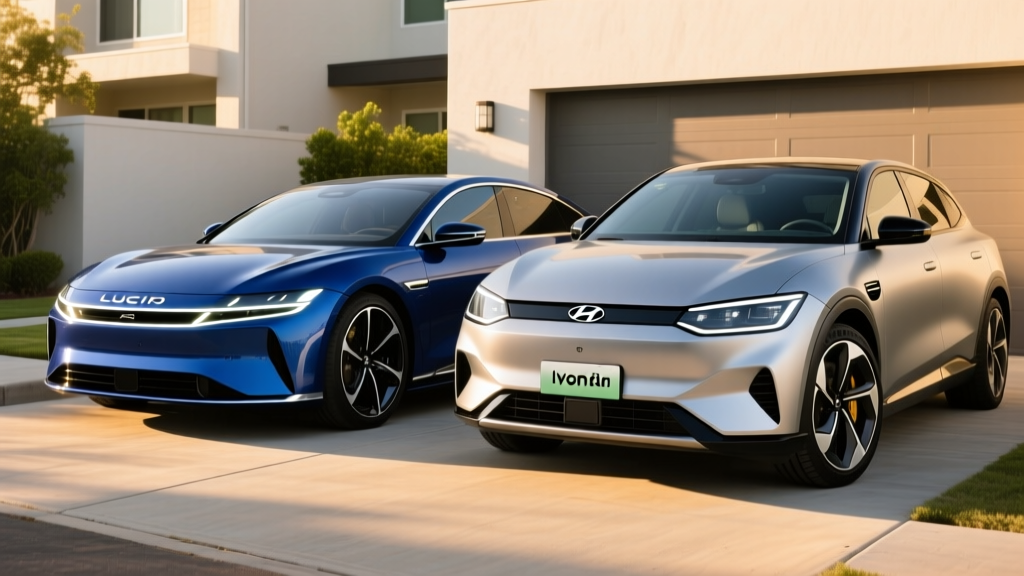
The Lucid Air and Hyundai Ioniq 5 occupy opposite ends of the electric-vehicle spectrum in 2026. One is a six-figure luxury sedan that rewrites the range and performance rulebook; the other is a sub-$50,000 crossover that delivers practical daily-driving electrification with standout charging speed. This isn't a head-to-head battle where one "wins" — it's a study in how far EV engineering stretches across price points.
If you're researching the Lucid Air and Ioniq 5 together, you're likely weighing whether premium range and performance justify a price premium that can exceed $60,000 — or whether Hyundai's value proposition delivers 90% of what most drivers actually need. Let's break down the numbers.
Spec-by-Spec Comparison: Lucid Air vs Ioniq 5 (2026 Models)
| Specification | Lucid Air Pure | Hyundai Ioniq 5 Long Range AWD |
|---|---|---|
| EPA Range | 419 miles | 304 miles |
| Battery (usable) | 88 kWh (NMC) | 84 kWh (NMC) |
| Drivetrain | RWD (single motor) | AWD (dual motor) |
| Horsepower | 430 hp | 320 hp |
| 0-60 mph | 5.0 seconds | 4.5 seconds |
| Peak DC Fast Charge | 200 kW | 240 kW (350 kW capable on V3 stalls) |
| 10-80% DC Time | ~25 minutes | ~18 minutes |
| Level 2 Home Charge Rate | 19.2 kW (48A) | 10.9 kW (48A max onboard) |
| MPGe (combined) | 140 MPGe | 110 MPGe |
| Cargo Volume | 32 cu ft (trunk) + frunk | 27.2 cu ft (rear) + 0.85 cu ft frunk |
| Base MSRP | $69,900 | $49,750 |
| Battery Warranty | 8 yr / 100,000 mi | 10 yr / 100,000 mi |
Range and Efficiency: Real-World Expectations vs. EPA Stickers
Lucid Air Pure: EPA 419 miles. Expect ~350-370 miles in mixed highway driving at 70 mph; ~290-310 miles in freezing temperatures with cabin heat.
Hyundai Ioniq 5 AWD: EPA 304 miles. Expect ~250-270 miles highway; ~210-230 miles in sub-30°F conditions.
The Lucid Air's efficiency advantage is genuine engineering, not marketing. At 140 MPGe combined (roughly 24 kWh/100mi), it extracts more miles per kilowatt-hour than almost any production sedan. The Ioniq 5's 110 MPGe (roughly 30 kWh/100mi) is respectable for a boxy crossover, but its aerodynamic drag and AWD system consume more energy per mile.
For context, a fueleconomy.gov comparison shows the Air Pure's efficiency rivals much smaller EVs — a result of Lucid's miniaturized motor design and low-drag body (Cd of 0.20). The Ioniq 5 prioritizes interior volume and upright styling over slipperiness, which costs it roughly 4-5 miles of range per 100 miles driven at sustained highway speeds.
Charging Speed: Where the Ioniq 5 Surprises
| Charging Level | Lucid Air Pure | Hyundai Ioniq 5 |
|---|---|---|
| Level 1 (120V, 12A) | ~3 mi/hr | ~3 mi/hr |
| Level 2 (240V, 48A) | ~55 mi/hr (19.2 kW onboard) | ~32 mi/hr (10.9 kW onboard) |
| DC Fast Charge (peak) | 200 kW | 240 kW (up to 350 kW on V3 chargers) |
| 10-80% DC Time | ~25 min | ~18 min |
| Miles Added in 15 Min DC | ~200 mi | ~180 mi |
Here's where the Ioniq 5's 800-volt architecture pays dividends. Hyundai's E-GMP platform supports charging at up to 350 kW on compatible Electrify America V3 stalls, though real-world sessions typically peak around 240 kW and taper above 80% State of Charge. The result: a 10-80% session in roughly 18 minutes under ideal conditions.
The Lucid Air uses a 900V+ system as well, but its 200 kW peak is more conservative. The larger 88 kWh battery means more total energy to push during a session, stretching the 10-80% window to about 25 minutes. On a road trip, that's roughly 7 extra minutes per stop — meaningful when you're covering 600+ miles in a day.
Home charging nuance: The Air's 19.2 kW onboard charger is among the fastest in any production EV, meaning a full overnight session on a hardwired 60A Level 2 circuit adds roughly 300+ miles in 8 hours. The Ioniq 5's 10.9 kW charger tops out around 250 miles in the same window. For most commuters, either is sufficient — but the Air's capability matters if you drive 150+ miles daily and need rapid overnight replenishment.
Performance and Driving Dynamics
The spec sheet tells an interesting story: the Ioniq 5 AWD hits 60 mph in 4.5 seconds, actually beating the Air Pure's 5.0-second time. That's because the Hyundai's dual-motor AWD launches with instant torque to all four wheels, while the Air Pure's single-motor RWD setup prioritizes efficiency over off-the-line grip.
However, the Lucid's 430 hp and lighter curb weight (~4,400 lbs vs the Ioniq 5's ~4,700 lbs) deliver stronger highway passing performance and a more composed ride at sustained speeds. The Air's adaptive air suspension (available on higher trims, standard on Grand Touring) absorbs imperfections with a luxury-car smoothness the Ioniq 5's conventional coil springs can't match.
The Ioniq 5 counters with a tighter turning radius (39.4 ft vs the Air's 40.8 ft), easier urban maneuverability, and a hatchback cargo opening that swallows bulkier items despite a slightly lower total cubic-footage figure.
Pricing, Tax Credits, and Total Cost
| Cost Factor | Lucid Air Pure | Hyundai Ioniq 5 SE AWD |
|---|---|---|
| Base MSRP | $69,900 | $49,750 |
| Destination Fee | $1,500 | $1,395 |
| As-Tested Price (typical options) | $74,000-$78,000 | $51,000-$54,000 |
| Federal §30D Credit Eligibility | Not eligible (MSRP exceeds $55,000 sedan cap) | Potentially eligible ($7,500) — subject to battery sourcing and buyer income limits |
| Effective Price After Max Credit | $69,900+ | ~$42,250 (if eligible) |
The IRS §30D federal tax credit has strict rules in 2026. Sedans must have an MSRP at or below $55,000 to qualify — immediately disqualifying every Lucid Air trim. The Ioniq 5, classified as an SUV/crossover, falls under the $80,000 MSRP cap and may qualify for the full $7,500 credit if:
- The buyer's adjusted gross income is ≤$150,000 (single) or ≤$300,000 (joint filers)
- The vehicle's battery meets critical-mineral and battery-component sourcing requirements (which shift annually — verify on irs.gov)
- The vehicle undergoes final assembly in North America (the Ioniq 5 qualifies as of 2026, with Hyundai's Ellabell, Georgia plant producing US-market units)
The credit can now be transferred to the dealer at point of sale, effectively reducing your out-of-pocket cost at purchase rather than waiting for a tax refund. Consult a tax professional to confirm your personal eligibility.
Interior, Tech, and Daily Livability
The Lucid Air's cabin feels like a Scandinavian lounge: minimalist, material-rich, and dominated by a curved 34-inch glass cockpit display. Rear legroom is exceptional at 41.3 inches — limousine territory. The infotainment system is responsive but has drawn criticism for burying climate controls in touchscreen menus.
The Ioniq 5 takes a retro-futuristic approach with physical climate knobs, a dual 12.3-inch display setup, and Hyundai's proven infotainment software with wireless Apple CarPlay and Android Auto. Its flat floor (enabled by the E-GMP skateboard platform) creates genuine three-across rear seating comfort. Rear legroom is 39.4 inches — generous for the class, if not Air-level expansive.
Driver assistance: Both vehicles offer Level 2 SAE driver-assist systems — meaning the driver must remain engaged at all times. The Lucid's DreamDrive Pro uses 32 sensors including LiDAR (on select trims) for adaptive cruise and lane centering. Hyundai's Highway Driving Assist 2 (HDA2) is effective and well-calibrated but relies on camera and radar without LiDAR. Neither system is "self-driving" — both require hands on or near the wheel with active monitoring.
Battery Chemistry, Degradation, and Warranty
Both vehicles use NMC (nickel manganese cobalt) lithium-ion chemistries, chosen for high energy density. Neither currently offers an LFP (lithium iron phosphate) variant in the US market — though LFP's heavier weight and lower energy density make it less suitable for these range-focused designs.
Warranty coverage differs meaningfully:
- Lucid Air: 8 years / 100,000 miles on the battery pack and drive unit, with a capacity-retention threshold of 70% over that period.
- Hyundai Ioniq 5: 10 years / 100,000 miles on the battery and powertrain, also at 70% minimum capacity — and Hyundai's longer track record with electrified vehicles provides more long-term confidence for risk-averse buyers.
Based on industry data from sources like Recurrent Auto, modern NMC packs with active thermal management (which both vehicles have) typically retain 85-92% capacity after 100,000 miles. Neither vehicle should see premature degradation under normal use patterns — avoid habitual DC fast-charging to 100% and prolonged storage above 80% SoC for best longevity.
Who Should Buy Which?
Choose the Lucid Air Pure if:
- You need 350+ real-world miles of range for frequent long-distance travel
- Rear-seat comfort and luxury materials are top priorities
- You can charge at home and rarely need public DC fast charging
- Budget comfortably exceeds $70,000 and tax credits aren't a factor
- You want the fastest DC charging in the sub-$55,000 segment
- Federal tax credit eligibility meaningfully reduces your cost
- You need hatchback cargo versatility and AWD for inclement weather
- You prioritize proven reliability history and a 10-year battery warranty
Pros and Cons at a Glance
- Industry-leading 419-mile EPA range
- 140 MPGe efficiency is exceptional
- 19.2 kW Level 2 charging is class-leading
- Spacious, premium interior with 41.3" rear legroom
- $69,900+ starting price; no federal tax credit
- 200 kW peak DC charging is modest for the price
- Limited service center network vs. legacy brands
- Touchscreen-only climate controls frustrate some users
- 18-minute 10-80% DC fast charging
- Eligible for $7,500 federal credit (if sourcing/income rules met)
- 10-year/100,000-mile battery warranty
- Physical climate controls; proven infotainment
- 304-mile range requires more frequent stops on road trips
- 10.9 kW Level 2 onboard charger is average
- Rear visibility hampered by thick C-pillars
- No front trunk (frunk is vestigial 0.85 cu ft)
Frequently Asked Questions
What is the real-world range of the Lucid Air and Ioniq 5?
The Lucid Air Pure delivers approximately 350-370 miles in real-world highway driving at 70 mph, dropping to 290-310 miles in freezing weather. The Ioniq 5 AWD returns roughly 250-270 miles highway and 210-230 miles in cold conditions. Both figures assume moderate HVAC use and no aggressive driving.
How fast does each EV charge at home and on DC fast chargers?
On a 240V Level 2 home charger, the Lucid Air adds about 55 miles per hour of charging (19.2 kW), while the Ioniq 5 adds about 32 miles per hour (10.9 kW). On DC fast chargers, the Ioniq 5 peaks at 240 kW (10-80% in ~18 minutes), while the Air peaks at 200 kW (10-80% in ~25 minutes).
Does either vehicle qualify for the $7,500 federal EV tax credit?
The Hyundai Ioniq 5 may qualify for the full $7,500 §30D credit if the buyer meets income caps (≤$300,000 joint / ≤$150,000 single), the battery meets critical-mineral sourcing requirements for 2026, and the vehicle is assembled in North America. The Lucid Air does not qualify — its MSRP exceeds the $55,000 sedan cap set by the Inflation Reduction Act. Always verify current rules at irs.gov before purchasing.
Is the Lucid Air worth the price premium over the Ioniq 5?
For buyers who prioritize maximum range, luxury ride quality, and a premium cabin, the Air delivers measurable engineering advantages — 115 additional EPA miles, 30% better efficiency, and faster home charging. For buyers whose daily driving stays under 200 miles and who value fast public charging, hatchback utility, and tax-credit savings, the Ioniq 5 provides outstanding value at roughly $20,000-$30,000 less.
Which EV is better for road trips?
The Lucid Air's 350+ real-world range means fewer charging stops on long drives — a meaningful advantage on corridors with sparse DC infrastructure. However, the Ioniq 5's faster 18-minute charging sessions minimize time spent at stops when chargers are available. For routes with reliable Electrify America or Tesla Supercharger (via adapter) coverage, the Ioniq 5 is a capable road-tripper. For remote or cold-climate routes, the Air's range buffer provides more margin.