The Quick Answer
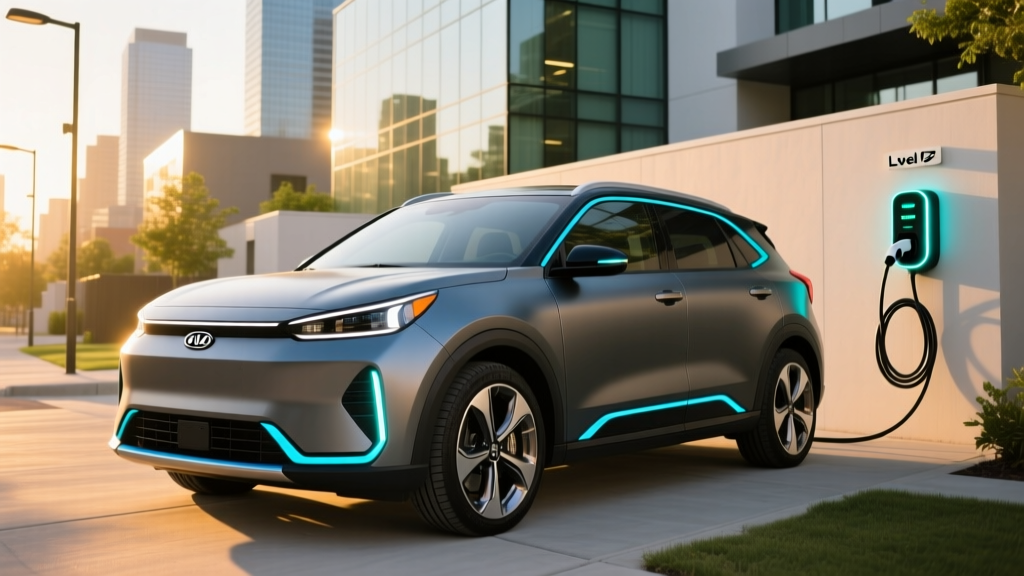
The 2026 Kia Niro EV is a compact electric SUV with an EPA-estimated 239 miles of range, a 64.8 kWh (usable) lithium-ion polymer battery, and a starting MSRP around $39,600. It charges at up to 85 kW on DC fast chargers (10–80% in roughly 43 minutes) and delivers 201 horsepower. Real-world highway range drops to approximately 200–215 miles, and cold-weather driving can reduce that further to 160–180 miles. Federal §30D tax-credit eligibility depends on battery-sourcing rules, your income, and MSRP caps — check current IRS guidance before counting on $7,500 off.
Is the Kia Niro EV the Right Electric SUV for You?
The Niro EV occupies a practical middle ground in the compact electric-crossover segment. It is not the longest-range option (the Hyundai Ioniq 5 and Tesla Model Y exceed 300 miles), nor the fastest-charging. What it offers is a conventional-crossover driving experience, competitive cargo space (19.1 cu ft behind the rear seats, 53.0 cu ft folded), and a price that undercuts many rivals before incentives.
If you drive fewer than 40 miles round-trip on most days, can install a Level 2 home charger, and live in a moderate climate, the Niro EV covers your needs with substantial margin. If you regularly take 300-mile road trips or live in sub-freezing regions without a garage, the range and charging-speed limitations become more relevant.
Range, Battery, and Real-World Efficiency
Kia equips the 2026 Niro EV with a 64.8 kWh usable battery pack using NMC (nickel-manganese-cobalt) cell chemistry. The EPA rates it at 239 miles of combined range, with an efficiency rating of approximately 113 MPGe combined (roughly 30 kWh/100 mi).
EPA vs. Real-World Range
| Condition | Expected Range |
|---|---|
| EPA Combined (sticker) | 239 mi |
| Highway (70 mph, 72°F) | ~200–215 mi |
| City / Suburban mixed | ~225–240 mi |
| Cold weather (30°F, highway) | ~160–185 mi |
| Cold weather + cabin heat (20°F) | ~140–165 mi |
The Niro EV uses a heat pump (standard on most trims) to improve cold-weather efficiency, but resistive cabin heating at very low temperatures still draws heavily from the pack. Source: fueleconomy.gov.
Charging Speeds: Home and Public
The Niro EV's charging architecture peaks at 85 kW on DC fast chargers. This is notably slower than 800V competitors like the Ioniq 5 (which peaks above 230 kW), and it means longer stops on road trips.
| Level | Power | Speed / Time | Connector |
|---|---|---|---|
| Level 1 (120V household) | ~1.4 kW | ~4 mi/hr added | J1772 / NACS adapter |
| Level 2 (240V, 48A) | ~11 kW | ~32 mi/hr; full charge ~7 hr | J1772 / NACS |
| DC Fast Charge | Peak 85 kW | 10–80% in ~43 min | CCS1 / NACS (via adapter) |
Charging-curve reality: The 85 kW peak is sustained roughly between 10–55% state of charge. Above 60%, the rate tapers to approximately 50–60 kW, and above 80% it drops below 25 kW. This is normal lithium-ion behavior, but it means a 10–90% charge takes closer to 60 minutes, not 43.
kW vs. kWh reminder: kW (kilowatts) measures the rate of energy flow — how fast you're charging. kWh (kilowatt-hours) measures total energy stored — the battery's capacity. The Niro EV has a 64.8 kWh battery and charges at up to 85 kW.
Cost of Ownership: Niro EV vs. Gas Niro vs. Niro Hybrid
The strongest argument for the Niro EV is operating cost. Below is a five-year cost projection assuming 12,000 miles/year, $0.14/kWh home electricity, $3.40/gallon gasoline, and typical maintenance schedules.
| Cost Category | Niro EV | Niro Hybrid | Gas Compact SUV (baseline) |
|---|---|---|---|
| Purchase Price (MSRP base) | $39,600 | $28,600 | $28,000 |
| Federal Tax Credit (§30D, if eligible) | Up to $7,500* | $0 | $0 |
| Net Purchase (after credit) | ~$32,100 | $28,600 | $28,000 |
| Fuel / Energy (60k mi) | ~$2,520 | ~$4,590 | ~$7,560 |
| Maintenance (60k mi) | ~$600 | ~$2,200 | ~$3,000 |
| Estimated Insurance (5 yr) | ~$8,500 | ~$7,200 | ~$7,000 |
| Total 5-Year Cost | ~$43,720 | ~$42,590 | ~$45,560 |
*Federal §30D credit eligibility depends on battery-component and critical-mineral sourcing requirements, buyer income caps ($150k single / $300k joint AGI), and the $55,000 MSRP cap for SUVs. The Niro EV qualifies on MSRP. Verify current-year rules at IRS.gov. Point-of-sale transfer is available through registered dealers.
Key takeaway: The Niro EV costs roughly the same as a gas compact SUV over five years when you qualify for the full tax credit. Without the credit, the hybrid wins on pure economics. The EV pulls ahead in years 6–10 as fuel and maintenance savings compound.
Performance, Tech, and What It's Like to Drive
The front-mounted electric motor produces 201 horsepower and 188 lb-ft of torque, available instantly from 0 RPM. The 0–60 mph time is approximately 7.8 seconds — adequate for merging and passing, but noticeably softer than the Ioniq 5 (5.2 sec) or Model Y Long Range (5.0 sec).
Regenerative braking is adjustable via steering-wheel paddles, from coast (level 0) to near-one-pedal driving (level 3). The Niro EV does not offer full one-pedal mode that brings the car to a complete stop and holds it, which some competitors include.
Driver assistance: Kia's Highway Driving Assist 2 (HDA2) is a Level 2 SAE system combining adaptive cruise control, lane-centering, and lane-change assist. The driver must keep hands on the wheel and eyes on the road at all times. This is not autonomous driving — it is a driver-assist system that reduces fatigue on long trips.
Common Misconceptions About the Niro EV
| Myth | Fact |
|---|---|
| "The battery will need replacing in 5 years." | Kia warranties the battery for 10 years/100,000 miles with a capacity-retention threshold of 70%. Industry data shows NMC packs typically retain 85–90% capacity at 100,000 miles under normal use. |
| "I can't take road trips." | You can, but plan for 40–50 minute DC fast-charge stops every 160–180 highway miles. CCS and NACS networks (Electrify America, EVgo, Tesla Superchargers via adapter) cover most interstate corridors. |
| "Electricity is just as expensive as gas." | At $0.14/kWh and 3.3 mi/kWh efficiency, the Niro EV costs roughly $0.042/mile to fuel. A 28-MPG gas SUV at $3.40/gal costs $0.121/mile — nearly 3× more per mile. |
| "Home charging requires a panel upgrade." | Most homes with a 200-amp panel and a 240V outlet (NEMA 14-50) within 50 ft of the parking spot can support Level 2 charging for $500–$1,500 installed. Older 100-amp panels may need an upgrade ($1,500–$3,000). Always consult a licensed electrician. |
| "The tax credit is guaranteed $7,500." | Eligibility depends on your AGI, the vehicle's battery sourcing compliance, and MSRP caps. The credit amount can be $0, $3,750, or $7,500 depending on sourcing requirements met. Check fueleconomy.gov tax credit pages for the latest. |
Decision Framework: Should You Buy the Niro EV?
Choose the Kia Niro EV If:
- You have access to Level 2 home charging (garage or driveway with 240V).
- Your daily round-trip commute is under 60 miles.
- You want a crossover with real cargo space (53 cu ft) without paying premium-EV prices.
- You qualify for at least $3,750 of the §30D federal credit, narrowing the price gap with the hybrid.
- You live in a moderate or warm climate, or have garage parking to mitigate cold-weather range loss.
Look Elsewhere If:
- You regularly drive 250+ miles between stops and cannot tolerate 40-minute charge breaks (consider Ioniq 5 or Model Y for faster DC charging).
- You rely exclusively on apartment or street parking with no charging access — a hybrid or PHEV is more practical.
- You need AWD for snow/mountain driving (the Niro EV is front-wheel drive only).
- You need more than 239 miles of EPA range for your use case without frequent charging stops.
First-Time EV Buyer Essentials
If the Niro EV is your first electric vehicle, here is what to prepare before delivery day:
- Install a Level 2 charger at home. A 48-amp, 240V hardwired unit (such as the ChargePoint Home Flex or Emporia Vue) charges the Niro EV from 0–100% overnight (~7 hours). Budget $500–$1,500 for equipment and electrician labor; more if your panel needs upgrading.
- Download charging apps. PlugShare, Electrify America, EVgo, and ChargePoint show real-time station availability and pricing. Preconditioning the battery (via the Kia Access app) before DC fast charging improves charge speed in cold weather.
- Adjust your insurance expectations. EV insurance premiums run 10–20% higher than equivalent gas vehicles due to repair costs and battery replacement pricing. Shop quotes before purchasing.
- Plan for winter. Precondition the cabin and battery while plugged in. Use seat heaters and steering-wheel heat instead of cabin air when possible to preserve range.
- Maintenance is minimal. No oil changes, no spark plugs, no transmission fluid. Expect cabin-air-filter replacements, tire rotations (EVs wear tires faster due to instant torque and higher weight), brake-fluid checks, and windshield-washer fluid. Budget roughly $100–$150/year.
Frequently Asked Questions
Does the 2026 Kia Niro EV qualify for the $7,500 federal tax credit?
It may qualify for the full $7,500, a partial $3,750, or nothing, depending on current-year battery-sourcing and critical-mineral requirements under IRS §30D. The Niro EV meets the MSRP cap ($55,000 for SUVs). Your income must not exceed $150,000 (single) or $300,000 (joint). The credit can be transferred to the dealer at point of sale as a down-payment reduction. Confirm current eligibility at irs.gov or with a tax professional.
How long does the Niro EV battery last?
Kia's battery warranty covers 10 years or 100,000 miles against capacity loss below 70%. Real-world data from similar NMC packs suggests 85–92% capacity retention at 100,000 miles with typical charging habits (avoiding consistent 100% charges and deep discharges). A full pack replacement, if ever needed outside warranty, currently costs between $8,000 and $12,000 including labor.
Can I charge the Niro EV at Tesla Superchargers?
Kia has been transitioning to the NACS (North American Charging Standard) connector. Depending on your model year and build date, your Niro EV may ship with a NACS port or a CCS1 port. CCS-equipped vehicles can access Tesla Superchargers using a Kia-approved NACS adapter. Confirm your vehicle's connector type at purchase.
How does the Niro EV compare to the Niro PHEV?
The Niro PHEV offers roughly 33 miles of electric-only range and 48 MPG combined after the battery depletes. It costs about $34,000 base and does not qualify for the full §30D credit (PHEV battery is too small to meet the kWh threshold). The PHEV is a better fit if you lack reliable home charging or frequently drive 300+ miles without stopping.
What is the real cost to charge at home vs. public DC fast chargers?
At $0.14/kWh (national average residential rate), a full 64.8 kWh charge costs about $9.07 and delivers roughly 215 real-world miles — that's $0.042/mile. Public DC fast chargers average $0.35–$0.50/kWh, making a 10–80% charge approximately $14–$20. Home charging is essential for cost savings; frequent DC-only charging narrows the gap with gasoline.