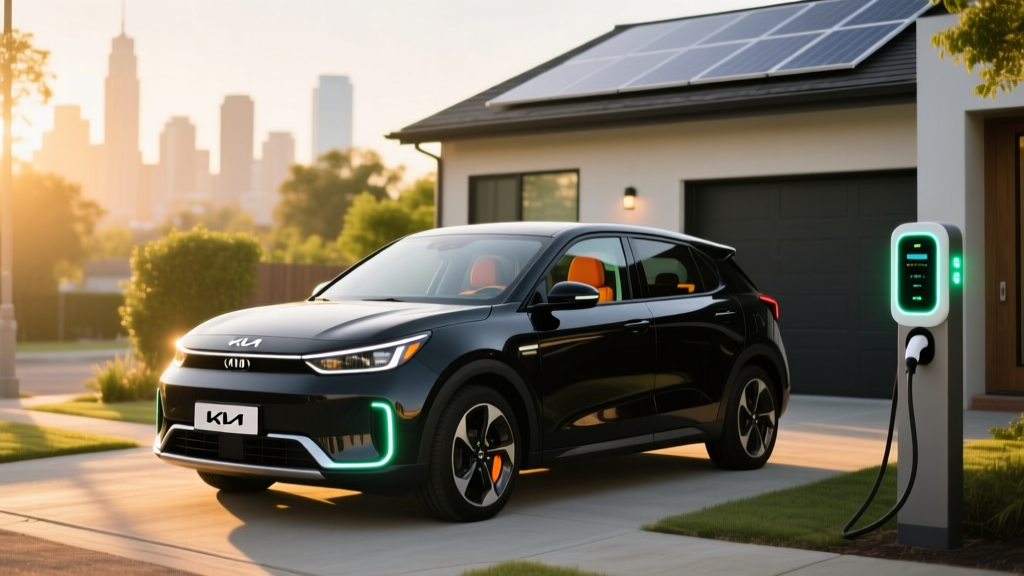
The 2026 Kia Niro EV occupies a specific niche: a practical, front-wheel-drive electric crossover with over 230 miles of EPA range and a starting price that undercuts most rivals. But the sticker price only tells part of the story. To evaluate whether current Kia Niro EV deals actually save you money, you need to run the full ownership equation — federal tax credits, home charging costs, insurance premiums, maintenance, and the depreciation hit that EVs have taken in recent years.
This guide walks through every line item with real numbers, using the 2026 Niro EV Wind (base) and Wave (top) trims as our reference points. We'll also address the §30D tax credit rules that determine whether you actually see $7,500 off — or nothing at all.
2026 Kia Niro EV: Quick Spec Reference
Before we get into cost math, here's what you're buying. The 2026 Niro EV carries over the second-generation platform with a 64.8 kWh usable battery (NMC chemistry), front-mounted motor, and CCS1/NACS charging compatibility (via adapter on earlier builds, native NACS on 2025+ models).
| Spec | Wind (Base) | Wave (Top) |
|---|---|---|
| Base MSRP | $39,600 | $44,600 |
| EPA Range | 239 miles | 239 miles |
| Battery (usable) | 64.8 kWh, NMC | 64.8 kWh, NMC |
| Motor Output | 201 hp / 188 lb-ft | 201 hp / 188 lb-ft |
| 0-60 mph | ~7.0 seconds | ~7.0 seconds |
| Max DC Fast Charge | ~85 kW peak | ~85 kW peak |
| 10-80% DCFC Time | ~43 minutes | ~43 minutes |
| Level 2 (240V) Rate | 10.9 kW | 10.9 kW |
| MPGe (combined) | 113 MPGe | 113 MPGe |
| Battery Warranty | 10 yr / 100,000 mi | 10 yr / 100,000 mi |
Federal Tax Credit: Do You Qualify for §30D?
The federal EV tax credit under IRS §30D can reduce your effective purchase price by up to $7,500 — but it's not automatic. The 2026 rules carry forward the battery-sourcing and critical-mineral requirements introduced under the Inflation Reduction Act, and the Niro EV's eligibility depends on Kia's supply chain for that specific model year.
- MSRP Cap: Vehicle must have an MSRP at or below $55,000 (SUVs/crossovers). Both Niro EV trims qualify.
- Buyer Income Cap: Modified AGI must not exceed $150,000 (single), $225,000 (head of household), or $300,000 (joint). Based on the tax year of delivery or the prior year — whichever is lower.
- Battery Sourcing: A percentage of critical minerals must be sourced from the US or a free-trade-agreement country, and battery components must be manufactured/assembled in North America. These thresholds tighten annually. Verify current-year compliance at fueleconomy.gov.
- Point-of-Sale Transfer: As of 2024, buyers can transfer the credit to the dealer at purchase, receiving the discount upfront rather than waiting to claim it on their tax return. The dealer must be IRS-registered.
- Final Assembly: Vehicle must undergo final assembly in North America. The Niro EV is assembled in South Korea — which has historically disqualified it from §30D. Check current eligibility before relying on the credit.
The assembly issue is the critical variable. The Niro EV has been manufactured in Hwaseong, South Korea. Under current §30D rules, vehicles must have final assembly in North America to qualify for the federal credit. This has been a persistent disqualifier for the Niro EV in prior model years. Before any dealer promises you $7,500 off, verify the VIN's assembly location via the NHTSA VIN decoder and cross-check eligibility on fueleconomy.gov.
If the Niro EV does not qualify for §30D, your effective price stays at MSRP minus any state/local incentives or dealer discounts. This fundamentally changes the deal calculus.
5-Year Total Cost of Ownership Breakdown
Here's what five years of Niro EV ownership actually costs, assuming 15,000 miles per year (75,000 miles total), home charging at the national average electricity rate, and typical insurance premiums. We compare against a similarly priced gas crossover (28 MPG combined) for context.
| Cost Category | Niro EV Wind | Gas Crossover (28 MPG) |
|---|---|---|
| Purchase Price (MSRP) | $39,600 | $34,000 |
| Federal Tax Credit (§30D) | $0 (assembly in S. Korea)* | $0 |
| Estimated State/Local Incentives | -$500 to -$2,000** | $0 |
| Fuel / Electricity (75k miles) | $3,375 (home, $0.15/kWh) | $10,040 ($3.75/gal) |
| Maintenance (5 years) | $1,800 | $4,200 |
| Insurance (5 years) | $9,500 | $7,200 |
| Depreciation (est. 5-yr) | -$18,000 | -$14,500 |
| Net 5-Year Cost | ~$35,775 | ~$40,940 |
* If the Niro EV qualifies for §30D in your model year, subtract $7,500 from the EV column, dramatically shifting the math. ** State incentives vary widely; see regional notes below.
Even without the federal credit, the Niro EV's lower fuel and maintenance costs close the gap over five years. With the credit, it becomes the cheaper option by a significant margin. The key variables are your electricity rate, annual mileage, and whether you can charge at home.
Charging vs. Gas: The Per-Mile Cost Math
The Niro EV averages roughly 3.4 miles per kWh (derived from its 113 MPGe combined rating, per fueleconomy.gov). Let's compare fuel costs at different charging scenarios:
| Scenario | Rate | Cost/Mile | Annual Cost (15k mi) |
|---|---|---|---|
| Home Level 2 (national avg) | $0.15/kWh | $0.044 | $660 |
| Home Level 2 (California avg) | $0.28/kWh | $0.082 | $1,235 |
| Home Level 2 (off-peak EV rate) | $0.09/kWh | $0.026 | $397 |
| Public DC Fast Charging | $0.40/kWh | $0.118 | $1,765 |
| Gas Crossover (28 MPG) | $3.75/gallon | $0.134 | $2,008 |
The takeaway: home charging on a standard or off-peak rate delivers 60-80% fuel savings over gas. If you rely exclusively on public DC fast charging, the savings narrow to roughly 12%. This is why home charging access is the single biggest factor in EV ownership economics.
The Niro EV's 10.9 kW Level 2 onboard charger means a full 0-100% charge at home takes roughly 6.5 hours — easily handled overnight on a 240V/48A circuit. For DC fast charging, the ~85 kW peak rate is modest by 2026 standards; competitors like the Hyundai Ioniq 5 (240 kW peak) charge significantly faster on road trips.
Maintenance Savings: What You Actually Skip
EVs eliminate several routine service items, but they're not maintenance-free. Here's a realistic comparison:
| Service Item | Niro EV | Gas Vehicle |
|---|---|---|
| Oil Changes | $0 (none required) | $450-$750 (5-7 changes) |
| Brake Pads/Rotors | $0-$200 (regen extends life 2-3x) | $600-$1,200 |
| Cabin Air Filter | $150-$250 | $150-$250 |
| Tire Rotation/Replacement | $1,200-$1,600 (EVs wear tires faster due to weight/torque) | $900-$1,200 |
| Coolant Flush | $100-$150 (battery thermal system) | $100-$200 |
| Transmission Fluid | $0 (single-speed reducer) | $150-$300 |
| Wipers, 12V Battery, Misc. | $300-$500 | $300-$500 |
| Estimated Total (5 yr) | $1,750-$2,700 | $2,650-$4,400 |
Net savings on maintenance run roughly $1,000-$2,000 over five years. The biggest offset is tire wear — EVs are heavier and deliver instant torque, which accelerates tread wear. Budget for a tire replacement around year 3-4.
Insurance Cost Reality for the Niro EV
EV insurance premiums typically run 15-25% higher than equivalent gas vehicles. For the Niro EV, expect annual premiums in the $1,700-$2,100 range (national average, varies by zip code, driving record, and coverage level), compared to $1,300-$1,600 for a comparable gas crossover.
The reasons are structural:
- Higher repair costs: Battery packs, power electronics, and specialized sensors are expensive to replace after a collision.
- Limited repair network: Fewer shops have EV-certified technicians, pushing repairs to dealerships at higher labor rates.
- Total-loss thresholds: Minor battery damage can trigger a total-loss declaration, increasing insurer payout risk.
- Vehicle MSRP: The Niro EV starts higher than many gas alternatives, raising comprehensive/collision premiums.
Over five years, this insurance gap adds roughly $2,000-$2,500 to your total cost. Factor this into your budget — it's a real expense that partially offsets fuel and maintenance savings.
Depreciation and Resale Value Trends
EV depreciation has been steeper than gas vehicles in recent years, driven by rapid price cuts on new models (notably Tesla), battery technology advancement anxiety, and a softening used-EV market. Industry data from 2024-2025 showed EVs losing 45-55% of value over three years, compared to 35-40% for gas vehicles.
For the Niro EV specifically:
- 5-year estimated depreciation: 45-50% (roughly $18,000-$20,000 on the Wind trim)
- Factors working against it: South Korean assembly (no federal credit for used buyers either under §25E), modest DC charging speed, strong competition from newer platforms
- Factors working for it: Kia's 10-year/100,000-mile battery warranty (transferable to second owner), proven reliability, practical crossover form factor
If you plan to keep the Niro EV for 8-10 years, depreciation matters less — you'll ride out the curve. If you trade every 3-4 years, the steeper EV depreciation will cost you at the dealership.
State, Local, and Utility Incentives
- California: Clean Fuel Rebate of up to $1,000 (income-dependent); some utilities (PG&E, SCE) offer $500-$1,500 EV charging rebates
- Colorado: State tax credit of up to $5,000 for EVs under $50,000 MSRP (stackable with federal)
- New York: Drive Clean Rebate of up to $2,000 (point-of-sale, income-tiered)
- Utility rebates (nationwide): Many utilities offer $250-$1,000 for Level 2 home charger installation, off-peak charging credits, or demand-response program enrollment
- HOV lane access: Several states (CA, CO, VA, MD) grant solo-carpool-lane access to EVs — a non-monetary but high-value perk for commuters
These incentives can meaningfully reduce your effective cost, but they're location-dependent. A Niro EV buyer in Colorado could stack a $5,000 state credit with utility rebates, saving $6,000+ beyond the purchase price. A buyer in a state with no EV incentives sees none of this.
Verdict: Who Should Buy the Niro EV in 2026?
- You have reliable home Level 2 charging and drive under 200 miles/day
- You live in a state with strong EV incentives that offset the lack of §30D eligibility
- You want a practical, efficient crossover with Kia's 10-year warranty and don't need 300+ mile range
- You value low running costs and plan to keep the vehicle 5+ years
- You rely on the $7,500 federal credit to make the math work — the Niro EV's South Korean assembly likely disqualifies it
- You take frequent road trips — the ~85 kW DC charging rate means longer stops than rivals
- You need AWD (the Niro EV is FWD only; consider the Sportage EV or Ioniq 5)
- You trade vehicles every 2-3 years — EV depreciation will hurt at resale
Frequently Asked Questions
How much does it really cost to own a Kia Niro EV over 5 years?
Based on our analysis, the 5-year net cost for a Niro EV Wind is approximately $35,775 — assuming no federal tax credit, home charging at $0.15/kWh, 15,000 miles/year, and typical insurance. This is roughly $5,000 less than a comparable gas crossover over the same period, driven primarily by fuel and maintenance savings. If you qualify for state incentives or the §30D credit becomes available, savings widen further.
Does the 2026 Kia Niro EV qualify for the $7,500 federal tax credit?
Likely not, due to the final-assembly-in-North-America requirement under §30D. The Niro EV is assembled in South Korea. Always verify using the NHTSA VIN decoder and fueleconomy.gov's credit eligibility tool before relying on the credit in your purchase decision. Rules can change, and Kia could shift production in future model years.
How much do I save on fuel and maintenance vs. a gas car?
Fuel savings run $6,000-$7,000 over five years with home charging at national average rates. Maintenance savings add another $1,000-$2,000. Combined, that's roughly $7,500-$9,000 in operational savings — enough to offset the Niro EV's higher purchase price even without the federal credit.
Are EVs more expensive to insure?
Yes, typically 15-25% more than equivalent gas vehicles. For the Niro EV, expect to pay $300-$500 more per year in premiums, totaling $2,000-$2,500 extra over five years. This is due to higher repair costs, specialized parts, and limited EV-certified body shops. Get quotes from your insurer before purchasing.
How well does the Kia Niro EV hold its value?
EV depreciation has been steeper than gas vehicles — expect the Niro EV to retain roughly 50-55% of its value after five years. Kia's 10-year/100,000-mile battery warranty (transferable) helps support resale, but rapid EV market changes and the vehicle's South Korean assembly (limiting used-buyer credit eligibility under §25E) work against it. Long-term owners (8+ years) are less affected.
What's the real-world range of the Niro EV?
The EPA rates it at 239 miles. In real-world highway driving at 70+ mph, expect 195-215 miles. In freezing temperatures, range drops to approximately 155-180 miles. The standard heat pump helps, but cold-weather range loss is a physics reality for NMC batteries.