Quick Answer: What Is the Kia GT1 Electric Grand Tourer?
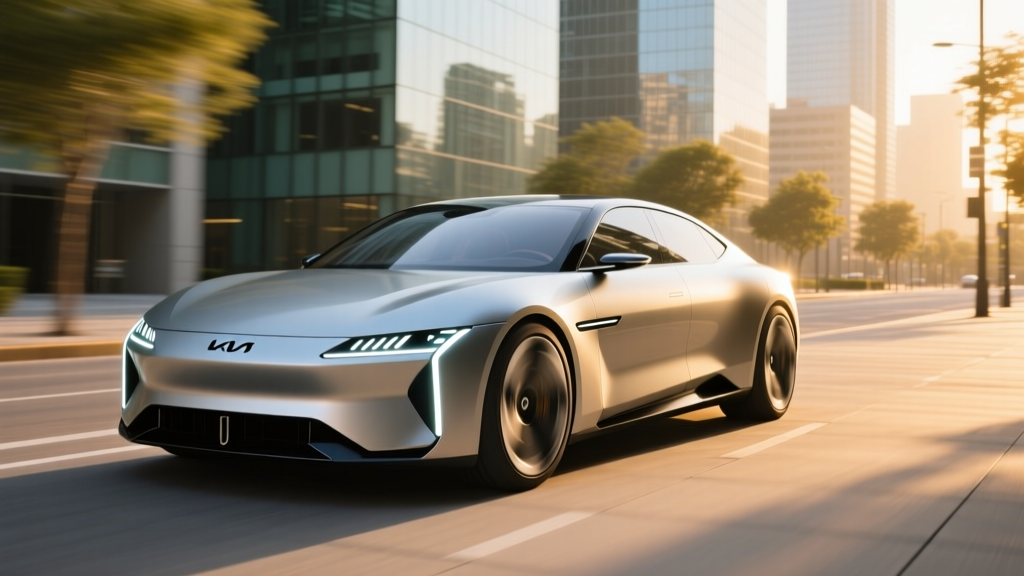
The Kia GT1 electric grand tourer (2027) is an announced, not-yet-on-sale battery-electric performance sedan positioned as Kia's flagship EV. Based on Kia's GT1 concept revealed in early 2025 and the production-intent previews shown through 2026, the GT1 is expected to ride on Hyundai Motor Group's next-generation eM platform with an estimated 100+ kWh usable battery, target EPA range of 310–350 miles, peak DC fast charging around 350 kW, and a starting MSRP likely between $55,000 and $65,000. Production is anticipated for late 2027 as a 2028 model year vehicle. All specs below are preliminary estimates based on Kia's official previews, platform leak data, and industry analysis — final EPA-certified numbers will arrive closer to launch.
Announced Specs and Platform Details
The GT1 represents Kia's bid to compete directly with the Porsche Taycan, Tesla Model S, BMW i5 M60, and the upcoming Genesis Electrified G80 in the electric grand tourer segment. Unlike the EV6 GT — which is a hot hatch — the GT1 is a low-slung, long-wheelbase sedan designed for high-speed Autobahn-style cruising paired with daily usability.
Kia has confirmed the GT1 will use the eM platform, the successor to the current E-GMP architecture found in the EV6, EV9, and Ioniq 5/6. The eM platform supports:
- 800V and potentially 1000V electrical architecture (enabling ultra-fast DC charging)
- Next-gen NMC battery cells with higher energy density than current E-GMP packs
- Rear-wheel-drive base and dual-motor AWD configurations
- Over-the-air updates for powertrain, chassis, and ADAS calibration
| Specification | Estimated Value | Notes |
|---|---|---|
| Battery Capacity (usable) | ~100–110 kWh | NMC chemistry expected; LFP unlikely for GT segment |
| EPA Range (target) | 310–350 mi | AWD variant likely ~290–310 mi |
| Peak DC Fast Charge | ~350 kW | Requires 350 kW+ station; 10–80% est. ~18–22 min |
| Level 2 AC Charge Rate | ~10.9–11 kW | Full charge overnight (~10 hrs from 10%) |
| Drivetrain | RWD base / AWD optional | Dual-motor AWD GT variant confirmed |
| Horsepower (AWD GT) | ~500–580 hp | Performance variant targeting sub-4.0s 0–60 |
| 0–60 mph (est.) | ~3.5–4.5 sec (AWD) | RWD base model likely ~5.5 sec |
| Starting MSRP (est.) | $55,000–$65,000 | GT performance trim likely $70,000+ |
| Battery Warranty | 10 yr / 100,000 mi | Based on Kia's current EV warranty structure |
Sources: Kia's official concept previews reference the eM platform and next-gen battery architecture. Final EPA figures will be published at fueleconomy.gov once the vehicle is certified.
Real-World Range: What the EPA Sticker Won't Tell You
If Kia hits its 340-mile EPA target for the RWD variant, that's a strong number on paper. But as with every EV, real-world range depends heavily on how and where you drive.
EPA vs. Real-World Range Expectations
EPA Estimated: 310–350 mi (RWD) / 290–310 mi (AWD GT)
Highway cruising at 75 mph: Expect ~250–280 mi (RWD), ~230–260 mi (AWD)
Cold weather (below 30°F): Expect 20–30% reduction — roughly 220–270 mi depending on cabin heating and battery preconditioning
Combined mixed driving (realistic daily use): ~270–310 mi is achievable with moderate speeds and mild temperatures
The GT1's expected heat pump (standard on current Kia EVs) will help mitigate cold-weather losses compared to vehicles without one. However, a grand tourer's aerodynamic profile — long hood, low roofline — means the battery is likely spread low and flat, which aids thermal management but doesn't eliminate physics. At sustained 80+ mph speeds on the interstate, efficiency drops significantly for every EV, and the GT1 will be no exception.
For context, the current Porsche Taycan (93.4 kWh Performance Battery Plus) achieves an EPA rating of ~246–282 mi depending on variant, and real-world highway testing regularly yields 200–230 mi. The GT1's larger battery and newer cell chemistry should outperform this, but buyers planning frequent 300+ mile road trips should plan charging stops regardless.
Charging Speed and Infrastructure Reality
The GT1's anticipated 800V+ architecture means it should be one of the fastest-charging sedans on the market — when paired with the right station.
| Charging Level | Power | Miles Added Per Hour | Typical Use Case |
|---|---|---|---|
| Level 1 (120V household) | ~1.4 kW | ~4–5 mi/hr | Emergency top-up only |
| Level 2 (240V home charger) | ~10.9 kW | ~33–38 mi/hr | Daily overnight charging |
| DC Fast Charge (150 kW station) | ~150 kW (capped) | ~450+ mi/hr (peak) | Common public chargers; won't use GT1's full capability |
| DC Fast Charge (350 kW station) | ~350 kW (peak) | ~1,000+ mi/hr (peak) | Electrify America, Tesla Supercharger V4 (NACS adapter) |
The charging curve reality: Peak 350 kW is not sustained across the full session. Like all EVs, the GT1 will charge fastest between roughly 10–40% State of Charge (SoC), then taper progressively. A realistic 10–80% session on a 350 kW charger should take approximately 18–22 minutes based on comparable 800V vehicles (Hyundai Ioniq 5 achieves 10–80% in ~18 min at 240 kW). Above 80%, charging slows dramatically to protect battery health — expect the 80–100% top-off to add another 20–30 minutes.
Connector note: By the 2027–2028 timeframe, Kia (as part of Hyundai Motor Group) will have transitioned to the NACS (Tesla-style) connector for North American models. The GT1 should ship with a native NACS port, granting direct access to Tesla's Supercharger network without an adapter. This is a significant advantage over current CCS-equipped vehicles that require adapter dongles for Supercharger access.
Cost Breakdown: Purchase, Charging, and Ownership
Estimated 5-Year Cost of Ownership: Kia GT1 vs. Comparable Gas Grand Tourer
Comparison: Kia GT1 AWD (est. $62,000) vs. BMW 840i Gran Coupe (MSRP ~$88,000) — both performance-oriented grand touring sedans.
| Cost Category | Kia GT1 (Estimated) | BMW 840i Gran Coupe |
|---|---|---|
| Purchase Price | $62,000 | $88,000 |
| Federal Tax Credit (§30D) | Up to $7,500 (eligibility varies — see below) | $0 |
| Effective Purchase Price | ~$54,500 (if credit applies) | $88,000 |
| Fuel/Energy (5 yr, 60,000 mi) | $4,200–$5,800 (home + public charging) | $12,000–$14,500 (premium gas at $4.20/gal, 24 MPG) |
| Maintenance (5 yr) | $1,200–$1,800 (no oil, fewer brake replacements due to regen) | $4,500–$6,000 (oil, filters, brakes, scheduled services) |
| Insurance (5 yr avg.) | $9,500–$12,000 (EVs typically 15–25% higher premiums) | $8,500–$11,000 |
| Estimated Depreciation | $22,000–$28,000 (EV depreciation still uncertain for new nameplates) | $30,000–$38,000 |
| 5-Year Total (approx.) | $91,400–$101,600 | $143,000–$157,500 |
Assumptions: 12,000 miles/year, electricity at $0.14/kWh avg. (home) and $0.35/kWh (public DC), gas at $4.20/gal. Actual costs vary by region, driving habits, and utility rates. Tax credit eligibility depends on MSRP caps, buyer income limits, and battery sourcing requirements under IRS §30D rules.
Federal Tax Credit Eligibility: Key Caveats
The GT1's eligibility for the full $7,500 federal tax credit under §30D is not guaranteed. Current rules require:
- MSRP cap: Sedans must be under $55,000 MSRP. If the GT1 base model prices above this threshold, it will not qualify — though a lower-priced RWD base trim could potentially fall under the cap.
- Buyer income limits: AGI must not exceed $150,000 (single) / $300,000 (joint filing).
- Battery sourcing: Critical minerals and battery components must meet escalating domestic/free-trade-partner sourcing percentages. By 2027–2028, these requirements will be stringent.
- Point-of-sale transfer: Eligible buyers can apply the credit as an upfront discount at the dealership rather than waiting for tax filing.
The $55,000 MSRP cap for sedans is the biggest obstacle. Kia may need to engineer a compelling base trim under that threshold, or buyers may need to rely on state-level incentives instead. Always verify current rules at IRS.gov before purchasing, as regulations continue to evolve.
How the GT1 Compares: Electric vs. Gas Grand Tourers
| Metric | Kia GT1 AWD (Est.) | BMW M850i xDrive | Porsche Taycan 4S |
|---|---|---|---|
| Powertrain | Dual-motor EV | 4.4L Twin-Turbo V8 | Dual-motor EV |
| Horsepower | ~550 hp | 523 hp | 562 hp (launch control) |
| 0–60 mph | ~3.7 sec | 3.6 sec | 3.8 sec |
| EPA Range / Fuel Economy | ~300 mi / ~95 MPGe | ~380 mi / 20 MPG | ~246 mi / ~79 MPGe |
| Energy/Fuel Cost per Mile | ~$0.05–$0.09 | ~$0.22 | ~$0.06–$0.10 |
| Starting MSRP | ~$62,000 | $113,000 | $105,000 |
| Cargo Space | ~15 cu ft (est. trunk + frunk) | 14.8 cu ft | 14.3 cu ft (trunk + frunk) |
The GT1's most compelling advantage is price-to-performance. If Kia prices the AWD variant near $62,000, it delivers M850i-rivaling acceleration and Taycan-rivaling tech at roughly half the cost. The trade-off is range versus the gas BMW's 380+ mile tank, and the uncertainty of long-term depreciation for a new EV nameplate.
Real-World Ownership Considerations for First-Time EV Buyers
Common Misconceptions About Buying a Grand Tourer EV
| Myth | Fact |
|---|---|
| "I'll never be able to take road trips." | With 300+ mi range and 18–22 min DC fast charging, a 600-mile trip requires one ~25-minute stop. Planning apps like A Better Routeplanner make this routine. |
| "The battery will need replacing in a few years." | Modern NMC batteries with active thermal management typically degrade 8–12% over 100,000 miles. Kia's 10-year/100,000-mile battery warranty covers capacity below ~70%. |
| "Home charging is too expensive to install." | A Level 2 home charger installation averages $800–$2,500 (equipment + electrician). If your panel needs upgrading (200A service), add $1,500–$3,500. Many utilities offer rebates. |
| "EVs cost more to insure." | True — typically 15–25% higher premiums due to repair costs and battery replacement risk. Shop quotes before buying; some insurers now offer EV-specific rates. |
| "Cold weather makes EVs impractical." | Cold reduces range 20–30%, but preconditioning (warming the battery while plugged in) recovers much of this loss. A garage helps enormously in sub-freezing climates. |
Home Charging Access: The Make-or-Break Factor
The GT1's 100+ kWh battery means Level 1 (120V) charging is essentially useless — adding only ~4–5 miles per hour, or roughly 40–50 miles overnight. For meaningful daily use, Level 2 home charging is strongly recommended.
If you have a garage or dedicated parking spot with access to a 240V circuit (like a dryer outlet), a Level 2 charger adds ~33–38 miles per hour of charging — enough to fully replenish the GT1 overnight. Estimated installation costs:
- Basic install (existing 240V circuit nearby): $500–$1,200
- Standard install (new 40–50A circuit, charger within 20 ft of panel): $1,200–$2,500
- Complex install (panel upgrade to 200A, long wire run): $3,000–$5,500
Apartment dwellers and street parkers should investigate workplace charging, public Level 2 networks (ChargePoint, EVgo), and whether their municipality offers curbside charging before committing.
Decision Framework: Should You Wait for the GT1?
Choose to Wait for the Kia GT1 If:
- You want a performance EV sedan under $70,000 and don't need to buy in the next 12–18 months
- You prioritize fast DC charging (350 kW class) for regular road trips
- You want native NACS access to Tesla Superchargers without an adapter
- You value Kia's 10-year/100,000-mile powertrain and battery warranty
- You prefer a grand tourer aesthetic (long, low, sleek) over a crossover or hatchback
Buy Now Instead If:
- You need a vehicle within the next 6 months — the GT1 is still 12–18 months from delivery
- The $55,000 MSRP cap for the federal tax credit is a dealbreaker for your budget — sedan pricing is tight
- You want proven real-world range data and reliability history (consider the Hyundai Ioniq 6, Porsche Taycan, or Tesla Model S instead)
- You don't have reliable home or workplace charging access — a PHEV like the BMW 530e may be more practical
- You need AWD with confirmed sub-$55,000 pricing — current options like the Hyundai Ioniq 5 or Tesla Model 3 Long Range AWD are available now with known specs
Frequently Asked Questions
Is the Kia GT1 electric grand tourer available to buy now?
No. As of mid-2026, the Kia GT1 remains an announced/preview vehicle. Kia has shown the concept and confirmed production intent, but the vehicle is not yet on sale. Deliveries are expected to begin in late 2027 or early 2028 as a 2028 model year vehicle. Reservations may open in late 2026 or early 2027.
Will the Kia GT1 qualify for the $7,500 federal EV tax credit?
It depends. The §30D tax credit imposes a $55,000 MSRP cap for sedans (vans, SUVs, and trucks have an $80,000 cap). If the GT1's base trim prices above $55,000, it will not qualify. Additionally, buyer income limits ($150K single / $300K joint) and battery sourcing requirements apply. Check current eligibility rules at IRS.gov and consult a tax professional before relying on the credit.
What battery chemistry will the GT1 use — LFP or NMC?
Kia has not officially confirmed chemistry, but the GT1's grand tourer positioning — prioritizing energy density, range, and performance — strongly suggests NMC (nickel manganese cobalt) chemistry. LFP batteries are heavier and less energy-dense, making them better suited to cost-focused models rather than performance GTs. NMC also handles cold-weather performance better, which matters for a car targeting the European and northern US markets.
How does the GT1 compare to the current Kia EV6 GT?
They serve different purposes. The EV6 GT is a 576-hp hot hatch based on the current E-GMP platform with a 77.4 kWh battery and ~206-mile EPA range. The GT1 is a larger, more refined grand touring sedan on the next-gen eM platform with a significantly larger battery (~100+ kWh), longer range (~310–350 mi), faster charging, and a more premium interior. Think of the EV6 GT as a track-day weapon and the GT1 as an Autobahn cruiser — same brand DNA, very different execution.
Will the GT1 have a front trunk (frunk)?
Kia has not confirmed frunk details, but the eM platform's dedicated EV architecture typically allows for some front storage. Expect a modest frunk (2–4 cu ft) suitable for charging cables and a small bag, similar to the Ioniq 6's front trunk. The primary cargo area will be the rear trunk, estimated at ~13–15 cu ft.
What ADAS and driver-assistance features are expected?
The GT1 will likely ship with Kia's latest Highway Driving Assist (HDA) system, which is a SAE Level 2 driver-assistance feature — meaning the driver must remain attentive with hands on or near the wheel at all times. Expect adaptive cruise control, lane-centering, automated lane changes, and navigation-based speed adjustment. Kia may also offer a more advanced semi-autonomous highway system on higher trims, but this will not be Level 3 or Level 4 self-driving. The driver remains responsible for the vehicle at all times.
What should I do while waiting for the GT1 to launch?
Use the time productively: get a Level 2 home charger installed, research your utility's EV time-of-use rates (charging overnight can cut costs to $0.03–$0.05/mi), check your federal and state incentive eligibility, and test-drive current competitors (Ioniq 6, Taycan, Model S, BMW i5) to benchmark what you like. This way, when the GT1 arrives, you'll have your charging infrastructure ready and a clear comparison baseline.