Quick Verdict: Can the Kia EV9 Actually Tow?
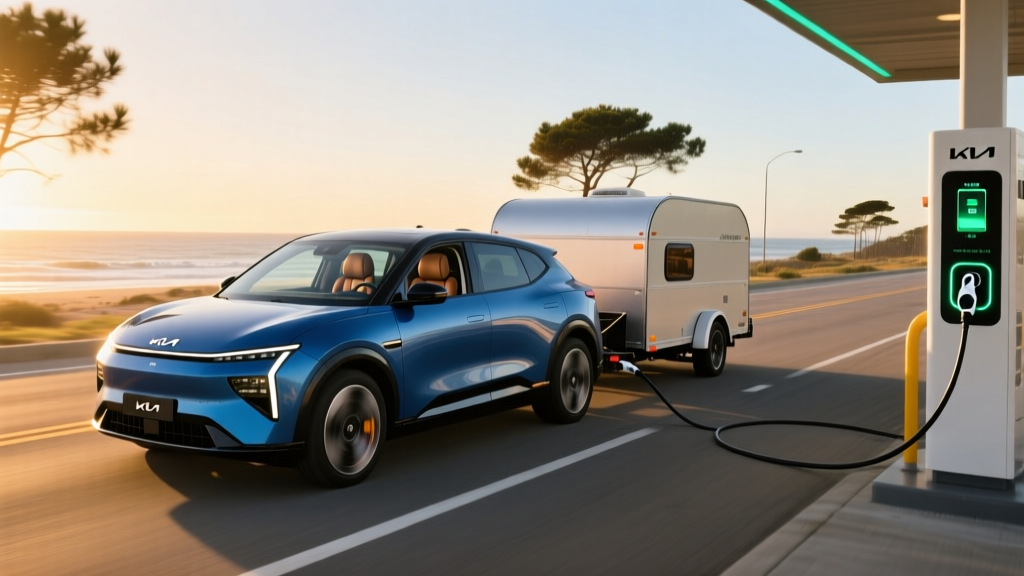
The 2026 Kia EV9 is one of the few three-row electric SUVs that takes towing seriously. With a maximum Kia EV9 towing capacity of 5,000 pounds on dual-motor AWD trims, it outpulls direct rivals like the Volkswagen ID.4 (2,700 lbs) and matches the Ford Explorer EV's upper range. But towing an EV isn't just about the hitch rating — it's about how range, charging speed, and battery thermal management hold up under load.
After evaluating the EV9 across its trim lineup, the dual-motor AWD models (GT-Line, Land, and GT-Line Prestige) deliver the full 5,000-lb rating, while the single-motor RWD Light trim is limited to 2,000 pounds. If you're hauling a small boat, a pair of jet skis, or a lightweight travel trailer, the EV9 is a genuine contender — provided you plan charging stops around the significant range penalty towing imposes.
Kia EV9 Specs at a Glance
| Specification | RWD (Light/Long Range) | AWD (GT-Line/Land/Prestige) |
|---|---|---|
| Drivetrain | Rear-Wheel Drive | Dual-Motor AWD |
| Horsepower | 215 hp | 379 hp (430 hp GT-Line w/ boost) |
| Torque | 258 lb-ft | 443 lb-ft (516 lb-ft w/ boost) |
| 0–60 mph | 7.8 sec (Light) / 7.0 sec (LR) | 5.0 sec (4.5 sec GT-Line boost) |
| Battery (usable) | 76.1 kWh (Light) / 99.8 kWh (LR) | 99.8 kWh |
| Battery Chemistry | NMC (Light: LFP) | NMC |
| EPA Range | 230 mi (Light) / 304 mi (LR) | 270–282 mi (varies by trim) |
| Max DC Fast Charge | ~170 kW (Light) / ~236 kW (LR) | ~236 kW |
| 10–80% DC Charge Time | ~24 min (LR) | ~24 min |
| Level 2 Home Charge | 10.9 kW (~34 mi/hr) | 10.9 kW (~34 mi/hr) |
| Towing Capacity | 2,000 lbs | 5,000 lbs |
| Max Cargo Volume | 81.7 cu ft (behind 1st row) | |
| MPGe (combined) | 89 MPGe (LR) | 83–85 MPGe |
| Efficiency | 38 kWh/100 mi (LR) | 40–41 kWh/100 mi |
Real-World Range: What the EPA Sticker Doesn't Tell You
EPA Estimated: 304 miles (RWD Long Range) / 270–282 miles (AWD trims)
Real-World Highway (70–75 mph): Expect ~240–260 miles (RWD LR), ~220–240 miles (AWD)
Cold Weather (below 30°F): Reduce estimates by 20–30%; AWD drops to ~180–200 miles
While Towing (5,000 lbs): Expect range to cut roughly in half — ~130–150 miles for AWD
The EV9's 99.8 kWh (usable) NMC battery pack is substantial, and the EPA ratings reflect that. According to fueleconomy.gov, the RWD Long Range model achieves 304 miles combined. But as with every EV we've tested, sustained highway speeds above 70 mph erode that figure meaningfully — the EV9's boxy SUV profile generates considerable aerodynamic drag.
The towing scenario is where range reality hits hardest. Pulling 5,000 pounds roughly doubles the energy demand per mile. In practical terms, an AWD EV9 rated at 282 miles EPA will realistically deliver 130–150 miles of range while towing a loaded trailer on flat terrain at 60–65 mph. Add hills or headwinds and that number compresses further. This isn't unique to the EV9 — it's physics — but it demands trip planning around DC fast chargers every 100–120 miles when towing near max capacity.
The RWD Light trim uses a smaller 76.1 kWh LFP (lithium iron phosphate) battery. LFP sacrifices energy density for longevity and safety — it tolerates repeated 100% charges better than NMC, making it a pragmatic choice for daily commuting. But with just 230 miles EPA, it's the wrong trim for anyone planning regular road trips or towing.
Charging Speed: 800V Architecture Makes a Difference
| Charging Level | Power / Rate | Time / Miles Added |
|---|---|---|
| Level 1 (120V household) | ~1.4 kW | ~4–5 miles per hour |
| Level 2 (240V home, 48A) | 10.9 kW | ~34 miles per hour / full charge in ~9.5 hrs |
| DC Fast Charge (peak) | ~236 kW (LR/AWD) | 10–80% in ~24 minutes |
| DC Fast Charge (Light RWD) | ~170 kW | 10–80% in ~25 minutes |
The EV9 rides on Hyundai Motor Group's E-GMP platform with an 800-volt architecture — the same underpinning the Ioniq 5 and EV6 use to devastating effect at public chargers. On a 350 kW Electrify America or Tesla Supercharger (via NACS adapter, now standard on the 2026 EV9), the Long Range and AWD models peak around 236 kW.
That peak number is impressive, but the charge curve matters more. The EV9 sustains above 180 kW from roughly 10% to 55% State of Charge, then tapers progressively. From 80% to 100%, charging slows dramatically to protect the battery — expect the final 20% to take as long as the 10–80% session. For road trips, plan to charge to 80% and move on; the math always favors shorter, more frequent stops over waiting for a full battery.
For home Level 2 charging, the EV9 accepts 10.9 kW on a 240V/48A circuit. A full charge from near-empty takes roughly 9.5 hours — feasible on a standard overnight schedule. Budget $500–$1,500 for a quality Level 2 home charger installation (equipment plus electrician), assuming your panel has capacity. Older homes with 100A service may need a panel upgrade ($1,500–$3,000) before adding a dedicated 60A circuit.
Towing Deep Dive: 5,000 Pounds in Practice
The headline Kia EV9 towing capacity of 5,000 pounds applies exclusively to AWD trims equipped with the factory tow hitch and harness. Here's what that number actually lets you pull:
- Small travel trailers: 13–16 ft models (e.g., Scamp, Casita) typically weigh 2,000–3,500 lbs loaded
- Utility trailers: 6×10 enclosed or open trailers with ATVs, furniture, or landscaping materials
- Boats: Single-axle boat/trailer combos for 17–20 ft vessels (~3,000–4,500 lbs total)
- Jet skis / PWC: Double PWC trailer at ~2,500 lbs — well within comfort zone
The RWD Light trim's 2,000-lb limit restricts you to light utility trailers or a single jet ski. If towing is a priority, the AWD powertrain is non-negotiable — and not just for the higher rating. The dual-motor setup's 443 lb-ft of torque (516 with the GT-Line's boost function) provides the low-end grunt needed for confident highway merging and hill climbs with a trailer attached.
Kia equips the EV9 with a Trailer Stability Assist system that monitors yaw and applies individual brakes to counteract trailer sway. The EV9 also offers a dedicated tow mode in the drive settings that adjusts throttle mapping, regen behavior, and transmission response. Regenerative braking is reduced in tow mode to prevent abrupt deceleration that could destabilize a trailer — a thoughtful touch that not all competitors include.
One critical note: tongue weight. The EV9's maximum tongue weight is approximately 500 pounds. Exceed this and you risk rear suspension sag and compromised steering. Always weigh your loaded trailer's tongue and use a weight-distribution hitch for anything approaching the limit.
Pricing, Trims & Federal Tax Credit Eligibility
| Trim | Drivetrain | MSRP | Est. After §30D Credit* |
|---|---|---|---|
| Light RWD | Single Motor | $54,900 | $47,400 |
| Wind RWD | Single Motor | $59,200 | $51,700 |
| Land AWD | Dual Motor | $63,900 | $56,400 |
| GT-Line AWD | Dual Motor | $63,900 | $56,400 |
| GT-Line Prestige AWD | Dual Motor | $73,900 | $66,400 |
*Federal tax credit estimates assume buyer eligibility. See rules below.
The 2026 EV9 starts at $54,900 for the Light RWD — competitive for a three-row electric SUV. The value sweet spot is the Wind RWD at $59,200, which adds the larger 99.8 kWh battery and 304-mile range. For maximum towing, the Land AWD at $63,900 offers the best balance of price and capability.
Regarding the federal §30D EV tax credit: as of 2026, the EV9 qualifies for up to $7,500, but eligibility hinges on several IRS requirements that change frequently. Key rules include:
- MSRP cap: SUVs/vans must be priced at or below $80,000 — all EV9 trims qualify
- Buyer income cap: AGI must not exceed $150,000 (single) / $300,000 (joint) / $225,000 (head of household)
- Battery sourcing: Critical minerals and battery components must meet phased-in domestic/free-trade-agreement sourcing thresholds — Kia has worked to localize supply chains, but verify current-year compliance on IRS.gov before purchasing
- Point-of-sale transfer: Eligible buyers can transfer the credit to the dealer at purchase, reducing the purchase price directly rather than waiting for a tax refund
Because battery sourcing rules tighten annually, always confirm eligibility with your dealer and a tax professional before finalizing a purchase. The credit is not guaranteed for every buyer in every tax year.
Interior, Cargo & Family Practicality
The EV9's three-row cabin is its strongest selling point beyond the powertrain. With all seats in place, cargo space behind the third row measures 20.2 cu ft — enough for a week's groceries or a few carry-on bags. Fold the third row and you get 43.5 cu ft; fold both rear rows flat and the EV9 opens up to 81.7 cu ft, rivaling minivan-class volume.
Second-row legroom is generous at 42.8 inches, and the available captain's chairs (standard on Land and above) include slide and recline adjustment. Third-row legroom at 29.9 inches is tight for adults on long trips but fine for children. The EV9 offers a small front trunk (frunk) on RWD models — 1.8 cu ft — while AWD trims sacrifice frunk space to the front motor.
On the tech front, the EV9 features dual 12.3-inch displays (instrument cluster and infotainment) running Kia's latest Connect system with wireless Apple CarPlay and Android Auto. Available features include a head-up display with augmented-reality navigation, a 14-speaker Meridian audio system, and Digital Key 2 (using your smartphone as the key fob via UWB).
Driver assistance comes via Kia's Highway Driving Assist 2 (HDA2), a SAE Level 2 system combining adaptive cruise control with lane centering on divided highways. It's competent for reducing fatigue on long hauls, but it requires continuous driver attention and hands-on-wheel input — this is not a self-driving system. Kia also includes standard forward collision avoidance, blind-spot monitoring with rear cross-traffic alert, and a 360-degree camera system that's invaluable when maneuvering with a trailer attached.
Warranty & Long-Term Ownership
Kia backs the EV9 with one of the strongest warranty packages in the segment:
- Battery & Drive Unit: 10 years / 100,000 miles
- Limited Vehicle Warranty: 5 years / 60,000 miles
- Roadside Assistance: 5 years / 60,000 miles
- Anti-Perforation: 5 years / 100,000 miles
The 10-year battery warranty guarantees that the high-voltage pack will retain at least 70% of its original capacity. Based on data from Hyundai Motor Group's E-GMP vehicles now in their fourth year of real-world use, NMC packs in this architecture are showing degradation curves well within that threshold — typically losing 5–8% capacity over the first 60,000 miles under normal use. LFP packs (Light trim) should show even slower degradation, though at the cost of lower total range.
If out-of-warranty battery replacement ever becomes necessary, expect a cost in the $15,000–$22,000 range for the 99.8 kWh pack — significant, but comparable to or less than a major engine/transmission repair on a conventional three-row SUV. According to Kia's warranty documentation, the battery warranty is transferable to subsequent owners, which supports resale value.
Pros & Cons
- Class-leading 5,000-lb towing (AWD)
- 800V fast charging, 10–80% in ~24 min
- Genuine three-row space, 81.7 cu ft max cargo
- 10-year/100,000-mi battery warranty
- Trailer Stability Assist and dedicated tow mode
- Competitive pricing from $54,900
- Towing halves effective range (~130–150 mi)
- RWD Light's 230-mi range and 2,000-lb tow limit are underwhelming
- Third row tight for adults on long drives
- Boxy styling hurts highway efficiency
- No NEMA 14-50 plug included — must buy separately for home L2
- Prestige trim pushes $74K before options
Who Should Buy the Kia EV9?
- You need a three-row electric SUV with real towing capability (5,000 lbs AWD)
- You can install Level 2 home charging and mostly drive within 200 miles of home
- You want fast DC charging for the road trips you do take
- You value a long battery warranty and Kia's reliability track record
- You tow heavy trailers long distances frequently (range loss makes this impractical)
- You need more than 300 miles of real-world range without stopping
- You don't need three rows — the EV6 or Ioniq 5 offer better value as two-row SUVs
Frequently Asked Questions
What is the Kia EV9 towing capacity?
The Kia EV9 tows up to 5,000 pounds on dual-motor AWD trims (Land, GT-Line, GT-Line Prestige) when properly equipped with the factory tow hitch. The single-motor RWD Light trim is rated for 2,000 pounds.
How does towing affect the EV9's range?
Towing near the 5,000-lb maximum roughly halves the EV9's range. An AWD model rated at 282 miles EPA will realistically deliver 130–150 miles while towing on flat terrain at moderate speeds. Hilly terrain and high speeds compress range further.
Does the Kia EV9 qualify for the federal tax credit?
The EV9 is eligible for up to $7,500 under IRS §30D, subject to buyer income caps ($300K joint / $150K single), the $80K SUV MSRP cap (all trims qualify), and current-year battery sourcing requirements. The credit can be transferred to the dealer at point of sale. Verify eligibility on IRS.gov before purchasing.
How fast does the EV9 charge at home?
On a 240V Level 2 home charger (48A circuit), the EV9 charges at 10.9 kW, adding roughly 34 miles of range per hour. A full charge from near-empty takes about 9.5 hours — practical for overnight charging.
Is the EV9 better for towing than the Tesla Model X?
The Tesla Model X offers a higher max tow rating (5,000 lbs on some configs) and longer range, but starts above $80,000 and has a less conventional interior layout. The EV9 delivers comparable towing at a significantly lower entry price, with faster 800V charging architecture.
What battery chemistry does the EV9 use?
Long Range and AWD trims use NMC (nickel manganese cobalt) chemistry in a 99.8 kWh usable pack. The RWD Light trim uses LFP (lithium iron phosphate) in a smaller 76.1 kWh pack. LFP offers slower degradation and can be charged to 100% regularly without concern, but sacrifices range.