The three-row electric SUV segment has exploded, but most entries treat the third row as an afterthought — a cramped penalty box suitable only for small children on short trips. The 2026 Kia EV9 was engineered from the ground up on Hyundai Motor Group's E-GMP platform with a wheelbase stretching 122.0 inches, and that extra length pays dividends behind the second row. This review focuses on what families actually need to know: does the Kia EV9 third row genuinely work for adults, how much range and charging speed do you sacrifice for that extra seating, and what does ownership look like after the federal tax credit?
Range, Efficiency, and the Real-World Caveat
The 2026 EV9 lineup splits into two efficiency camps. The single-motor RWD Light Long Range model carries the EPA-estimated 304-mile range badge, while the dual-motor AWD trims (Wind, Land, and GT-Line) are rated at 270 miles (Wind) or 280 miles (Land/GT-Line with the smaller 20-inch wheels). Step up to the GT-Line with 21-inch alloys and the sticker drops to roughly 270 miles.
EPA 304 mi (RWD) / 280 mi (AWD Land) — but plan for ~250–265 mi on sustained 75-mph highway runs in the AWD models, and as low as 210–230 mi in sub-freezing winter conditions with the heater running. The RWD Light Long Range gets closer to its sticker in mixed driving (~275–290 mi), but highway-heavy commutes at speed will still shave 10–15% off. Battery preconditioning for DC fast charging is automatic when a charger is set in the navigation — use it.
Efficiency on the AWD models lands around 85–88 MPGe combined, or roughly 38–40 kWh/100 mi depending on wheel size. The RWD Long Range pushes closer to 94 MPGe (36 kWh/100 mi). For a 5,000-pound three-row SUV, those figures are genuinely competitive with the Rivian R1S and significantly better than the ICE baseline of a Toyota Grand Highlander Hybrid's fuel cost per mile in most electricity markets.
Battery Chemistry, Capacity, and Longevity
All 2026 EV9 trims use a 99.8 kWh (usable) NMC (nickel-manganese-cobalt) lithium-ion battery pack. Kia has not adopted LFP chemistry for the EV9, prioritizing energy density to hit the 300-mile target in a large, heavy vehicle. NMC offers superior cold-weather performance and higher specific energy, but it does mean owners should avoid routinely charging to 100% for daily use — set the charge limit to 80–90% for regular driving and save the full charge for road trips.
| Spec | RWD Light Long Range | AWD Wind / Land / GT-Line |
|---|---|---|
| Battery (usable) | 99.8 kWh, NMC | 99.8 kWh, NMC |
| EPA Range | 304 mi | 270–280 mi |
| Horsepower | 215 hp | 379 hp |
| 0–60 mph | ~7.7 sec | ~4.5 sec (5.0 sec Wind) |
| Drivetrain | RWD, single motor | AWD, dual motor |
| Max DC Fast Charge | ~236 kW | ~236 kW |
| 10–80% DC Time | ~24 min | ~24 min |
| MPGe (combined) | 94 MPGe | 85–88 MPGe |
Kia backs the battery with an 8-year / 100,000-mile warranty covering defects and capacity loss below 70% state of health. This matches the industry standard set by Hyundai/Kia and exceeds the federal minimum. The powertrain (motors, reduction gear, onboard charger) carries the same 8-year/100,000-mile coverage.
Charging Speed: DC Fast, Level 2, and the 800-Volt Advantage
The EV9 retains the E-GMP platform's 800-volt electrical architecture, which is a significant advantage at DC fast chargers. On a 350 kW station (like Electrify America or EVgo's newest stalls), the EV9 peaks at approximately 236 kW and sustains above 150 kW through the 40–65% state-of-charge window before tapering. The 10–80% charge takes roughly 24 minutes under ideal thermal conditions.
On a 150 kW charger — still the most common DC fast-charger rating in the US — expect 10–80% in about 32–35 minutes. The charge curve is aggressive early but tapers meaningfully past 80%, so plan your road-trip stops to leave at 75–80% rather than waiting for a full top-off.
| Charging Level | Power / Rate | Miles Added per Hour | 10–80% Time |
|---|---|---|---|
| Level 1 (120V household) | ~1.4 kW | ~4 mi/hr | ~50+ hours |
| Level 2 (240V, 48A home) | ~10.9 kW | ~32 mi/hr | ~7.5 hours |
| DC Fast (350 kW station) | Peak ~236 kW | ~700+ mi/hr (peak) | ~24 min |
| DC Fast (150 kW station) | Peak ~135 kW | ~400 mi/hr (peak) | ~33 min |
For home charging, the EV9's onboard charger accepts up to 10.9 kW on a Level 2, 48-amp, 240-volt circuit. That translates to roughly 32 miles of range per hour of charging — enough to fully replenish the battery overnight from near-empty. Most owners charging from a typical 20–40% daily deficit will wake up full every morning. A NEMA 14-50 outlet installation with a quality Level 2 EVSE (ChargePoint Home Flex, Emporia, or Wallbox) typically costs $800–$1,500 all-in with a licensed electrician, assuming no panel upgrade is needed.
The EV9 uses the CCS1 connector for DC fast charging. Kia has confirmed NACS (Tesla-style) adoption for future models, but the 2026 EV9 still ships with CCS1. Adapters for Tesla Supercharger access are available and expanding compatibility, though native CCS networks (Electrify America, EVgo) remain the most reliable pairing.
Third-Row Space: The EV9's Defining Feature
This is where the EV9 separates itself from nearly every electric competitor. The 122.0-inch wheelbase — 4.3 inches longer than the Telluride's — translates directly to third-row habitability. Here are the official interior dimensions that matter:
- Third-row legroom: 32.0 inches
- Third-row headroom: 37.8 inches
- Third-row shoulder room: 55.4 inches
- Second-row legroom: 42.8 inches (bench) / 42.7 in (captain's chairs)
- First-row legroom: 41.4 inches
In practice, adults up to about 5'10" can sit in the third row for a 30–45 minute trip without serious complaint. The floor is relatively flat thanks to the skateboard battery layout — there's no transmission tunnel eating into foot space, and the seat cushion height is decent for a three-row SUV. Compare this to the Tesla Model X's third row (roughly 32.7 inches of legroom but with a more sloping roofline that cuts headroom) or the Rivian R1S (30.4 inches of third-row legroom in earlier models, improved slightly in the 2025+ Tri-Motor refresh). The EV9 is among the most livable third rows in any electric vehicle sold today.
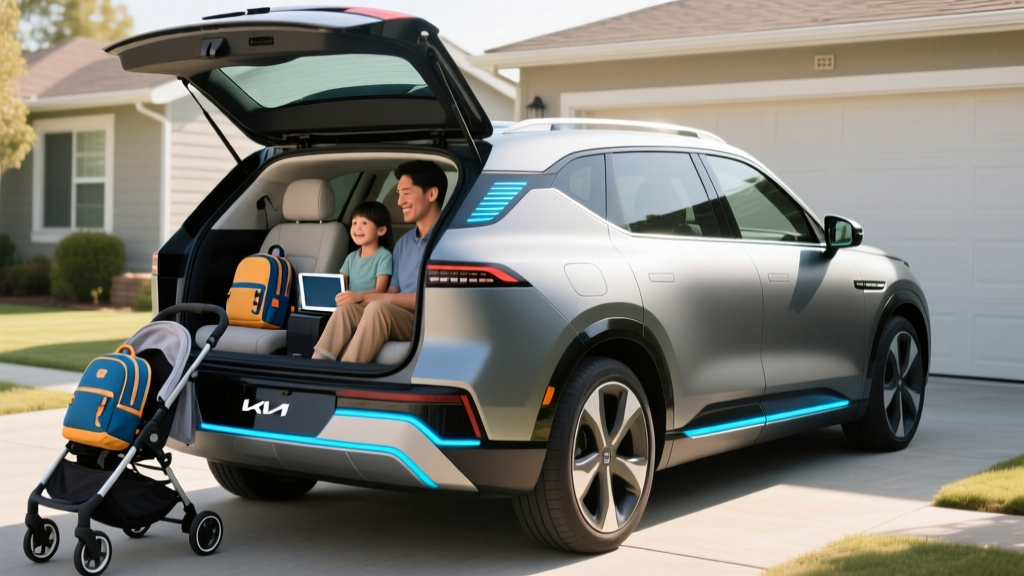
Cargo space behind the third row is 20.2 cubic feet — enough for a week's groceries or two carry-on suitcases and a stroller. Fold the third row and you get 43.5 cubic feet; fold both rear rows for a maximum of 81.7 cubic feet. The front trunk (frunk) adds 1.8 cubic feet on AWD models and 3.2 cubic feet on RWD — useful for charging cables or a small bag but not a major cargo area.
Pricing, Trims, and the Federal Tax Credit Question
The 2026 Kia EV9 is offered across six trims. Pricing has remained relatively stable year-over-year, though Kia has adjusted packaging on certain trims:
| Trim | MSRP (incl. destination) | Est. After §30D Credit* |
|---|---|---|
| Light RWD (Standard Range) | ~$56,395 | ~$48,895 |
| Light Long Range RWD | ~$60,595 | ~$53,095 |
| Wind AWD | ~$65,395 | ~$57,895 |
| Land AWD | ~$71,395 | ~$63,895 |
| GT-Line AWD | ~$75,395 | ~$67,895 |
| GT-Line AWD Prestige | ~$78,395 | ~$70,895 |
*Credit eligibility is not guaranteed. The figures above assume the buyer qualifies for the full $7,500 federal EV tax credit under IRS §30D rules. As of 2026, qualifying requires:
- MSRP cap: SUVs/vans/pickups must have an MSRP at or below $80,000. All EV9 trims currently clear this threshold.
- Buyer income cap: Modified AGI must not exceed $300,000 (joint filers), $225,000 (head of household), or $150,000 (single). Check your prior-year or current-year AGI, whichever is lower.
- Battery sourcing: A percentage of critical minerals and battery components must be sourced from the US or free-trade-agreement partners. Kia's supply chain has progressively met these thresholds, but the exact credit amount ($3,750 vs. $7,500) can shift based on annual sourcing compliance. Confirm with your dealer and review the IRS's current eligible vehicle list at purchase time.
- Point-of-sale transfer: As of 2024+, buyers can elect to transfer the credit to the dealer at purchase, reducing the purchase price directly rather than waiting for a tax refund. This requires the dealer to be registered with the IRS Energy Credits portal.
The EV9's MSRP cap compliance and Kia's improving battery-sourcing profile make it one of the stronger candidates for the full credit among three-row EVs, but always verify at the point of purchase — rules and sourcing compliance shift annually.
Performance, Ride, and Daily Driving Impressions
The dual-motor AWD EV9 produces 379 horsepower and a stout 516 lb-ft of torque (Land and GT-Line trims). That's good for a 0–60 mph time of approximately 4.5 seconds — remarkable for a vehicle this size and a meaningful advantage when merging onto highways or passing on two-lane roads. The Wind trim, tuned slightly differently, runs about 5.0 seconds to 60. The RWD Long Range, with 215 hp, manages around 7.7 seconds — adequate for commuting but noticeably less urgent.
Ride quality is a highlight. The EV9's long wheelbase and well-damped suspension absorb highway expansion joints and suburban speed bumps with composure that rivals the Genesis Electrified GV70. Body roll is present but controlled in corners — this is a family hauler, not a sports SUV, and the steering is light and accurate rather than communicative. Regenerative braking offers multiple levels adjustable via steering-wheel paddles, including a true one-pedal driving mode (i-Pedal) that can bring the vehicle to a complete stop without touching the brake pedal.
The EV9 is rated to tow up to 5,000 pounds with the AWD trims (braked trailer, properly equipped). RWD models are limited to 2,000 pounds. Towing will cut range roughly in half — plan for 130–150 miles between charging stops when pulling a loaded trailer.
Tech, Driver Assists, and Standout Features
The EV9's cabin centers on a dual 12.3-inch panoramic display (instrument cluster and infotainment) running Kia's latest connected-car OS. Wireless Apple CarPlay and Android Auto are standard across all trims. The GT-Line Prestige adds a head-up display with augmented-reality navigation overlays, a 14-speaker Meridian audio system, and Kia's Digital Key 2 (UWB-based phone-as-key).
Driver-assist technology falls under the Highway Driving Assist 2 (HDA2) umbrella — a Level 2 SAE system combining adaptive cruise control, lane-centering, and lane-change assist. It's competent on interstates and reduces fatigue on long drives, but it requires hands on the wheel and full driver attention. This is not an eyes-off or hands-off system. Kia also includes standard forward collision-avoidance assist, blind-spot collision-avoidance, rear cross-traffic collision-avoidance, and safe exit assist.
Highway Driving Assist 2 is a Level 2 driver-assist system, not autonomous or "self-driving." The driver must remain fully engaged, hands on the wheel, eyes on the road. It will not navigate unmapped roads, handle construction zones autonomously, or respond to all hazards. Kia's system is competitive with Toyota Safety Sense 3.0 and Honda Sensing but does not offer the hands-off capability of GM's Super Cruise on mapped highways.
Unique to the EV9 is Vehicle-to-Load (V2L) capability via an interior 120V outlet and an exterior adapter, allowing you to power devices, tools, or even a small appliance from the battery — useful for camping, tailgating, or emergency backup power during outages (up to 3.6 kW output).
Pros and Cons at a Glance
- Genuinely usable third row for adults on moderate trips
- 800V architecture enables ~24-min 10–80% DC fast charging
- Up to 304 mi EPA range (RWD); strong AWD range
- 5,000-lb towing capacity (AWD)
- Spacious cargo: 81.7 cu ft max
- 8-year/100,000-mi battery warranty
- Strong §30D tax-credit candidate (all trims under $80K MSRP cap)
- V2L capability for outdoor/emergency power
- CCS1 connector (no native NACS; adapter required for Superchargers)
- Third-row cargo (20.2 cu ft) tight when all seats occupied
- AWD range drops to 270–280 mi; real-world highway less
- No hands-off Level 2+ system (no Super Cruise equivalent)
- Premium trims push $78K+ before options
- Frunk is small (1.8–3.2 cu ft)
- Cold-weather range loss typical of NMC (~15–25% below freezing)
Who Should Buy the 2026 Kia EV9?
The EV9 is purpose-built for families who need three rows of seating but want to go electric without stepping into the $80,000+ territory of a Rivian R1S or the $100,000+ Tesla Model X. It's ideal for:
- Commuting families with school runs, sports practices, and a daily round-trip under 80 miles (charge nightly at home, rarely visit a DC fast charger).
- Road-trip households who take 2–4 longer trips per year and can plan around 20–25 minute DC fast-charge stops.
- Buyers who prioritize third-row usability over sporty driving dynamics — the EV9 is comfortable and composed, not thrilling.
- Light tower/haulers who need 5,000-lb towing for a boat, camper, or utility trailer on shorter hauls.
It's less ideal for buyers who need maximum cargo volume with all seats in use (the minivan segment still wins there), those who want hands-off highway driving (GM's Super Cruise is ahead), or anyone whose primary DC fast-charging access is exclusively Tesla Superchargers without a CCS adapter.
Frequently Asked Questions
What is the real-world range of the Kia EV9?
The EPA rates the RWD Long Range at 304 miles and AWD models at 270–280 miles. In real-world mixed driving, expect roughly 275–290 miles from the RWD and 245–265 miles from the AWD. Sustained highway driving at 75+ mph and cold weather (below 32°F) will reduce these figures by 10–25% depending on conditions.
How fast does the EV9 charge at home and on the road?
At home on a Level 2 (240V, 48A) charger, the EV9 adds about 32 miles of range per hour, fully charging overnight in roughly 7.5 hours. On a 350 kW DC fast charger, it peaks at ~236 kW and charges from 10–80% in about 24 minutes. On a 150 kW charger, expect ~33 minutes for the same range.
Does the 2026 Kia EV9 qualify for the $7,500 federal tax credit?
Most likely, yes — all trims fall under the $80,000 SUV MSRP cap, and Kia's battery sourcing has progressively met critical-mineral and component thresholds. However, your personal eligibility depends on income caps ($300K joint / $150K single) and the specific sourcing compliance at the time of purchase. Confirm on the IRS clean vehicle credit page and with your dealer before signing.
Is the Kia EV9 worth buying vs. the Rivian R1S or Tesla Model X?
The EV9 offers the best value in the three-row EV segment. The Rivian R1S is more capable off-road and offers a NACS connector but starts significantly higher (typically $75,900+ for dual-motor) and has a tighter third row. The Tesla Model X offers falcon-wing doors and Supercharger access but starts above $100,000 and has a less practical third row. For families prioritizing space-per-dollar and tax-credit eligibility, the EV9 is the strongest pick.
Can adults sit comfortably in the Kia EV9 third row?
Yes, for moderate-duration trips. With 32.0 inches of legroom and 37.8 inches of headroom, adults up to about 5'10" can sit reasonably comfortably for 30–45 minutes. The flat floor and decent seat cushion height help. For all-day comfort or passengers over 6 feet, a minivan remains the better choice.
What connector does the EV9 use, and can it charge at Tesla Superchargers?
The 2026 EV9 uses a CCS1 connector natively. Tesla Supercharger access requires a CCS-to-NACS adapter. Kia has announced NACS adoption for future model years, but the current EV9 ships with CCS1. Public CCS networks (Electrify America, EVgo) are the most seamless pairing.
How does towing affect the EV9's range?
Towing at or near the 5,000-lb AWD maximum will roughly halve the vehicle's range — expect 130–150 miles between charging stops with a loaded enclosed trailer. Aerodynamic drag from the trailer is the primary range killer, more so than weight alone. Plan routes around reliable DC fast chargers.