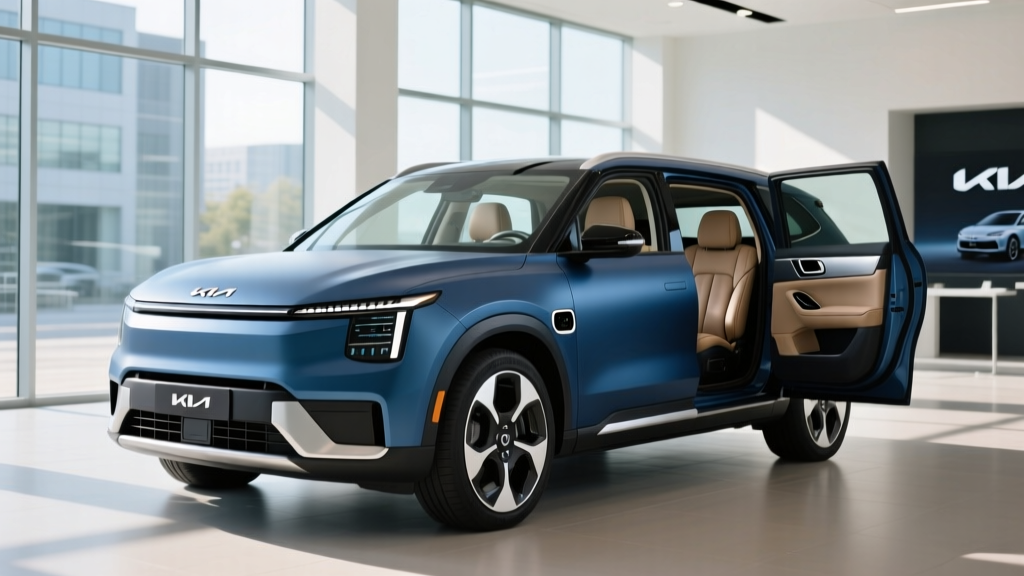
The Kia EV9 remains one of the very few battery-electric SUVs offering genuine three-row seating at a mainstream price point. While rivals like the Rivian R1S and Tesla Model X also seat seven, the EV9 undercuts them by tens of thousands of dollars — and the question buyers keep asking is whether those Kia EV9 seats actually work for adults, car seats, and daily family logistics. This review breaks down the seating layout, cargo math, real-world range, charging behavior, and ownership economics for the 2026 model year.
Quick Verdict: Who the EV9 Is Built For
The EV9 is a 3-row, body-on-frame-style electric family hauler aimed at households that need space for six or seven passengers without burning gas. It is not a luxury SUV pretending to be affordable; it is a practical electric minivan alternative with SUV styling. If your use case involves school runs, road trips with kids in boosters, or hauling gear with five passengers aboard, the EV9 is currently the default answer in the sub-$70,000 EV segment. Single-motor buyers who commute solo should look at the Ioniq 5 or EV6 instead — the EV9's size and weight tax efficiency in city-only driving.
Kia EV9 Seats: Layout, Dimensions & Real-World Usability
The headline feature is the seating. The EV9 offers two configurations:
- 7-seat layout (2-3-2): Standard on Light and Wind trims. Second-row bench seats three; third row seats two.
- 6-seat layout (2-2-2): Available on Land and GT-Line trims. Second-row captain's chairs with a center pass-through; third row seats two.
Second-Row Seat Comfort
The second row is where the EV9 earns its keep. Legroom measures 42.8 inches — enough for adults on longer trips, and generous for rear-facing child seats (a common pain point in midsize SUVs). Headroom is 39.8 inches. In the 6-seat config, the captain's chairs slide fore/aft and recline, and the optional "Premium Relaxation" mode on higher trims adds powered leg rests — useful for DC fast-charging stops but not usable while driving. LATCH anchors are present on both outboard second-row seats; the center position in the 7-seat bench uses a tether-only setup.
Third-Row Reality Check
Third-row legroom is 29.9 inches. That is tight for adults beyond a 30-minute trip but workable for children, teenagers, or occasional overflow passengers. Headroom (37.5 inches) is adequate. Access is via a one-touch slide-and-tumble mechanism on the second row — it operates smoothly, though the step-up height is noticeable because of the floor-mounted battery pack. If your third row will see daily use by adults, the Rivian R1S offers a slightly roomier back; if it is kids-only or occasional, the EV9's third row is acceptable.
Cargo Volume Behind Each Row
- Behind third row: 20.2 cu ft (enough for 2-3 carry-ons or a double stroller)
- Behind second row (third row folded): 43.5 cu ft
- Behind first row (all rear rows folded): 81.7 cu ft
- Front trunk (frunk): 1.8 cu ft on AWD trims; 3.2 cu ft on RWD (smaller on AWD due to front motor)
Range, Efficiency & the Real-World Caveat
The EV9 uses a 99.8 kWh (gross) battery pack with NMC (nickel-manganese-cobalt) chemistry across all trims. Kia does not currently offer an LFP variant. Usable capacity is approximately 96 kWh after the top/bottom buffer.
- EPA estimated range: 304 mi (Light RWD Long Range), 279 mi (Wind/Land AWD), 270 mi (GT-Line AWD)
- Real-world highway (70-75 mph, mild weather): Expect 240–265 mi for AWD trims. The EV9's 5,000+ lb curb weight and boxy aero profile hurt efficiency at speed.
- Cold-weather (below 30°F): Plan for 20–30% range loss — roughly 195–225 mi on AWD trims. The heat pump (standard on Wind and above) mitigates cabin energy draw but does not eliminate the physics of cold battery chemistry.
- City/commuter driving: Regen-heavy stop-and-go can push AWD trims to 280–290 mi thanks to the EV9's strong one-pedal braking mode.
EPA efficiency for the AWD Long Range (Wind/Land) is 85 MPGe combined, or roughly 40 kWh/100 mi. The RWD Long Range Light trim achieves 89 MPGe combined (38 kWh/100 mi). For context, this is less efficient than the Hyundai Ioniq 5 (114 MPGe) but expected for a 5,100-lb three-row SUV. Source: fueleconomy.gov.
| Spec | Light RWD LR | Wind/Land AWD | GT-Line AWD |
|---|---|---|---|
| EPA Range | 304 mi | 279 mi | 270 mi |
| Battery (gross / usable) | 99.8 / ~96 kWh | 99.8 / ~96 kWh | 99.8 / ~96 kWh |
| Chemistry | NMC | NMC | NMC |
| Drivetrain | RWD single-motor | AWD dual-motor | AWD dual-motor |
| Horsepower | 215 hp | 379 hp | 379 hp |
| 0–60 mph | 7.7 sec | 5.0 sec | 5.0 sec |
| MPGe (combined) | 89 MPGe | 85 MPGe | 83 MPGe |
| Max DC Charge Rate | 210 kW | 210 kW | 210 kW |
| 10–80% DCFC Time | ~24 min | ~24 min | ~24 min |
| Level 2 Rate (kW) | 10.9 kW | 10.9 kW | 10.9 kW |
| Towing Capacity | 2,000 lb | 5,000 lb | 5,000 lb |
| Seating | 7 | 6 or 7 | 6 |
Charging Speed: Home, Public DC & Curve Behavior
The EV9's 800V electrical architecture is one of its strongest ownership advantages. It enables sustained high-power DC charging without the steep thermal throttling seen on 400V competitors.
| Level | Power / Rate | Time / Miles Added | Notes |
|---|---|---|---|
| Level 1 (120V) | ~1.4 kW | ~4 mi/hr | Emergency only; 96 kWh pack takes days |
| Level 2 (240V home) | 10.9 kW | ~29 mi/hr; full charge ~9.5 hr | Requires 48A circuit; 60A breaker recommended |
| DC Fast Charge (peak) | 210 kW | 10–80% in ~24 min | Preconditioning required for peak rate |
| DCFC taper (80–100%) | ~45 kW avg | 80–100% in ~25 min | Typical NMC taper curve; avoid routinely charging to 100% |
Charging-curve reality: The 210 kW peak holds roughly from 10% to 55% SoC at optimal battery temperature (achieved via navigation-based preconditioning — set a DC charger as your nav destination and the EV9 warms/cool the pack en route). From 55% to 80%, rate tapers to approximately 120–150 kW. The 10–80% time of ~24 minutes is competitive with the best in class, but the 80–100% tail is slow, as it is on nearly all NMC packs. Plan road-trip stops around 10–80% cycles and skip topping off unless your destination requires it.
Pricing, Trims & Federal Tax Credit Eligibility
The 2026 Kia EV9 is priced from $54,900 (Light RWD) to approximately $73,900 (GT-Line AWD with Premium Package). Destination adds $1,375.
| Trim | MSRP (incl. dest.) | Federal §30D Credit | Effective Price |
|---|---|---|---|
| Light RWD Long Range | $56,275 | Up to $7,500* | ~$48,775 |
| Wind AWD | $61,875 | Up to $7,500* | ~$54,375 |
| Land AWD | $67,375 | Up to $7,500* | ~$59,875 |
| GT-Line AWD | $75,275 | Up to $7,500* | ~$67,775 |
*§30D eligibility is not automatic. Per IRS rules, the buyer must meet all of the following:
- MSRP cap: SUVs/vans must be ≤ $80,000. All EV9 trims qualify.
- Income cap: AGI ≤ $150,000 (single), $225,000 (head of household), $300,000 (joint). Exceed these and the credit phases out.
- Battery sourcing: Critical minerals and battery components must meet escalating domestic/free-trade-partner percentages. Kia sources from SK On; verify current-year compliance at purchase as rules tighten annually.
- Point-of-sale transfer: You may apply the credit as a dealer discount at purchase rather than waiting for a tax refund — this effectively reduces your out-of-pocket price on day one.
Confirm eligibility with your tax professional and the dealer's §30D paperwork before signing.
Performance, Ride & Notable Tech
The dual-motor AWD EV9 hits 0–60 mph in 5.0 seconds — brisk for a 5,100-lb SUV and adequate for confident highway merging. The RWD Light trim, at 7.7 seconds, is noticeably slower but still acceptable for daily driving. Ride quality is composed; the multi-link rear suspension handles broken pavement well, though the 20- and 21-inch wheels on Land and GT-Line transmit more impact than the 19-inch on Wind. Steering is light and numb, which is fine for a family hauler but not engaging.
Standout tech:
- Highway Driving Assist 2 (HDA2): SAE Level 2 driver-assist combining adaptive cruise, lane centering, and lane-change assist. Not self-driving — hands on wheel required. Competent for long highway stretches but less assertive than GM Super Cruise.
- Dual 12.3-inch panoramic displays: Curved instrument cluster + infotainment, wireless CarPlay/Android Auto.
- Digital Key 2: Use your phone as the key fob; share access with family members.
- Vehicle-to-Load (V2L): Power accessories or small appliances from the charge port (up to 3.6 kW with adapter).
- Over-the-air updates: Kia continues to push firmware updates for efficiency and feature refinement.
Notable drawbacks:
- Infotainment still uses capacitive touch buttons for HVAC — frustrating while driving.
- No front trunk on AWD trims beyond a tiny 1.8 cu ft cubby (frunk space lost to front motor).
- Third-row seat bottoms are thin; long trips will fatigue adult passengers.
- Towing maxes at 5,000 lb (AWD) — respectable, but range drops sharply when towing (plan for 40–50% range loss at highway speeds with a loaded trailer).
- True 3-row seating with usable second row for adults
- 800V architecture enables ~24 min 10–80% DC charging
- 5,000-lb towing capacity (AWD)
- Competitive pricing vs. Rivian R1S, Tesla Model X
- Strong Kia warranty: 10-yr/100,000-mi powertrain
- Third row tight for adults (29.9" legroom)
- Highway efficiency drops in cold weather and at speed
- Capacitive HVAC controls are a usability miss
- No NACS port native (CCS1; NACS adapter available)
- GT-Line price creeps into luxury-SUV territory
Warranty & Long-Term Ownership
Kia backs the EV9 with:
- Battery & powertrain: 10 years / 100,000 miles (capacity retention threshold: 70% of original — below that, Kia replaces or repairs under warranty)
- Bumper-to-bumper: 5 years / 60,000 miles
- Roadside assistance: 5 years / 60,000 miles
The 10-year battery warranty is among the longest in the industry, matching Hyundai and exceeding most competitors (Tesla offers 8 yr/120,000 mi on Model Y). NMC degradation on the E-GMP platform has tracked well in early fleet data — expect ~85–90% State of Health at 100,000 miles with normal charging habits (avoid routine 100% charges; keep daily SoC around 80%).
How It Stacks Up: EV9 vs. Key Competitors
| Spec | Kia EV9 Land AWD | Rivian R1S (Dual) | Tesla Model X LR |
|---|---|---|---|
| Starting MSRP | ~$67,375 | ~$79,900 | ~$84,990 |
| EPA Range | 279 mi | ~340 mi (Max Pack) | 335 mi |
| 3rd-Row Legroom | 29.9" | 30.5" | 31.2" |
| DCFC Peak | 210 kW | 220 kW | 250 kW |
| Towing | 5,000 lb | 7,700 lb | 5,000 lb |
| Federal Credit | Up to $7,500 | Up to $7,500 | Up to $7,500 |
Look at the Rivian R1S if: You need serious towing (7,700 lb), more third-row room, and off-road capability — and can absorb the $15K+ price premium.
Consider the Tesla Model X if: Supercharger network access is non-negotiable (though Kia's NACS adapter largely closes this gap for 2026), and you want falcon-wing doors and 335 mi of range — at a luxury price.
Frequently Asked Questions
What is the real-world range of the Kia EV9?
The EPA rates the AWD EV9 at 279 miles. In real-world highway driving at 70–75 mph in mild weather, expect 240–265 miles. In sub-30°F cold, plan for 195–225 miles. RWD Light trim ekes out more: EPA 304, real-world highway ~265–285 miles.
How fast does the EV9 charge at home and on the road?
At home on a 240V Level 2 charger (10.9 kW), the EV9 adds roughly 29 miles per hour and fully charges in about 9.5 hours — fine for overnight. On a DC fast charger, it peaks at 210 kW and charges 10–80% in approximately 24 minutes when preconditioned.
Does the Kia EV9 qualify for the $7,500 federal tax credit?
The EV9 qualifies for up to $7,500 under IRS §30D, provided the buyer meets income caps ($300K joint / $150K single), the MSRP is under $80K (all trims qualify), and battery-sourcing requirements are met at time of purchase. The credit can be applied at point of sale as a dealer discount. Verify with your tax professional and the IRS §30D page.
Can adults fit in the Kia EV9 third row?
Short trips, yes. With 29.9 inches of legroom, adults over 5'8" will find the third row cramped beyond 30 minutes. It is best suited for children, teens, or occasional overflow. If adult third-row comfort is a priority, test the Rivian R1S or consider a minivan.
Is the Kia EV9 worth buying in 2026?
For families needing an electric 3-row SUV under $70,000, the EV9 is the default recommendation. Its 800V charging, 10-year battery warranty, and usable seating layout are hard to match at this price. The main trade-offs are highway efficiency (expect real-world range below EPA) and a third row best reserved for kids. If those are acceptable, the EV9 delivers strong value.
Does the EV9 use NACS or CCS for charging?
The EV9 ships with a CCS1 port. Kia offers a NACS adapter for Tesla Supercharger access, and the 2026 model year may include native NACS on later production runs — confirm with your dealer. The 800V architecture works across all major DC networks (Electrify America, EVgo, Tesla Superchargers with adapter).