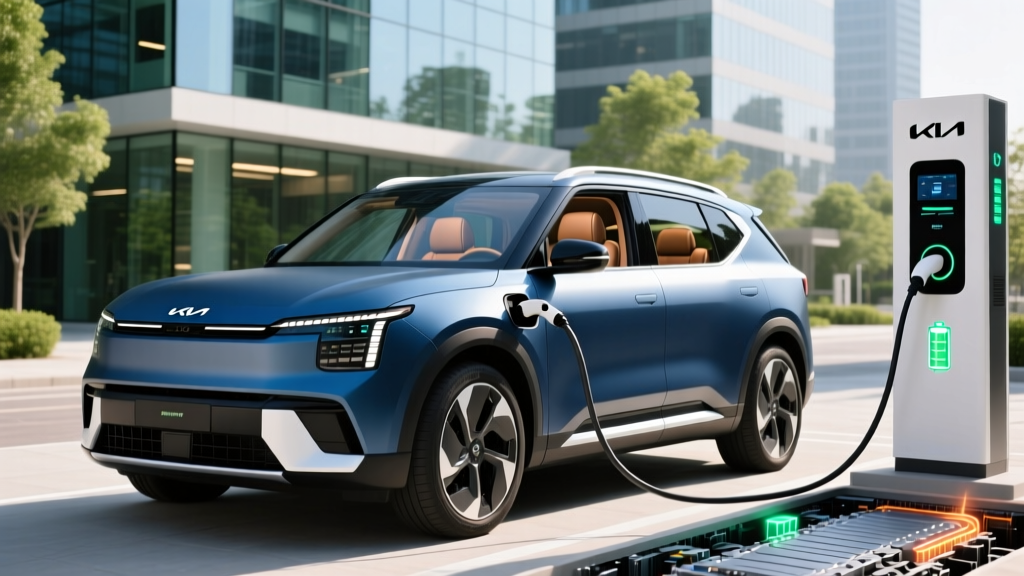
The Kia EV9 remains one of the few mainstream three-row electric SUVs that actually accommodates adults in every row. While competitors like the Tesla Model X and Rivian R1S push past $80,000, the EV9 starts under $55,000 and delivers usable range, fast charging, and genuine cargo versatility. This review covers every dimension buyers search for — from the flexible Kia EV9 seating configurations to real-world range, charging curves, and federal tax-credit eligibility under current IRS §30D rules.
Quick Verdict: Who the EV9 Is For
The EV9 fits families who need a daily-driver EV with room for six or seven, occasional 250-mile road trips, and Level 2 home charging. It does not suit buyers who need 400+ miles of range, frequent DC fast-charging in extreme cold without preconditioning, or third-row space for tall adults on long hauls. If your household runs two adults plus kids and cargo, the EV9's footprint and efficiency are hard to beat in this segment.
| Spec | Light RWD | Wind/Land AWD | GT-Line AWD |
|---|---|---|---|
| EPA Range | 304 mi | 270 mi | 270 mi |
| Battery (usable) | 76.1 kWh (LFP) | 99.8 kWh (NMC) | 99.8 kWh (NMC) |
| Horsepower | 215 hp | 379 hp | 379 hp |
| 0-60 mph | 7.7 sec | 5.0 sec | 4.5 sec (Boost) |
| Max DC Charge Rate | 150 kW | 210 kW | 210 kW |
| 10-80% DC Time | ~28 min | ~24 min | ~24 min |
| Level 2 Rate | 10.9 kW | 10.9 kW | 10.9 kW |
| EPA Efficiency | 89 MPGe (36 kWh/100mi) | 83 MPGe (40 kWh/100mi) | 83 MPGe |
| Base MSRP | $54,900 | $59,900 | $73,900 |
| Towing Capacity | 2,000 lb | 5,000 lb | 5,000 lb |
Kia EV9 Seating: Configurations and Interior Dimensions
Searches for "Kia EV9 seating" spike because the cabin layout is genuinely unusual for an EV. The EV9 offers two distinct configurations depending on trim:
- 7-passenger (2-3-2): Available on Light, Wind, and Land trims. Second-row bench splits 60/40 and slides fore/aft.
- 6-passenger (2-2-2): Standard on GT-Line, optional on Land. Second-row captain's chairs with a pass-through to the third row. Available with Relaxation mode (powered leg rests) on the front and second-row outboard seats.
| Measurement | Value |
|---|---|
| Headroom (F / 2nd / 3rd) | 40.9 / 39.4 / 37.3 in |
| Legroom (F / 2nd / 3rd) | 41.4 / 42.8 / 32.0 in |
| Cargo (behind 3rd / 2nd / 1st) | 20.2 / 43.5 / 81.7 cu ft |
| Front Trunk (frunk) | 1.8 cu ft (AWD) / 3.2 cu ft (RWD) |
The third row fits adults up to about 5'8" comfortably on short trips. For longer drives, children or shorter passengers are better suited back there. The 32 inches of third-row legroom trails the Rivian R1S (34.3 in) but beats the original Tesla Model X. Second-row legroom is class-leading at 42.8 inches with the bench slid rearward.
Range, Efficiency, and Real-World Expectations
The Light RWD with its 76.1 kWh LFP battery achieves an EPA-estimated 304 miles. The larger 99.8 kWh NMC pack in AWD trims carries more weight and less efficient dual motors, dropping the EPA figure to 270 miles.
Real-World Range Reality Check
EPA Sticker: 270 mi (AWD) / 304 mi (RWD)
Highway (70-75 mph, 68°F): Expect 230-250 mi (AWD), 260-280 mi (RWD)
Cold Weather (20-30°F, heater on): Expect 180-210 mi (AWD), 210-240 mi (RWD)
Towing (3,500 lb trailer): Range roughly halves to 120-140 mi
The EV9's boxy shape creates aerodynamic drag that hurts highway efficiency more than sleeker crossovers. Plan conservatively for road trips.
Efficiency lands at 83 MPGe combined for AWD and 89 MPGe for RWD per fueleconomy.gov. That translates to roughly 40 kWh per 100 miles (AWD) — reasonable for a 5,000+ lb SUV but thirstier than the Hyundai Ioniq 5 or Tesla Model Y.
Charging Speed: DC Fast and Home Level 2
The EV9's 800-volt architecture enables peak DC fast-charging rates up to 210 kW on long-range AWD models. The LFP Light RWD peaks lower at roughly 150 kW due to battery chemistry constraints.
| Charging Level | Power | Miles Added per Hour | Notes |
|---|---|---|---|
| Level 1 (120V household) | 1.4 kW | ~4 mi/hr | Emergency/top-off only |
| Level 2 (240V, 48A) | 10.9 kW | ~32 mi/hr | Full charge in ~9-10 hours |
| DC Fast (Light RWD peak) | 150 kW | ~350 mi/hr (peak) | 10-80% in ~28 min |
| DC Fast (AWD peak) | 210 kW | ~500 mi/hr (peak) | 10-80% in ~24 min |
Peak charge rates are not sustained. The AWD EV9 hits 210 kW briefly between 10-30% state of charge, then tapers to ~150 kW through 60%, and drops sharply above 80%. Real-world 10-80% sessions average 24-28 minutes on a 350 kW-capable Electrify America or Tesla Supercharger (with NACS adapter, now standard on 2026 models).
For home Level 2 charging, a 48-amp hardwired station on a 60-amp circuit delivers the full 10.9 kW. Expect roughly $600-$1,200 for a quality Level 2 unit (ChargePoint Home Flex, Emporia, or Wallbox) plus $800-$2,500 for electrician installation depending on panel proximity. A 200-amp panel upgrade adds $1,500-$3,000 if needed.
Performance and Drivetrain
The single-motor RWD Light trim prioritizes efficiency with 215 hp and a 7.7-second 0-60 time — adequate for commuting and merging but not exciting. Dual-motor AWD models (Wind, Land, GT-Line) bump output to 379 hp, cutting 0-60 to 5.0 seconds.
The GT-Line with Boost mode activated drops the 0-60 time to approximately 4.5 seconds, making it genuinely quick for a three-row SUV. Torque vectoring on AWD models improves cornering confidence, though the EV9's 5,100-lb curb weight is noticeable on twisty roads. Ride quality is composed, with well-damped suspension tuning that absorbs highway imperfections better than the stiffer Rivian R1S.
Pricing, Trims, and Federal Tax Credit Eligibility
Kia prices the EV9 across five trims. Destination charges add approximately $1,390 to all MSRP figures below.
| Trim | Base MSRP | §30D Credit Eligible? | Effective Price (if eligible) |
|---|---|---|---|
| Light RWD | $54,900 | Yes (MSRP < $80k) | ~$47,400 |
| Light Long Range RWD | $57,500 | Yes | ~$50,000 |
| Wind AWD | $59,900 | Yes | ~$52,400 |
| Land AWD | $65,400 | Yes | ~$57,900 |
| GT-Line AWD | $73,900 | Yes (MSRP < $80k SUV cap) | ~$66,400 |
Critical §30D caveats per IRS guidelines:
- Income caps: Modified AGI must not exceed $150,000 (single), $225,000 (head of household), or $300,000 (joint).
- MSRP cap: SUVs/vans must be under $80,000. All EV9 trims qualify.
- Battery sourcing: The credit amount (up to $7,500) depends on critical-mineral and battery-component sourcing requirements that change annually. The EV9's Georgia-built assembly helps, but battery cell sourcing determines the exact credit — $3,750 or $7,500. Check the latest IRS qualified vehicle list before purchasing.
- Point-of-sale transfer: As of 2024+, you can transfer the credit to the dealer for an immediate price reduction rather than waiting for tax filing.
Technology, Driver Assists, and Notable Drawbacks
The EV9 comes standard with a dual 12.3-inch panoramic display, wireless Apple CarPlay and Android Auto, and Kia's Highway Driving Assist 2 (HDA2) — a competent Level 2 driver-assist system with lane-centering, adaptive cruise, and lane-change assist. HDA2 requires hands-on-wheel supervision at all times; it is not autonomous driving.
Available features include a head-up display with augmented-reality navigation, digital key (NFC/UWB), remote smart parking assist, and vehicle-to-load (V2L) power output up to 3.6 kW — enough to run a campsite or provide emergency home backup for essentials.
Pros
- Best-in-class second-row legroom (42.8 in)
- 800V architecture enables 210 kW peak charging
- Standard V2L capability
- All trims under $80k MSRP cap for §30D credit
- 5,000-lb towing (AWD)
- Quiet, composed highway ride
Cons
- 32-in third-row legroom is tight for adults
- Boxy shape reduces highway range vs EPA
- No front trunk on AWD models (1.8 cu ft is negligible)
- LFP Light RWD charges slower (150 kW peak)
- Infotainment can lag with multiple apps open
- Insurance premiums run 15-25% above ICE equivalents
Competitor Comparison: EV9 vs Model X vs R1S
The EV9's closest rivals differ sharply in price and philosophy:
- Tesla Model X ($79,990+): More range (320-348 mi), faster Supercharger network access natively, but significantly pricier and aging interior.
- Rivian R1S ($75,900+): Better off-road capability, more third-row space, quad-motor performance option, but higher base price and limited DC charging network access.
- Hyundai Ioniq 9 (upcoming): Shares the E-GMP platform, expected similar specs, but not yet on sale.
The EV9 wins on value. No three-row EV undercuts it on price while offering comparable range, charging speed, and interior flexibility.
Warranty and Long-Term Ownership
Kia covers the EV9 with a 5-year/60,000-mile basic warranty and a 10-year/100,000-mile powertrain and battery warranty. The battery warranty guarantees at least 70% capacity retention over the coverage period, consistent with industry norms. For context, federal regulations mandate 8-year/100,000-mile battery coverage (10 years/150,000 in CARB states), and Kia exceeds the baseline in most states.
The NMC battery in long-range trims offers higher energy density but slightly faster degradation than the LFP pack in the Light RWD. LFP chemistry tolerates regular 100% charging without accelerated wear, making it ideal for daily commuters who charge nightly at home.
Frequently Asked Questions
What is the real-world range of the Kia EV9?
The EPA rates the AWD at 270 miles and RWD at 304 miles. In real-world highway driving at 70-75 mph, expect 230-250 miles from AWD and 260-280 from RWD. Cold weather (below 30°F) reduces range by 20-30%, dropping AWD to roughly 180-210 miles.
How fast does the EV9 charge at home and on the road?
At home on a 48-amp Level 2 station, the EV9 charges at 10.9 kW, adding roughly 32 miles per hour — a full charge takes 9-10 hours. On DC fast chargers, AWD models peak at 210 kW and reach 10-80% in about 24 minutes. The LFP Light RWD peaks at 150 kW and takes approximately 28 minutes for the same session.
How much does the EV9 cost after federal tax credits?
With the full $7,500 §30D credit (subject to income caps, MSRP limits, and battery-sourcing requirements), the Light RWD drops to approximately $47,400 and the Land AWD to roughly $57,900. Verify current credit eligibility on irs.gov before purchase, as sourcing rules update annually.
Is the Kia EV9 worth buying over the Tesla Model X or Rivian R1S?
If budget matters and you need three rows, yes. The EV9 undercuts both rivals by $15,000-$25,000 while delivering competitive range and charging speed. The Model X offers more range and Supercharger convenience; the R1S delivers superior off-road capability and third-row space. For most families, the EV9 hits the value sweet spot.
Does the EV9 qualify for the federal EV tax credit?
All EV9 trims fall under the $80,000 SUV MSRP cap and are assembled in Georgia, making them structurally eligible. However, the actual credit amount ($3,750 or $7,500) depends on battery-sourcing requirements that change yearly, and buyer income must not exceed IRS thresholds ($300,000 joint, $150,000 single). Consult a tax professional and check the IRS qualified vehicle list.
Does the Kia EV9 seating fit adults in the third row?
Adults up to about 5'8" can sit comfortably in the third row for short trips. The 32 inches of legroom and 37.3 inches of headroom are tight for taller passengers on long drives. Children and shorter adults are fine. For frequent full-capacity adult hauling, the Rivian R1S offers more third-row space.
Can the EV9 tow, and how does towing affect range?
AWD trims tow up to 5,000 pounds; RWD is limited to 2,000 pounds. Towing a 3,500-pound trailer roughly halves range to 120-140 miles. Plan short hops or route through DC fast chargers when towing.