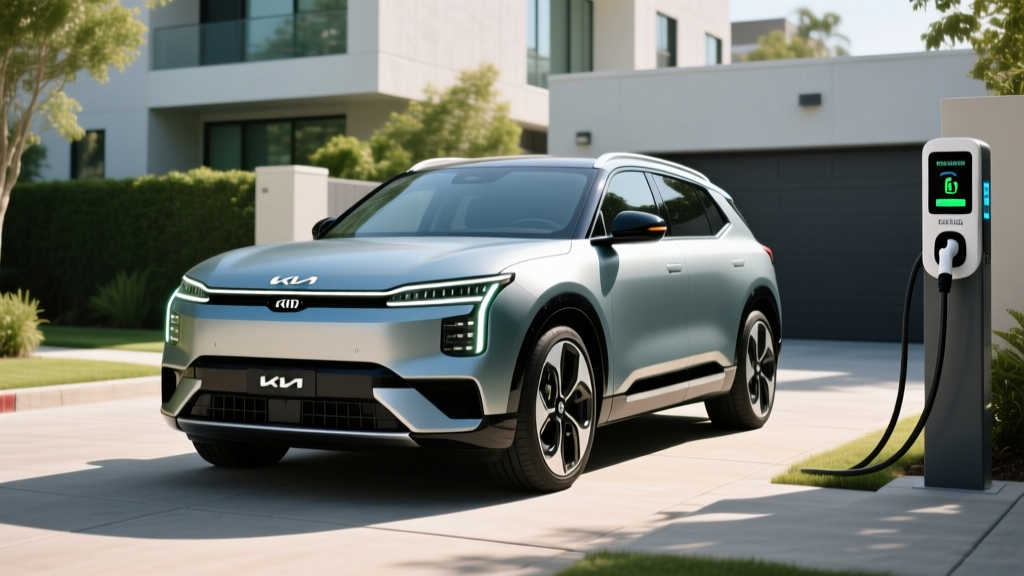
The Kia EV9 is the first mainstream three-row electric SUV priced under $60,000, but sticker price is only the beginning of the math. Between federal tax credits, state rebates, utility incentives, and the realities of insurance and depreciation, the actual five-year cost of owning an EV9 can swing by tens of thousands of dollars depending on where you live and how you charge. This guide breaks down every dollar — the savings and the premiums — so you can decide if the EV9 fits your budget beyond the showroom floor.
Kia EV9 at a Glance: 2026 Specs That Affect Your Wallet
Before we get to incentives, here are the numbers that anchor every ownership calculation. The 2026 Kia EV9 carries over the battery and powertrain architecture introduced for the 2024 model year, with minor software and efficiency updates.
| Spec | Light (RWD) | Wind / Land (AWD) | GT-Line (AWD) |
|---|---|---|---|
| Battery (usable) | 76.1 kWh (NMC) | 99.8 kWh (NMC) | 99.8 kWh (NMC) |
| EPA Range | 230 mi | 280 mi | 270 mi |
| Real-World Highway Range* | ~190 mi | ~235 mi | ~225 mi |
| MPGe (combined) | 90 MPGe | 85 MPGe | 83 MPGe |
| Peak DC Fast Charge | ~170 kW | ~210 kW | ~210 kW |
| 10–80% DC Fast Charge | ~24 min | ~20 min | ~20 min |
| Level 2 Charge Rate | 10.9 kW | 10.9 kW | 10.9 kW |
| Horsepower | 215 hp | 379 hp | 379 hp |
| 0–60 mph | 7.7 sec | 5.0 sec | 5.0 sec |
| Base MSRP | $54,900 | $59,900 | $73,900 |
| Battery/Powertrain Warranty | 10 yr / 100,000 mi | ||
*Real-world highway range estimated at 70 mph in 65°F conditions; expect 15–30% reduction in sub-freezing temperatures. Source: fueleconomy.gov and manufacturer data.
Federal Tax Credit: Do You Qualify for §30D on the EV9?
The federal Clean Vehicle Credit under IRS §30D offers up to $7,500 for qualifying new EVs. However, "up to" is doing heavy lifting — the EV9 must clear multiple hurdles, and your personal tax situation matters just as much as the vehicle's specs.
The $7,500 Credit Is Split Into Two Halves
Under current rules, the credit is composed of two independent $3,750 components:
- Critical Minerals Requirement ($3,750): A percentage of the battery's critical minerals must be extracted or processed in the U.S. or a free-trade-agreement country, or recycled in North America. The required percentage increases annually.
- Battery Components Requirement ($3,750): A percentage of battery components must be manufactured or assembled in North America. This threshold also increases annually.
If the EV9 satisfies only one requirement, you receive $3,750. If it satisfies both, you receive the full $7,500. If the battery contains components from a "foreign entity of concern" (FEOC), you receive $0 regardless of other qualifications. Kia sources batteries primarily from SK On, and sourcing compliance has shifted model year to model year — always verify the current-year status on the IRS qualified vehicles list before purchasing.
Your Income and the Purchase Must Also Qualify
- MSRP Cap: The EV9 is classified as an SUV/van, so the MSRP cap is $80,000. All current trims fall under this threshold.
- Buyer Income Cap (MAGI): $300,000 (married filing jointly), $225,000 (head of household), $150,000 (all other filers). You must fall under the cap in either the purchase year or the prior year.
- Vehicle Assembly: Final assembly must occur in North America. The EV9 is assembled at Kia's West Point, Georgia plant — this requirement is satisfied.
- Battery Sourcing: Must meet current-year critical mineral and component thresholds (see above — verify annually).
- Point-of-Sale Transfer: As of 2024, you can transfer the credit to the dealer at purchase, reducing your out-of-pocket cost immediately rather than waiting to claim it on your tax return. You must still meet income requirements when you file.
- One Credit Per VIN: Each vehicle can only receive the credit once.
Bottom line for EV9 buyers: The Light RWD trim at $54,900 and most AWD trims fall well within the $80,000 SUV cap. If you're below the income threshold and the battery sourcing qualifies in your purchase year, the full $7,500 brings the effective Light trim price to approximately $47,400 — a significant value for a three-row SUV. Always confirm current-year qualification at irs.gov and with your tax professional before signing.
State, Local, and Utility Rebates: Where You Live Changes Everything
The federal credit is only one layer. Depending on your zip code, additional incentives can stack to save you thousands more — or you may be in a state with no additional programs at all.
State and utility incentives vary enormously by jurisdiction and change frequently. The examples below are illustrative — always verify current programs through your state energy office, utility provider, and the Alternative Fuels Data Center.
- California (CVRP): Up to $7,000 for income-qualified buyers, stackable with federal credit. Some air-district programs add $2,500–$9,500 for residents in disadvantaged communities.
- Colorado: State tax credit of up to $5,000 for EVs with MSRP under $80,000, plus potential utility rebates from Xcel Energy or others.
- New York (Drive Clean Rebate): Point-of-sale rebate up to $2,000 based on income and vehicle price.
- Utility Rebates (varies): Many utilities offer $250–$1,500 rebates for purchasing an EV, plus additional rebates ($300–$1,000) for installing a Level 2 home charger. Examples include PG&E, ConEdison, Austin Energy, and others.
- Home Charger Tax Credits (§30C): Up to $1,000 (30% of cost) for residential EV charger installation, subject to income and census-tract eligibility.
In the best-case scenario (federal $7,500 + state $5,000 + utility $1,000 + charger credit $1,000), you could reduce your net EV9 cost by $14,500 or more. In states with no programs, you're relying on the federal credit alone.
Charging vs. Gas: The Per-Mile Cost Reality
The most-cited EV advantage is fuel savings, but the math depends entirely on how you charge. Here's a direct comparison using the EV9 AWD (85 MPGe combined) against a comparable gas three-row SUV averaging 22 MPG combined.
| Scenario | Cost per kWh / Gallon | Cost per Mile | Annual Cost (12,000 mi) |
|---|---|---|---|
| EV9 — Home Level 2 (national avg electricity) | $0.16/kWh | $0.051 | $612 |
| EV9 — Home Level 2 (off-peak TOU rate) | $0.09/kWh | $0.029 | $348 |
| EV9 — Public DC Fast Charging (avg) | $0.40/kWh | $0.128 | $1,536 |
| Gas SUV (22 MPG combined) | $3.40/gal | $0.155 | $1,860 |
Key takeaway: If you charge primarily at home on a standard residential rate, you'll spend roughly $600/year on electricity — about $1,250 less than the gas equivalent. If you use time-of-use rates and charge overnight, savings widen to ~$1,500/year. However, if you rely exclusively on public DC fast chargers at $0.35–$0.50/kWh, your "fuel" cost can approach or even exceed gas costs. The EV9's 99.8 kWh battery means a full DC fast-charge session from 10–80% at $0.40/kWh costs roughly $28 — about what you'd pay for 8 gallons of gas.
Home charging access is the single biggest determinant of EV operating economics. If you cannot install a Level 2 charger at home or work, run the public-charging numbers honestly before committing.
Maintenance Savings: What You Won't Pay For
EVs eliminate the recurring maintenance items that define gas-car ownership. The EV9 has no engine oil, no transmission fluid, no spark plugs, no exhaust system, and no timing belt. Regenerative braking significantly reduces brake pad and rotor wear — many EV owners report original brake pads lasting 80,000–100,000+ miles.
| Maintenance Item | Gas SUV (5-year cost) | Kia EV9 (5-year cost) |
|---|---|---|
| Oil changes (conventional/synthetic) | $350–$750 | $0 |
| Transmission fluid service | $150–$300 | $0 |
| Spark plugs | $200–$400 | $0 |
| Brake pads (front + rear) | $400–$800 | $0–$200 (regen extends life) |
| Engine air filter | $75–$150 | $0 |
| Cabin air filter | $100–$200 | $100–$200 |
| Tire rotation | $100–$200 | $100–$200 |
| Coolant service | $100–$200 | $0–$100 (longer intervals) |
| Total Estimated (5 years) | $1,475–$3,000 | $200–$700 |
Over five years and 60,000 miles, expect to save roughly $1,000–$2,300 on maintenance with the EV9. One caveat: EVs are heavier (the EV9 AWD weighs approximately 5,600 lbs), and that mass accelerates tire wear. Budget for a set of replacement tires at 30,000–45,000 miles — roughly $800–$1,400 for a set of four all-season tires sized for the EV9's 20- or 21-inch wheels.
Insurance Costs: The Premium You Should Expect
This is where EV ownership costs bite. Insurance premiums for the Kia EV9 are typically 15–30% higher than for a comparably priced gas SUV, and there are concrete reasons why:
- Higher repair costs: EV battery packs and power electronics are expensive to replace after a collision. Even minor rear-end damage can total a vehicle if the high-voltage battery enclosure is compromised.
- Specialized labor: Fewer body shops are certified for high-voltage system repairs, increasing labor rates and repair times.
- Vehicle weight: The EV9's ~5,600-lb curb weight increases collision energy, raising liability and physical-damage premiums.
- Parts availability: EV-specific components (battery modules, inverters, heat-pump assemblies) can have longer lead times than commodity gas-car parts.
Based on national averages and insurer data aggregators, expect annual premiums for the EV9 to fall in the $1,800–$2,600 range for a driver with a clean record and good credit, varying significantly by state, zip code, and coverage level. That's roughly $300–$700 more per year than a gas Kia Telluride at a similar MSRP.
What to do: Get quotes from at least three insurers before purchasing. Some carriers offer EV-specific discounts (e.g., for home charging or ADAS features like the EV9's Highway Driving Assist 2). Bundling home and auto, raising your deductible, and maintaining a clean driving record can narrow the gap.
Depreciation and Resale Value: The Honest Picture
EV depreciation has been a moving target. In 2023–2024, aggressive price cuts by Tesla and others dragged down used EV values industry-wide. By 2025–2026, the market has stabilized somewhat, but EVs as a category still tend to depreciate faster than popular gas SUVs in the first three years.
For the Kia EV9 specifically:
- 3-year projected retention: ~48–55% of original MSRP (varies by trim and market conditions)
- 5-year projected retention: ~35–42% of original MSRP
- Comparison — Kia Telluride (gas): ~55–62% at 3 years, ~42–50% at 5 years
Several factors work in the EV9's favor: Kia's strong 10-year/100,000-mile battery warranty (transferable to the second owner), the vehicle's segment uniqueness as an affordable three-row EV, and growing consumer familiarity with EVs. Factors working against it include rapid battery technology improvement (making older EVs feel outdated faster), uncertainty about long-term battery replacement costs, and the fact that federal tax credits effectively lower the "real" purchase price, which compresses resale values.
If you bought the EV9 Light at $54,900 and claimed the $7,500 federal credit (net cost: $47,400), a 5-year resale value of $19,000–$22,000 represents depreciation of roughly $25,400–$28,400 — or about $5,100–$5,700 per year. Compare that against the gas alternative's depreciation and the fuel/maintenance savings to see where the breakeven falls.
Total 5-Year Cost of Ownership: EV9 vs. Gas Three-Row SUV
Here's the full picture, comparing the Kia EV9 Wind AWD ($59,900 MSRP) against a comparably equipped gas SUV at $52,000 MSRP (such as a mid-trim Kia Telluride or Hyundai Palisade), assuming 12,000 miles/year, mostly home charging, and a 5-year ownership period.
| Cost Category | Kia EV9 Wind AWD | Gas SUV ($52,000 MSRP) |
|---|---|---|
| Purchase Price (MSRP) | $59,900 | $52,000 |
| Federal Tax Credit | −$7,500 (if qualified) | $0 |
| State/Utility Rebates (est. avg) | −$2,000 | $0 |
| Net Purchase Cost | $50,400 | $52,000 |
| Fuel / Electricity (5 years) | $3,060 (home avg) | $9,300 |
| Maintenance (5 years) | $500 | $2,200 |
| Insurance (5 years) | $11,000 | $8,500 |
| Home Charger Install (Level 2) | $800–$2,000 | $0 |
| Total Out-of-Pocket (5 yr) | $65,760–$66,960 | $72,000 |
| Estimated Resale Value (Year 5) | $22,000 | $24,000 |
| Net 5-Year Cost (after resale) | $43,760–$44,960 | $48,000 |
The verdict: When you qualify for the full federal credit and have home charging access, the EV9's 5-year net cost of ownership can be $3,000–$4,200 lower than a comparable gas SUV — even with higher insurance and faster depreciation. The savings are almost entirely driven by fuel and maintenance reductions. Remove the federal credit (due to income caps or battery sourcing changes) or rely on public charging exclusively, and the math can flip in the gas SUV's favor.
Frequently Asked Questions
How much does it really cost to own a Kia EV9 over 5 years?
With the full $7,500 federal tax credit, average state incentives, and mostly home charging, expect a net 5-year cost (purchase + operating costs minus resale value) of approximately $44,000–$45,000 for the Wind AWD trim. Without the federal credit or with heavy public-charging reliance, that figure can rise to $50,000–$53,000.
Do I qualify for the $7,500 federal tax credit on the EV9?
You may, but it depends on three things: (1) your modified adjusted gross income must be under $150,000 (single), $225,000 (head of household), or $300,000 (joint); (2) the EV9's MSRP must be under $80,000 (all trims currently qualify); and (3) the battery must meet current-year critical-mineral and component-sourcing requirements. Verify the EV9's sourcing qualification on the IRS qualified-vehicles list for your purchase year. The credit can be transferred to the dealer at point of sale for an immediate price reduction.
How much do I save on fuel and maintenance with the EV9?
With home charging at the national average electricity rate ($0.16/kWh), expect to spend about $612/year on electricity versus $1,860/year on gas for a comparable 22-MPG three-row SUV — a savings of roughly $1,250/year or $6,250 over five years. Maintenance savings add another $1,000–$2,300 over five years, primarily from eliminated oil changes, transmission service, and extended brake life from regenerative braking.
Are EVs like the EV9 more expensive to insure?
Yes, typically 15–30% more than comparably priced gas SUVs. Higher repair costs for battery and power-electronics damage, specialized labor requirements, and the EV9's substantial curb weight all contribute. Expect annual premiums of $1,800–$2,600 depending on your location, driving record, and coverage. Get quotes before purchasing to avoid surprises.
How well does the Kia EV9 hold its value?
Current projections estimate the EV9 will retain approximately 35–42% of its MSRP after five years, which is somewhat below segment-leading gas SUVs like the Telluride (42–50%) but competitive within the EV category. Kia's transferable 10-year/100,000-mile battery warranty provides a resale-value floor that many competitors lack. Depreciation is the largest single ownership cost for any vehicle — EV or gas.
What happens if battery sourcing rules change and the EV9 loses credit eligibility?
The §30D battery-sourcing thresholds increase annually, and vehicles that qualify one year may not the next (and vice versa as supply chains adjust). If the EV9 loses eligibility in your purchase year, your net purchase cost rises by $3,750–$7,500. This is why you should verify qualification as close to your purchase date as possible and factor the credit as a bonus rather than a guarantee in your budget planning.