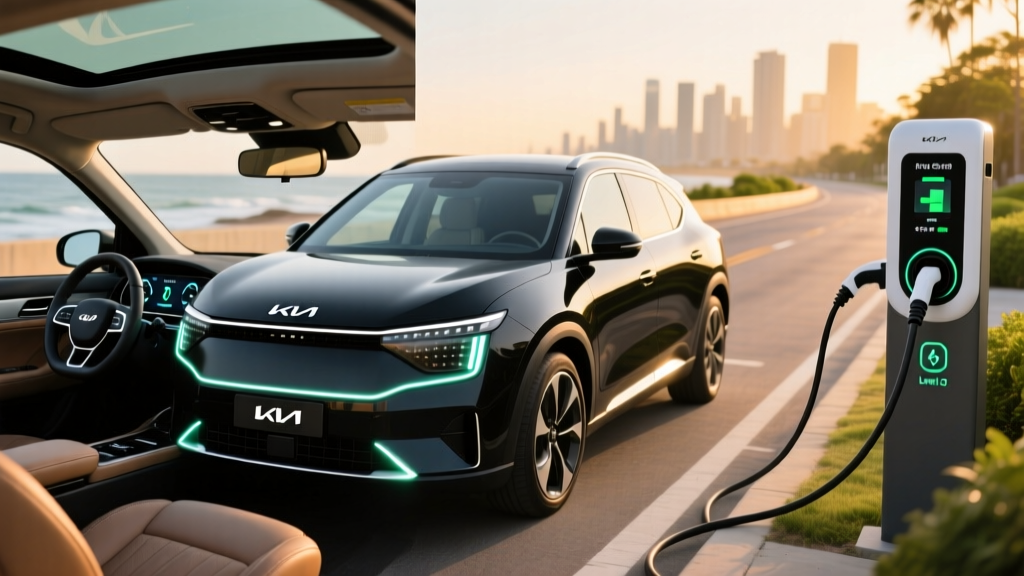
Quick Verdict: What the Kia EV9 Offers Family EV Buyers
The three-row electric SUV segment has expanded rapidly, but the Kia EV9 remains one of the few models that combines genuine adult-sized third-row seating with competitive range and fast charging. For 2026, the EV9 continues on the Hyundai Motor Group's E-GMP platform with a 100.0 kWh (usable) battery pack, up to 304 miles of EPA-estimated range in rear-wheel-drive form, and peak DC fast-charging speeds of 210 kW. Pricing starts around $56,395 for the base Light RWD trim and climbs past $75,000 for the fully loaded GT-Line AWD — placing it squarely against the Rivian R1S, Tesla Model X, and the Hyundai Ioniq 9.
The headline question for most shoppers: what does the Kia EV9 offer that its rivals don't? The answer centers on interior practicality, 800-volt charging architecture, and Kia's generous warranty. But real-world range, tax-credit eligibility, and a few tech frustrations deserve a closer look before you sign.
Range, Efficiency, and Real-World Expectations
EPA Estimate: 304 miles (Light/Long Range RWD) | 270 miles (AWD trims)
Real-World Expectation: ~245–275 miles on highway-heavy trips at 70–75 mph; ~210–240 miles in freezing weather with cabin heat. City and suburban driving with regen braking can match or slightly exceed the EPA sticker.
The EV9's efficiency varies significantly by drivetrain and wheel size. The RWD Long Range models achieve an EPA-estimated 88 MPGe combined (roughly 38 kWh/100 miles), while the dual-motor AWD versions drop to approximately 83 MPGe combined. If you opt for the GT-Line's 21-inch wheels, expect a further 5–8% reduction in range versus the 20-inch setup.
In our experience with E-GMP-platform vehicles, the 100.0 kWh usable battery provides a reliable buffer for daily driving. A 250-mile round-trip commute is easily manageable without mid-day charging in moderate weather. However, towing — rated at up to 5,000 lbs for AWD trims — will slash range by 30–40%, bringing real-world towing range down to roughly 150–170 miles. Plan your charging stops accordingly.
| Spec | RWD Long Range | AWD | AWD (GT-Line 21") |
|---|---|---|---|
| EPA Range | 304 mi | 270 mi | ~255 mi (est.) |
| MPGe Combined | 88 MPGe | 83 MPGe | ~80 MPGe |
| kWh/100 mi | 38 | 41 | ~42 |
| Battery (Usable) | 100.0 kWh | 100.0 kWh | 100.0 kWh |
Source: fueleconomy.gov
Battery Chemistry, Charging Speeds, and the 800V Advantage
The EV9 uses an NMC (nickel-manganese-cobalt) lithium-ion battery pack with a gross capacity of approximately 100.0 kWh usable. Kia has not switched to LFP chemistry for the EV9, meaning you get higher energy density (critical for a vehicle this large) but should follow the 80% daily charge limit recommendation for longevity. LFP batteries can sit at 100% without the same degradation concerns, but NMC's range advantage in a 5,000-lb SUV is the practical trade-off.
| Charging Level | Power / Rate | Speed (Approx.) | Notes |
|---|---|---|---|
| Level 1 (120V) | 1.4 kW | ~4 mi/hr | Emergency / trickle only |
| Level 2 (240V, 48A) | 11.5 kW | ~32 mi/hr | Full charge in ~9.5 hours |
| DC Fast Charge | Peak 210 kW | 10–80% in ~24 min | 800V architecture; tapers above 80% |
The 800-volt electrical architecture is one of the EV9's strongest technical assets. On a 350 kW Electrify America or Ionity station, the EV9 sustains above 150 kW through much of the 10–60% state-of-charge window before tapering. The 10–80% time of approximately 24 minutes is competitive with the best in class. However, as with all EVs, charging above 80% slows dramatically — expect the final 20% to take an additional 25–30 minutes. For road trips, the 10–80% sprint is the number that matters.
For home charging, the 11.5 kW onboard charger means a Level 2 wall connector on a 60-amp circuit adds roughly 32 miles of range per hour. Most owners will plug in overnight and wake up with a full battery. Installation costs for a 240V Level 2 home charger typically run $800–$2,000 depending on your electrical panel's capacity — budget for a potential panel upgrade if you're running a 100-amp service.
Performance, Drivetrain, and Ride Quality
The EV9's powertrain options are straightforward:
- RWD (Long Range): 201 hp, single rear motor, 0–60 mph in ~8.2 seconds
- AWD: 379 hp, dual-motor, 0–60 mph in ~5.0 seconds
- AWD (GT-Line with boost): 379 hp + boost function, 0–60 mph in ~4.7 seconds
The AWD model's 5.0-second sprint is genuinely quick for a three-row SUV weighing over 5,500 lbs. More importantly for daily driving, the dual-motor setup provides confident highway merging and all-weather traction. The RWD model is adequate for commuting but feels its weight when fully loaded with passengers and cargo.
Ride quality is a highlight. The EV9's long wheelbase (122.0 inches) and well-tuned suspension absorb most road imperfections, and cabin noise levels at highway speed are impressively low. The steering is light and not particularly communicative — this is a comfort-oriented cruiser, not a sport SUV. If you want dynamic handling, the Rivian R1S quad-motor setup is the more engaging choice.
Interior Space, Cargo, and Three-Row Practicality
Where the EV9 truly separates itself from mid-size electric SUVs is interior volume. This is a genuine three-row vehicle with dimensions that rival mid-size ICE SUVs:
- Front headroom: 40.0 inches | Legroom: 41.4 inches
- Second-row headroom: 39.0 inches | Legroom: 42.8 inches (captain's chairs)
- Third-row headroom: 37.8 inches | Legroom: 32.0 inches
- Cargo behind 3rd row: 20.2 cu ft
- Cargo behind 2nd row: 43.5 cu ft
- Cargo behind 1st row (max): 81.7 cu ft
The third row accommodates adults on shorter trips — a meaningful advantage over competitors like the Tesla Model Y, which offers a cramped third-row option only suitable for children. Second-row captain's chairs (available on higher trims) include available heated and ventilated cushions, and some trims offer Kia's "Relaxation" seats that recline with a leg rest for charging-stop comfort.
A small front trunk (frunk) is available on RWD models, providing approximately 1.8 cu ft of additional storage. AWD models forgo the frunk to house the front motor.
Pricing, Trims, and Federal Tax Credit Eligibility
| Trim | Drivetrain | Base MSRP | Est. After §30D Credit* |
|---|---|---|---|
| Light | RWD | $56,395 | $48,895 |
| Wind | RWD | $60,695 | $53,195 |
| Land | AWD | $65,395 | $57,895 |
| GT-Line | AWD | $73,895 | $66,395 |
*Federal tax credit estimates shown assume full $7,500 eligibility. Actual credit depends on IRS §30D requirements.
- MSRP Cap: SUVs must have an MSRP at or below $80,000. All current EV9 trims qualify.
- Buyer Income Cap: AGI must not exceed $300,000 (married filing jointly), $225,000 (head of household), or $150,000 (single).
- Battery Sourcing: Critical minerals and battery components must meet phased-in sourcing thresholds. Kia has worked to localize supply chains, but the exact credit amount ($3,750 or $7,500) depends on current-year sourcing compliance.
- Point-of-Sale Transfer: Eligible buyers can transfer the credit to the dealer at purchase, reducing the purchase price directly.
- Verify before buying: Check the latest eligibility at fueleconomy.gov and consult a tax professional.
Kia also offers a competitive ownership package: the EV9 includes 3 years of complimentary DC fast charging at Electrify America (1,000 kWh total on select trims) and Kia Connect remote services for the first year.
Technology, Driver Assistance, and Notable Drawbacks
The EV9 comes equipped with a dual 12.3-inch display setup (instrument cluster and infotainment), wireless Apple CarPlay and Android Auto, and Kia's latest connected-car platform with over-the-air updates. Higher trims add a head-up display with augmented-reality navigation and a digital rearview mirror.
Driver assistance falls under Kia's Highway Driving Assist 2 (HDA2), a Level 2 system that includes adaptive cruise control with stop-and-go, lane-centering, and automated lane changes when the driver confirms with the turn signal. Per SAE automation definitions, this is a driver-support system — you must keep your hands on the wheel and eyes on the road at all times. It is not self-driving.
Notable drawbacks worth flagging:
- The capacitive-touch climate controls and gloss-black center console attract fingerprints and lack the tactile feedback of physical buttons.
- The infotainment system's response time is occasionally sluggish compared to Tesla or Rivian interfaces.
- No native NACS port on early production models — a CCS1-to-NACS adapter is included for Tesla Supercharger access, and Kia has committed to native NACS on future model years.
- Third-row access requires a two-step fold-and-slide of the second row, which is less elegant than some competitors' one-touch mechanisms.
Warranty Coverage and Long-Term Ownership
Kia's warranty remains one of the strongest in the industry and a key reason the EV9 appeals to risk-averse buyers:
- Battery: 10 years / 100,000 miles (capacity retention above 70%)
- Powertrain: 10 years / 100,000 miles
- Bumper-to-bumper: 5 years / 60,000 miles
- Roadside assistance: 5 years / 60,000 miles
The 10-year battery warranty exceeds the federal minimum of 8 years/100,000 miles and provides meaningful peace of mind for a vehicle with a $56,000+ starting price. Long-term NMC battery degradation data from E-GMP platform vehicles (Ioniq 5, EV6) suggests approximately 8–12% capacity loss over the first 100,000 miles with normal use — well within Kia's 70% retention threshold.
Pros, Cons, and Who Should Buy the EV9
- Genuine 3-row seating with adult-usable third row
- 800V architecture enables ~24 min 10–80% DC charging
- 304-mi EPA range (RWD) is strong for a 3-row EV SUV
- Class-leading 10-yr/100,000-mi battery warranty
- Quiet, comfortable highway ride quality
- 5,000-lb towing capacity (AWD)
- Starting price above $56K — premium segment territory
- Infotainment responsiveness lags behind top competitors
- CCS1 port requires adapter for Tesla Supercharger access
- Real-world range drops significantly when towing or in cold
- RWD model feels underpowered for the vehicle's weight
- Gloss-black interior trim is a fingerprint magnet
- Choose the EV9 if: You need a true three-row electric SUV with adult passengers in all seats, value fast 800V charging for road trips, and want the security of a 10-year battery warranty.
- Look elsewhere if: You only need two rows (the Ioniq 5 or EV6 offer better value), you prioritize sporty driving dynamics (Rivian R1S), or your budget caps below $50,000.
Frequently Asked Questions
What is the real-world range of the Kia EV9?
The EPA estimates 304 miles for the RWD Long Range and 270 miles for AWD trims. In real-world highway driving at 70–75 mph, expect 245–275 miles. In freezing temperatures, plan for 210–240 miles due to cabin heating demands and reduced battery efficiency.
How fast does the EV9 charge at home and on the road?
On a Level 2 home charger (240V, 48A), the EV9 charges at up to 11.5 kW, adding roughly 32 miles per hour for a full overnight charge. On a DC fast charger, it peaks at 210 kW and reaches 10–80% in approximately 24 minutes on a 350 kW-capable station.
Does the Kia EV9 qualify for the federal EV tax credit?
As of the current tax year, the EV9 qualifies for up to $7,500 under IRS §30D, subject to buyer income limits ($150K single / $300K joint), the $80K SUV MSRP cap (all trims qualify), and battery critical-mineral sourcing compliance. Eligibility can change — verify at irs.gov before purchasing. Point-of-sale transfer to the dealer is available for eligible buyers.
Is the Kia EV9 worth buying over the Rivian R1S or Tesla Model X?
The EV9 wins on warranty coverage, third-row accessibility, and starting price. The Rivian R1S offers superior off-road capability and more engaging driving dynamics but starts higher and has a smaller service network. The Tesla Model X provides faster charging and the Supercharger network natively but costs significantly more and has a less practical third row. For mainstream family use, the EV9 is the most balanced option.
What are the biggest pros and cons?
Top pros: adult-sized third row, 304-mi range, 800V fast charging, 10-year battery warranty. Top cons: premium pricing, CCS1 port (adapter needed for NACS), infotainment lag, significant range loss when towing or in extreme cold.