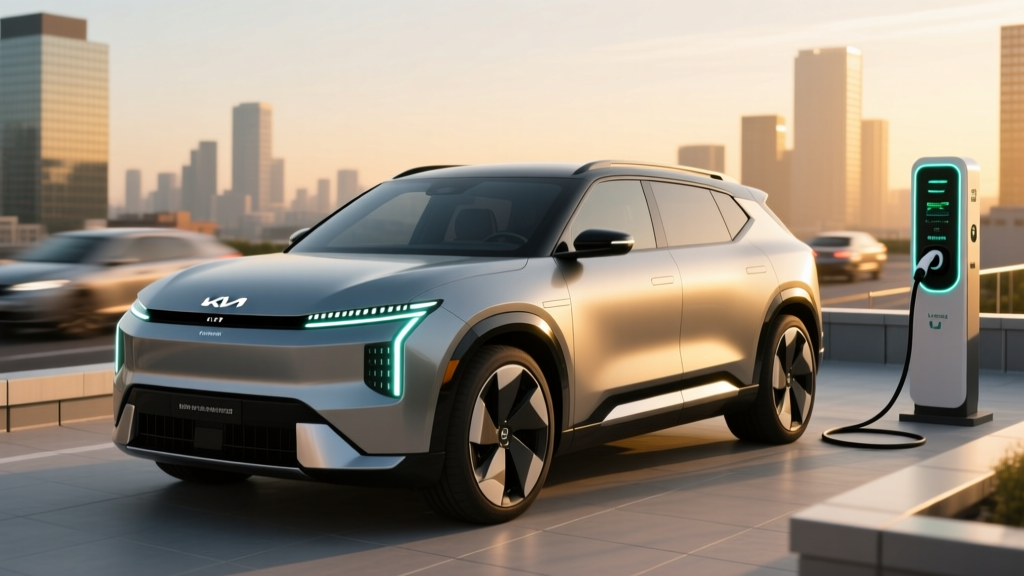
Quick Verdict: The EV9 Redefines the Electric Family Hauler
If you've been searching for a three-row electric SUV that doesn't compromise on interior volume, the Kia EV9 remains the benchmark entering the 2026 model year. Built on Hyundai Motor Group's E-GMP platform with an 800-volt electrical architecture, the EV9 delivers rapid DC fast charging, usable third-row space, and a footprint that commands attention. But the question many buyers ask before pulling into a garage is practical: will it actually fit?
This review breaks down every dimension — starting with the Kia EV9 length — alongside real-world range data, charging performance, pricing, and federal tax credit eligibility under current IRS §30D rules. We'll also address where the EV9 excels and where competitors like the Rivian R1S or Tesla Model X might serve you better.
Dimensions & Design: Kia EV9 Length, Width, and Cargo Capacity
The 2026 Kia EV9's exterior dimensions place it firmly in full-size SUV territory. Here's what you're working with:
| Dimension | Measurement |
|---|---|
| Overall Length | 197.4 inches |
| Wheelbase | 122.0 inches |
| Overall Width (excl. mirrors) | 77.9 inches |
| Overall Height | 70.1 inches (70.5 in. GT-Line) |
| Ground Clearance | 7.8 inches |
| Curb Weight (AWD Land) | ~5,500 lbs |
The EV9 length of 197.4 inches is roughly 6 inches longer than a Kia Telluride and comparable to a Volvo XC90. That wheelbase — 122 inches — is where the interior magic happens, pushing wheels to the corners and freeing up cabin volume that a shorter-overhang ICE SUV can't match.
Cargo & Passenger Space
| Area | Measurement |
|---|---|
| Cargo (behind 3rd row) | 20.2 cu ft |
| Cargo (3rd row folded) | 43.5 cu ft |
| Cargo (all rear rows folded) | 81.7 cu ft |
| Front Legroom | 41.5 in |
| 2nd-Row Legroom | 42.8 in |
| 3rd-Row Legroom | 32.0 in |
| Front Headroom | 40.5 in |
The 20.2 cu ft behind the third row is tight for a week-long family road trip with six passengers, but it handles groceries and strollers fine. Fold the third row and you get 43.5 cu ft — enough for four suitcases and camping gear. The available second-row captain's chairs (standard on Land and above) sacrifice one seat but dramatically improve access and comfort.
The EPA rates the 2026 EV9 Light RWD at 304 miles and the AWD Land at 270 miles. In real-world highway driving at 70-75 mph with climate control on, expect 230–255 miles from the AWD trims. In sub-30°F winter conditions, that can drop to 195–220 miles without preconditioning. Use the heat pump (standard on all trims) and battery preconditioning to minimize cold-weather losses.
Range, Battery & Efficiency
The 2026 EV9 continues with two battery configurations carried over from the platform's debut:
| Trim | Battery (usable) | Chemistry | Drivetrain | EPA Range | MPGe (combined) |
|---|---|---|---|---|---|
| Light (Standard Range) | 76.1 kWh | NMC | RWD | 230 mi | 88 MPGe |
| Light / Wind / Land (Long Range RWD) | 99.8 kWh | NMC | RWD | 304 mi | 88 MPGe |
| Wind / Land / GT-Line (AWD) | 99.8 kWh | NMC | Dual-Motor AWD | 270–280 mi | 85 MPGe |
Kia uses NMC (nickel-manganese-cobalt) chemistry across the lineup, which delivers higher energy density than LFP but requires more careful thermal management. The 99.8 kWh usable pack (roughly 102.5 kWh gross) is one of the largest in the segment, and that capacity shows up on long highway stretches where the EV9's boxy aerodynamics work against it.
Efficiency lands around 34–36 kWh per 100 miles for AWD trims in mixed driving — thirstier than a Tesla Model X but expected given the EV9's frontal area and weight. If efficiency is your top priority, the RWD Wind trim is the sweet spot.
Charging Performance: DC Fast & Home Level 2
The EV9's 800-volt E-GMP architecture is its strongest ownership asset. Here's what charging looks like across all three levels:
| Charging Level | Power | Speed / Time |
|---|---|---|
| Level 1 (120V household) | ~1.4 kW | ~3–4 miles per hour |
| Level 2 (240V home/public) | 10.9 kW (max onboard) | ~30–35 miles per hour; full charge ~10 hrs |
| DC Fast Charge (CCS/NACS) | Up to 236 kW peak | 10–80% in ~24 min (99.8 kWh pack) |
Charging curve reality: The EV9 peaks at 236 kW on a 350 kW-capable charger, but that rate only sustains roughly from 10% to 45% State of Charge. From 45–80%, the rate tapers to 120–160 kW, and above 80% it drops sharply to protect battery health. A realistic 10–80% session takes about 24 minutes at a properly rated station. On a 150 kW charger, plan for 35–40 minutes.
For 2026, Kia continues to equip the EV9 with the NACS (Tesla-style) charge port on new-production vehicles, granting native access to the Tesla Supercharger network without an adapter — a significant advantage over CCS-only competitors. Always confirm port type at purchase, as early 2024–2025 models shipped with CCS1.
Home Level 2 charging at 10.9 kW means a full overnight recharge in roughly 10 hours on a 48-amp hardwired EVSE connected to a 60-amp circuit. Budget $800–$1,800 for professional installation depending on panel proximity and whether your home needs a service upgrade.
Performance & Drivetrain
| Trim/Config | Horsepower | Torque | 0–60 mph | Drivetrain |
|---|---|---|---|---|
| Light Standard Range (RWD) | 215 hp | 258 lb-ft | 7.7 sec | RWD |
| Light/Wind/Land Long Range (RWD) | 201 hp | 258 lb-ft | 8.2 sec | RWD |
| Wind/Land/GT-Line (AWD) | 379 hp | 516 lb-ft | 4.5 sec | Dual-Motor AWD |
The AWD dual-motor setup is the one to get if you tow, drive in snow, or simply want effortless highway merging. The 4.5-second 0–60 time in a 5,500-lb three-row SUV is genuinely quick. The RWD models feel adequate around town but show their weight when fully loaded on uphill freeway on-ramps.
Towing capacity reaches 4,500 lbs on AWD trims with the factory tow package — enough for a small camper or dual-axle utility trailer. RWD trims are rated at 2,000 lbs. Keep in mind that towing at capacity will cut your range roughly in half.
Pricing, Trims & Federal Tax Credit Eligibility
| Trim | MSRP (est.) | Drivetrain | Key Features |
|---|---|---|---|
| Light Standard Range | $56,395 | RWD | Base tech, 230-mi range |
| Light Long Range | $59,995 | RWD | 304-mi range, heated seats |
| Wind | $63,995 | RWD or AWD | 3rd-row USB-C, premium audio |
| Land | $69,995 | AWD | Captain's chairs, dual 12.3" displays |
| GT-Line | $73,995 | AWD | Sport styling, boost function, HUD |
Does the EV9 Qualify for the Federal EV Tax Credit?
Under current IRS §30D rules, the EV9's eligibility for the up-to-$7,500 federal tax credit depends on three key criteria, and this is where the EV9 faces challenges:
- MSRP Cap: SUVs must be under $80,000. All EV9 trims clear this threshold.
- Buyer Income Cap: Modified AGI must not exceed $300,000 (joint), $225,000 (head of household), or $150,000 (single).
- Battery Sourcing Requirements: Critical minerals and battery components must meet escalating domestic-sourcing thresholds. As of 2026, the EV9's South Korean-built battery cells face partial disqualification under the foreign-entity-of-concern (FEOC) rules, meaning many trims qualify for $3,750 (half credit) rather than the full $7,500.
Beginning January 1, 2026, buyers can transfer the credit to the dealer at point of sale, reducing the purchase price directly — no need to wait for a tax refund. Always verify current eligibility at IRS.gov and confirm with your tax professional before purchasing, as sourcing rules tighten annually.
Warranty Coverage
Kia backs the EV9 with its industry-leading warranty package:
- Basic: 5 years / 60,000 miles
- Powertrain: 10 years / 100,000 miles
- Battery: 10 years / 100,000 miles (capacity retention above 70%)
The 10-year battery warranty with a 70% retention threshold is among the most generous in the segment and should ease long-term ownership concerns.
Technology, Safety & Driver Assistance
The EV9's tech suite is comprehensive across all trims:
- Dual 12.3-inch panoramic displays (instrument cluster + infotainment)
- Wireless Apple CarPlay and Android Auto
- Highway Driving Assist 2 (HDA2) — SAE Level 2 driver assistance with lane-centering, adaptive cruise, and lane-change assist
- Remote Smart Parking Assist (on Land and GT-Line)
- Digital Key 2 (phone-as-key via NFC/UWB)
- Available head-up display with augmented-reality navigation (GT-Line)
- Vehicle-to-Load (V2L) — power devices or a home during outages via the charge port or interior outlet
Highway Driving Assist 2 is an SAE Level 2 system. It requires the driver to keep hands on or near the wheel and remain fully attentive at all times. It is not self-driving and does not navigate complex urban environments autonomously. Always maintain situational awareness.
Safety ratings are strong. The EV9 earned the IIHS Top Safety Pick+ designation and a 5-star overall rating from NHTSA.
Pros, Cons & Who Should Buy the EV9
Pros
- Genuine 3-row usability with adult-capable third row
- 800V architecture enables 10–80% DC charging in ~24 min
- 10-year/100,000-mi battery warranty
- Class-leading 122-inch wheelbase maximizes interior volume
- V2L capability for camping and backup power
- NACS port (2026 production) for native Supercharger access
Cons
- AWD real-world highway range falls short of EPA sticker
- Federal tax credit limited to $3,750 on most trims due to battery sourcing
- Boxy shape hurts efficiency at highway speeds (~35 kWh/100mi)
- RWD trims feel underpowered when fully loaded
- Third-row cargo space (20.2 cu ft) is tight for long trips with 6 passengers
- No frunk (front trunk) — E-GMP packaging uses that space for HVAC components
Who Is the EV9 For?
Choose the EV9 if: You need three rows for regular passenger duty, want fast DC charging for road trips, value the 10-year warranty, and have home Level 2 charging access. The Land AWD trim is the best all-around pick.
Look elsewhere if: You prioritize maximum range over seating capacity (consider the Tesla Model X or Rivian R1S Dual-Motor Max), you need a frunk for gear, or your budget can't stretch past $50,000 before incentives.
How the EV9 Stacks Up Against Competitors
| Spec | Kia EV9 Land AWD | Rivian R1S Dual-Motor | Tesla Model X LR |
|---|---|---|---|
| EPA Range | 270 mi | ~340 mi (Max Pack) | 335 mi |
| Length | 197.4 in | 200.8 in | 199.1 in |
| Peak DC Charge | 236 kW | ~220 kW | 250 kW |
| 0–60 mph | 4.5 sec | 4.5 sec | 3.8 sec |
| Starting MSRP | $69,995 | ~$79,900 | ~$79,990 |
| Battery Warranty | 10 yr/100k mi | 8 yr/175k mi | 8 yr/150k mi |
The EV9 undercuts both the R1S and Model X by roughly $10,000 at comparable trim levels while offering competitive charging speeds and better warranty coverage. The trade-off is less real-world range and lower efficiency. For buyers who charge at home nightly and take road trips a few times a year, the EV9's value proposition holds up well. See fueleconomy.gov for official EPA efficiency comparisons.
Frequently Asked Questions
What is the exact Kia EV9 length and will it fit in a standard garage?
The 2026 EV9 measures 197.4 inches long (16.45 feet). A standard two-car garage is typically 20–24 feet deep, so the EV9 fits with room to spare — but measure your garage door opening height too, as the EV9 stands 70.1 inches tall (70.5 for GT-Line), which clears most 7-foot residential doors with just inches to spare.
What is the real-world range of the Kia EV9 AWD?
The EPA rates the AWD EV9 at 270–280 miles depending on trim and wheel size. In real-world highway driving at 70–75 mph in moderate temperatures, expect 230–255 miles. In cold weather (below 30°F), plan for 195–220 miles unless you precondition the battery while plugged in.
How fast does the EV9 charge at home and on the road?
At home on a Level 2 (240V/48A) charger, the EV9 adds roughly 30–35 miles of range per hour, fully recharging the 99.8 kWh pack in about 10 hours. On a 350 kW DC fast charger, it peaks at 236 kW and charges from 10–80% in approximately 24 minutes.
Does the 2026 Kia EV9 qualify for the $7,500 federal tax credit?
Most EV9 trims qualify for $3,750 (half credit) under current IRS §30D rules due to battery component sourcing requirements. The MSRP and buyer income caps are met, but the FEOC battery-sourcing rules limit the credit. Starting in 2026, eligible buyers can transfer the credit at point of sale. Always verify at IRS.gov before purchasing.
Is the Kia EV9 worth buying over the Rivian R1S or Tesla Model X?
The EV9 is worth buying if you want the lowest entry price in a three-row electric SUV, the longest battery warranty, and fast 800V charging. Choose the R1S if you need more range and off-road capability. Choose the Model X if you prioritize maximum range, Supercharger ubiquity, and performance — but expect to pay $10,000+ more.
Does the EV9 have a frunk?
No. The E-GMP platform uses the front compartment for HVAC and power electronics, so there is no front trunk. All cargo must go in the rear cargo area or the cabin.