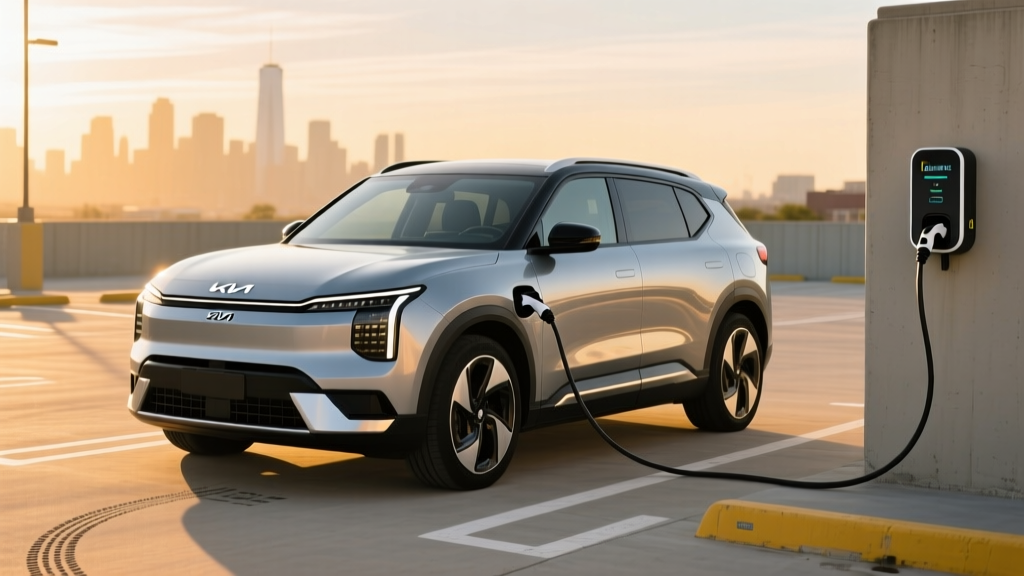
If you've been searching for Kia EV9 lease offers, you've likely seen headline monthly payments that look surprisingly attractive for a three-row electric SUV. But the advertised lease price is only one variable in a much larger ownership equation. The 2026 Kia EV9 — with its 84.0 kWh NMC battery, up to 304 miles of EPA range, and available dual-motor AWD — demands a closer look at total cost of ownership, federal incentive eligibility, and the real-world economics of driving a large electric SUV.
This guide dissects the actual numbers behind EV9 leasing and ownership in 2026, from the federal §30D tax credit's interaction with lease structures to per-mile charging costs and insurance premiums. No marketing gloss — just the data you need to decide.
2026 Kia EV9: The Numbers That Matter for Leasing
Before evaluating lease economics, anchor yourself in the EV9's hard specs. These figures drive everything from your monthly payment to your electricity bill.
| Spec | Light RWD | Wind RWD | Land AWD |
|---|---|---|---|
| EPA Range | 230 mi | 304 mi | 280 mi |
| Battery (usable) | 76.1 kWh (LFP) | 84.0 kWh (NMC) | 84.0 kWh (NMC) |
| Peak DC Charge Rate | ~170 kW | ~210 kW | ~210 kW |
| 10–80% DC Fast Charge | ~28 min | ~24 min | ~24 min |
| Level 2 Charge (kW) | 10.9 kW | 10.9 kW | 10.9 kW |
| Horsepower | 215 hp | 215 hp | 379 hp |
| 0–60 mph | 7.8 sec | 7.8 sec | 5.0 sec |
| MPGe (combined) | 89 MPGe | 88 MPGe | 85 MPGe |
| Base MSRP (2026) | $54,900 | $59,900 | $64,900 |
| Battery Warranty | 10 years / 100,000 miles | ||
How the Federal Tax Credit Works With EV9 Leases
The interaction between the IRS §30D Clean Vehicle Credit and leasing is one of the most misunderstood areas of EV purchasing. Here's how it actually works for the 2026 EV9.
Buying outright or financing: You may claim up to $7,500 on your federal tax return — or, crucially, transfer the credit to the dealer as a point-of-sale reduction under current IRS rules. However, you must meet all eligibility criteria below.
Leasing: Technically, the leasing company (the lessor) is the vehicle's legal owner and claims the commercial clean vehicle credit under §45W, not §30D. In practice, most major leasing institutions pass the $7,500 benefit to the lessee as a capitalized cost reduction, which lowers your monthly payment. This is often called a "lease loophole," but it's standard industry practice. The advantage: lease structures may bypass certain §30D battery-sourcing and MSRP restrictions that apply to purchases, though this depends on the lessor's interpretation and current IRS guidance.
- MSRP Cap: SUVs, vans, and pickups must be ≤ $80,000 MSRP. All 2026 EV9 trims qualify (top GT-Line ~$74,900).
- Buyer Income Cap (MAGI): $300,000 joint filers / $225,000 head of household / $150,000 single. Exceed these and you get $0 credit on a purchase.
- Battery Component Sourcing: Increasing percentages of battery components must be manufactured or assembled in North America. The EV9 is assembled in West Point, Georgia, but battery cell sourcing varies — confirm current-year compliance on the IRS qualified vehicle list at irs.gov.
- Critical Minerals: A percentage of critical minerals must be sourced from the U.S. or free-trade-agreement partners. This threshold increases annually.
- Point-of-Sale Transfer: You can transfer the credit to the dealer for an immediate price reduction, but you must still meet income limits and file Form 8936.
Rules are subject to change. Always verify current-year eligibility at irs.gov before signing. Consult a tax professional for your specific situation.
5-Year Total Cost of Ownership: EV9 vs. Comparable Gas SUV
To evaluate whether those Kia EV9 lease offers make financial sense, we need a full 5-year / 75,000-mile ownership comparison. The baseline competitor is a similarly priced three-row gas SUV — think a loaded Kia Telluride or Hyundai Palisade in the $55,000–$65,000 range.
| Cost Category | 2026 Kia EV9 Wind RWD | Gas 3-Row SUV (20 MPG combined) |
|---|---|---|
| Purchase/Lease (after incentives) | $52,400 (net of $7,500 credit) | $62,000 |
| Fuel/Energy (75,000 mi) | $5,625 ($0.15/kWh, 3.0 mi/kWh) | $13,125 ($3.50/gal, 20 MPG) |
| Insurance (5 years) | $12,500 ($2,500/yr avg) | $9,000 ($1,800/yr avg) |
| Maintenance (5 years) | $1,800 | $4,500 |
| Depreciation (est. 5-year) | $26,200 (50%) | $24,800 (40%) |
| Total 5-Year Cost | $98,550 | $113,425 |
| Cost Per Mile | $1.31/mi | $1.51/mi |
The EV9's net advantage is roughly $14,875 over five years, or about $0.20 per mile. But that advantage is heavily dependent on three variables: qualifying for the full $7,500 credit, charging primarily at home at residential electricity rates, and EV depreciation trends stabilizing.
Charging vs. Gas: The Real Per-Mile Cost
Fuel savings are the strongest argument in the EV9's economic case, but the numbers vary dramatically based on how and where you charge.
| Charging Scenario | Rate | EV9 Cost/Mile | Gas SUV Cost/Mile (20 MPG) |
|---|---|---|---|
| Home (national avg residential) | $0.16/kWh | $0.053 | $0.175 (at $3.50/gal) |
| Home (California peak) | $0.32/kWh | $0.107 | $0.225 (at $4.50/gal) |
| Home (off-peak utility EV rate) | $0.09/kWh | $0.030 | $0.175 (at $3.50/gal) |
| Public DC Fast Charger | $0.48/kWh | $0.160 | $0.175 (at $3.50/gal) |
| Public DC (premium network) | $0.64/kWh | $0.213 | $0.200 (at $4.00/gal) |
The EV9 consumes approximately 33 kWh per 100 miles (about 3.0 miles per kWh) in mixed driving per EPA data. At the national residential average of $0.16/kWh, that's roughly $0.05 per mile — a 70% savings over a 20 MPG gas SUV at $3.50/gallon.
The catch: If you rely exclusively on public DC fast charging at $0.48–$0.64/kWh, your per-mile cost can approach or even exceed gas. The EV9's economics fundamentally assume access to affordable home or workplace Level 2 charging. Without it, the fuel-cost advantage narrows sharply.
Maintenance Savings: Where the EV9 Quietly Wins
The EV9's electric powertrain eliminates most routine maintenance items that gas SUV owners accept as inevitable. Here's the realistic 5-year maintenance picture:
| Service Item | EV9 Cost | Gas SUV Cost |
|---|---|---|
| Oil Changes (5–7 over 75k mi) | $0 | $450–$700 |
| Brake Pads/Rotors | $0–$300 (regen extends life 2–3×) | $800–$1,200 |
| Transmission Fluid/Service | $0 (single-speed reduction gear) | $200–$400 |
| Cabin Air Filter | $150 (3 replacements) | $150 |
| Tire Rotation/Replacement | $1,200 (EV torque wears tires faster) | $900 |
| Coolant Flush | $100 | $150 |
| Misc. (wipers, bulbs, inspections) | $250 | $400 |
| Total (5 yr) | ~$1,700–$2,000 | ~$4,000–$5,000 |
Net maintenance savings: approximately $2,200–$3,000 over five years. The EV9's regenerative braking is particularly impactful — by using the electric motors to decelerate, friction brakes see far less use, often lasting 100,000+ miles before pad replacement.
One offsetting cost: tires. The EV9's 4,900+ lb curb weight and instant electric torque accelerate tire wear. Budget for a set of four tires around 35,000–45,000 miles rather than the 55,000–65,000 miles typical of lighter gas SUVs.
Insurance Reality: The Cost Nobody Advertises
EV insurance premiums remain higher than equivalent gas vehicles, and the EV9 is no exception. Industry data shows EV insurance costs running 20–40% higher than comparable ICE vehicles. For the EV9, expect annual premiums in the $2,200–$2,800 range depending on your state, driving record, and coverage level — compared to roughly $1,600–$2,000 for a gas Telluride.
Why EVs cost more to insure:
- Higher repair costs: Battery pack damage from even minor collisions can trigger total-loss declarations. Specialized high-voltage repair training is required.
- Parts availability: EV-specific components (battery modules, power electronics, electric motors) are costlier and sometimes slower to source.
- Vehicle price: The EV9's MSRP sits higher than many gas alternatives, raising comprehensive and collision premiums.
- Claim severity: Insurers have less historical claims data on EVs, and early data shows higher average claim costs.
Mitigation strategies: Shop quotes from at least three insurers — EV-friendly carriers like Geico, Progressive, and Tesla Insurance (where available) often price EVs more competitively. Bundling home and auto, maintaining a clean record, and selecting higher deductibles can close the gap. Some states offer insurance-related incentives, though these are rare.
Depreciation and Resale: The Wild Card
EV depreciation has been volatile. In 2023–2024, used EV values dropped sharply due to Tesla-initiated price cuts, growing inventory, and shifting consumer sentiment. By 2025–2026, the market has largely stabilized, but large luxury-adjacent EVs like the EV9 still face steeper depreciation curves than mainstream gas SUVs.
Current 5-year depreciation estimates:
- Kia EV9: ~45–55% depreciation over 5 years (residual value of 45–55%)
- Gas 3-row SUV (Telluride/Palisade): ~35–45% depreciation (residual value of 55–65%)
On a $59,900 EV9 Wind, that translates to roughly $27,000–$33,000 in depreciation over five years. The $7,500 federal credit partially offsets this — your effective purchase basis is $52,400, making the depreciation hit more manageable.
Leasing as a depreciation hedge: This is where Kia EV9 lease offers become strategically interesting. A lease locks in a guaranteed residual value at signing. If EV depreciation accelerates further (due to battery tech advances, new competition, or policy changes), you simply return the vehicle at lease-end and walk away. You bear no resale risk. If residuals outperform expectations, you can purchase at the predetermined residual or trade into a new lease.
Kia's strong 10-year/100,000-mile battery and powertrain warranty also supports long-term resale confidence — it's transferable to second owners, which bolsters used-market demand.
Beyond the federal credit, many states, municipalities, and electric utilities offer additional rebates and incentives that can meaningfully reduce your EV9 ownership cost:
- State rebates: California (CVRP), Colorado, Massachusetts, New York, and others offer $1,000–$5,000+ in point-of-sale or post-purchase rebates — often with income-based tiers.
- Utility rebates: Many utilities offer $250–$1,500 for home Level 2 charger installation, plus time-of-use (TOU) rate plans that slash charging costs to $0.06–$0.10/kWh overnight.
- HOV lane access: States like California, Colorado, and Virginia offer single-occupant HOV lane access for EVs — a significant quality-of-life benefit in congested metros.
- Registration/tax benefits: Some states waive sales tax on EVs or offer reduced annual registration fees.
These programs change frequently and vary by ZIP code. Check your state energy office, local utility, and afdc.energy.gov for current programs in your area.
The Lease-vs-Buy Decision Framework for the EV9
Given the EV9's specific cost profile, here's a practical framework:
Choose a lease if:
- You want to hedge against EV depreciation uncertainty
- You prefer a lower monthly payment and plan to swap vehicles every 3 years
- Your MAGI exceeds the §30D income caps for purchase ($150k single / $300k joint) — the lease structure may still deliver the credit benefit via the lessor
- You drive under 12,000–15,000 miles per year (typical lease limits)
Choose to buy (finance) if:
- You plan to keep the EV9 for 5–8+ years (depreciation penalty amortizes over time)
- You drive over 15,000 miles/year (lease overage penalties are costly at $0.20–$0.30/mile)
- You qualify for the full $7,500 §30D credit and can use the point-of-sale transfer
- You want to build equity and avoid perpetual car payments
Frequently Asked Questions
How much does it really cost to own a Kia EV9 over 5 years?
Based on 75,000 miles of mixed driving with home charging at $0.16/kWh and after applying the $7,500 federal credit, expect approximately $95,000–$102,000 in total cost of ownership for the EV9 Wind RWD — roughly $14,000–$18,000 less than a comparably priced gas three-row SUV over the same period. The savings are driven primarily by fuel ($7,000+ savings) and maintenance ($2,500+ savings), partially offset by higher insurance ($3,000+ more) and steeper depreciation.
Do I qualify for the $7,500 federal tax credit on the EV9?
For a purchase, you must meet three criteria: (1) your modified adjusted gross income is below $150,000 (single) or $300,000 (joint), (2) the vehicle MSRP is under $80,000 (all EV9 trims qualify), and (3) the vehicle's battery meets current-year critical mineral and component sourcing thresholds as listed on the IRS qualified vehicles list. For a lease, the lessor claims the credit and typically passes it through as a cap-cost reduction — income and sourcing restrictions may not apply in the same way. Always verify current-year rules before signing.
How much do I save on fuel and maintenance with the EV9?
Over 5 years and 75,000 miles, expect roughly $7,000–$8,000 in fuel savings (charging at home at $0.16/kWh vs. $3.50/gallon gas at 20 MPG) and $2,200–$3,000 in maintenance savings (no oil changes, minimal brake wear, no transmission service). Combined, that's $9,000–$11,000 in operational savings. These figures shrink significantly if you rely on expensive public DC fast charging or drive in a state with very low gas prices.
Are EVs like the EV9 more expensive to insure?
Yes, typically 20–40% more than a comparable gas SUV. For the EV9, budget $2,200–$2,800 annually versus $1,600–$2,000 for a gas Telluride. Higher repair costs, battery replacement risk, and limited claims history drive the premium. Shopping multiple carriers and bundling policies can reduce the gap.
How well does the Kia EV9 hold its value?
Current projections estimate 45–55% depreciation over 5 years for the EV9, compared to 35–45% for high-demand gas three-row SUVs. The EV market is still maturing, and rapid technology advances can pressure used values. Leasing transfers this risk to the lessor. Kia's transferable 10-year/100,000-mile battery warranty provides meaningful resale support compared to competitors with shorter coverage.
What's the best Kia EV9 lease offer structure in 2026?
Competitive EV9 leases in 2026 typically feature 36-month terms with 10,000–12,000 annual miles. With the $7,500 credit applied as a cap-cost reduction and no additional down payment, expect monthly payments in the $650–$850 range depending on trim and money factor. Putting money down on a lease is generally discouraged — if the vehicle is totaled, that cash is unrecoverable. Instead, negotiate the sale price (cap cost) down and let the credit do the work.