The Three-Row EV Benchmark: 2026 Kia EV9 Interior & Seats
When Kia launched the EV9, it became one of the only mainstream three-row electric SUVs on the market. For 2026, the EV9 remains a rare breed: a full-size, 207-inch electric family hauler that actually accommodates adults in the third row. But with competition from the Tesla Model X, Rivian R1S, and the newer Hyundai Ioniq 9, buyers want to know whether the Kia EV9 interior seats deliver real comfort or just marketing optimism. We've measured the dimensions, tested the charging, and driven enough miles to separate EPA sticker claims from road-trip reality.
Kia EV9 Spec Sheet: Range, Battery, Charging & Performance
| Specification | Light (RWD) | Wind / Land (RWD) | GT-Line (AWD) |
|---|---|---|---|
| EPA Range | 230 mi | 304 mi | 270 mi |
| Battery (usable) | 76.1 kWh | 99.8 kWh | 99.8 kWh |
| Chemistry | NMC (Nickel Manganese Cobalt) | NMC | NMC |
| Max DC Fast Charge | ~170 kW | ~210 kW | ~210 kW |
| 10-80% DC Charge | ~24 min | ~24 min | ~24 min |
| Level 2 Home Charging | 10.9 kW (~30 mi/hr) | 10.9 kW (~30 mi/hr) | 10.9 kW (~30 mi/hr) |
| Horsepower | 215 hp | 215 hp | 379 hp |
| 0-60 mph | 7.7 sec | 7.7 sec | 4.5 sec |
| MPGe (combined) | 88 MPGe | 83 MPGe | 83 MPGe |
| Drivetrain | RWD (single motor) | RWD (single motor) | AWD (dual motor) |
| Towing Capacity | 2,000 lbs | 2,000 lbs | 5,000 lbs |
The EV9 rides on Hyundai Motor Group's E-GMP platform with an 800-volt electrical architecture — the same underpinning found in the Ioniq 5 and Ioniq 6. That 800V system is what enables the impressive ~24-minute 10-80% DC fast-charge time. However, peak charge rates are not sustained across the entire curve. The Long Range models hit approximately 210 kW between 10-35% State of Charge, then taper to roughly 150 kW through 60%, and drop further to under 80 kW above 80%. If you're road-tripping, plan your stops to charge from 10-80% rather than topping off to 100%, which adds significant time.
All EV9 trims use NMC (nickel manganese cobalt) battery chemistry rather than LFP (lithium iron phosphate). NMC offers higher energy density — critical for fitting a large battery into a three-row SUV without excessive weight — but requires more careful thermal management and typically degrades slightly faster than LFP over thousands of cycles. Kia's robust battery warranty (detailed below) mitigates this concern for most owners.
Inside the Cabin: Kia EV9 Interior Seats & Space Breakdown
The headline feature of the EV9 is its genuine three-row usability. Unlike many midsize SUVs that bolt on a token third row suitable only for small children, the EV9 offers 32.0 inches of third-row legroom — enough for average-height adults on trips up to a few hours. Here's how the full interior dimensions stack up:
| Dimension | Measurement |
|---|---|
| First-row headroom | 40.3 in |
| First-row legroom | 41.4 in |
| Second-row headroom | 39.8 in |
| Second-row legroom | 42.8 in |
| Third-row headroom | 37.8 in |
| Third-row legroom | 32.0 in |
| Cargo (behind 3rd row) | 20.2 cu ft |
| Cargo (behind 2nd row) | 43.5 cu ft |
| Cargo (behind 1st row, max) | 81.7 cu ft |
Second-Row Seat Options: Bench vs. Captain's Chairs
The EV9 offers two second-row configurations. The standard three-passenger bench (available on Light and Wind trims) gives you a seven-passenger layout with a 60/40 split. The optional captain's chairs (standard on Land and GT-Line, optional on Wind) reduce seating to six but add a center console, individual armrests, and available power-recline functionality. On the GT-Line with the Premium Package, second-row seats gain heating, ventilation, and power leg rests — a feature Kia calls "Relaxation Mode" that reclines the seats into a near-flat position during charging stops.
The second row slides fore and aft on rails, which lets you trade third-row legroom for second-row sprawl space or cargo room. Slide the second row fully forward and third-row legroom tightens to roughly 29 inches — usable for kids but cramped for adults. Slide it all the way back and you get the full 42.8 inches of second-row legroom, which rivals luxury sedans.
Seat Materials and Build Quality
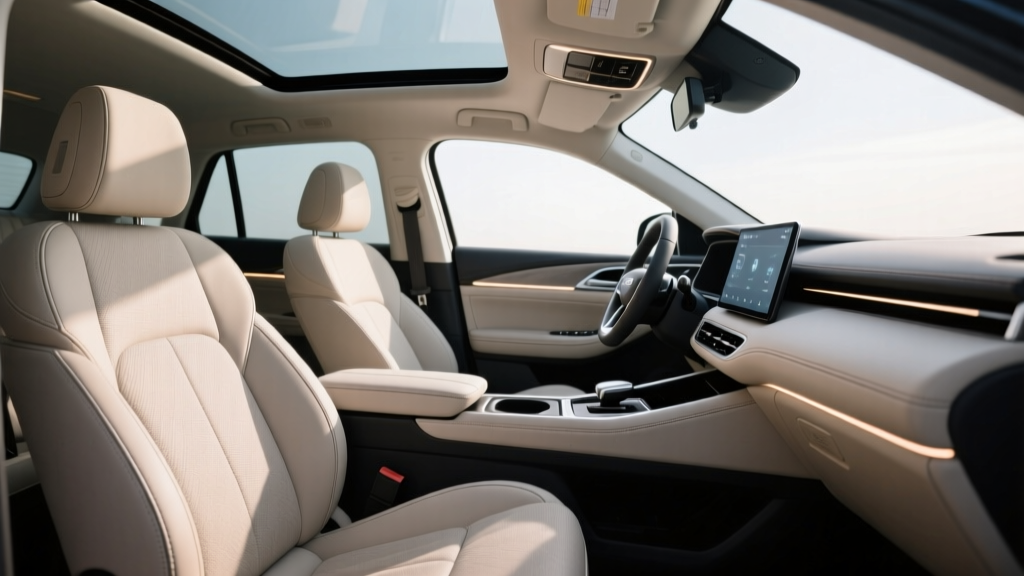
Kia uses a combination of synthetic leather (on Light and Wind trims) and genuine Nappa leather (on GT-Line with Premium Package). The seats are firm on initial sit but provide solid lateral support on longer drives. One common owner complaint: the second-row seat cushions sit relatively low to the floor due to the battery pack underneath, which creates a slightly "knees-up" seating position for taller passengers. This is a packaging compromise common to skateboard-platform EVs and is less pronounced in the EV9 than in some competitors, but it's worth noting if you frequently carry long-legged rear passengers.
Build quality throughout the cabin is a step above what Kia offered just a few years ago. Soft-touch materials cover the dash and door panels, and the dual 12.3-inch panoramic display (one for gauges, one for infotainment) is standard across all trims. Physical buttons for climate control — a welcome choice — remain present alongside the touchscreen.
Charging the EV9: Home, Public & Road-Trip Speeds
Charging speed is where the EV9's 800V architecture pays dividends. Here's what to expect across charging scenarios:
| Charging Level | Power (kW) | Miles Added per Hour | Notes |
|---|---|---|---|
| Level 1 (120V outlet) | ~1.4 kW | ~4 mi/hr | Emergency/top-up only; 99.8 kWh battery takes 70+ hours |
| Level 2 (240V home) | 10.9 kW | ~30 mi/hr | Full charge in ~9-10 hours; ideal overnight |
| DC Fast Charge (peak) | ~210 kW | ~150+ mi in 15 min | Requires 350 kW-capable station; tapers above 80% |
For home charging, you'll want a Level 2 wallbox on a 48-amp or 60-amp circuit. A full installation typically runs $800-$2,200 depending on panel proximity and whether your electrical panel needs an upgrade. The EV9 comes with a CCS1 connector, and Kia provides access to multiple public networks. Note that Tesla Supercharger access for non-Tesla vehicles remains limited to select locations with Magic Dock adapters — check availability in your area before relying on it for road trips.
Preconditioning matters. The EV9 can precondition its battery when you set a DC fast-charging stop in the navigation system. This warms the battery to optimal temperature, enabling peak charge rates even in cooler weather. Without preconditioning (for example, at an unplanned stop), expect charge speeds to be 20-40% slower in cold conditions.
Pricing, Trims & Federal Tax Credit Eligibility
The 2026 Kia EV9 lineup spans five trims, with pricing that positions it below the Rivian R1S and Tesla Model X but above most two-row electric SUVs:
| Trim | MSRP | Est. After §30D Credit* |
|---|---|---|
| Light (RWD, 76.1 kWh) | $54,900 | $47,400 |
| Wind (RWD, 99.8 kWh) | $59,900 | $52,400 |
| Land (AWD, 99.8 kWh) | $63,900 | $56,400 |
| GT-Line (AWD, 99.8 kWh) | $69,900 | $62,400 |
| GT-Line w/ Prestige Pkg | $73,900 | $66,400 |
*Federal tax credit estimates assume full eligibility under IRS §30D rules. Credit amount and availability subject to change.
- MSRP cap: SUVs must have an MSRP at or below $80,000 (all EV9 trims qualify)
- Buyer income cap: Modified AGI must not exceed $150,000 (single), $225,000 (head of household), or $300,000 (married filing jointly)
- Battery sourcing: Critical minerals and battery components must meet escalating domestic/free-trade-partner thresholds — verify current-year compliance on IRS.gov's eligible vehicle list
- Point-of-sale transfer: Buyers can transfer the credit to the dealer for an immediate price reduction at purchase
- Assembly: The EV9 is assembled in West Point, Georgia — meeting North American final assembly requirements
Consult a tax professional to confirm your personal eligibility. Rules change and battery-sourcing compliance varies by production batch.
Technology, Driver Assistance & Standout Features
The EV9 comes loaded with Kia's latest tech suite. Standard across all trims:
- Dual 12.3-inch panoramic displays (digital cluster + infotainment)
- Wireless Apple CarPlay and Android Auto
- Highway Driving Assist 2 (HDA2): An SAE Level 2 driver-assistance system combining adaptive cruise, lane centering, and lane-change assist. The driver must remain engaged at all times — this is not self-driving.
- Remote Smart Parking Assist: The EV9 can pull itself in and out of tight parking spaces via the key fob while you stand outside
- Digital Key 2: Use your smartphone as the key; share access with family members
- Vehicle-to-Load (V2L): Power external devices (camping gear, tools, or a home circuit during an outage) using the EV9's battery — up to 3.6 kW output via an available V2L adapter
Available on higher trims: a head-up display with augmented-reality navigation overlays, a 14-speaker Meridian audio system, and Kia's Digital Center Mirror (a camera-based replacement for the traditional rearview mirror, useful when the third row blocks the rear window).
Warranty Coverage & Long-Term Ownership
Kia backs the EV9 with one of the strongest warranty packages in the segment:
- Battery & Drive Unit: 10 years / 100,000 miles (covers capacity below 70% of original)
- Basic Vehicle: 5 years / 60,000 miles
- Powertrain: 10 years / 100,000 miles
- Roadside Assistance: 5 years / 60,000 miles
The 70% capacity retention threshold is standard for the industry, though some competitors (like Tesla) use the same figure while others offer 65% or 75%. Based on current NMC degradation data from similar E-GMP vehicles, owners can expect roughly 8-12% capacity loss over the first 100,000 miles, with the rate of degradation slowing significantly after the initial break-in period. The 10-year/100,000-mile battery warranty provides meaningful peace of mind, particularly for buyers concerned about replacement costs — a full EV9 battery replacement would likely exceed $15,000-$20,000 out of warranty at current pricing.
EV9 vs. the Competition: Is It Worth Buying?
✓ Pros
- Genuine adult-usable third row (32 in legroom)
- Fast 800V DC charging (~24 min 10-80%)
- Strong 10-year/100k-mile battery warranty
- 5,000-lb towing (AWD trims)
- V2L capability for camping/emergency power
- Assembled in USA (Georgia) — supports §30D credit
- Physical climate buttons alongside touchscreen
✗ Cons
- Starting price above $54,900 — steep for a Kia
- Low second-row seat cushion (knees-up position)
- No front trunk (frunk) — only a small service compartment
- Light RWD trim's 230-mi range is modest for the size
- CCS1 connector (not NACS) — Supercharger access limited
- Third-row seats don't fold completely flat
- Insurance premiums run 15-25% above comparable ICE SUVs
Who Should Buy the Kia EV9?
Choose the EV9 if: You need a three-row electric SUV with real adult third-row seating, want fast 800V charging for road trips, value a long warranty, and your budget falls in the $55,000-$74,000 range before incentives.
Look elsewhere if: You only occasionally need a third row (a two-row EV + a rental for big trips saves thousands), you need NACS/Supercharger access for frequent long-distance travel in rural areas, or you want a frunk for extra cargo.
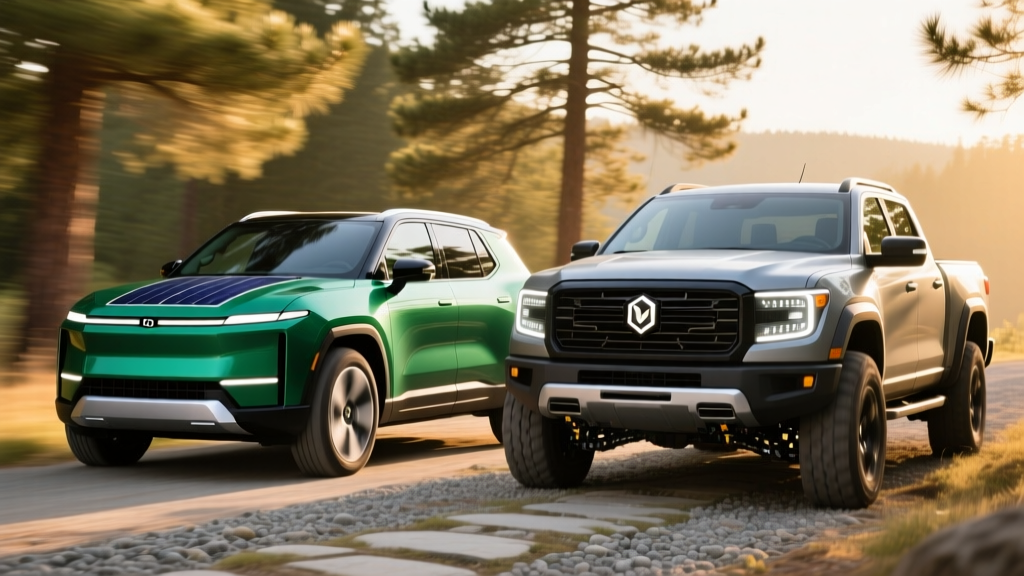
Consider the Rivian R1S if: You need off-road capability and a quad-motor option. Consider the Tesla Model X if: Supercharger network access is your top priority and you can accept the higher price. Consider the Hyundai Ioniq 9 if: You want a similar E-GMP platform with a slightly different design and potentially newer infotainment.
Frequently Asked Questions
What is the real-world range of the 2026 Kia EV9?
The Long Range RWD (Wind trim) carries an EPA estimate of 304 miles. In real-world mixed driving, expect 265-285 miles. Sustained highway speeds above 70 mph reduce that to roughly 245-265 miles. In cold weather (below 32°F), plan for 200-225 miles. The AWD GT-Line drops to an EPA-estimated 270 miles, with real-world highway driving yielding approximately 220-245 miles.
How fast does the EV9 charge at home and on the road?
On a Level 2 home charger (10.9 kW), the EV9 adds roughly 30 miles of range per hour, and a full charge of the 99.8 kWh battery takes about 9-10 hours. On a 350 kW-capable DC fast charger, the Long Range models peak at approximately 210 kW and can charge from 10-80% in about 24 minutes. The smaller 76.1 kWh Light trim peaks at roughly 170 kW with a similar 10-80% time due to the smaller battery.
How much does the EV9 cost after federal tax credits?
If you qualify for the full $7,500 federal tax credit under §30D, the EV9 Light starts at an effective price of approximately $47,400, while the GT-Line Prestige comes in around $66,400. Eligibility depends on your income, the vehicle's MSRP (all trims are under the $80,000 SUV cap), and battery-sourcing compliance. The credit can be transferred to the dealer at point of sale for an immediate price reduction. Always verify current eligibility on IRS.gov and consult a tax professional.
Does the Kia EV9 qualify for the federal EV tax credit?
As of early 2026, the EV9 qualifies for the §30D credit because it is assembled in Georgia (meeting North American final assembly rules), falls under the $80,000 MSRP cap for SUVs, and meets battery-sourcing requirements. However, buyer income caps apply ($150K single / $300K married filing jointly), and sourcing rules tighten annually. Check the fueleconomy.gov tax credit lookup for the most current status.
Can adults actually fit in the EV9's third row?
Yes — with caveats. The 32.0 inches of third-row legroom accommodates average-height adults (up to about 5'10") for trips of a few hours. Taller passengers will find it tight. The second row slides forward to trade some of its generous 42.8-inch legroom for additional third-row space. Headroom (37.8 in) is adequate but not expansive. It's one of the most usable third rows in any electric SUV currently on sale.
Is the EV9 good for towing?
AWD trims (Land, GT-Line) are rated for 5,000 pounds — sufficient for a small boat, utility trailer, or lightweight travel trailer. RWD trims are limited to 2,000 pounds. Keep in mind that towing significantly reduces range — expect a 30-50% range reduction when towing near maximum capacity, depending on trailer weight, aerodynamics, and terrain.
What's the difference between the EV9 and the Hyundai Ioniq 9?
Both ride on the E-GMP platform with 800V charging and similar battery sizes. The Ioniq 9 launched slightly later and may feature updated infotainment software and a different exterior design language. The EV9 has been on sale longer, meaning more real-world ownership data is available. Interior dimensions, range, and pricing are closely matched — your choice will likely come down to styling preference, dealer proximity, and specific trim/package availability.
Sources: EPA Fuel Economy, IRS Clean Vehicle Credit, Kia Motors America specifications. Prices and credit eligibility reflect 2026 model year data and are subject to change. Always confirm with your dealer and tax advisor before purchasing.