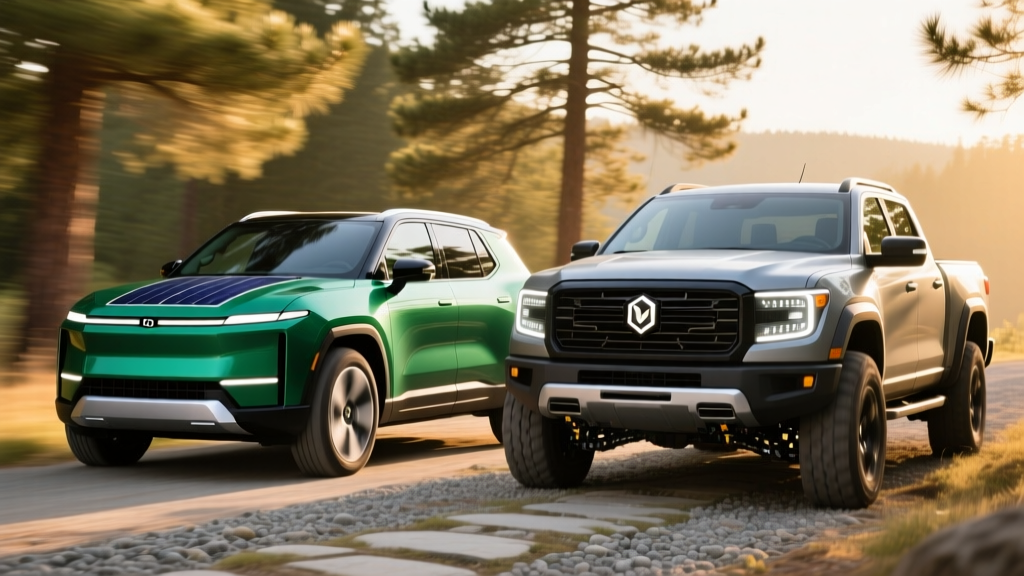
If you've been searching "are Rivian's all electric" while researching your next vehicle, the short answer is yes: every vehicle Rivian produces is a battery-electric vehicle (BEV). There are no hybrids, no plug-in hybrids, and no range-extender variants in Rivian's lineup. The Irvine, California–based automaker builds exclusively on its proprietary electric skateboard platform, currently offering two core models: the R1S three-row SUV and the R1T pickup truck.
Both vehicles received significant updates for the 2025 model year (dubbed the "Gen 2" platform) that carry into 2026, including a new in-house drive unit, enhanced electrical architecture, and the adoption of the North American Charging Standard (NACS) port. This review breaks down the exact specs, real-world range expectations, charging speeds, pricing, and federal tax credit eligibility you need to decide whether a Rivian belongs in your driveway.
Rivian's Full Electric Lineup at a Glance
Rivian offers two vehicles, each available in multiple battery and motor configurations. Here's how the 2026 lineup stacks up on paper:
| Spec | R1S (Dual-Motor, Standard) | R1S (Dual-Motor, Max) | R1T (Dual-Motor, Standard) | R1T (Dual-Motor, Max) |
|---|---|---|---|---|
| EPA Range | ~270 mi | ~410 mi | ~270 mi | ~420 mi |
| Battery (usable) | ~92 kWh (LFP) | ~141 kWh (NMC) | ~92 kWh (LFP) | ~141 kWh (NMC) |
| Horsepower | 533 hp | 533 hp | 533 hp | 533 hp |
| 0–60 mph | ~4.5 sec | ~4.5 sec | ~4.5 sec | ~4.5 sec |
| Drivetrain | AWD (Dual-Motor) | AWD (Dual-Motor) | AWD (Dual-Motor) | AWD (Dual-Motor) |
| Max DC Fast Charge | ~200 kW | ~220 kW | ~200 kW | ~220 kW |
| 10–80% DCFC Time | ~28 min | ~42 min | ~28 min | ~42 min |
| Level 2 Home Rate | 11.5 kW (~25 mi/hr) | 11.5 kW (~25 mi/hr) | 11.5 kW (~25 mi/hr) | 11.5 kW (~25 mi/hr) |
| MPGe (combined) | ~73 MPGe | ~65 MPGe | ~73 MPGe | ~65 MPGe |
| Towing Capacity | 7,700 lb | 7,700 lb | 11,000 lb | 11,000 lb |
Note: Rivian also offers a Tri-Motor performance variant for both models with 850+ hp and 0–60 under 3 seconds, though range is slightly reduced. Specs above reflect the volume-selling Dual-Motor configurations. Always verify final specs at rivian.com.
Real-World Range: What the EPA Sticker Doesn't Tell You
EPA Estimate: Up to 410 miles (R1S Max Pack) / 420 miles (R1T Max Pack)
Real-World Highway Expectation: ~310–340 miles at 70–75 mph
Cold-Weather Impact: Expect 15–25% range reduction in sub-freezing temps, meaning the Max Pack drops to roughly 280–320 miles in winter conditions.
The Max Pack's headline EPA numbers are genuinely impressive — among the longest of any production EV. However, Rivian's vehicles are large, heavy, and boxy. Aerodynamic drag at highway speeds cuts into efficiency significantly. On a 70 mph interstate run in moderate temperatures (65–75°F), owners consistently report efficiency in the range of 2.0–2.2 kWh/mile for the Max Pack, which nets roughly 310–340 real-world miles before you'd want to stop and charge.
The Standard Pack's LFP battery is more modest at ~270 miles EPA. Highway driving in warm weather yields around 210–230 miles of practical range. In winter, with cabin heating and battery conditioning drawing extra power, plan for 175–200 miles between stops. This isn't unusual for a large electric SUV or truck, but it demands route planning on road trips.
The LFP chemistry in the Standard Pack has a trade-off: lower energy density means less range, but LFP cells tolerate being held at 100% state of charge without accelerated degradation. Rivian recommends charging the Standard Pack to 100% daily, whereas the Max Pack's NMC chemistry is happiest at 80–90% for routine use.
Charging Speed: DC Fast, Level 2, and the NACS Transition
Rivian's Gen 2 vehicles come equipped with the NACS (North American Charging Standard) charge port natively, meaning direct access to the Tesla Supercharger network — over 20,000 stalls in North America — without an adapter. This is a major practical advantage over CCS-equipped competitors that require a CCS-to-NACS adapter.
| Charge Level | Power / Rate | Speed (approx.) | Notes |
|---|---|---|---|
| Level 1 (120V household) | ~1.4 kW | ~3–4 mi/hr | Emergency/trickle only |
| Level 2 (240V home) | 11.5 kW | ~25 mi/hr | Full charge overnight (~10–14 hrs for Max Pack) |
| DC Fast Charge (Standard Pack) | Peak ~200 kW | 10–80% in ~28 min | LFP sustains rate well |
| DC Fast Charge (Max Pack) | Peak ~220 kW | 10–80% in ~42 min | Tapers significantly above 80% |
The Max Pack's larger 141 kWh battery means even at a 220 kW peak rate, a 10–80% session takes longer than smaller-battery EVs. The charge curve is the real story: Rivian's thermal management holds peak rate reasonably well through 50–60% SoC, but the rate tapers aggressively past 80% to protect cell longevity. On a road trip, plan your stops around 10–80% sessions and skip topping off to 100% unless it's your final destination.
For home charging, the onboard 11.5 kW charger means a 48-amp Level 2 circuit (hardwired, 60-amp breaker) will replenish roughly 25 miles of range per hour. A full Standard Pack charges in about 9–10 hours; the Max Pack takes 12–14 hours. Most owners find a nightly plug-in routine more than sufficient regardless of pack size.
Home install tip: If your electrical panel is older or already near capacity, budget $500–$2,000+ for a panel upgrade before installing a Level 2 charger. Consult a licensed electrician for a site assessment.
Performance, Drivetrain, and Efficiency
Every 2026 Rivian comes with dual-motor all-wheel drive as standard. Rivian's in-house-developed drive units (introduced with Gen 2) replaced the earlier Bosch-supplied motors and are more compact, lighter, and more efficient.
The Dual-Motor produces 533 horsepower and achieves a 0–60 mph time of approximately 4.5 seconds — quick for a vehicle weighing over 6,500 pounds. The available Tri-Motor variant pushes output to 850+ hp with a sub-3.0-second 0–60, placing it in supercar territory despite its size.
Efficiency varies meaningfully by pack size:
- Standard Pack (LFP): ~73 MPGe combined / ~46 kWh/100 mi
- Max Pack (NMC): ~65 MPGe combined / ~52 kWh/100 mi
These figures are typical for full-size electric SUVs and trucks. For comparison, the Tesla Model X achieves roughly 100 MPGe combined, but it's lighter and more aerodynamic. The Rivian trades efficiency for off-road capability, ground clearance (up to 14.9 inches with air suspension), and genuine truck utility.
Pricing, Trims, and Federal Tax Credit Eligibility
Rivian positions the R1S and R1T in the premium segment. Here's where pricing stands for 2026:
| Model / Config | Base MSRP | As-Tested (typical) | §30D Credit Eligible? |
|---|---|---|---|
| R1S Dual-Motor Standard | ~$75,900 | $79,000–$85,000 | Partial — see below |
| R1S Dual-Motor Max | ~$90,900 | $95,000–$105,000 | No — exceeds MSRP cap |
| R1T Dual-Motor Standard | ~$69,900 | $73,000–$80,000 | Partial — see below |
| R1T Dual-Motor Max | ~$85,900 | $90,000–$98,000 | No — exceeds MSRP cap |
- MSRP Cap: SUVs (R1S) must be ≤$80,000; trucks (R1T) must be ≤$80,000 to qualify. The Standard Pack base MSRP fits, but options can push you over.
- Income Cap: Buyer AGI must not exceed $150,000 (single) / $300,000 (joint) / $225,000 (head of household).
- Battery Sourcing: Critical minerals and battery component requirements phase in progressively. Verify current-year compliance at IRS.gov §30D.
- Point-of-Sale Transfer: Eligible buyers can transfer the credit to the dealer at purchase, reducing the purchase price directly rather than waiting for a tax refund.
Eligibility is complex and changes annually. Consult a tax professional and verify on fueleconomy.gov before purchasing.
The Max Pack variants' MSRPs exceed the $80,000 cap, making them ineligible for the federal credit regardless of buyer income. If the tax credit is a deciding factor, the Standard Pack Dual-Motor configurations are your best bet — but verify the final as-equipped price stays under the cap and confirm battery sourcing compliance for the current tax year.
Interior, Cargo, and Technology
Rivian's interior design philosophy blends minimalism with rugged utility. Both vehicles feature a 15.6-inch center touchscreen running Rivian's proprietary OS, a 12.3-inch digital driver display, and a dedicated 6.8-inch rear-seat touchscreen for climate and entertainment controls.
R1S (SUV) cargo and passenger space:
- Cargo behind 3rd row: ~11 cu ft
- Cargo behind 2nd row (3rd row folded): ~47 cu ft
- Max cargo (all rear seats folded): ~92 cu ft
- Front trunk (frunk): ~11 cu ft — a genuine differentiator vs. ICE SUVs
- 3rd-row legroom: ~30 inches (best for children on longer trips)
R1T (Truck) cargo and utility:
- Bed length: 54 inches (4.5 ft) — shorter than a full-size truck
- Gear Tunnel: ~11 cu ft lockable, pass-through storage behind the cab (R1T exclusive)
- Frunk: ~11 cu ft
- Max payload: ~1,760 lb
- Towing: up to 11,000 lb (best-in-class for electric trucks)
Standout tech features:
- Rivian Driver+: Level 2 driver-assist with adaptive cruise, lane centering, and automatic lane changes on mapped highways. Requires hands on wheel and continuous driver attention — this is not autonomous driving.
- Over-the-air (OTA) updates: Frequent software improvements adding features and refining performance.
- Camp Kitchen accessory: Slide-out kitchen system for the R1T Gear Tunnel (optional, ~$5,000).
- V2L (Vehicle-to-Load): Power external devices from the vehicle's battery — useful for camping or job-site use.
Notable drawbacks: The third row in the R1S is tight for adults. The R1T's 4.5-foot bed is shorter than many truck buyers expect. Rivian's service center network is still expanding, and wait times for body repair can be lengthy in some regions. The infotainment system, while functional, lacks Apple CarPlay and Android Auto — a deliberate choice by Rivian that frustrates some buyers.
Warranty, Ownership Costs, and Longevity
Rivian's warranty coverage is competitive for the EV segment:
- Battery & Drive Unit: 8 years / 175,000 miles (whichever comes first)
- Vehicle (bumper-to-bumper): 5 years / 60,000 miles
- Roadside Assistance: 5 years / 60,000 miles
The 175,000-mile battery warranty exceeds the federal minimum (8 years / 100,000 miles) and signals confidence in both the LFP and NMC cell suppliers. Battery replacement cost, should it be needed out of warranty, is estimated at $15,000–$25,000+ depending on pack size — though this is speculative as widespread replacements have not yet been necessary for Rivian vehicles.
Insurance costs tend to run 15–30% higher than comparable ICE vehicles due to repair complexity and parts availability. Get quotes before purchasing.
Pros, Cons, and Who Should Buy a Rivian
- Class-leading electric range with Max Pack (410–420 mi EPA)
- Native NACS port — direct Tesla Supercharger access
- Genuine off-road capability (up to 14.9" ground clearance)
- R1T's 11,000-lb towing + Gear Tunnel are unique in the EV truck segment
- OTA updates continuously improve the vehicle
- 8-yr / 175,000-mi battery warranty
- Premium pricing — $70K–$105K depending on config
- Max Pack variants exceed $80K MSRP cap (no federal credit)
- R1S third row is tight; R1T bed is short (4.5 ft)
- No Apple CarPlay or Android Auto
- Service center network still maturing in some regions
- Efficiency trails lighter, more aero EVs (65–73 MPGe)
- Adventure-oriented families who need three rows (R1S) or truck utility (R1T) and want zero tailpipe emissions.
- Outdoor enthusiasts who value off-road clearance, V2L capability, and the R1T's Gear Tunnel.
- Home-charging-capable buyers who can install a Level 2 charger and handle daily driving within the Standard Pack's range.
- Towing users who want electric torque and up to 11,000 lb capacity (note: towing cuts range by 30–50%).
Look elsewhere if: You need maximum highway efficiency, a sub-$50K price point, a full-size truck bed, or a mature third-party service network in rural areas.
Frequently Asked Questions
Are all Rivian vehicles fully electric?
Yes. Rivian manufactures only battery-electric vehicles (BEVs). The R1S SUV and R1T truck have no internal combustion engine, no hybrid system, and no range extender. Every mile is driven on electricity stored in the onboard battery pack.
What is the real-world range of a Rivian?
Real-world range depends on pack size and conditions. The Max Pack achieves roughly 310–340 miles at highway speeds in warm weather and 280–320 miles in cold weather. The Standard Pack delivers about 210–230 miles highway in warm conditions and 175–200 miles in winter. These figures assume moderate driving habits and use of climate control.
How fast does a Rivian charge?
On a DC fast charger, the Standard Pack peaks at ~200 kW (10–80% in ~28 minutes), while the Max Pack peaks at ~220 kW (10–80% in ~42 minutes). At home on a 240V Level 2 charger at 11.5 kW, expect ~25 miles of range per hour — a full overnight charge for most daily driving needs.
Does the Rivian R1S or R1T qualify for the $7,500 federal EV tax credit?
Only the Standard Pack Dual-Motor variants may qualify, and only if the as-equipped MSRP stays at or below the $80,000 cap and the buyer meets IRS income limits ($150K single / $300K joint). Battery sourcing requirements also apply. Max Pack variants exceed the MSRP cap and are ineligible. Verify current rules at IRS.gov and confirm with a tax professional.
Is the Rivian worth it versus competitors like the Tesla Model X or Ford F-150 Lightning?
It depends on your priorities. The Rivian offers superior off-road capability, more distinctive utility (Gear Tunnel, camp kitchen), and a more rugged build than the Model X, though the Tesla is more efficient and has a denser Supercharger network (which Rivian now accesses via NACS). Versus the F-150 Lightning, the R1T is more compact with a shorter bed but offers more range, a more premium interior, and better ground clearance. For adventure use cases, the Rivian is arguably the most capable electric vehicle available. For pure commuting efficiency or fleet use, competitors may be more practical.
Does Rivian offer Apple CarPlay or Android Auto?
No. Rivian uses its own proprietary infotainment system and has not announced plans to support CarPlay or Android Auto. Navigation, music streaming, and phone integration are handled natively. Some buyers appreciate the integrated experience; others find it limiting compared to phone-mirroring systems.
Data sourced from fueleconomy.gov, Rivian official specifications, and IRS.gov §30D guidance. Pricing and tax credit rules are subject to change; verify at time of purchase.