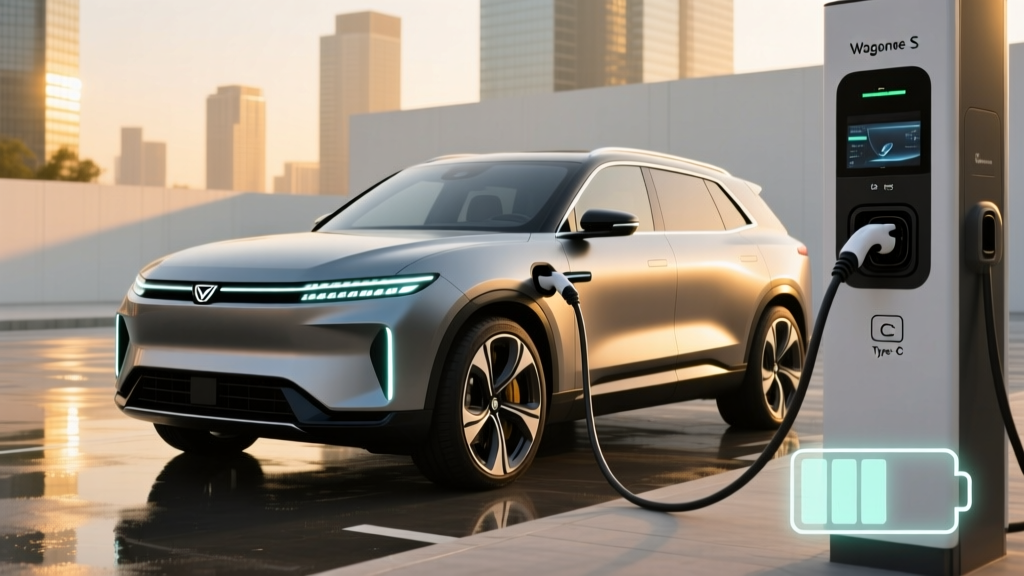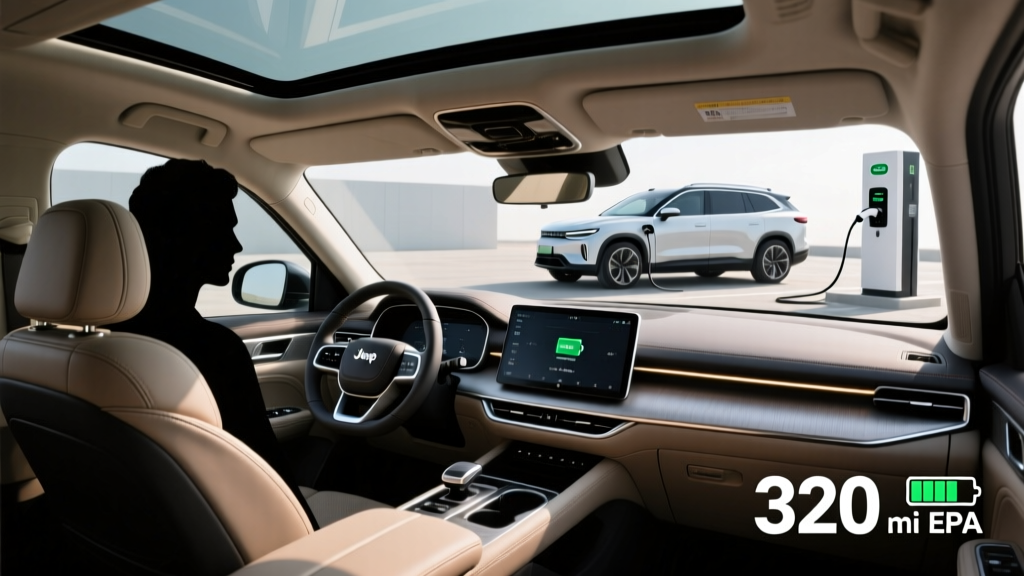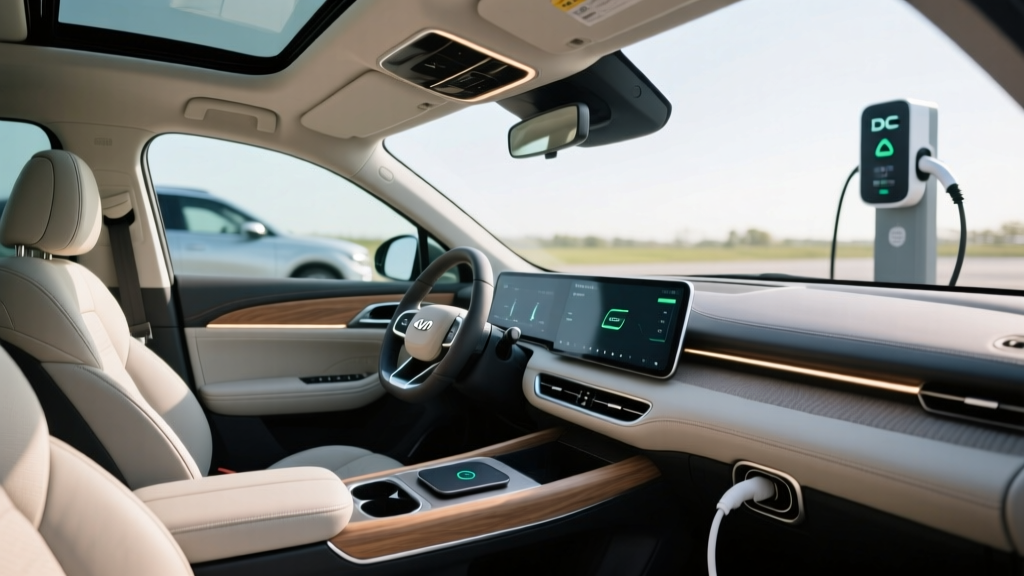
The three-row electric SUV segment has a clear benchmark, and it isn't wearing a luxury badge. The Kia EV9 pairs a genuinely usable third row with an 800-volt architecture that charges faster than almost anything in its class. For 2026, Kia continues the EV9 with minor trim adjustments, but the core formula remains the same: a spacious cabin, strong DC charging, and a starting price that undercuts European rivals by tens of thousands.
This review digs into the Kia EV9 interior, real-world range expectations, charging speeds, and the total cost picture after federal incentives. If you're cross-shopping the Rivian R1S, Tesla Model X, or Hyundai Ioniq 9, the numbers below should make the decision easier.
Quick Verdict: Who the EV9 Is For
The EV9 fits families who need three usable rows, want sub-25-minute fast-charging stops on road trips, and prefer not to pay luxury-SUV premiums. The Light RWD trim is the value play at 304 miles of EPA range; the GT-Line AWD sacrifices roughly 35 miles for dual-motor performance and a more aggressive look. Towing capacity tops out at 5,000 pounds on AWD trims when properly equipped — adequate for a small boat or camper trailer, but not a heavy horse trailer.
Choose the EV9 if: You need a third row, want fast DC charging without a Tesla badge, and value a 10-year powertrain warranty.
Look elsewhere if: You regularly tow over 5,000 lbs, need over 320 miles of range, or want a frunk (the EV9 has a small one only on RWD trims).
Kia EV9 Interior Space, Cargo, and Cabin Tech
The Kia EV9 interior is the primary reason buyers choose it over the Hyundai Ioniq 5 or Tesla Model Y. Built on the E-GMP platform with a flat floor and a 123.6-inch wheelbase, the cabin feels closer to a minivan than a midsize SUV in terms of passenger volume.
Passenger Dimensions
| Measurement | Row 1 | Row 2 | Row 3 |
|---|---|---|---|
| Headroom (in) | 40.0 | 39.0 | 37.8 |
| Legroom (in) | 41.4 | 42.8 | 32.0 |
| Shoulder room (in) | 59.6 | 58.4 | 54.6 |
Second-row legroom is exceptional — 42.8 inches exceeds what most full-size SUVs offer. The third row's 32.0 inches of legroom accommodates children and shorter adults on trips under two hours. For adults over 5'10", the third row works for errands but not cross-country drives.
Cargo Volume
- Behind Row 3: 20.2 cu ft (enough for 4–5 carry-on suitcases)
- Behind Row 2 (Row 3 folded): 43.5 cu ft
- Behind Row 1 (all rear seats folded): 81.7 cu ft
- Front trunk (frunk): 1.8 cu ft on RWD; 0.5 cu ft on AWD (fits a charging cable bag, not much else)
Infotainment and Displays
The dashboard features dual 12.3-inch screens (instrument cluster and infotainment) under a single curved glass panel running Kia's latest ccNC (Connected Car Navigation Cockpit) software. Wireless Apple CarPlay and Android Auto are standard across all trims. Physical buttons remain for climate controls and volume — a practical choice that avoids the touchscreen-only frustration found in some competitors.
Available features include a head-up display with augmented-reality navigation prompts, a digital rearview mirror, and Hyundai Motor Group's Highway Driving Assist 2 (HDA2), which provides adaptive cruise control with lane-centering and automated lane changes on divided highways. HDA2 is an SAE Level 2 system — the driver must keep hands on the wheel and eyes on the road at all times.
Range, Battery, and Efficiency
The EV9 uses a 99.8 kWh (total) / ~95.0 kWh (usable) lithium-ion battery pack with NMC (nickel-manganese-cobalt) chemistry. Kia does not offer an LFP variant for the EV9 in the US market. The NMC pack delivers higher energy density, which is necessary for a vehicle of this size, but it also means you should avoid routinely charging to 100% for daily use — setting the charge limit to 80% will help preserve long-term battery health.
| Spec | Light RWD | Wind/Land/GT-Line AWD |
|---|---|---|
| EPA Range | 304 mi (20" wheels) / 230 mi (GT-Line 21") | 280 mi (Wind) / 270 mi (Land) / 257 mi (GT-Line) |
| Battery (usable) | ~95.0 kWh, NMC | |
| MPGe (combined) | 88 MPGe | 83–85 MPGe |
| kWh/100 mi | 38 kWh | 39–41 kWh |
| Drivetrain | RWD, single motor | AWD, dual motor |
| Horsepower | 215 hp | 379 hp |
| 0–60 mph | 7.6 sec | 4.5 sec |
| Towing (max) | 2,000 lbs | 5,000 lbs (w/ brake) |
Real-World Range Reality: The EPA 304-mile figure for the Light RWD assumes a mix of city and highway driving at moderate temperatures. Expect roughly 250–270 miles on sustained highway driving at 70–75 mph. In cold weather (below 32°F), range drops 15–25% depending on cabin heating use — plan for 200–230 miles in winter conditions. The GT-Line AWD's 257-mile EPA rating translates to approximately 210–230 miles highway, 170–190 miles in cold weather.
Charging Speed: DC Fast, Level 2, and the 800V Advantage
The EV9's 800-volt electrical architecture is its most underappreciated feature. While most competitors in this price range use 400V systems, the EV9 can accept up to 236 kW peak DC fast-charge power at a compatible 350 kW charger. That translates to a 10–80% charge in approximately 24 minutes under ideal conditions (warm battery, low state of charge at plug-in).
However, the charging curve tapers significantly above 80%. Charging from 80–100% can add another 25–30 minutes, so for road trips, plan stops around the 70–80% mark and move on rather than waiting for a full charge.
| Charging Level | Power / Rate | Time / Miles Added |
|---|---|---|
| Level 1 (120V household) | ~1.4 kW | ~4 miles per hour of charging |
| Level 2 (240V home, 48A) | ~11.5 kW | ~33 miles per hour; full charge in ~9 hours |
| DC Fast Charge (peak) | 236 kW peak | 10–80% in ~24 min; ~150 mi in 15 min |
| DC Fast Charge (sustained avg) | ~150–170 kW avg (10–80%) | Real-world sessions vary by temperature |
Home charging setup: A 48-amp Level 2 wall connector on a 60-amp dedicated circuit will fully replenish the EV9 overnight. Most owners will plug in at 20–30% remaining and wake up to 80% — roughly 7 hours of charging. Expect to pay $800–$1,800 for a professional Level 2 installation, depending on panel capacity and conduit run distance. If your home has a 100-amp electrical panel, a panel upgrade to 200 amps may be necessary, adding $1,500–$3,000.
The EV9 ships with a NACS (North American Charging Standard) port for 2026, giving direct access to Tesla Supercharger stations via native plug — no adapter required. CCS1 compatibility is maintained via an included adapter for Electrify America and other legacy networks.
Pricing, Trims, and Federal Tax Credit Eligibility
The 2026 Kia EV9 starts at $54,900 for the Light RWD trim (excluding destination). Fully loaded GT-Line AWD models with the Premium Package approach $75,000. Here's the trim breakdown:
| Trim | Drivetrain | Base MSRP | Est. After §30D Credit* |
|---|---|---|---|
| Light | RWD | $54,900 | $47,400 |
| Wind | AWD | $63,900 | $56,400 |
| Land | AWD | $69,900 | $62,400 |
| GT-Line | AWD | $73,900 | $66,400 |
*Federal tax credit estimate. Actual eligibility depends on IRS §30D requirements.
Federal Tax Credit: §30D Rules to Know
As of 2026, the Kia EV9 is assembled in West Point, Georgia, which qualifies it for the up to $7,500 federal tax credit under IRS §30D — but only if you meet all of the following criteria:
- MSRP cap: The EV9 is classified as an SUV, so the MSRP cap is $80,000. All current trims fall under this limit.
- Buyer income cap: Modified adjusted gross income (MAGI) must not exceed $150,000 (single), $225,000 (head of household), or $300,000 (married filing jointly).
- Battery sourcing: A percentage of critical minerals and battery components must be sourced from the US or free-trade-agreement countries. Kia has confirmed the EV9 meets the 2026 thresholds for the full $7,500, but always verify with the IRS clean vehicle credit page before purchasing.
- Point-of-sale transfer: You can transfer the credit to the dealer at purchase, reducing your out-of-pocket cost immediately rather than waiting to claim it on your tax return.
Consult a tax professional for your specific situation. State and local incentives (such as utility rebates for home charger installation) may stack on top of the federal credit but vary by jurisdiction.
Pros, Cons, and How It Compares
Pros
- Genuine 3-row usability with 42.8" second-row legroom
- 800V architecture: 10–80% in ~24 min at 350 kW chargers
- 304-mile EPA range on RWD; strong for a 3-row SUV
- 10-year/100,000-mile powertrain warranty; 8-year/100,000-mile battery warranty
- NACS port standard for 2026 — direct Supercharger access
- Physical climate buttons; wireless CarPlay/Android Auto
- US-assembled (Georgia), eligible for full $7,500 §30D credit
Cons
- GT-Line AWD range drops to 257 mi EPA (~190 mi cold)
- Frunk is nearly useless (0.5–1.8 cu ft depending on trim)
- Third-row legroom (32") tight for adults on long trips
- No LFP battery option for buyers who prefer 100% daily charging
- Base Light trim lacks premium features (no ventilated seats, no HUD)
- Insurance costs run 15–25% higher than comparable gas SUVs
EV9 vs. Key Competitors
| Spec | Kia EV9 (Land AWD) | Rivian R1S (Dual-Motor) | Tesla Model X (LR) |
|---|---|---|---|
| EPA Range | 270 mi | 352 mi (Max Pack) | 335 mi |
| Starting MSRP | $69,900 | $79,900 | $84,990 |
| 10–80% DC Charge | ~24 min | ~30 min | ~25 min |
| 3rd-Row Legroom | 32.0" | 33.4" | 34.9" |
| Towing Max | 5,000 lbs | 7,700 lbs | 5,000 lbs |
| Federal §30D Credit | Eligible (up to $7,500) | Eligible (up to $7,500) | Eligible (up to $7,500) |
The EV9's advantage is price-to-space ratio. The Rivian R1S offers superior range and towing but costs $10,000+ more and has a shorter warranty. The Model X has more third-row room and Supercharger network maturity, but its starting price is $15,000 higher and its interior quality has drawn consistent criticism. For buyers prioritizing value and warranty coverage, the EV9 wins on cost per square foot of cabin space.
Ownership Costs and Warranty
Kia backs the EV9 with one of the strongest warranty packages in the EV space:
- Battery: 8 years / 100,000 miles (retains ≥70% capacity per Kia's warranty threshold)
- Powertrain: 10 years / 100,000 miles
- Bumper-to-bumper: 5 years / 60,000 miles
- Roadside assistance: 5 years / 60,000 miles
The battery warranty's 70% capacity retention threshold is industry-standard. Real-world NMC degradation data from Hyundai Motor Group's E-GMP vehicles (Ioniq 5, EV6) suggests approximately 8–12% degradation over 100,000 miles when owners avoid routine 100% charges and DC fast-charge moderately. The EV9's larger thermal management system should produce similar or slightly better results.
For a 5-year ownership estimate, the EPA's fueleconomy.gov lists the EV9 Land AWD at approximately 39 kWh/100 miles. At the US average electricity rate of $0.17/kWh, that's roughly $663 per year in electricity for 10,000 miles of driving — compared to approximately $1,500–$1,800 in gasoline for a similarly sized gas SUV at 22 MPG combined and $3.50/gallon.
Frequently Asked Questions
What is the real-world range of the Kia EV9?
The EPA rates the EV9 Light RWD at 304 miles and the GT-Line AWD at 257 miles. In real-world highway driving at 70–75 mph, expect 250–270 miles (RWD) or 210–230 miles (AWD). Cold weather below freezing reduces range by 15–25%, so winter road trips require more conservative planning.
How fast does the EV9 charge at home and on the road?
On a 48-amp Level 2 home charger, the EV9 adds roughly 33 miles per hour, with a full charge taking about 9 hours. At a 350 kW DC fast charger, it peaks at 236 kW and charges from 10–80% in approximately 24 minutes. Charging slows considerably above 80% due to the battery management system protecting cell longevity.
Does the 2026 Kia EV9 qualify for the $7,500 federal tax credit?
Yes — the EV9 is assembled in Georgia and meets the 2026 battery-sourcing requirements for the full $7,500 credit under IRS §30D. However, you must also meet income caps ($300,000 joint / $150,000 single) and the vehicle MSRP must be under $80,000 (all EV9 trims qualify). The credit can be transferred to the dealer at point of sale. Always verify current eligibility on irs.gov.
Is the Kia EV9 worth buying over the Rivian R1S or Tesla Model X?
If your priorities are a usable third row, strong fast-charging speed, a 10-year powertrain warranty, and a sub-$70,000 price before incentives, the EV9 is the most practical choice. The Rivian R1S is better for towing and off-road use; the Model X offers more range and third-row room but at a steep price premium.
Does the EV9 have a frunk?
Yes, but it's small. RWD trims offer 1.8 cu ft — enough for a charging cable bag or a small backpack. AWD trims shrink to 0.5 cu ft due to the front motor. Don't plan on storing groceries up front.
What is the EV9's safety rating?
The EV9 earned a 5-star overall safety rating from NHTSA and was named an IIHS Top Safety Pick+ for the prior model year. Standard safety features include forward collision-avoidance assist, blind-spot monitoring, rear cross-traffic collision-avoidance, and safe exit assist.