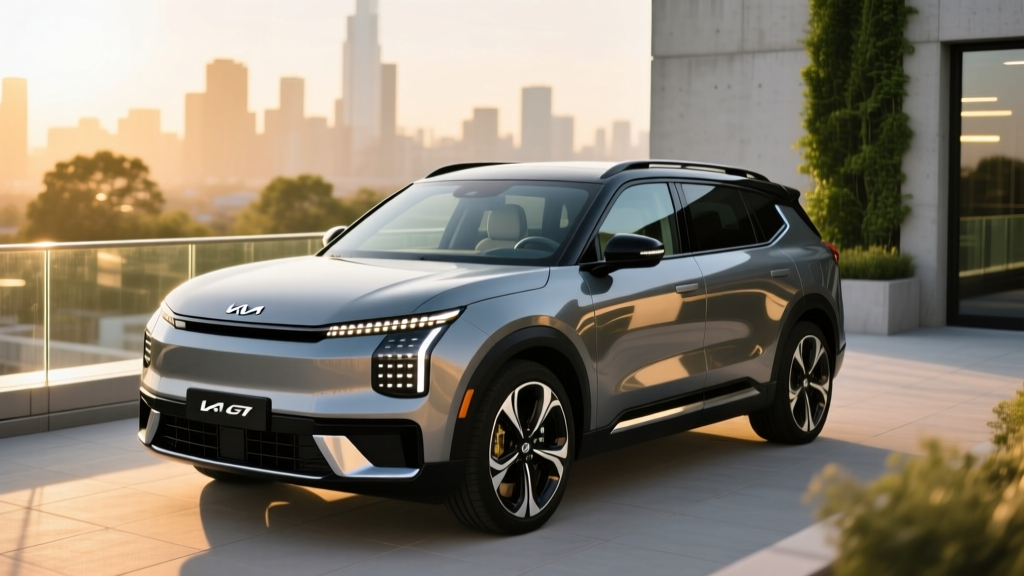
The three-row electric SUV segment has matured quickly, but the Kia EV9 GT-Line remains one of the few that genuinely fits six adults, charges at flagship speeds, and undercuts luxury rivals on price. Now in its third model year for 2026, the EV9 GT-Line carries over the dual-motor AWD powertrain that debuted in 2024 while receiving updated infotainment software, revised ADAS tuning, and expanded NACS-native charging support. If you're cross-shopping the Rivian R1S, Tesla Model X, or even the Hyundai Ioniq 9, this profile gives you the exact numbers you need to decide.
Quick Verdict: Who the EV9 GT-Line Is For
The EV9 GT-Line targets families who need three usable rows, want DC fast-charging that actually keeps up on road trips, and prefer a mainstream warranty over a luxury badge. It is not a performance SUV in the Model X Plaid sense — the GT-Line moniker here is an appearance and equipment package, not a track tune. Choose it if your priority is passenger space, 800-volt charging architecture, and a sub-$75,000 starting price before incentives.
Look elsewhere if: You want sub-4-second 0-60 performance, need over 320 miles of EPA range, or require hands-free Level 2+ highway driving comparable to GM Super Cruise.
Range, Battery & Real-World Efficiency
The 2026 EV9 GT-Line uses a 100.0 kWh usable battery pack (109.5 kWh gross) built on Hyundai Motor Group's E-GMP platform with an 800-volt electrical architecture. Kia sources NMC (nickel-manganese-cobalt) cells from SK On, consistent with prior model years. The GT-Line comes exclusively with dual-motor AWD, which trims range compared to the single-motor Light/Wind trims.
| Attribute | Value |
|---|---|
| EPA Range (AWD GT-Line) | 270 miles |
| Battery Usable Capacity | 100.0 kWh (NMC, SK On) |
| Drivetrain | Dual-motor AWD |
| Horsepower / Torque | 379 hp / 516 lb-ft (GT-Line w/ boost) |
| 0-60 mph | 5.0 seconds |
| MPGe (Combined) | 85 MPGe (est.) |
| Efficiency | ~39 kWh/100 mi |
| Max DC Fast Charge | 238 kW peak |
| 10-80% DC Time | ~20 minutes (optimal conditions) |
| Level 2 Home Charging | 10.9 kW / ~33 mi/hr |
| Towing Capacity | 5,000 lbs (w/ towing package) |
| Base MSRP (GT-Line AWD) | $69,900 |
| Battery Warranty | 10 years / 100,000 miles |
Efficiency in the large-SUV class is respectable at roughly 39 kWh per 100 miles. That's less efficient than the Tesla Model X (~34 kWh/100 mi) but comparable to the Rivian R1S dual-motor. The 800V architecture's main advantage isn't efficiency — it's charging speed, which we'll cover next.
Charging Speed: DC Fast & Home Level 2
This is where the EV9 GT-Line earns its keep. The 800V platform allows peak DC charging rates of 238 kW at compatible chargers (Electrify America 350 kW stalls, Tesla Supercharger V4 with NACS adapter, or any CCS2/NACS station delivering 400+ amps). Kia has transitioned the 2026 EV9 to a native NACS charge port, eliminating the need for the CCS-to-NACS adapter that 2024-2025 models required.
| Charging Level | Power | Rate / Time | Typical Use |
|---|---|---|---|
| Level 1 (120V household) | ~1.4 kW | ~4 mi/hr | Emergency / overnight trickle |
| Level 2 (240V home) | 10.9 kW | ~33 mi/hr; full charge ~9.5 hrs | Daily home charging |
| DC Fast (peak) | 238 kW | 10-80% in ~20 min | Road-trip stops |
| DC Fast (sustained avg) | ~160-180 kW | 10-80% real-world ~24 min | Average session with taper |
Charging curve reality: The 238 kW peak is achieved between roughly 10-45% state of charge. Above 55%, the rate tapers to ~150 kW, and above 80%, it drops further to protect the battery. A 10-80% session at a well-maintained 350 kW Electrify America station typically takes 20-24 minutes. At a 150 kW station, expect 35-40 minutes. Battery preconditioning activates automatically when you navigate to a charger via the built-in route planner — this is critical for achieving peak rates in cold weather.
For home charging, the 10.9 kW onboard charger adds roughly 33 miles of range per hour, meaning a full recharge from near-empty takes about 9-10 hours on a 48-amp Level 2 circuit. Most owners charging overnight from 20-80% will need only 5-6 hours.
Performance, Ride & Drivetrain
The dual-motor AWD GT-Line produces 379 horsepower and 516 lb-ft of torque when the GT boost mode is engaged (standard on GT-Line). The 0-60 mph time of 5.0 seconds is quick for a 5,400-pound three-row SUV — roughly matching a base Porsche Cayenne — but it's not attempting to be a performance vehicle. The emphasis is on confident highway merging and passing.
Ride quality is composed thanks to a multi-link rear suspension, though the 21-inch wheels standard on GT-Line transmit more road imperfections than the 19-inch wheels on lower trims. The GT-Line does not include the adaptive air suspension available on the Ioniq 9 or Rivian R1S. Steering is light and accurate, and the turning radius is manageable for a vehicle of this size at 19.7 feet.
Regenerative braking offers multiple levels selectable via steering-wheel paddles, including an i-Pedal one-pedal driving mode that brings the EV9 to a complete stop. The brake blending between regen and friction brakes is well-tuned — a common weak point in early E-GMP vehicles that Kia has addressed.
Interior, Cargo & Passenger Space
The EV9's boxy design maximizes interior volume, and the GT-Line's premium touches (vegan leather, ambient lighting, aluminum trim) close the gap with luxury competitors without the luxury price.
| Measurement | Value |
|---|---|
| Front Legroom | 41.5 in |
| Second-Row Legroom | 42.8 in |
| Third-Row Legroom | 29.9 in |
| Cargo (behind 3rd row) | 20.2 cu ft |
| Cargo (3rd row folded) | 43.5 cu ft |
| Cargo (all rear rows folded) | 81.7 cu ft |
| Frunk (front trunk) | 3.2 cu ft (AWD) |
The second row offers captain's chairs (standard on GT-Line) with a walk-through gap to the third row. Third-row adults will find it tighter than a Telluride but more accommodating than a Tesla Model X's occasional rear seats. The 20.2 cu ft behind the third row fits roughly four carry-on suitcases — adequate for a family road trip if you use a roof box for overflow.
Tech highlights: The GT-Line features a 12.3-inch digital cluster merged with a 12.3-inch infotainment touchscreen running Kia's latest Connect software with wireless Apple CarPlay and Android Auto. Over-the-air updates, digital key (NFC + UWB), and a head-up display with augmented-reality navigation are standard. The GT-Line also includes a fingerprint-authenticated driver profile system and a premium 14-speaker Meridian audio system.
Pricing, Trims & Federal Tax Credit
The 2026 EV9 GT-Line AWD starts at $69,900 (including destination). A GT-Line S package adds ~$3,500 for features like a digital rearview mirror, remote smart parking assist, and premium interior materials, pushing the as-tested price to approximately $73,400.
| Trim | MSRP | Est. Federal Credit* | Effective Price |
|---|---|---|---|
| EV9 GT-Line AWD | $69,900 | Up to $7,500 | ~$62,400 |
| EV9 GT-Line S AWD | $73,400 | Up to $7,500 | ~$65,900 |
*Federal tax credit caveat (§30D): The up-to-$7,500 credit requires meeting all of the following per IRS rules: buyer AGI under $150,000 (single) / $300,000 (joint), vehicle MSRP under the $80,000 SUV cap, and compliance with critical-minerals and battery-component sourcing requirements. The EV9 is assembled in West Point, Georgia, which satisfies the North American final-assembly requirement. However, the battery-sourcing rules tighten annually — verify current-year eligibility on fueleconomy.gov before purchasing. As of early 2026, the EV9 qualifies for the full $7,500 for eligible buyers, and the point-of-sale transfer option allows you to apply the credit as a down-payment reduction at the dealer.
Safety, ADAS & Driver Assistance
The EV9 earned an IIHS Top Safety Pick+ rating (when equipped with specific headlights) and a 5-star overall NHTSA rating. Standard ADAS includes:
- Highway Driving Assist 2 (HDA2) — adaptive cruise + lane centering with lane-change assist
- Forward collision-avoidance assist with pedestrian/cyclist detection
- Blind-spot collision-avoidance assist
- Rear cross-traffic collision-avoidance
- Navigation-based smart cruise control (curve/speed-zone slowdown)
HDA2 is competent and less aggressive than some competitors in lane-centering calibration, but it lacks the hands-free capability of GM's Super Cruise or Ford's BlueCruise on pre-mapped highways. This is a notable gap if hands-free highway driving is a top priority.
Ownership Costs, Warranty & Competitor Comparison
Kia's warranty is among the strongest in the industry: 5 years/60,000 miles bumper-to-bumper and 10 years/100,000 miles on the battery and powertrain. The battery warranty guarantees at least 70% capacity retention over the 10-year period, though real-world E-GMP degradation data from 2022-2024 Ioniq 5 and EV6 owners suggests 90%+ retention is typical at 100,000 miles.
| Cost Factor | Kia EV9 GT-Line | Rivian R1S Dual | Tesla Model X LR |
|---|---|---|---|
| Purchase (after credit) | ~$62,400 | ~$74,900 | ~$79,990 |
| Est. 5-yr Fuel/Energy | $5,200 | $5,800 | $5,000 |
| Est. 5-yr Insurance | $11,500 | $13,200 | $14,000 |
| Est. 5-yr Maintenance | $1,800 | $2,200 | $1,500 |
| Est. 5-yr Depreciation | $22,000 | $28,000 | $30,000 |
| 5-Yr Total (est.) | ~$102,900 | ~$124,100 | ~$130,490 |
The EV9's 5-year total cost of ownership undercuts both the Rivian R1S and Tesla Model X by $20,000-$28,000, primarily due to its lower purchase price and Kia's historical depreciation curve being less punishing than luxury EV brands. Insurance costs are moderate for the class — expect $2,100-$2,500 annually depending on your state and driving record, per industry averages for large electric SUVs.
Pros & Cons
- 800V charging: 10-80% in ~20 min at 350 kW stations
- Genuine 3-row seating with usable cargo behind 3rd row
- 10-year/100,000-mile battery & powertrain warranty
- $69,900 MSRP undercuts luxury 3-row EVs by $10K-$30K
- Native NACS port (2026) — no adapter needed at Superchargers
- 5,000-lb towing capacity with factory tow package
- 270-mile EPA range is modest for the class; real-world ~235-250 mi highway
- No hands-free driving mode (HDA2 requires hands on wheel)
- 21-inch GT-Line wheels reduce ride comfort vs. 19-inch option
- 3rd-row legroom (29.9 in) tight for adults on long trips
- No frunk on AWD models (only 3.2 cu ft — effectively a cable storage bin)
- GT-Line is appearance package only — no performance upgrades over standard AWD
Frequently Asked Questions
What is the real-world range of the Kia EV9 GT-Line?
The EPA rates the GT-Line AWD at 270 miles. In real-world highway driving at 70-75 mph, expect 235-250 miles. In cold weather (below 30°F), plan for 200-220 miles. City driving with regenerative braking can match or slightly exceed the EPA estimate.
How fast does the EV9 GT-Line charge?
At a 350 kW DC fast charger, the EV9 peaks at 238 kW and charges from 10-80% in approximately 20-24 minutes (including taper above 55% SoC). At home on a 240V Level 2 charger (10.9 kW), it adds about 33 miles per hour, fully recharging overnight in ~9.5 hours.
Does the 2026 Kia EV9 GT-Line qualify for the federal EV tax credit?
As of early 2026, the EV9 qualifies for the full $7,500 federal tax credit under IRS §30D for eligible buyers. Requirements include: AGI under $150K (single) / $300K (joint), MSRP under the $80K SUV cap, and compliance with battery-sourcing rules. The EV9 is assembled in Georgia, satisfying the final-assembly requirement. Verify current eligibility at fueleconomy.gov before purchase. The credit can be transferred to the dealer at point of sale as a down-payment reduction.
Is the EV9 GT-Line worth buying vs. the Rivian R1S or Tesla Model X?
If your priorities are value, warranty, and practical three-row space, the EV9 GT-Line wins on total cost of ownership by $20K+ over 5 years. Choose the R1S if you need off-road capability, air suspension, or a larger frunk. Choose the Model X if you prioritize range (~330 mi EPA), the Supercharger network exclusively, or falcon-wing rear doors for tight parking. The EV9 is the pragmatic family choice.
Can the EV9 GT-Line tow, and how does towing affect range?
Yes — with the factory towing package, the EV9 GT-Line AWD is rated for 5,000 lbs. Towing a 3,500-lb camper trailer typically reduces range by 40-50%, bringing real-world towing range to approximately 120-150 miles. Plan charging stops accordingly and use the built-in route planner's towing mode for accurate range estimates.
What is the battery warranty and expected degradation?
Kia covers the battery for 10 years or 100,000 miles, guaranteeing at least 70% capacity retention. Based on E-GMP platform data from 2022-2025 models, most owners see 5-8% degradation at 50,000 miles, suggesting 90%+ retention at the warranty limit is realistic. NMC chemistry in this pack is well-managed by the liquid thermal management system.
The 2026 Kia EV9 GT-Line occupies a specific and compelling niche: the most affordable three-row electric SUV with flagship-tier DC charging speeds, a class-leading warranty, and genuine daily-driver practicality. Its 270-mile EPA range won't win road-trip marathons against a Model X, and its hands-on-wheel ADAS lags behind GM and Ford's hands-free systems. But at roughly $62,400 after the federal credit, with 20-minute charging stops and Kia's 10-year safety net, it's the EV that the growing family-utility segment has been waiting for.