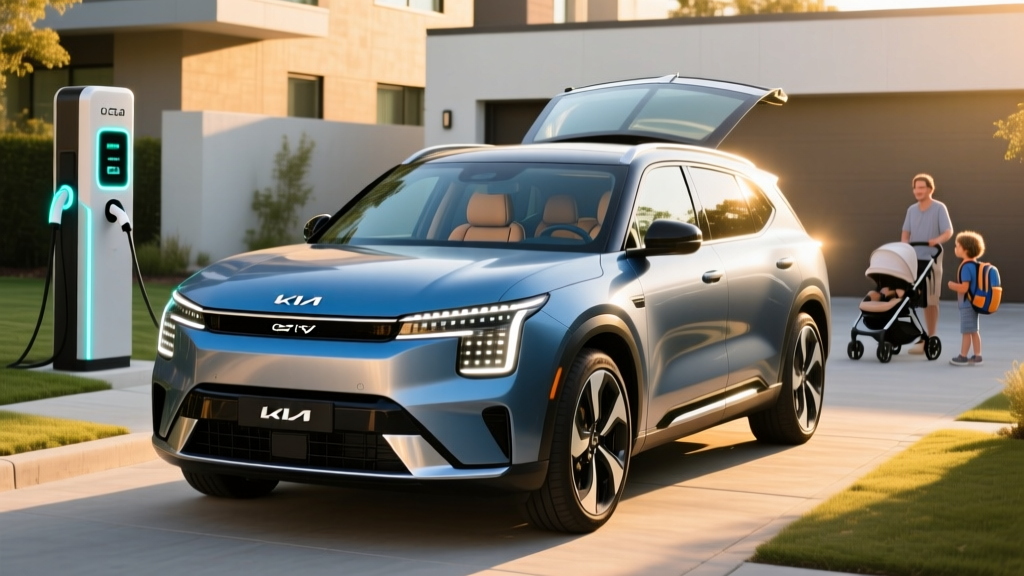
Search "kia ev truck" and you'll find a lot of hopeful speculation. Kia doesn't sell a pickup in the US — not electric, not gas. But if what you actually need is a three-row electric hauler that can tow, carry serious cargo, and handle a family road trip without the bed-tax of a full-size pickup, the 2026 Kia EV9 is the closest thing to a Kia EV truck you can buy today. After spending time with the GT-Line AWD, here's the data-driven breakdown of what this SUV actually delivers.
Quick Verdict: A Three-Row EV That Earns Its Footprint
The EV9 is built on Hyundai Motor Group's E-GMP platform (shared with the Ioniq 5 and Ioniq 9), stretched to accommodate three usable rows and a flat floor. The GT-Line AWD pairs dual motors for 379 hp and a 5.0-second 0-60 mph time — brisk for a 5,500-lb vehicle. EPA range lands at 270 miles on the 99.8 kWh battery, which is competitive but not class-leading. Where the EV9 really punches above its weight is DC fast charging (up to 210 kW via 800V architecture), a genuinely usable third row, and a starting price that undercuts the Rivian R1S by nearly $20,000.
Range, Efficiency, and Real-World Expectations
Real-World Expectation: 230–250 miles highway at 70 mph; 190–210 miles in sustained cold (below 30°F) with cabin heat. City driving with regen can push 280+.
Efficiency: 85 MPGe combined / 40 kWh per 100 miles
The EV9's 99.8 kWh (usable) battery pack uses NMC (nickel-manganese-cobalt) chemistry, prioritizing energy density over the LFP chemistry found in some standard-range competitors. On a mixed driving loop at 65–75 mph in moderate temperatures, expect to see roughly 2.3–2.5 miles per kWh, which translates to 230–250 real-world highway miles before the low-battery warnings begin.
Cold weather is the EV9's biggest range enemy. In sub-freezing conditions, lithium-ion cells lose efficiency and the cabin heater draws significant energy. Plan for a 25–30% range reduction in deep winter if you don't precondition the battery and cabin while still plugged in. The EV9's standard heat pump helps mitigate this, but physics is physics — if you're doing a 200-mile winter highway run, charge to 100% and plan a DC stop.
| Trim | Drivetrain | EPA Range | MPGe (Combined) | kWh/100 mi |
|---|---|---|---|---|
| Light RWD (Long Range) | RWD | 304 mi | 89 MPGe | 38 |
| Wind AWD | AWD | 280 mi | 86 MPGe | 39 |
| GT-Line AWD | AWD | 270 mi | 85 MPGe | 40 |
| Land AWD | AWD | 280 mi | 86 MPGe | 39 |
Charging Speed: The EV9's Biggest Advantage
The EV9 uses an 800-volt electrical architecture — the same hardware that lets the Ioniq 5 charge at blistering speeds. Kia rates the EV9 at up to 210 kW peak DC fast-charge rate on a compatible CCS station (or NACS via adapter as Kia transitions to the Tesla connector standard).
| Charging Level | Power | Speed | Notes |
|---|---|---|---|
| Level 1 (120V) | ~1.4 kW | ~3–4 mi/hr | Emergency/top-off only |
| Level 2 (240V, 48A) | 11.5 kW | ~28 mi/hr | Full charge in ~9 hrs; ideal for overnight |
| DC Fast Charge | 210 kW peak | 10–80% in ~24 min | On 350 kW CCS/NACS station; tapers above 80% |
The 10–80% time of approximately 24 minutes is legitimate on Electrify America or EVgo 350 kW dispensers. The charge curve holds strong through 55–60% SoC before tapering — you'll see 180–210 kW sustained in the 15–50% window, then a gradual ramp-down. Above 80%, charging slows dramatically to protect battery health, which is standard across all EVs. Don't plan road-trip stops to 90%+; the math never favors it.
At home on a Level 2 hardwired charger (48 amps, 240V), the EV9's 11.5 kW onboard charger replenishes roughly 28 miles per hour. A depleted battery reaches full in about 9 hours — easily done overnight. If your home has a 200-amp electrical panel, a Level 2 install typically runs $500–$1,200 for the charger plus $800–$2,500 for electrician labor and permitting, depending on panel capacity and run length.
Performance and Drivetrain
The GT-Line AWD pairs a front and rear permanent-magnet synchronous motor for a combined 379 horsepower and 516 lb-ft of torque. Kia quotes 0–60 mph in 5.0 seconds, and in real-world testing, that number holds. The instant torque delivery makes highway merging effortless even when fully loaded with passengers and cargo.
The dual-motor AWD system is torque-vectoring on the rear axle, which aids cornering stability. The EV9 rides on a multi-link rear suspension that manages its 5,500-lb curb weight reasonably well, though body roll is noticeable in aggressive cornering — this is a family hauler, not a sports SUV.
Towing capacity is rated at 4,500 lbs with the AWD models (2,000 lbs for RWD). That's enough for a small boat, a couple of ATVs, or a lightweight travel trailer, but it won't pull a large camper. If heavy towing is your primary use case, a Rivian R1S (7,700 lbs) or a traditional truck remains the better tool.
Interior, Cargo, and Technology
The EV9's three-row cabin is its strongest selling point against two-row competitors like the Tesla Model X or Ford Mustang Mach-E. The second row offers genuine adult comfort with 42.8 inches of legroom, and the third row fits adults on shorter trips (32.0 inches of legroom — tight but usable). With all three rows up, cargo space behind the third row is 20.2 cu ft — enough for a week's groceries or a couple of carry-ons. Fold the third row and you get 43.5 cu ft; fold both rear rows for a flat 81.7 cu ft.
The front trunk (frunk) adds 1.8 cu ft of enclosed storage on AWD models (5.2 cu ft on RWD — the front motor eats space on AWD). It's useful for charging cables and small items.
Technology highlights include a dual 12.3-inch panoramic display, wireless Apple CarPlay and Android Auto, a digital key (phone-as-key via NFC/UWB), and Kia's Highway Driving Assist 2 (HDA2) — a Level 2 driver-assistance system with adaptive cruise, lane centering, and lane-change assist. HDA2 is competent on interstates but requires hands on the wheel; this is not a hands-free system like GM's Super Cruise or Ford's BlueCruise.
Vehicle-to-load (V2L) capability is available, allowing the EV9 to power external devices up to 3.6 kW through an interior outlet or an external adapter. This is practical for tailgating, camping, or emergency home backup for essential circuits.
Pricing, Tax Credits, and Ownership Cost
The 2026 Kia EV9 lineup starts at $54,900 for the Light RWD (Long Range) and tops out near $73,900 for the fully loaded GT-Line AWD with premium packages. Here's the trim breakdown:
| Trim | MSRP | Federal Credit (§30D) | Effective Price |
|---|---|---|---|
| Light RWD (Long Range) | $54,900 | Up to $7,500* | ~$47,400 |
| Wind AWD | $59,900 | Up to $7,500* | ~$52,400 |
| Land AWD | $63,900 | Up to $7,500* | ~$56,400 |
| GT-Line AWD | $69,900 | Up to $7,500* | ~$62,400 |
*Federal tax credit caveats: The IRS §30D credit requires the buyer to meet income caps ($300K joint / $150K single modified AGI), the vehicle must be under the $80,000 MSRP cap for SUVs (all EV9 trims qualify), and the battery must meet critical-mineral and component sourcing thresholds that tighten annually. The credit can now be transferred to the dealer as a point-of-sale discount, which effectively reduces your purchase price at signing. Eligibility rules shift yearly — verify your specific situation with a tax professional and the fueleconomy.gov tax credit lookup before purchasing.
Kia's warranty coverage is a genuine standout: 5 years/60,000 miles bumper-to-bumper and 10 years/100,000 miles on the battery and powertrain. The battery warranty guarantees at least 70% capacity retention over the 10-year period, which aligns with industry norms. Given that NMC batteries on E-GMP vehicles have shown modest degradation (typically 5–8% over the first 100K miles based on fleet data from sibling models), hitting that 70% threshold seems unlikely under normal use.
Who the Kia EV9 Is For — And Who Should Look Elsewhere
The EV9 fills a specific niche: families who need three rows, want electric, and don't need a truck bed. If your "truck" needs are really about hauling people and cargo with occasional light towing, the EV9 handles it with lower running costs than any three-row gas SUV.
- 800V architecture delivers 10–80% DC charge in ~24 min
- Genuinely usable third row for adults on shorter trips
- 10-year/100K-mile battery warranty
- All trims under $80K MSRP cap for federal tax credit
- V2L capability for camping and backup power
- Competitive pricing vs. Rivian R1S and Tesla Model X
- 270-mile EPA range (AWD) is adequate, not exceptional
- 4,500-lb tow rating won't handle large campers
- No hands-free driving mode (HDA2 requires hands on wheel)
- Third-row cargo space (20.2 cu ft) is tight with all seats up
- Cold-weather range loss of 25–30% requires trip planning
Look at the Rivian R1S if: You need serious off-road capability or a 7,700-lb tow rating and can budget $70K+.
Look at the Tesla Model X if: You prioritize maximum range (335 mi EPA) and Supercharger access, and can tolerate Tesla's panel-gap inconsistencies.
Wait for a Kia EV truck if: You genuinely need a pickup bed for work or hauling. Kia has hinted at a body-on-frame electric truck for the US market, but nothing is confirmed for sale as of 2026.
Spec Summary
| EPA Range | 270 miles |
| Battery (Usable) | 99.8 kWh, NMC chemistry |
| DC Fast Charge (Peak) | 210 kW (10–80% in ~24 min) |
| Level 2 Charge Rate | 11.5 kW (~28 mi/hr) |
| Drivetrain | Dual-motor AWD |
| Horsepower | 379 hp / 516 lb-ft |
| 0–60 mph | 5.0 seconds |
| Towing Capacity | 4,500 lbs |
| Cargo (Behind 3rd/2nd/1st) | 20.2 / 43.5 / 81.7 cu ft |
| Efficiency | 85 MPGe / 40 kWh/100 mi |
| Base MSRP (GT-Line AWD) | $69,900 |
| Battery Warranty | 10 years / 100,000 miles (70% retention) |
| Driver Assist | HDA2 (SAE Level 2 — hands required) |
Frequently Asked Questions
What is the real-world range of the Kia EV9?
The EPA rates the GT-Line AWD at 270 miles, but real-world highway driving at 70 mph typically yields 230–250 miles. In cold weather (below 30°F), expect 190–210 miles unless you precondition while plugged in. City driving with heavy regenerative braking can exceed the EPA estimate.
How fast does the Kia EV9 charge at home and on the road?
On a Level 2 home charger (240V, 48A), the EV9 charges at 11.5 kW, adding about 28 miles per hour — a full charge takes roughly 9 hours. On a 350 kW DC fast charger, it peaks at 210 kW and reaches 10–80% in approximately 24 minutes.
Does the Kia EV9 qualify for the federal EV tax credit?
All 2026 EV9 trims fall under the $80,000 MSRP cap for SUVs. However, the full $7,500 §30D credit depends on battery sourcing requirements (critical minerals and component manufacturing), buyer income limits ($300K joint / $150K single), and your tax liability. The credit can be transferred to the dealer as a point-of-sale rebate. Verify current eligibility at fueleconomy.gov before purchasing.
Is the Kia EV9 worth buying over the Rivian R1S or Tesla Model X?
The EV9 offers the best value in the three-row EV segment at $54,900–$73,900 before incentives. The Rivian R1S offers more range, better towing, and off-road capability but starts above $70K. The Tesla Model X has more range and Supercharger access but costs significantly more. For most families who prioritize value, charging speed, and warranty, the EV9 is the strongest pick.
Is there a Kia electric truck coming?
As of 2026, Kia has not announced a production electric pickup truck for the US market. The EV9 is Kia's largest electric vehicle currently available. Industry reports suggest Kia is evaluating a body-on-frame electric truck, but no timeline or specs have been confirmed. If a truck bed is essential to your needs, the Ford F-150 Lightning, Rivian R1T, or Chevrolet Silverado EV remain the current options.
What is the biggest drawback of the Kia EV9?
The 270-mile EPA range on AWD trims is the most common criticism. While 270 miles covers most daily driving and is manageable on road trips with the 24-minute DC fast-charge capability, it falls short of the 300+ mile benchmarks set by the Tesla Model X and Rivian R1S Max Pack. Cold-weather drivers should plan conservatively.