The Three-Row EV Landscape and the Kia EV9
The transition to electric family haulers has historically been bottlenecked by exorbitant prices and limited options. For years, parents seeking a three-row electric SUV were forced to choose between the ultra-premium Tesla Model X, the rugged but expensive Rivian R1S, or plug-in hybrid compromises. Enter the Kia EV9, a vehicle that aims to democratize the three-row electric SUV segment without sacrificing the technology, space, or performance required for modern family life. Built on the Hyundai Motor Group’s highly modular Electric-Global Modular Platform (E-GMP), the EV9 represents a data-backed leap forward in spatial efficiency and charging architecture. In this comprehensive review, we analyze the hard numbers behind the EV9’s powertrain, interior dimensions, and total cost of ownership to determine if it truly is the ultimate family EV.
Battery Configurations and Real-World Range Data
The Kia EV9 offers a bifurcated powertrain strategy tailored to different family needs and budgets. The entry-level Standard Range model utilizes a 77.4 kWh battery pack paired with a single rear-mounted electric motor, producing 215 horsepower and an EPA-estimated range of 230 miles. While adequate for urban commuting and school runs, road-tripping families will gravitate toward the Long Range configurations.
The Long Range models feature a larger 99.8 kWh battery pack. When equipped with the single-motor rear-wheel-drive (RWD) setup, the EV9 achieves an EPA-estimated 304 miles of range. Opting for the dual-motor all-wheel-drive (AWD) system—which bumps output to 379 horsepower and 516 lb-ft of torque—reduces the range estimate to 280 miles. From a data-driven perspective, the EV9’s aerodynamic profile plays a critical role in these numbers. Despite its boxy, SUV silhouette, Kia engineers achieved a remarkably low drag coefficient (Cd) of 0.28 through active air flaps, a flat underbody, and optimized A-pillar angles. Real-world testing by automotive analysts frequently shows the RWD Long Range model achieving within 5% of its EPA estimates in mixed driving conditions, a testament to the thermal management efficiency of the E-GMP platform.
800-Volt Charging Architecture: Speed and Efficiency
Range is only half the equation for family road trips; charging speed dictates your itinerary. The EV9’s native 800-volt electrical architecture is a standout feature in this price bracket, allowing it to accept DC fast-charging rates that rival vehicles costing twice as much. When connected to a 350-kW charger, the EV9 can peak at approximately 236 kW.
The critical metric for families is the 10% to 80% state-of-charge time, which Kia rates at roughly 24 minutes under optimal conditions. Furthermore, the EV9’s charging curve is highly resilient. Data shows that the vehicle maintains a charging rate above 150 kW well past the 60% state-of-charge mark, meaning you spend less time waiting at the plug. Additionally, the EV9 supports Vehicle-to-Load (V2L) functionality, allowing the massive 99.8 kWh battery to output up to 3.68 kW of power. This is enough to run camping gear, power tools, or even essential home appliances during an outage via an available V2L adapter, adding a layer of utilitarian value that internal combustion family haulers simply cannot match.
Interior Dimensions and Cargo Capacity Analysis
For a three-row SUV, passenger comfort and cargo volume are the ultimate arbiters of success. The EV9’s wheelbase stretches to 122.0 inches, providing a massive footprint that translates directly into interior volume. Below is a data comparison of the EV9 against its primary electric competitors and a traditional internal combustion benchmark.
| Metric | Kia EV9 (AWD) | Tesla Model X | Rivian R1S |
|---|---|---|---|
| Cargo (Behind 3rd Row) | 20.2 cu-ft | 15.8 cu-ft | 10.6 cu-ft |
| Cargo (Behind 2nd Row) | 43.5 cu-ft | 41.1 cu-ft | 46.7 cu-ft |
| Max Cargo (All Seats Folded) | 81.7 cu-ft | 85.7 cu-ft | 104.7 cu-ft |
| Wheelbase | 122.0 in | 116.7 in | 121.1 in |
| 3rd Row Headroom | 37.8 in | 35.7 in | 37.3 in |
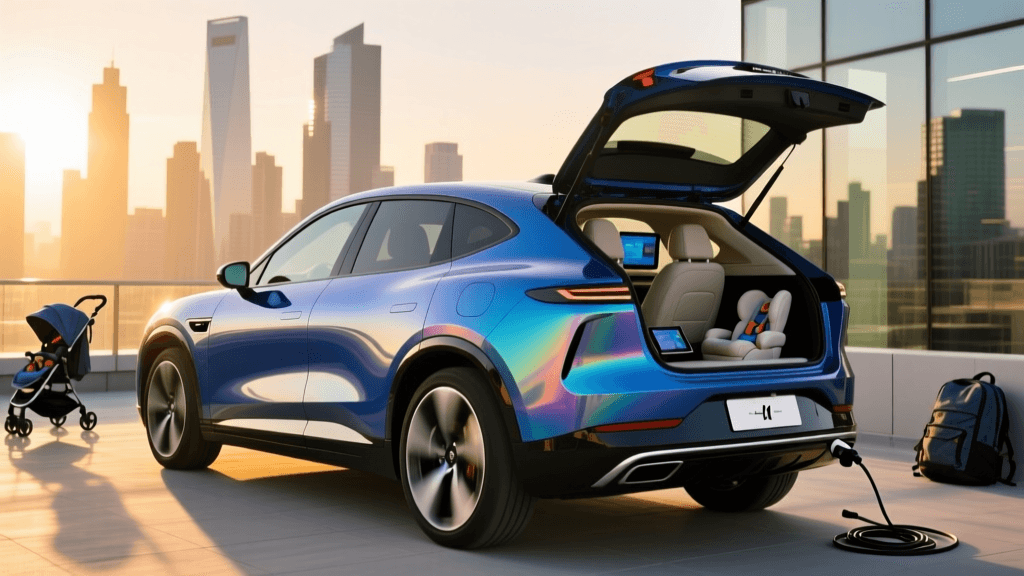
The data reveals a distinct advantage for the EV9 in behind-the-third-row cargo space. With 20.2 cubic feet available, families can easily fit multiple strollers or a week's worth of groceries without folding a single seat. The third-row headroom (37.8 inches) also outclasses the Model X, making the rearmost seats genuinely viable for teenagers or adults on shorter trips, rather than just small children.
Safety Metrics and Family-Centric Technology
Safety is paramount for family vehicles, and the EV9’s structural rigidity, bolstered by the battery pack's integration into the chassis, yields impressive crash-test metrics. According to IIHS safety ratings, the EV9 was engineered to meet stringent global crash standards, featuring a multi-load path structure designed to dissipate impact energy away from the passenger cell and high-voltage battery.
On the active safety front, the EV9 comes standard with Kia’s Highway Driving Assist 2 (HDA2). This system utilizes radar and camera sensors to maintain set distances, center the vehicle in its lane, and even assist with lane changes when the turn signal is engaged. Inside the cabin, the family experience is enhanced by a dual 12.3-inch panoramic display setup, a 12-inch augmented reality head-up display (HUD), and a digital rearview mirror—a crucial feature when the cargo area is packed to the roof and blocks the traditional glass mirror. Second-row captain’s chairs feature one-touch tilt-and-slide mechanisms for easy third-row access, and USB-C fast-charging ports are distributed across all three rows.
Trim-Level Value and Total Cost of Ownership
When analyzing the total cost of ownership, the EV9’s pricing structure is highly disruptive. As detailed in Edmunds' pricing and trim analysis, the EV9 starts at an MSRP of approximately $54,900 for the Standard Range Light trim, undercutting almost every other three-row EV on the market by tens of thousands of dollars. Even the fully loaded GT-Line AWD, which includes luxury amenities like Nappa leather, heated and ventilated massaging front seats, and a Meridian premium audio system, tops out around $73,900.
Comparatively, a similarly equipped Tesla Model X or Rivian R1S will easily push past the $90,000 to $100,000 threshold. Furthermore, EV owners benefit from drastically reduced maintenance costs. Without the need for oil changes, transmission fluid replacements, or spark plugs, and with regenerative braking significantly extending the life of the friction brake pads, the EV9’s long-term operational costs are a fraction of those associated with traditional gas-powered three-row SUVs like the Toyota Highlander or Ford Explorer.
Final Data-Driven Verdict
The Kia EV9 is not merely a compromise for families wanting to go electric; it is a benchmark vehicle that leverages data-driven engineering to solve the specific pain points of the family hauler segment. Its class-leading third-row cargo space, rapid 800V charging capabilities, and sub-$60,000 entry price create a value proposition that is currently unmatched in the automotive market. While the Rivian R1S offers superior off-road dynamics and the Tesla Model X boasts falcon-wing theatrics, the EV9 delivers exactly what the vast majority of families actually need: space, efficiency, safety, and financial sense. For parents ready to make the jump to a three-row EV, the data overwhelmingly points to the Kia EV9 as the smartest purchase on the market today.