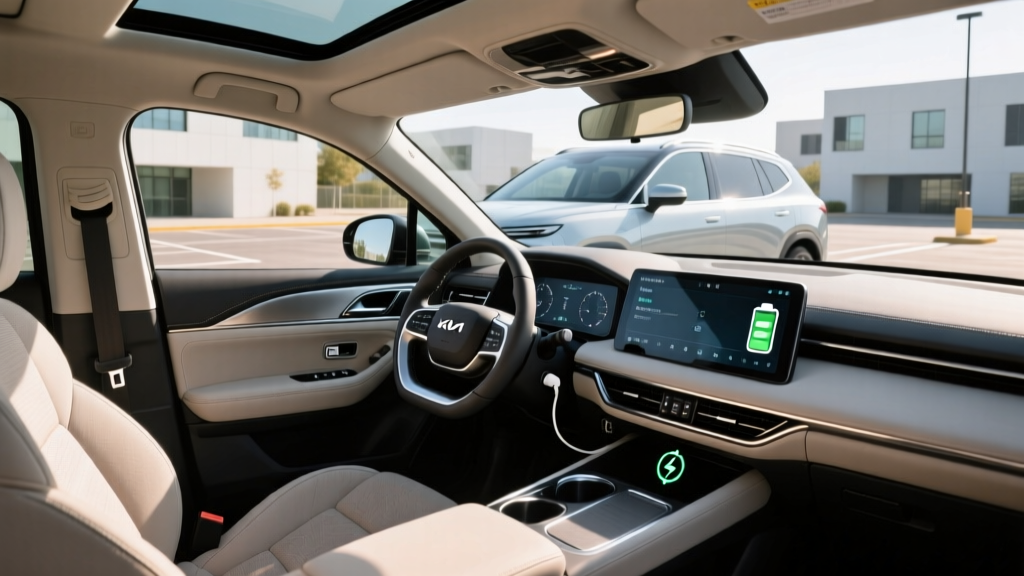
The three-row electric SUV segment remains surprisingly thin, and the Kia EV9 continues to be one of the only mainstream battery-electric vehicles offering genuine third-row seating without a six-figure price tag. For 2026, the EV9 carries over the powertrain and battery architecture introduced at its U.S. launch, but with expanded trim availability and continued eligibility for federal incentives that keep its effective price competitive against internal-combustion alternatives like the Kia Telluride and Hyundai Palisade.
But does that third row actually work for families, and can the EV9's range and charging speed support real road trips? Below is a data-driven breakdown of what owning the EV9 looks like in practice — not just the EPA sticker.
2026 Kia EV9 3rd Row: Core Specifications at a Glance
| Specification | Light Long Range (RWD) | Wind / Land AWD |
|---|---|---|
| EPA Range | 304 miles | 270–280 miles |
| Usable Battery | 99.8 kWh (NMC) | 99.8 kWh (NMC) |
| Drivetrain | Rear-Wheel Drive | Dual-Motor AWD |
| Horsepower | 215 hp | 379 hp |
| 0–60 mph | ~8.2 sec | ~5.0 sec |
| Max DC Fast Charge | ~210 kW peak | ~210 kW peak |
| 10–80% DC Time | ~24 min | ~24 min |
| Level 2 Charge Rate | 10.9 kW (44 mi/hr) | 10.9 kW (44 mi/hr) |
| EPA Efficiency | 85 MPGe (39 kWh/100mi) | 83 MPGe (41 kWh/100mi) |
| Base MSRP | $54,900 | $63,900 (Wind AWD) |
Source: EPA fueleconomy.gov, Kia America specifications.
Range Reality: EPA Sticker vs. the Highway and the Cold
Real-World Expectation: 240–270 mi highway at 70 mph; 190–230 mi in freezing temperatures with cabin heat
The EV9's 99.8 kWh nickel-manganese-cobalt (NMC) battery is one of the largest in its class, but this is a heavy, boxy SUV with the aerodynamics of a rolling apartment. In mixed city/highway driving during moderate temperatures, hitting 280–290 miles before needing a charge is realistic in the RWD model. Push it to sustained 75–80 mph highway speeds and expect consumption to climb to roughly 42–45 kWh/100mi, dropping real range to around 240 miles.
Cold weather compounds the penalty. Without preconditioning, a 32°F morning commute can knock 20–30% off range. The EV9 does offer a heat pump (standard on most trims), which helps, but it won't eliminate the physics of a cold-soaked 5,000-lb battery pack. For northern-climate owners, budgeting 200–220 miles of usable winter range is prudent.
One often-overlooked advantage: the EV9's battery preconditioning feature. Navigate to a DC fast charger using the built-in navigation, and the thermal management system will warm the pack for optimal charge acceptance — a meaningful difference when you're trying to hit that advertised 210 kW peak rate.
Charging Speed: From the Supermarket to the Supercharger
Kia built the EV9 on the Hyundai Motor Group E-GMP platform with an 800-volt electrical architecture, which translates to fast DC charging on compatible infrastructure. Here's what that looks like across charging levels:
| Charging Level | Power | Approx. Speed | Use Case |
|---|---|---|---|
| Level 1 (120V outlet) | ~1.4 kW | ~4 mi/hr | Emergency top-ups only |
| Level 2 (240V home) | 10.9 kW | ~44 mi/hr (full in ~9.5 hr) | Overnight home charging |
| DC Fast Charge (peak) | ~210 kW | 10–80% in ~24 min | Road-trip stops |
A critical nuance on DC fast charging: that 210 kW peak is not sustained. Like all EVs, the EV9's charge curve tapers significantly above 80% state of charge (SoC). The 10–80% sprint takes roughly 24 minutes at a 350 kW Electrify America or Ionity station, but charging from 80–100% can add another 20+ minutes. For road trips, plan to charge to 80% and go — it's faster than waiting for a full pack.
The EV9 uses the CCS1 connector natively. Tesla Supercharger access requires an adapter (Kia provides or sells one depending on model year and region), and peak speeds on V3 Superchargers (250 kW) are limited by the adapter's throughput. Expect roughly 150–180 kW on adapted Superchargers, not the EV9's native peak.
For home charging, the 10.9 kW onboard charger means a full overnight replenishment on a 48-amp Level 2 circuit. Most owners will need a dedicated 60-amp breaker and 6-gauge wire — factor in $500–$1,500 for professional installation depending on panel proximity. If your home has a 200-amp panel already near capacity, a panel upgrade to 400 amps can add $2,000–$4,000.
Third-Row Space, Cargo, and Real Family Practicality
This is the EV9's reason for existing, and the numbers tell a mostly positive story for a vehicle of its footprint:
- Third-row legroom: 32.0 inches — adequate for children and shorter adults on trips under an hour. Taller teens and adults will find it cramped for long hauls.
- Second-row legroom: 42.8 inches (captain's chairs) — genuinely spacious, with slide-and-recline adjustability on higher trims.
- Cargo behind 3rd row: 20.2 cu ft — enough for a couple of carry-ons or a week's groceries, but tight for a family road trip with all seats occupied.
- Cargo behind 2nd row (3rd row folded): 43.5 cu ft
- Max cargo (all rear seats folded): 81.7 cu ft
The available power-folding third row (GT-Line and Land trims) is a genuine convenience win — it collapses flat with a button press, making the cargo transition seamless. The low, flat load floor (thanks to the skateboard battery architecture) is easier to load than most body-on-frame SUVs.
Where the EV9 falls short for larger families: no available second-row bench option in the U.S. You're limited to either a 6-passenger layout (captain's chairs) or, on lower trims, a 7-passenger layout with a second-row bench. The GT-Line exclusively uses captain's chairs, capping capacity at six.
Pricing, Trims, and Federal Tax Credit Eligibility
The EV9's MSRP places it firmly in the premium-but-not-luxury bracket. Here's the 2026 lineup:
| Trim | Drivetrain | Base MSRP | Est. After §30D Credit* |
|---|---|---|---|
| Light Long Range | RWD | $54,900 | ~$47,400 |
| Wind | AWD | $63,900 | ~$56,400 |
| Land | AWD | $69,900 | ~$62,400 |
| GT-Line | AWD | $73,900 | ~$66,400 |
*Federal tax credit eligibility depends on IRS §30D requirements. See checklist below.
- MSRP cap: SUVs/vans/pickups must be ≤$80,000 (all EV9 trims qualify)
- Buyer income cap: AGI ≤$300,000 (married filing jointly), $225,000 (head of household), $150,000 (single)
- Battery sourcing: Critical minerals and battery components must meet escalating domestic-content thresholds — verify current-year compliance on IRS.gov before purchase
- Assembly: Must be assembled in North America (EV9 is built in West Point, Georgia — qualifies)
- Point-of-sale transfer: Eligible buyers can transfer the credit to the dealer for an immediate price reduction at purchase
The EV9's Georgia assembly is a significant advantage — it clears the North American final-assembly requirement that disqualifies several imported competitors. However, battery-sourcing rules tighten annually, and Kia's supply chain for NMC cathode materials has been subject to periodic compliance shifts. Always verify current eligibility on the IRS clean vehicle credit page or with a tax professional before relying on the $7,500 figure.
Technology, Driver Assistance, and What's Missing
The EV9 comes loaded with Kia's latest tech suite:
- Infotainment: Dual 12.3-inch displays (instrument cluster + touchscreen) running Kia's Connected Car Navigation system with wireless Apple CarPlay and Android Auto
- Highway Driving Assist 2 (HDA2): Level 2 lane-centering and adaptive cruise with lane-change assist — competent on highways but requires constant driver supervision
- Remote Smart Parking Assist: Move the EV9 in/out of tight spaces via keyfob on select trims
- V2L (Vehicle-to-Load): Power accessories or small appliances via interior and exterior 120V-style outlets (up to 3.6 kW)
- Digital Key 2: Use your smartphone as the key fob (UWB-compatible)
Notable tech gaps: no hands-free driving system comparable to GM's Super Cruise or Ford's BlueCruise on mapped highways. Kia's HDA2 is solid SAE Level 2 assistance, but it won't let you take your eyes off the road. Over-the-air updates are supported for infotainment and some vehicle systems, but Kia's OTA track record is less mature than Tesla's or Rivian's.
Pros, Cons, and the Honest Verdict
- Genuine 3-row seating at a mainstream price point
- 800V architecture enables ~24 min 10–80% DC charging
- Built in Georgia — qualifies for §30D credit (verify sourcing annually)
- Strong standard warranty: 10yr/100,000mi battery, 5yr/60,000mi bumper-to-bumper
- V2L capability for camping and emergency power
- Comfortable ride quality; composed for its size
- Third row is tight for adults on longer trips
- Only 20.2 cu ft cargo with all rows up — tight for road trips
- AWD models lose 25–35 mi of EPA range vs. RWD
- Peak DC charging requires 350 kW stations — still sparse in many regions
- High starting price for a Kia brand vehicle
- No hands-free highway driving system (yet)
Who Should Buy the Kia EV9?
Buy it if: You need a three-row SUV for school runs, weekend activities, and occasional road trips, and you have reliable home Level 2 charging. The RWD Light Long Range at ~$47,400 after the federal credit is one of the best value-per-seat propositions in the EV market.
Look elsewhere if: Your third-row passengers are tall teenagers or adults who ride back there regularly (consider a minivan like the Chrysler Pacifica Hybrid). If you frequently tow or take long road trips through charging-desert regions, the EV9's 5,000-lb towing capacity and 240-mile real-world AWD range may feel limiting.
Key competitors: The Rivian R1S offers more range and off-road capability but starts ~$20K higher. The Hyundai Ioniq 9 (when available) shares the platform with different styling. The Tesla Model X provides more range and Supercharger access but at a steep premium and with a less practical third row.
Frequently Asked Questions
What is the real-world range of the Kia EV9?
In moderate temperatures with mixed driving, expect 260–280 miles (RWD) or 230–260 miles (AWD). Highway-only driving at 75+ mph drops this to 240/220 miles respectively. Freezing weather can reduce range by 20–30% without preconditioning.
How fast does the EV9 charge at home and on the road?
On a home Level 2 charger (10.9 kW), a full charge takes about 9.5 hours — ideal for overnight replenishment. On a 350 kW DC fast charger with preconditioning, 10–80% takes roughly 24 minutes. On 150 kW chargers, expect 30–35 minutes for the same session.
Does the Kia EV9 qualify for the $7,500 federal tax credit?
The EV9 is assembled in Georgia and its MSRP is under the $80,000 SUV cap, so it meets the assembly and price requirements. However, buyer income limits and battery critical-mineral sourcing rules apply and change annually. Verify current-year eligibility at IRS.gov or with a tax professional before purchase.
Is the EV9's third row practical for adults?
With 32.0 inches of legroom, it works for children and shorter adults on shorter trips. Taller adults will find it cramped beyond 30–45 minutes. If third-row comfort is a priority, test-sit before buying.
What is the EV9's battery warranty?
Kia covers the high-voltage battery for 10 years or 100,000 miles (whichever comes first), with a capacity retention threshold typically around 70%. The basic vehicle warranty is 5 years/60,000 miles, and the powertrain is covered for 10 years/100,000 miles.
Can the EV9 tow?
Yes — the AWD models are rated for up to 5,000 lbs (braked trailer). The RWD model is rated lower, at approximately 2,000 lbs. Towing significantly impacts range; expect a 30–50% reduction depending on trailer weight and aerodynamics.