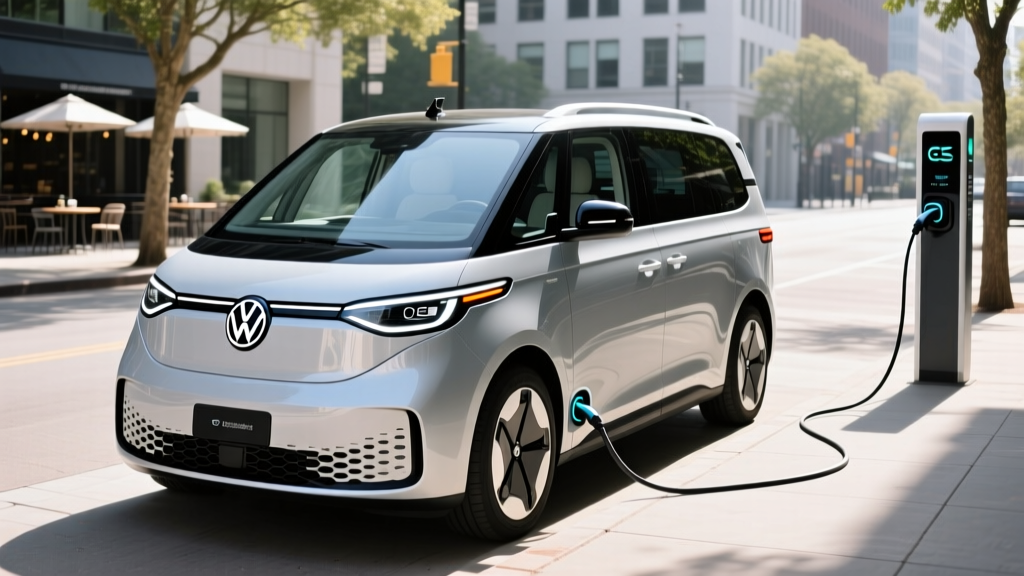
If you've been searching for the new VW electric bus, you're looking at the Volkswagen ID. Buzz — a retro-styled, three-row electric minivan that finally reached U.S. dealers in late 2024 as a 2025 model and carries forward into 2026 with minor software and packaging updates. Here's the direct answer most shoppers need: the ID. Buzz delivers an EPA-estimated 231–234 miles of range (RWD), seats up to seven, starts around $59,995, and currently does not qualify for the full $7,500 federal §30D tax credit due to battery-sourcing requirements. It's a compelling family hauler if you can charge at home and your daily driving stays under ~180 miles, but road-trippers and cold-climate buyers should read the caveats below before signing.
Quick Verdict: Is the VW ID. Buzz Right for You?
Choose the ID. Buzz if: You want a stylish, spacious three-row EV for school runs, grocery hauls, and weekend trips within ~180 miles; you have reliable Level 2 home charging; and you value interior space and design over maximum range.
Look elsewhere if: You regularly drive 300+ miles between charging stops, live in extreme cold without a garage, need the $7,500 federal credit to make the math work, or want a proven reliability track record over several model years.
Range, Battery, and What You'll Actually See on the Road
The U.S.-spec ID. Buzz uses a 91 kWh usable battery pack (107 kWh gross) with NMC (nickel-manganese-cobalt) chemistry, mounted low in the floor. The EPA rates the rear-wheel-drive model at 234 miles and the 4MOTION all-wheel-drive version at 231 miles. For a vehicle this size — it rides on a 127.5-inch wheelbase and weighs roughly 5,800 lbs — that's competitive with, though not class-leading against, rivals like the Chrysler Pacifica Hybrid's electric-only range combined with its gas engine.
Real-World Range Expectations
EPA Sticker: 234 mi (RWD) / 231 mi (AWD)
Highway (70 mph, mild weather): Expect ~190–205 mi
Cold weather (below 32°F, cabin heat): Expect ~155–175 mi
Mixed daily driving: ~210–220 mi is achievable
The boxy shape creates aerodynamic drag that hurts highway efficiency. On a flat, 65-mph suburban loop, you'll easily match the EPA number. Sustained 75-mph interstate driving, especially into headwinds, drops efficiency noticeably. Per fueleconomy.gov, the RWD ID. Buzz rates at approximately 83 MPGe combined (roughly 40 kWh/100 mi).
| Spec | RWD (Std Range) | AWD (4MOTION) |
|---|---|---|
| EPA Range | 234 mi | 231 mi |
| Battery (usable / gross) | 91 kWh / 107 kWh | 91 kWh / 107 kWh |
| Chemistry | NMC | NMC |
| Horsepower | 282 hp | 335 hp |
| 0–60 mph | ~7.9 sec | ~6.1 sec |
| Max DC Fast Charge | 170 kW | 170 kW |
| 10–80% DC Charge | ~26 min | ~26 min |
| Level 2 AC Charge (11 kW) | ~9.5 hrs (0–100%) | ~9.5 hrs (0–100%) |
| Seating | 6 or 7 | 6 or 7 |
| Cargo (behind 3rd row) | 18.6 cu ft | 18.6 cu ft |
| Starting MSRP | $59,995 | $63,495 |
| Battery Warranty | 8 yr / 100,000 mi | 8 yr / 100,000 mi |
Charging Speeds: Home Setup and DC Fast Charging Reality
The ID. Buzz accepts a peak 170 kW on DC fast chargers. In practice, you'll see that peak only briefly in the 10–30% state-of-charge window. The charge curve tapers progressively: by 60% SoC you're closer to 120 kW, and above 80% it drops below 50 kW. A 10–80% session takes approximately 26 minutes at a capable 350 kW Electrify America or Tesla Supercharger (with NACS adapter) station. If you're arriving at 10% and leaving at 80%, plan for roughly half an hour including plugging in and preconditioning.
At home, the onboard charger maxes at 11 kW AC (48 amps on a 60-amp Level 2 circuit). A full 0–100% charge takes roughly 9.5 hours, meaning overnight replenishment is straightforward on a properly installed Level 2 home charger. If you're still on a standard 120V outlet (Level 1), expect roughly 2–3 miles of range per hour of charging — essentially useless for a vehicle this size unless your daily driving is under 20 miles.
| Level | Power | Speed | Best For |
|---|---|---|---|
| Level 1 (120V) | ~1.4 kW | ~3 mi/hr | Emergency trickle only |
| Level 2 (240V, 48A) | 11 kW | ~25 mi/hr | Overnight home charging |
| DC Fast (peak) | 170 kW | ~180 mi in 26 min (10–80%) | Road trips |
Home charging installation note: A 60-amp dedicated circuit with a hardwired Level 2 charger typically costs $800–$2,000 installed if your electrical panel has capacity. Older homes with 100-amp service may need a panel upgrade ($1,500–$3,500). Always get a quote from a licensed electrician before committing to the vehicle.
How the ID. Buzz Compares to Gas and Hybrid Minivans
The ID. Buzz's natural competitors are the Chrysler Pacifica Hybrid (PHEV), Toyota Sienna (HEV), Honda Odyssey (gas), and Kia Carnival (gas). Each serves a different use case. Below is a 5-year cost snapshot assuming 15,000 miles/year, $3.50/gal gas, and $0.14/kWh electricity.
| Vehicle | MSRP (base) | Fuel/Energy (5 yr) | Maintenance (5 yr est.) | Total (excl. insurance) |
|---|---|---|---|---|
| VW ID. Buzz RWD | $59,995 | $5,250 | $1,800 | $67,045 |
| Chrysler Pacifica Hybrid | $51,095 | $5,800 | $3,200 | $60,095 |
| Toyota Sienna HEV | $39,890 | $7,350 | $2,800 | $50,040 |
| Honda Odyssey | $40,635 | $10,500 | $3,500 | $54,635 |
The ID. Buzz saves significantly on fuel and maintenance — no oil changes, fewer brake jobs thanks to regenerative braking, no transmission fluid. But the $10,000–$20,000 higher purchase price means those operational savings take 5–8 years to break even without a tax credit. If you qualify for state incentives (California's CVRP, Colorado's state credit, etc.), the gap narrows. Check the IRS §30D page for current federal credit eligibility, as battery-sourcing rules continue to tighten.
Pricing, Trims, and Tax Credit Status for 2026
The 2026 ID. Buzz is offered in three trims:
- ID. Buzz Pro S (RWD): ~$59,995 — 7-seat layout, 20" wheels, heated front seats, power sliding doors
- ID. Buzz 1st Edition (AWD): ~$65,495 — two-tone paint, panoramic roof, premium interior accents (limited availability)
- ID. Buzz Pro S Plus (AWD): ~$67,995 — top trim with Harman Kardon audio, ventilated front seats, head-up display
Federal tax credit status: As of early 2026, the ID. Buzz does not qualify for the $7,500 §30D new clean vehicle credit. The battery cells are manufactured outside the U.S., and the critical-minerals and battery-component sourcing requirements under current IRS rules have not been met. This could change if VW shifts supply chains or if trade agreements evolve, so verify at the point of purchase. The credit also has MSRP caps ($80,000 for vans/SUVs — the ID. Buzz clears this) and buyer income limits ($300K joint / $150K single). If eligible through other means, the point-of-sale transfer lets you apply the credit as a down payment reduction.
§30D Federal Tax Credit Checklist
- ✔ Vehicle MSRP under $80,000 (vans/SUVs) — ID. Buzz qualifies
- ✔ Buyer AGI under $300K joint / $150K single — varies by buyer
- ✘ Battery components ≥60% manufactured/assembled in N. America — ID. Buzz does NOT currently meet this
- ✘ Critical minerals ≥60% from U.S. or FTA partners — ID. Buzz does NOT currently meet this
- ✔ Final assembly in North America — ID. Buzz does NOT meet this (built in Hannover, Germany)
Source: IRS.gov §30D. Rules subject to change. Consult a tax professional.
Real Ownership Considerations: What First-Time EV Buyers Should Know
The ID. Buzz is many families' first electric vehicle, and several practical realities matter beyond the spec sheet:
Home charging is nearly essential. Public-only charging with a vehicle this large and with 234 miles of range is frustrating. If you live in an apartment without charging access or park on the street, the ID. Buzz becomes a logistics challenge. Confirm your charging plan before purchasing.
Cold weather reduces range by 25–35%. The ID. Buzz includes a heat pump (standard on U.S. models), which helps, but physics wins in sub-freezing temperatures. If you live in Minnesota or upstate New York and need to drive 150+ miles in January, plan charging stops conservatively.
Road trips require planning. With ~190 real-world highway miles, you'll stop every 2.5–3 hours on long drives. The 170 kW charge rate means ~26-minute stops at DC fast chargers. That's manageable but longer than the 5-minute gas fill-up. Preconditioning the battery via the navigation system before arriving at a charger is critical for hitting peak charge rates.
Insurance costs are higher. EV insurance premiums run 15–25% above comparable gas minivans due to repair costs and battery replacement risk. Get quotes from your insurer before purchasing.
Cargo space is good, not class-leading. Behind the third row, you get 18.6 cu ft — adequate for groceries but less than the Sienna or Odyssey. Fold the third row and you unlock ~75 cu ft, which is genuinely useful.
Common Misconceptions About the ID. Buzz
| Myth | Fact |
|---|---|
| "It gets 300+ miles of range." | EPA is 234 mi (RWD). Real-world highway is ~190–205 mi. |
| "It qualifies for the $7,500 federal tax credit." | As of 2026, it does not — built in Germany with non-U.S. battery sourcing. |
| "It charges as fast as a Tesla." | 170 kW peak vs. Tesla Model X's 250 kW. The ID. Buzz takes ~26 min (10–80%) vs. ~18 min for some competitors. |
| "It's basically a converted gas van." | It rides on VW's dedicated MEB EV platform with a flat floor, rear motor, and purpose-built architecture. |
| "The battery will need replacing in 5 years." | VW warrants the battery for 8 years/100,000 mi with ≥70% capacity retention. NMC packs typically last 150,000–200,000+ mi before significant degradation. |
Decision Framework: Should You Buy the ID. Buzz?
The ID. Buzz Makes Sense If:
- Your daily driving is under 150 miles round-trip and you can charge overnight on Level 2 at home.
- You want a three-row family vehicle that stands out and don't want a crossover SUV.
- You have access to state or utility incentives that offset the lack of a federal credit.
- You prioritize low running costs and can absorb the higher purchase price over a 5+ year ownership period.
Consider Alternatives If:
- You regularly drive 300+ miles between home and destinations — look at the Chrysler Pacifica Hybrid (32 mi electric + gas backup) or Toyota Sienna HEV (36 MPG combined, no range limit).
- You can't install a Level 2 charger at home — public-only charging with 234 mi of range and 170 kW charging will feel restrictive.
- The $7,500 federal credit is critical to your budget — consider the Chrysler Pacifica Hybrid (qualifies for up to $7,500) or wait for potential ID. Buzz eligibility changes.
- You live in extreme cold and need reliable 200+ mi range year-round — real-world winter range drops to ~155–175 mi.
Frequently Asked Questions
Does the VW ID. Buzz have a frunk (front trunk)?
No. The ID. Buzz does not include a front trunk. All cargo space is in the rear, with 18.6 cu ft behind the third row. VW opted for a flat front hood design that houses HVAC and electronics components.
Can the ID. Buzz tow?
Yes. The AWD ID. Buzz is rated to tow up to 3,500 lbs (braked trailer). The RWD model is rated for approximately 2,200 lbs. Towing will reduce range by 25–40% depending on trailer weight and aerodynamics.
Is the ID. Buzz self-driving?
No. The ID. Buzz includes VW's IQ.DRIVE suite — adaptive cruise control, lane-keeping assist, and automatic emergency braking. This is SAE Level 2 driver assistance, meaning the driver must remain fully engaged with hands on the wheel and eyes on the road at all times. It is not autonomous.
What charger connector does the ID. Buzz use?
The 2025–2026 U.S. ID. Buzz uses the CCS1 (Combined Charging System) connector. VW has announced a transition to the NACS (Tesla-style) connector for future model years, and adapters for Tesla Supercharger access are expected. Check with your dealer for the latest adapter availability.
How long will the battery last?
VW warrants the high-voltage battery for 8 years or 100,000 miles, whichever comes first, against capacity loss below 70%. Based on NMC chemistry degradation data from other MEB-platform vehicles (ID.4, Audi Q4 e-tron), most owners can expect 10–15% total degradation over 100,000 miles with normal use — meaning a 234-mi new range would settle around ~200–210 mi after 100K miles.
Where is the ID. Buzz built?
The U.S.-spec ID. Buzz is assembled in Hannover, Germany. This is a key reason it does not qualify for the §30D federal tax credit, which requires North American final assembly.
Sources: fueleconomy.gov (EPA), IRS §30D Clean Vehicle Credits, Volkswagen of America official specifications.