Kia EV9 Overview: A Genuine 3-Row Electric SUV
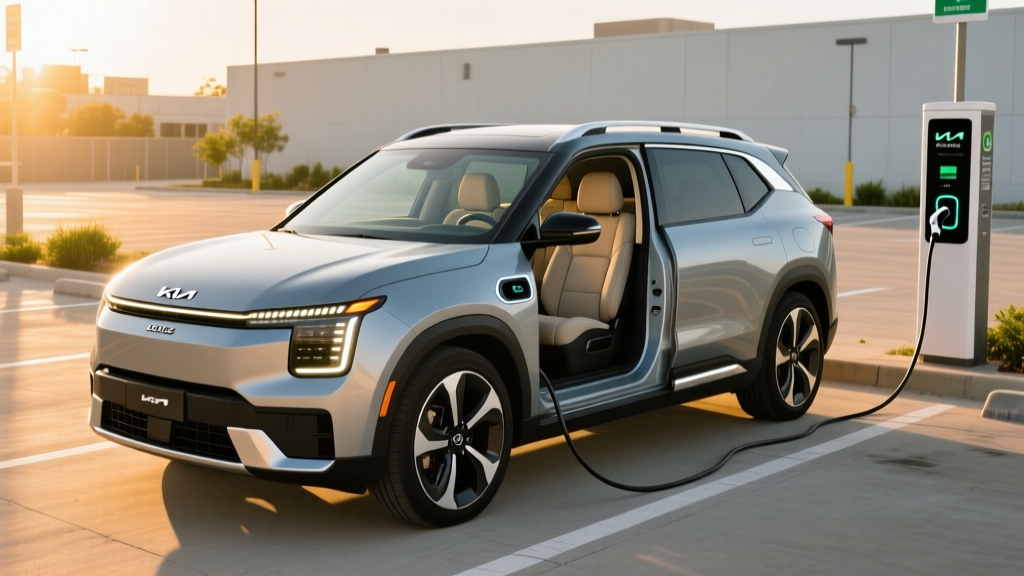
The Kia EV9 remains one of the few mainstream battery-electric vehicles that can credibly carry six or seven adults without turning the third row into a punishment seat. For 2026, it continues on the Hyundai Motor Group E-GMP platform with an 800-volt electrical architecture, a 99.8 kWh usable battery (for Long Range trims), and DC fast-charging that peaks near 210 kW. If your household needs three usable rows, over 270 miles of EPA range, and access to the Tesla Supercharger network via the NACS port adopted on recent model years, the EV9 demands a spot on your shortlist.
But how does it stack up where it counts for families — specifically the Kia EV9 3rd row legroom, real-world highway range, charging speed, and total cost after federal incentives? We break down every number below.
| Spec | Long Range RWD | AWD (Land / GT-Line) |
|---|---|---|
| EPA Range | 304 mi | 270–280 mi (trim/wheel dependent) |
| Battery (usable) | 99.8 kWh, NMC lithium-ion | |
| Horsepower / Torque | 215 hp / 258 lb-ft | 379 hp / 516 lb-ft |
| 0–60 mph | ~7.7 sec | ~4.5 sec (w/ Boost) |
| Peak DC Fast Charge | ~210 kW (800V architecture) | |
| 10–80% DC Time | ~24 min (ideal conditions) | |
| Level 2 Home Charge (11.5 kW) | ~31 mi/hr of range | |
| MPGe (city/hwy/combined) | 99/83/91 MPGe | 91/79/85 MPGe |
| Towing Capacity | 2,000 lb | 5,000 lb |
| Base MSRP | $56,445 (Light LR) | $65,445 (Land) |
| Battery/Powertrain Warranty | 10 yr / 100,000 mi | |
Interior Space: Kia EV9 3rd Row Legroom and Cargo
The headline number for families: the EV9 delivers 32.0 inches of third-row legroom in the standard 6- and 7-passenger configurations. That figure puts it in the upper tier of midsize 3-row SUVs, gas or electric, and is a full 2–4 inches more than many crossover competitors that bolt on a token third row. Headroom in the third row measures around 37.5 inches, and shoulder room is generous enough for two adults on longer trips.
Second-row legroom is an expansive 42.7 inches with the bench, and the available captain's chairs (6-passenger layout) offer a center walk-through for easier third-row access. Cargo volume behind the third row sits at 20.2 cu ft — enough for a week of groceries or a couple of rolling carry-ons. Fold the third row and you open up 43.5 cu ft; fold both rear rows for up to 81.7 cu ft of flat-load space. The front trunk (frunk) on AWD trims provides roughly 1.8 cu ft for charging cables or a small bag.
Bottom line on space: If the Kia EV9 3rd row legroom question is your make-or-break criterion, this SUV genuinely accommodates adults back there — not just children. For comparison, the Mazda CX-90 PHEV's third row is notably tighter, and the Rivian R1S (post-refresh) is close but at a significantly higher price point.
Range, Efficiency, and Real-World Expectations
The Long Range RWD EV9 carries an EPA-estimated 304 miles on a full charge, while AWD variants range from roughly 270 to 280 miles depending on wheel size and trim (20- and 21-inch wheels reduce efficiency vs. the 19-inch base). Efficiency for the RWD model lands at about 91 MPGe combined, or roughly 37 kWh/100 mi — reasonable for a 5,000-lb, three-row SUV.
Real-World Range Reality Check
EPA 304 mi (RWD) / 270–280 mi (AWD) is the sticker number. Expect approximately 250–275 miles on sustained 70–80 mph highway driving in mild weather, dropping to 210–240 miles in sub-freezing winter conditions due to cabin heating demand and increased battery resistance. City and suburban driving with regenerative braking can actually exceed the EPA figure. Plan road trips around a 200–220 mile buffer between DC fast-charge stops for comfort.
The EV9 uses an NMC (nickel manganese cobalt) lithium-ion chemistry in its 99.8 kWh pack. NMC offers higher energy density than LFP, which is why Kia can fit this much range into a vehicle of this size, though it means you'll want to avoid routinely charging to 100% for daily use — a daily 80% limit preserves long-term State of Health.
Charging Speed: 800V Architecture Pays Off
The EV9's 800-volt electrical architecture is one of its biggest ownership advantages. On a 350 kW-class DC fast charger (such as Electrify America or Ionity stalls), the EV9 can peak near 210 kW, adding 10–80% State of Charge in approximately 24 minutes under ideal thermal conditions. Preconditioning the battery — triggered automatically when you navigate to a DC fast charger via the built-in route planner — is critical to achieving these numbers, especially in cold weather.
| Charging Level | Power / Voltage | Speed (approx.) |
|---|---|---|
| Level 1 (120V household) | ~1.4 kW | ~3–4 mi/hr |
| Level 2 (240V home, 48A) | 11.5 kW onboard | ~31 mi/hr (full charge ~10 hr) |
| DC Fast (350 kW stall) | Peak ~210 kW | 10–80% in ~24 min |
| DC Fast (150 kW stall) | ~150 kW peak | 10–80% in ~33 min |
Charge-curve reality: Like all modern EVs, the EV9 does not sustain peak kW to 80%. Expect the curve to taper noticeably past 60–65% SoC, and charging from 80–100% on DC is significantly slower — plan to unplug at 80% on road trips to maximize your miles-per-minute. At home on a Level 2 wallbox, overnight charging is the norm: a 10% to 80% top-up takes roughly 7 hours, which is ideal for off-peak electricity rates.
Beginning with recent model years, Kia has equipped the EV9 with the NACS (Tesla-style) charge port on North American models, granting access to Tesla Supercharger stalls (with V3 stalls limited by adapter/vehicle negotiation to ~150 kW). For older CCS-equipped EV9s, a manufacturer-approved NACS adapter enables the same access. Verify your specific model year's port configuration before purchase.
Performance and Driving Impressions
The Long Range RWD EV9 makes 215 hp and 258 lb-ft of torque, yielding a 0–60 mph time around 7.7 seconds. That's adequate for merging and passing but won't feel quick in a vehicle of this mass. The AWD dual-motor variants are a different story: 379 hp and 516 lb-ft (with the available Boost function engaged) drop the 0–60 time to approximately 4.5 seconds — genuinely quick for a three-row family hauler.
Ride quality is composed and comfortable, tuned more for long-distance comfort than sportiness. The EV9 offers multiple levels of regenerative braking controlled via steering-wheel paddles, including an i-Pedal mode that enables near-one-pedal driving. Kia's Highway Driving Assist 2 (HDA2) is standard on most trims — a competent Level 2 driver-assist system with lane-centering, adaptive cruise, and lane-change assist. Keep in mind: HDA2 is a supervised system, not autonomous driving. You must keep hands on or near the wheel and eyes on the road at all times.
Pricing, Trims, and Federal Tax Credit Eligibility
The 2026 Kia EV9 lineup starts around $56,445 for the Light Long Range RWD and climbs through Wind ($61,445), Land ($65,445), and the GT-Line variants approaching $74,000. Destination charges add roughly $1,495.
| Trim | Drivetrain | MSRP | §30D Credit Eligible? |
|---|---|---|---|
| Light Long Range | RWD | $56,445 | Check sourcing rules |
| Wind | AWD | $61,445 | Check sourcing rules |
| Land | AWD | $65,445 | Check sourcing rules |
| GT-Line | AWD | $70,445–$73,945 | MSRP cap: $80K (SUV) |
Federal tax credit (§30D) eligibility is nuanced. The EV9 qualifies as an SUV under IRS vehicle-classification rules, so the MSRP cap is $80,000 — meaning all current trims clear that threshold. However, the full $7,500 credit depends on meeting both critical-mineral and battery-component sourcing requirements that shift annually under the Inflation Reduction Act. Buyer income caps also apply: modified AGI cannot exceed $150,000 (single), $225,000 (head of household), or $300,000 (married filing jointly). The credit can be transferred at the point of sale as a discount on the purchase price.
Always verify current eligibility on IRS.gov and confirm with your tax professional before purchasing, as battery-sourcing rules are updated periodically and can change a vehicle's eligibility mid-year.
Technology, Safety, and Standout Features
The EV9's cabin tech centers on a 12.3-inch digital instrument cluster and a 12.3-inch infotainment touchscreen running Kia's latest Connect system with wireless Apple CarPlay and Android Auto. Higher trims offer a head-up display with augmented-reality navigation overlays, a digital rearview mirror, and remote smart parking assist (the EV9 can park itself in tight spaces while you stand outside).
Safety credentials are strong: the EV9 earned the IIHS Top Safety Pick+ designation (when equipped with specific headlights) and a 5-star overall rating from NHTSA. Standard active-safety features include forward collision-avoidance assist with pedestrian and cyclist detection, blind-spot collision-avoidance, rear cross-traffic collision-avoidance, and safe exit assist.
Standout features:
- Vehicle-to-Load (V2L): power external devices or appliances up to 3.6 kW via an interior or exterior outlet — useful for camping, tailgating, or emergency backup
- Digital key via smartphone (NFC/UWB)
- Over-the-air (OTA) software updates for powertrain, chassis, and infotainment
- Available Highway Driving Assist 2 with auto lane-change
- 6- or 7-passenger seating with available second-row relaxation/comfort seats
Notable drawbacks:
- RWD base model feels underpowered for a vehicle of this weight
- Infotainment relies heavily on touch controls — limited physical buttons for HVAC
- No frunk on RWD trims (AWD trims get a small one)
- Third-row access requires folding/sliding the second row — not as seamless as some minivans
- Insurance costs tend to run higher than comparable ICE SUVs (get quotes before buying)
Pros
- Genuine adult-sized 3rd row (32.0" legroom)
- 800V fast charging: 10–80% in ~24 min
- 304 mi EPA range (RWD) is class-leading
- V2L capability for off-grid power
- 10-yr / 100,000-mi battery warranty
- NACS port / Supercharger access
- 5,000-lb towing (AWD)
Cons
- RWD acceleration is merely adequate
- Top trims push $74K+ before options
- Touch-heavy infotainment interface
- Real-world winter range drops ~20%
- Higher insurance premiums than ICE equivalents
- Small frunk (AWD only)
Who Should Buy the Kia EV9?
The EV9 is purpose-built for families who need a third row but want to eliminate gasoline costs and reduce maintenance. It's ideal for:
- Commuting families with home Level 2 charging — daily driving under 60 miles means you'll rarely visit a DC fast charger
- Road-trippers willing to plan 20–25 minute charging stops every 200–220 miles
- Light towing households — the AWD model's 5,000-lb capacity handles small boats, utility trailers, and campers
- Tech-forward buyers who value OTA updates, V2L, and advanced driver-assist features
It's not the best choice if you regularly drive 400+ miles between charging opportunities, need heavy-duty towing (7,500+ lb), or want a minivan's sliding-door convenience for child-seat access.
Kia EV9 vs. Key Competitors
In the 3-row electric SUV segment, the EV9 faces limited but growing competition. The Rivian R1S offers more off-road capability and a quad-motor option but starts above $75,000 and lacks the same federal-credit clarity. The Tesla Model X provides more range and Supercharger-native access but costs significantly more and has a less conventional interior layout. The Hyundai Ioniq 9 (mechanically related) shares the platform but wears different styling and tuning. For plug-in hybrid alternatives, the Toyota Grand Highlander Hybrid offers 3 rows without range anxiety but sacrifices the EV driving experience and lower running costs.
Warranty and Ownership Costs
Kia backs the EV9 with a 10-year / 100,000-mile battery and powertrain warranty, covering defects and capacity loss below a specified threshold (typically 70% State of Health during the warranty period). The basic vehicle warranty is 5 years / 60,000 miles. These terms are among the strongest in the industry and should ease long-term battery-degradation concerns.
Ownership costs benefit from the elimination of oil changes, reduced brake wear (thanks to regenerative braking), and electricity costs that typically run $0.12–$0.16/kWh at home — translating to roughly $0.04–$0.06 per mile vs. $0.12–$0.18/mile for a comparable gasoline 3-row SUV at current fuel prices. Factor in potential federal and state incentives, and the EV9's total cost of ownership over 5 years can undercut ICE competitors even before accounting for the time savings of home charging.
What is the real-world range of the Kia EV9?
The EPA rates the Long Range RWD at 304 miles and AWD trims at 270–280 miles. In real-world highway driving at 70–80 mph, expect roughly 250–275 miles in mild weather and 210–240 miles in freezing temperatures. City driving with regen braking can match or slightly exceed EPA estimates.
How fast does the Kia EV9 charge at home and on the road?
On a 350 kW DC fast charger, the EV9 peaks near 210 kW and charges 10–80% in about 24 minutes. On a home Level 2 wallbox (240V, 48A, 11.5 kW), you'll add roughly 31 miles of range per hour, with a full 10–80% charge taking around 7 hours. Level 1 (120V) trickle-charging adds only 3–4 miles per hour.
Does the Kia EV9 qualify for the $7,500 federal EV tax credit?
The EV9 falls under the $80,000 SUV MSRP cap, so all trims clear that threshold. However, full credit eligibility depends on current-year battery-component and critical-mineral sourcing rules under IRS §30D, as well as buyer income limits ($150K single / $300K married filing jointly). The credit can be applied as a point-of-sale discount. Always verify on IRS.gov and consult a tax professional.
Is the Kia EV9 worth buying over the competition?
If you need genuine 3-row adult seating, strong DC fast-charging, and mainstream pricing with a strong warranty, the EV9 is one of the best options available. The Rivian R1S is more capable off-road but pricier; the Tesla Model X offers more range but at a premium; and plug-in hybrid alternatives trade EV efficiency for unlimited range. For most families, the EV9 hits the best balance of space, range, and value.
How much does the Kia EV9 cost after tax credits?
Pricing starts around $56,445 for the Light Long Range RWD and climbs to roughly $74,000 for the GT-Line AWD. If you qualify for the full $7,500 federal credit (subject to sourcing and income rules), effective pricing can start near $48,945. State and utility incentives may further reduce cost — check fueleconomy.gov and your local utility for details.
What are the biggest pros and cons of the Kia EV9?
Pros: adult-usable 3rd row (32.0" legroom), 304-mi EPA range, ~24-minute 10–80% DC fast charge, V2L capability, 10-year battery warranty, and NACS/Supercharger access. Cons: RWD is underpowered, top trims are expensive, touch-heavy interior controls, real-world winter range drops ~20%, and insurance premiums tend to be higher than ICE equivalents.