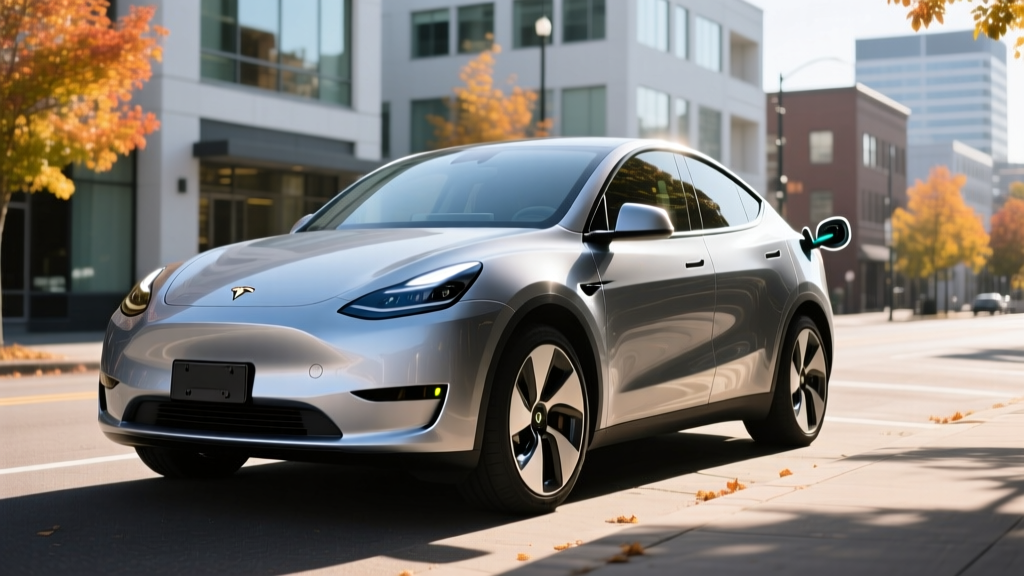
The Tesla Model Y has been one of the best-selling electric vehicles in the world for good reason: strong range, access to the Supercharger network, and a starting price that undercuts many rivals. But for families eyeing the optional third-row seat, the calculus changes. The 3rd row Tesla Model Y transforms this compact electric crossover from a five-passenger daily driver into a seven-seat family hauler — at least on paper. In practice, that extra row reshapes cargo capacity, curb weight, real-world efficiency, and everyday usability in ways every prospective buyer should understand before checking the option box.
This review covers the 2026 Model Y Long Range AWD with the third-row configuration. We'll walk through EPA range versus what you'll actually see on the highway, charging speeds from DC fast chargers to your garage Level 2, the true cost after federal tax credits, and how this seven-seat EV stacks up against three-row competitors like the Kia EV9 and Hyundai Ioniq 9. If you're researching whether the 3rd row Tesla Model Y is a genuine family solution or a compromise-laden marketing checkbox, you're in the right place.
Quick Verdict: Who the 3rd Row Model Y Actually Serves
Choose the 3rd row Model Y if: You need occasional seating for two small children (under ~5'4"), you want Supercharger network access for road trips, and you prioritize driving dynamics and software over third-row comfort.
Look at the Kia EV9 or Hyundai Ioniq 9 instead if: You regularly carry teenagers or adults in the third row, need maximum cargo volume with all seats in use, or want vehicle-to-load (V2L) capability for camping and power outages.
The third-row option adds approximately $3,000 to the Model Y's sticker price and reduces both cargo volume behind the third row and EPA-estimated range slightly due to added weight. It is best understood as a 2+3+2 configuration where the rearmost seats are suitable for children on short-to-medium trips, not a minivan replacement.
2026 Model Y Long Range AWD: Full Spec Sheet
| Specification | 2026 Model Y Long Range AWD (3rd Row) |
|---|---|
| EPA Estimated Range | 303 miles (5-seat); ~295 miles (7-seat est.) |
| Battery Capacity (usable) | ~79 kWh (NMC chemistry) |
| Drivetrain | Dual-motor AWD |
| Horsepower | ~384 hp combined |
| 0-60 mph | 4.8 seconds |
| Max DC Fast Charge Rate | 250 kW peak (CCS via NACS adapter or native NACS) |
| 10-80% DC Fast Charge Time | ~27 minutes |
| Level 2 Home Charging (11.5 kW / 48A) | ~32 miles of range per hour |
| Efficiency | 117 MPGe combined / 29 kWh/100 mi |
| Seating Capacity | 7 (2+3+2) |
| Cargo (behind 3rd row) | ~12 cu ft |
| Cargo (3rd row folded) | ~34 cu ft |
| Cargo (all rear rows folded) | ~72 cu ft |
| 3rd Row Legroom | ~26.5 inches |
| Base MSRP (5-seat Long Range AWD) | $48,990 |
| 3rd Row Option Add-On | ~$3,000 |
| As-Tested Price (3rd Row + FSD) | ~$59,990 |
| Battery & Drive Unit Warranty | 8 years / 120,000 miles |
| Basic Vehicle Warranty | 4 years / 50,000 miles |
Sources: EPA fueleconomy.gov, Tesla.com specifications. Third-row range and cargo figures are estimated based on added weight and published 5-seat data; verify with Tesla at order time.
Real-World Range: What You'll Actually Drive
EPA Sticker: ~303 miles (Long Range AWD, 5-seat configuration)
Real-World Expectation:
- City/suburban mixed driving (65-75°F): 280-300 miles achievable with moderate regen use
- Highway cruising (70-75 mph, 75°F): 240-265 miles — aerodynamic drag at speed cuts efficiency by roughly 15-20%
- Cold weather (30°F and below, highway): 190-225 miles — battery chemistry resistance and cabin heating reduce range 25-35%
- With 3rd row occupied + cargo: Subtract an additional 5-10 miles from any of the above due to increased mass
The Model Y's NMC (nickel manganese cobalt) battery pack offers strong energy density, which is how Tesla fits roughly 79 usable kWh into a relatively compact crossover footprint. However, NMC chemistry is more sensitive to extreme cold than LFP (lithium iron phosphate) packs found in the base RWD Model Y. In sub-freezing conditions, expect the vehicle's thermal management system to precondition the battery — this protects longevity and improves charge acceptance but consumes energy if the car isn't plugged in during preconditioning.
Practical tip: Always precondition while plugged in at home before a cold-weather drive. This draws power from the grid rather than the pack, preserving your full range for the road. Tesla's scheduled departure feature automates this.
Charging Speed: DC Fast, Level 2, and the Supercharger Advantage
| Charging Level | Power (kW) | Range Added | Best Use Case |
|---|---|---|---|
| Level 1 (120V household) | ~1.4 kW | ~3-4 mi/hr | Emergency/top-up only |
| Level 2 (240V / 48A home) | 11.5 kW | ~32 mi/hr (full charge ~8-9 hrs) | Daily home charging |
| DC Fast Charge (peak) | 250 kW | ~162 mi in 15 min (Tesla est.) | Road trips |
| DC Fast Charge (10-80%) | Variable (tapers) | ~27 minutes | Highway rest stops |
The Model Y Long Range AWD peaks at 250 kW on V3 Superchargers and compatible CCS/NACS DC fast chargers. However, peak rate is not sustained rate. The charge curve is aggressive between 10-50% SoC (state of charge), where you'll see the full 230-250 kW, then tapers progressively: roughly 150 kW by 60%, 100 kW by 70%, and below 50 kW past 85%. This is normal for NMC packs and protects cell longevity, but it means charging from 80-100% takes nearly as long as 10-80%.
Road trip strategy: Plan stops around 10-80% increments. Arriving at a Supercharger at 10-15% SoC and leaving at 75-80% minimizes total trip time. Tesla's built-in navigation automatically preconditions the battery when you route to a Supercharger, ensuring you hit peak charge rates on arrival — a meaningful advantage over EVs that lack active thermal preconditioning for charging.
For home charging, a Level 2 wall connector at 48 amps (11.5 kW) is the practical standard. Installation typically costs $800-$2,000 depending on your electrical panel's capacity and the run distance from panel to garage. Homes with 200-amp service usually accommodate this without a panel upgrade; older 100-amp panels may require a $2,000-$4,000 service upgrade. Always consult a licensed electrician for final specifications.
Performance, Efficiency, and Driving Impressions
The dual-motor AWD powertrain delivers roughly 384 combined horsepower and launches the Model Y to 60 mph in 4.8 seconds — brisk for a family crossover and quicker than most three-row competitors. The instant torque delivery makes highway merging and passing effortless, and the low center of gravity (battery pack under the floor) keeps body roll well-controlled through corners.
Efficiency is rated at 117 MPGe combined (29 kWh per 100 miles) by the EPA. In real-world mixed driving, owners typically see 27-31 kWh/100 mi depending on speed, terrain, and climate control usage. At a national average electricity price of ~$0.16/kWh, that translates to roughly $0.046-$0.050 per mile — compared to $0.12-$0.14/mile for a 25 MPG gas crossover at $3.40/gallon.
Regenerative braking in the Model Y is strong enough for one-pedal driving in most scenarios. Tesla removed the adjustable regen setting in recent model years, so the calibration is fixed — most owners adapt within a week, but if you're coming from a vehicle with customizable regen (like a Hyundai or Kia EV), expect a brief adjustment period.
Interior, Third-Row Practicality, and Technology
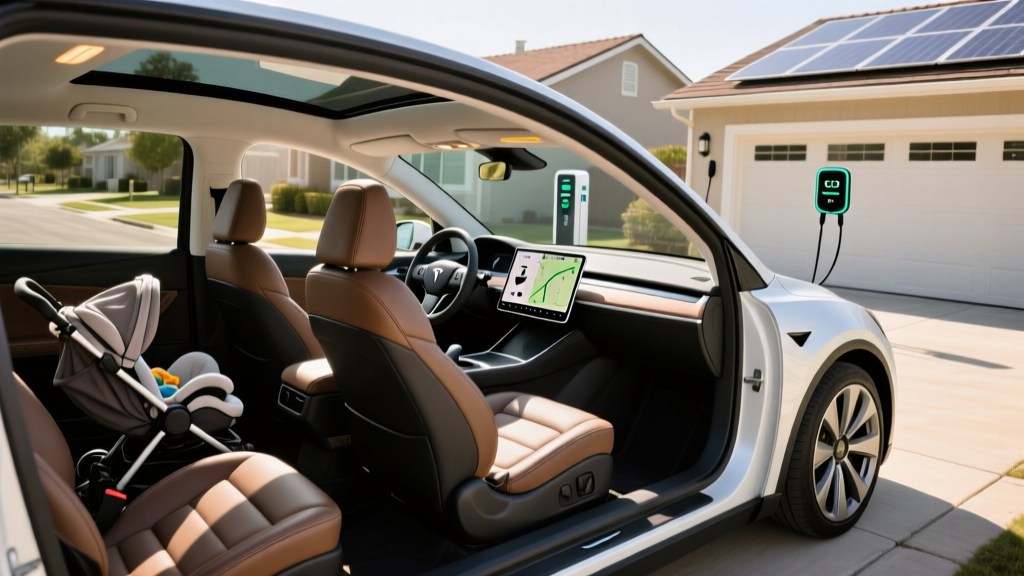
The Model Y's minimalist interior centers on a 15.4-inch touchscreen that controls virtually all vehicle functions — climate, media, navigation, vehicle settings, and even the glovebox release. There is no traditional instrument cluster; speed and navigation info appear on the upper-left corner of the main display. This approach polarizes buyers: some love the clean aesthetic, others miss physical buttons for volume and climate.
Third-Row Reality Check
The third row is the crux of this review, and honesty is warranted. With approximately 26.5 inches of legroom, the rearmost seats accommodate children up to roughly age 10-12 comfortably. Teenagers and adults can sit there for short trips (under 30 minutes) but will find the low cushion height and limited foot space fatiguing beyond that. Headroom is adequate for passengers under about 5'6".
Access to the third row requires tilting and sliding the second-row bench forward. It's manageable but not as convenient as the walk-through aisles in larger SUVs like the Kia EV9 or the sliding captain's chairs in a minivan. Installing child seats in the third row is possible with the LATCH anchors but tight.
Cargo space behind the raised third row drops to approximately 12 cubic feet — enough for a couple of grocery bags or a small stroller, but not both simultaneously. This is the Model Y's most significant compromise as a family vehicle. For context, the Kia EV9 offers roughly 20 cu ft behind its third row, and a Toyota Sienna minivan provides over 33 cu ft.
Standout Tech Features
- Tesla Supercharger network: Over 20,000 DC fast chargers in North America with industry-leading reliability and seamless plug-to-charge billing
- Over-the-air updates: Regular software improvements to navigation, efficiency, entertainment, and driver assists
- Autopilot (standard): SAE Level 2 adaptive cruise + lane centering on highways — requires full driver attention at all times
- Full Self-Driving Supervised ($8,000 option or $99/mo): Enhanced SAE Level 2 with automatic lane changes, traffic light/stop sign response, and navigation-on-autopilot — still requires hands-on-wheel supervision
- Sentry Mode / Dashcam: 360-degree cameras record incidents while parked and while driving
- Dog Mode / Camp Mode: Maintains cabin climate for pets or camping with the vehicle parked
Notable Drawbacks
- No Apple CarPlay or Android Auto — Tesla's proprietary infotainment only
- No head-up display
- Rear visibility is limited; reliance on cameras and mirrors
- Build quality variability — panel gaps and trim alignment remain inconsistent across deliveries
- No spare tire — tire repair kit only
- Turn signal stalks removed in the 2025 refresh; signals are now steering-wheel-mounted buttons, which many drivers find unintuitive
Pricing, Trim Levels, and Federal Tax Credit Eligibility
| Configuration | MSRP | Est. Federal Credit (§30D) | Effective Price |
|---|---|---|---|
| Long Range RWD (5-seat) | $44,990 | Up to $7,500* | ~$37,490 |
| Long Range AWD (5-seat) | $48,990 | Up to $7,500* | ~$41,490 |
| Long Range AWD + 3rd Row | $51,990 | Up to $7,500* | ~$44,490 |
| Performance AWD (5-seat) | $53,990 | Up to $7,500* | ~$46,490 |
*Federal tax credit eligibility under IRS §30D is subject to multiple requirements that change periodically. As of 2026, key rules include:
- MSRP cap: SUVs/crossovers must be priced at or below $80,000 (all Model Y trims qualify)
- Buyer income cap: Modified AGI must not exceed $150,000 (single), $225,000 (head of household), or $300,000 (married filing jointly)
- Battery sourcing: Critical minerals and battery components must meet phased-in domestic/free-trade-agreement sourcing thresholds — Tesla has worked to qualify, but verify current-year status at IRS.gov before purchase
- Point-of-sale transfer: Eligible buyers can transfer the credit to the dealer at purchase, reducing the upfront price rather than waiting for a tax refund
- VIN registration: The vehicle's VIN must be reported and validated through the IRS energy credit portal
Critical note: Battery component and critical mineral sourcing rules tighten annually. A Model Y that qualifies for the full $7,500 in early 2026 may see partial credit eligibility if supply chains shift mid-year. Always confirm eligibility at the time of purchase using the IRS portal and consult a tax professional for your specific situation.
How the 3rd Row Model Y Compares to Rivals
| Attribute | Tesla Model Y (3rd Row) | Kia EV9 (3-row) | Hyundai Ioniq 9 (3-row) |
|---|---|---|---|
| EPA Range | ~295 mi | ~304 mi (LR RWD) | ~335 mi (LR RWD) |
| Battery | ~79 kWh NMC | 100 kWh NMC | 110.3 kWh NMC |
| Peak DC Charge | 250 kW | 236 kW | 236 kW |
| 10-80% Charge | ~27 min | ~24 min | ~24 min |
| 3rd Row Legroom | ~26.5 in | ~32.0 in | ~32.5 in |
| Cargo (behind 3rd) | ~12 cu ft | ~20 cu ft | ~22 cu ft |
| Starting MSRP (3-row) | ~$51,990 | ~$59,900 | ~$61,000 |
| Federal Credit | Likely eligible* | Eligibility varies by sourcing | Eligibility varies by sourcing |
| Charging Network | NACS (Supercharger native) | CCS → NACS adapter available | CCS → NACS adapter available |
Best for Budget + Supercharger Access: Tesla Model Y 3rd Row — lowest entry price and native Supercharger integration.
Best for Genuine Third-Room Comfort: Hyundai Ioniq 9 — significantly more legroom, cargo space, and V2L capability.
Best for Value + Space Balance: Kia EV9 — strong range, usable third row, and competitive pricing.
The Model Y's advantages are price, Supercharger access, software ecosystem, and efficiency. Its disadvantages versus dedicated three-row platforms are clear: less third-row space, less cargo behind the third row, and no V2L. If your third row is for occasional short trips with young children, the Model Y works. If you need a true family hauler for daily carpools with older kids, the EV9 or Ioniq 9 are meaningfully more capable in the rear.
Ownership Costs: 5-Year Estimate
| Cost Category | Model Y LR AWD (3rd Row) | Gas Crossover (e.g., Toyota Highlander) |
|---|---|---|
| Purchase Price (after credit) | ~$44,490 | ~$42,000 |
| Fuel/Energy (75,000 mi) | ~$3,600 (home charging) | ~$10,200 (25 MPG, $3.40/gal) |
| Maintenance (5 yr) | ~$1,500 | ~$3,800 |
| Insurance (5 yr avg) | ~$12,500 | ~$9,000 |
| Estimated Depreciation | ~$18,000 | ~$15,000 |
| 5-Year Total Cost | ~$80,090 | ~$80,000 |
The Model Y's energy and maintenance savings are substantial — roughly $8,900 less over five years. However, EV insurance premiums run 20-40% higher on average, and depreciation on EVs has been steeper than comparable gas vehicles in recent years due to price wars and rapid model updates. Total cost of ownership lands remarkably close to a gas crossover when all factors are included. Your local electricity rate, annual mileage, and insurance quote will determine which comes out ahead.
Pros and Cons at a Glance
Pros
- Lowest-priced 3-row electric SUV with 290+ miles of range
- Native Supercharger network access — best road-trip charging experience
- Quick 4.8-second 0-60 and confident AWD traction
- Excellent efficiency (117 MPGe) keeps charging costs low
- Continuous OTA software updates add features over time
- Strong safety ratings (IIHS Top Safety Pick+, 5-star NHTSA)
- 8-year/120,000-mile battery warranty
Cons
- Third row is tight — best for children only, ~26.5" legroom
- Only ~12 cu ft cargo behind third row — very limited for a family vehicle
- No Apple CarPlay/Android Auto
- Steering-wheel turn signal buttons are divisive
- Insurance costs notably higher than gas alternatives
- Build quality inconsistency persists
- No V2L capability for off-grid power
- FSD remains SAE Level 2 (supervised) despite the name
Frequently Asked Questions
What is the real-world range of the 3rd row Tesla Model Y?
The EPA rates the Long Range AWD at approximately 303 miles in 5-seat configuration; the 7-seat option reduces this slightly (estimated ~295 miles). In real-world highway driving at 70-75 mph, expect 240-265 miles. In cold weather below 30°F, plan for 190-225 miles. Always precondition the battery while plugged in to maximize cold-weather range.
How fast does the Model Y charge at home and on the road?
On a 250 kW DC fast charger (V3 Supercharger), the Model Y charges from 10-80% in roughly 27 minutes, adding up to 162 miles in 15 minutes under ideal conditions. At home on a Level 2 wall connector (11.5 kW / 48A), you gain about 32 miles of range per hour, meaning a full overnight charge from 20-100% takes roughly 8-9 hours. Level 1 (120V) adds only 3-4 miles per hour and is suitable only for emergency top-ups.
How much does the 3rd row Model Y cost after the federal tax credit?
The Long Range AWD with the third-row option starts around $51,990. If you qualify for the full $7,500 federal tax credit under IRS §30D (income, MSRP, and battery sourcing requirements all met), the effective price drops to approximately $44,490. The credit can be transferred to the dealer at point of sale, reducing your upfront payment. Verify current eligibility at IRS.gov before purchasing.
Does the Tesla Model Y qualify for the $7,500 federal EV tax credit?
The Model Y has historically qualified for the full $7,500 credit, but eligibility depends on current-year battery sourcing rules, your income level (capped at $300,000 MFJ), and the vehicle's MSRP (under the $80,000 SUV cap). Tesla periodically adjusts its supply chain, and credit eligibility can shift. Always check the IRS clean vehicle credit portal and your tax professional before relying on the credit in your purchase budget.
Is the 3rd row Tesla Model Y worth buying vs the Kia EV9 or Ioniq 9?
It depends on your third-row usage. If you need the third row daily for older children or adults, the Kia EV9 and Hyundai Ioniq 9 offer substantially more legroom (~32 inches vs ~26.5) and cargo space. If you use the third row occasionally for small children and prioritize lower price, Supercharger access, and sportier driving dynamics, the Model Y is the better choice. The Model Y is a five-seat crossover with an occasional-use third row; the EV9 and Ioniq 9 are purpose-built three-row SUVs.
What are the biggest pros and cons of the 3rd row Model Y?
Top pros: lowest-priced 3-row EV with strong range, native Supercharger network, quick acceleration, excellent efficiency, and robust software. Top cons: cramped third row suited only for children, minimal cargo space with all seats up, no Apple CarPlay, higher insurance costs, and no V2L capability.
How long will the Model Y's battery last?
Tesla warranties the battery and drive unit for 8 years or 120,000 miles (whichever comes first) with a minimum 70% capacity retention guarantee. Real-world data from Tesla's fleet suggests NMC packs retain approximately 85-90% capacity at 100,000 miles under normal use. To maximize longevity, avoid routinely charging to 100% (set daily limit to 80-90%) and minimize repeated DC fast charging when Level 2 is available.
Is Tesla Autopilot or FSD actually self-driving?
No. Both Autopilot and Full Self-Driving (Supervised) are SAE Level 2 driver-assistance systems. They provide adaptive cruise control, lane centering, and (with FSD) automatic lane changes and intersection handling, but the driver must remain fully engaged with hands on the wheel and eyes on the road at all times. True self-driving (SAE Level 4) is currently available only in limited robotaxi services like Waymo in select cities — not in any consumer vehicle.
Safety and reliability sources: NHTSA, IIHS. Pricing and specifications verified at Tesla.com. Tax credit information sourced from IRS.gov.