Quick Verdict: Can the Kia EV6 Actually Tow?
The 2026 Kia EV6 remains one of the most capable electric crossovers on the market, and yes — it can tow. The Kia EV6 towing capacity peaks at 2,700 pounds when equipped with all-wheel drive, enough for a small utility trailer, a pair of jet skis, or a lightweight teardrop camper. Rear-wheel-drive models drop to a 1,650-pound rating. But towing is only part of the story. With its 800-volt architecture, the EV6 charges faster than nearly anything in its class, and the 2026 refresh brings updated battery chemistry options and a revised infotainment system that address previous pain points.
This review covers everything a buyer needs: real-world range under load, charging curve behavior, tax credit eligibility under current IRS §30D rules, and whether the EV6's tow rating is practical for your use case — or if you should look at a Ford F-150 Lightning instead.
2026 Kia EV6 Spec Sheet at a Glance
| Specification | RWD (Light/Wind) | AWD (Wind/GT-Line) | GT |
|---|---|---|---|
| EPA Range | 310 mi | 282 mi | 248 mi |
| Battery (usable) | 77.4 kWh (NMC) | 77.4 kWh (NMC) | 77.4 kWh (NMC) |
| Horsepower | 225 hp | 325 hp | 576 hp |
| 0-60 mph | 7.2 sec | 4.5 sec | 3.4 sec |
| Drivetrain | RWD single motor | AWD dual motor | AWD dual motor |
| Max DC Fast Charge | 240 kW | 240 kW | 240 kW |
| 10-80% DC Time | ~18 min | ~18 min | ~18 min |
| Level 2 Rate | 10.9 kW (~37 mi/hr) | 10.9 kW (~37 mi/hr) | 10.9 kW (~37 mi/hr) |
| Towing Capacity | 1,650 lbs | 2,700 lbs | 2,700 lbs |
| MPGe (combined) | 134 MPGe | 117 MPGe | 85 MPGe |
| Efficiency | 26 kWh/100mi | 29 kWh/100mi | 39 kWh/100mi |
| Base MSRP | $43,700 | $48,300 | $62,700 |
Sources: fueleconomy.gov, Kia America official specifications. Prices include destination charge.
Towing Capacity Breakdown: What 2,700 Pounds Gets You
The Kia EV6 towing capacity of 2,700 pounds (AWD models) is competitive within the electric crossover segment. For context:
- Tesla Model Y AWD: 3,500 lbs
- Hyundai Ioniq 5 AWD: 2,300 lbs
- Ford Mustang Mach-E AWD: 2,200 lbs (with optional hitch)
- Volkswagen ID.4 AWD: 2,700 lbs
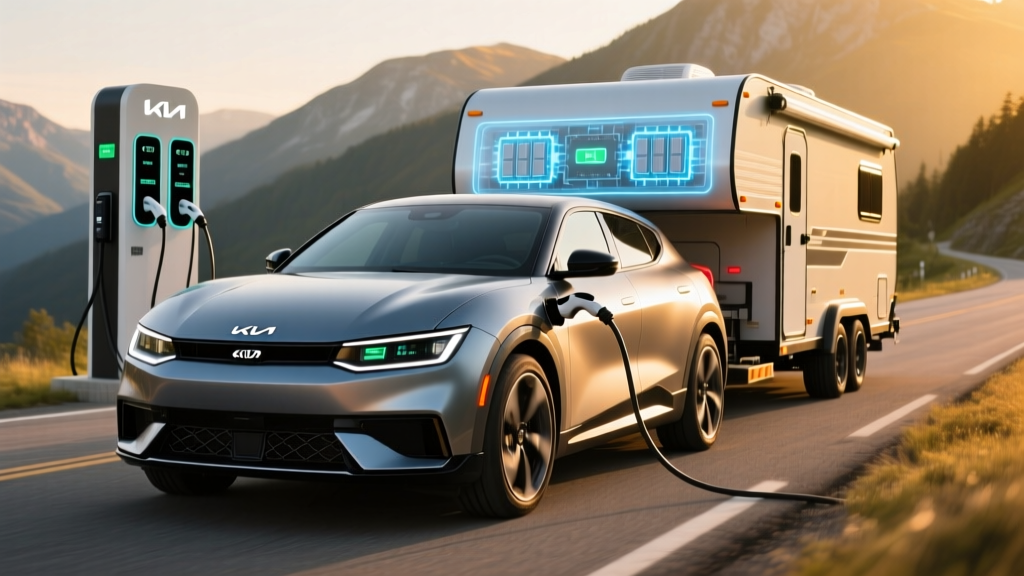
At 2,700 pounds, the EV6 AWD can handle a 5x8 utility trailer loaded with landscaping materials (~2,000 lbs gross), a small boat on a single-axle trailer, or a teardrop camper in the 1,500-2,200 lb range. It cannot tow a full-size travel trailer, a horse trailer, or most car-hauler loads — for those, you need an F-150 Lightning (7,700 lbs) or Rivian R1T (11,000 lbs).
The Range Penalty When Towing
This is where EV towing gets real. Expect a 40-55% range reduction when towing near the maximum capacity at highway speeds. The aerodynamic drag of a trailer and the additional rolling resistance force the motors to work substantially harder.
An EV6 AWD rated at 282 miles EPA will deliver approximately 130-170 miles of range when towing a 2,500 lb trailer at 65 mph in moderate temperatures. Add headwinds, hills, or cold weather, and that number compresses further. Plan charging stops every 100-120 miles to maintain a safety buffer.
If your primary use case involves frequent towing over long distances, the EV6's towing capacity is adequate for short hauls but impractical for cross-country trips with a trailer in tow.
Real-World Range vs. EPA Sticker
EPA estimate: 310 mi (RWD) / 282 mi (AWD) / 248 mi (GT)
Real-world highway (70-75 mph, 65°F): ~260-275 mi (RWD) / ~235-250 mi (AWD)
Real-world city/mixed (55 mph avg, 65°F): ~285-300 mi (RWD) / ~260-275 mi (AWD)
Cold weather (25°F, highway): ~210-230 mi (RWD) / ~190-210 mi (AWD)
The EV6's 77.4 kWh NMC (nickel-manganese-cobalt) battery pack delivers strong efficiency in mild conditions. The RWD model's 134 MPGe combined rating is among the best in the midsize EV crossover class. However, like all EVs, the EV6 loses range in three key scenarios: sustained highway speeds above 70 mph, cold temperatures below freezing, and towing or heavy cargo loads.
The EV6 includes a heat pump as standard equipment on all 2026 trims, which mitigates cold-weather cabin-heating energy draw by roughly 30% compared to resistive heating. Battery preconditioning is also standard — activate it via the navigation system before arriving at a DC fast charger to ensure optimal charge speeds in cold conditions.
Charging Speed: The 800-Volt Advantage
The Kia EV6's 800-volt electrical architecture is its standout engineering feature, enabling DC fast-charge rates that outpace most competitors still running 400-volt systems.
| Charging Level | Power | Rate / Time | Notes |
|---|---|---|---|
| Level 1 (120V household) | ~1.4 kW | ~4 mi/hr | Emergency/trickle only; full charge in ~55 hours |
| Level 2 (240V home) | 10.9 kW | ~37 mi/hr | Full 0-100% in ~8.5 hours; requires 48A circuit |
| DC Fast Charge (peak) | 240 kW | 10-80% in ~18 min | Requires 350 kW-capable CCS or NACS station |
| DC Fast Charge (50 kW station) | 50 kW | 10-80% in ~65 min | Common at older ChargePoint/EVgo locations |
Understanding the Charge Curve
The 240 kW peak rate is impressive, but it's a peak, not a sustained rate. In real-world DC fast charging, the EV6 typically sustains 200+ kW from 10% to about 55% State of Charge (SoC), then tapers progressively. From 55-80%, expect an average of roughly 120-150 kW. Above 80%, the rate drops sharply to protect battery health — charging from 80-100% at a DC fast charger can take as long as the 10-80% session. For road trips, plan to charge to 80% and go.
For home Level 2 charging, you'll need a 240V outlet (NEMA 14-50 or hardwired) on a dedicated 50-amp or 60-amp circuit. A quality Level 2 charger like the Emporia Vue or ChargePoint Home Flex costs $400-$700 for the unit, with professional installation typically running $500-$1,500 depending on panel proximity and local permitting. Budget $1,000-$2,200 total for a complete home charging setup.
Pricing, Trims & Federal Tax Credit Eligibility
The 2026 Kia EV6 lineup spans four trims, with pricing that positions it firmly in the premium-but-accessible EV crossover segment.
| Trim | Drivetrain | MSRP | Key Features |
|---|---|---|---|
| Light | RWD | $43,700 | Base model, 310-mi range, 12.3" dual displays |
| Wind | RWD or AWD | $47,300 / $48,300 | Heated/ventilated seats, power liftgate, Highway Driving Assist 2 |
| GT-Line | AWD | $53,200 | Sport styling, augmented reality HUD, remote smart parking |
| GT | AWD | $62,700 | 576 hp, electronic LSD, track mode, 3.4-sec 0-60 |
Does the 2026 Kia EV6 Qualify for the §30D Federal Tax Credit?
Under current IRS §30D rules, the Kia EV6's tax credit eligibility requires careful attention to three criteria:
- MSRP cap: SUVs/crossovers must be ≤$80,000. All EV6 trims qualify.
- Buyer income cap: Modified AGI must not exceed $150,000 (single), $225,000 (head of household), or $300,000 (joint).
- Battery sourcing requirements: Critical minerals and battery components must meet phased-in percentages from US or FTA-partner sources. Kia has restructured supply chains for the 2026 model year, but final credit amounts ($3,750 or $7,500) depend on the specific VIN's battery composition at time of delivery.
The credit can now be transferred at the point of sale, reducing your purchase price directly at the dealership rather than waiting for a tax refund. Confirm eligibility with your dealer and cross-reference the VIN on the IRS portal before signing. Consult a tax professional for your specific situation — incentive rules are subject to legislative change.
Interior, Cargo & Technology
The EV6's cabin is modern and well-finished, with Kia's latest dual 12.3-inch curved display layout and physical climate controls — a welcome carryover from the 2024 refresh that addressed complaints about the previous touch-only HVAC panel.
Space & Cargo
- Cargo (behind rear seats): 24.4 cu ft
- Cargo (rear seats folded): 50.2 cu ft
- Front trunk (frunk): 0.7 cu ft (AWD) / 1.8 cu ft (RWD) — enough for charging cables
- Rear legroom: 39.4 inches
- Front headroom: 40.1 inches
The frunk is notably small compared to the Hyundai Ioniq 5 (0.85 cu ft AWD) or Tesla Model Y (4.1 cu ft). The rear cargo area is competitive but not class-leading — the Model Y offers 30.2 cu ft behind the second row.
Driver Assistance & Tech
The EV6 comes equipped with Highway Driving Assist 2 (HDA2), Kia's SAE Level 2 driver-assist system. HDA2 provides adaptive cruise control with stop-and-go, lane centering, and lane-change assist on divided highways. It is not a self-driving system — the driver must keep hands on the wheel and eyes on the road at all times.
Additional tech highlights include vehicle-to-load (V2L) capability, which allows you to power external devices (up to 3.6 kW) through an interior outlet or an external adapter — useful for camping, tailgating, or emergency backup power.
Warranty & Long-Term Ownership
Kia's warranty coverage is among the strongest in the EV segment:
- Battery & drive unit: 10 years / 100,000 miles
- Limited vehicle warranty: 5 years / 60,000 miles
- Roadside assistance: 5 years / 60,000 miles
- Battery capacity retention: Kia warrants the high-voltage battery to retain at least 70% of original capacity during the coverage period
The 77.4 kWh NMC battery has demonstrated strong longevity data in the E-GMP platform family (EV6, Ioniq 5, GV60). Real-world degradation reports from high-mileage E-GMP owners show approximately 8-12% capacity loss over 100,000 miles, with most of that loss occurring in the first 20,000 miles before stabilizing. The NMC chemistry trades some cycle-life longevity versus LFP (lithium iron phosphate) in exchange for higher energy density — meaning more range in a smaller, lighter pack.
Pros, Cons & Who Should Buy the EV6
Pros
- 240 kW DC fast charging (10-80% in ~18 min) is class-leading
- 2,700-lb towing (AWD) covers light trailer duty
- Heat pump standard on all trims
- 10-year/100,000-mile battery warranty
- V2L capability for off-grid power
- Strong real-world efficiency (134 MPGe RWD)
Cons
- Tiny frunk (0.7 cu ft AWD)
- Range drops ~50% when towing near max capacity
- No LFP battery option for buyers prioritizing longevity over range
- Rear cargo space trails Model Y by ~6 cu ft
- Towing hitch is dealer-installed accessory, not factory-integrated
- GT trim's 85 MPGe makes it expensive to fuel on road trips
Who the EV6 Suits Best
- Daily commuters who want fast home charging and excellent efficiency (RWD Light or Wind)
- Weekend adventurers who occasionally tow a small trailer, kayak trailer, or bike rack (AWD Wind or GT-Line)
- Tech-forward buyers who value V2L, 800V charging, and a modern interior without paying luxury-brand premiums
Who should look elsewhere: If you tow a large camper regularly, need maximum cargo space, or want a full-size truck's capability, consider the Ford F-150 Lightning, Rivian R1S, or Tesla Model X.
Frequently Asked Questions
What is the real-world range of the Kia EV6?
The EPA rates the RWD EV6 at 310 miles and the AWD at 282 miles. In real-world highway driving at 70-75 mph in mild weather, expect 260-275 miles from the RWD and 235-250 from the AWD. Cold weather (below 30°F) reduces range by an additional 20-30%, bringing the AWD down to roughly 190-210 miles on the highway.
How fast does the Kia EV6 charge at home and on the road?
On a Level 2 home charger (10.9 kW), the EV6 gains approximately 37 miles of range per hour, with a full charge taking about 8.5 hours. At a DC fast charger rated at 350 kW, the EV6 peaks at 240 kW and charges from 10-80% in roughly 18 minutes — one of the fastest times in its class thanks to the 800V platform.
Does the Kia EV6 qualify for the federal EV tax credit?
The EV6 meets the MSRP cap ($80,000 for SUVs) for all trims. Buyer income must be under $150K/$225K/$300K (single/HOH/joint). The actual credit amount ($3,750 or $7,500) depends on battery mineral sourcing and component origin, which varies by VIN. The point-of-sale transfer option lets you apply the credit at purchase. Always verify on the IRS clean vehicle credit page and consult a tax professional.
Is the Kia EV6 worth buying vs. the Hyundai Ioniq 5 or Tesla Model Y?
The EV6 and Ioniq 5 share the E-GMP platform and nearly identical powertrains, but the EV6's slightly lower roofline gives it a sportier look at the cost of a smaller frunk and slightly tighter rear headroom. The Tesla Model Y offers more cargo space (30.2 cu ft), a higher tow rating (3,500 lbs), and access to the Supercharger network natively — though the EV6's CCS/NACS adapter compatibility and faster peak charge rate (240 kW vs. Model Y's ~250 kW peak but slower sustained curve) narrow the gap on road trips. Choose the EV6 for charge speed and warranty; choose the Model Y for cargo volume and tow capacity.
Can I install a tow hitch on the EV6 myself?
Kia offers a dealer-installed tow hitch accessory with integrated wiring harness. While aftermarket hitches (Curt, Draw-Tite) are available, we recommend the OEM hitch to ensure proper integration with the EV6's trailer stability control software and to avoid any warranty complications with the rear subframe or high-voltage cabling routing.
How much does it cost to charge a Kia EV6 vs. gasoline?
At the US average residential electricity rate of ~$0.16/kWh, fully charging the 77.4 kWh battery at home costs approximately $12.38, yielding a cost of roughly $0.04-$0.05 per mile (AWD). A comparable gasoline SUV getting 25 MPG at $3.30/gallon costs about $0.13 per mile. Over 15,000 miles per year, that's a fuel savings of approximately $1,200-$1,350 annually with home charging.