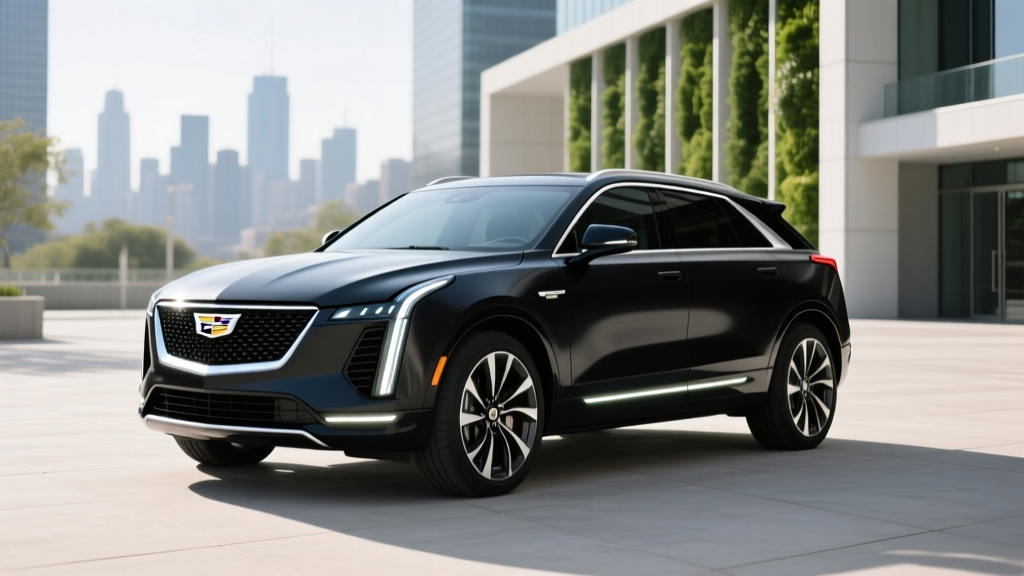
Bottom Line: The 2026 Cadillac Vistiq is a three-row luxury electric SUV with an EPA-estimated 305 miles of range, 250 kW DC fast charging (10–80% in ~25 minutes), and a starting MSRP of $58,590. It qualifies for up to $7,500 in federal tax credits (subject to income and battery-sourcing rules). Real-world range drops to roughly 250–270 miles at sustained highway speeds and 210–240 miles in freezing weather. Total 5-year ownership cost runs approximately $48,000–$54,000 depending on home charging access — roughly $8,000–$12,000 less than a comparable gas-powered Cadillac XT6 over the same period.
If you're researching the Cadillac Vistiq electric SUV as a family hauler, you're likely weighing it against the BMW iX, Mercedes EQS SUV, Tesla Model X, or even a three-row hybrid like the Toyota Grand Highlander. This guide breaks down the Vistiq's real-world specs, ownership economics, and the practical factors that determine whether it fits your daily driving life.
Vistiq Specs at a Glance: Range, Battery, and Performance
The 2026 Vistiq rides on GM's Ultium platform with a dual-motor all-wheel-drive powertrain standard across all trims. Here's what the numbers look like before we get into real-world adjustments.
| Specification | 2026 Cadillac Vistiq |
|---|---|
| EPA Range | 305 miles |
| Battery (Usable) | 102 kWh, NMC (nickel manganese cobalt) |
| Peak DC Fast Charge | 250 kW |
| 10–80% DC Charge Time | ~25 minutes |
| Level 2 Charge Rate | 11.5 kW (~34 mi/hr) |
| Horsepower | 615 hp (Velocity Package) |
| 0–60 mph | 3.7 seconds (Velocity Package) |
| Efficiency (MPGe) | 89 MPGe combined |
| Towing Capacity | 4,000 lbs |
| Base MSRP (Luxury) | $58,590 |
| Battery/Powertrain Warranty | 8 years / 100,000 miles |
Real-World Range Reality Check: The EPA's 305-mile estimate assumes a mix of city and moderate-speed driving. Expect roughly 250–270 miles on sustained 75 mph highway trips, and 210–240 miles in sub-freezing temperatures (below 32°F) due to cabin heating demands and battery chemistry limitations. If your commute is mostly stop-and-go city driving, you may see results close to or even slightly above the EPA number thanks to regenerative braking. Source: fueleconomy.gov
Charging the Vistiq: Home Setup and Public DC Speeds
The Vistiq uses the NACS (North American Charging Standard) connector natively, meaning direct access to Tesla's Supercharger network — currently the most reliable and dense public DC fast-charging infrastructure in the U.S. — without an adapter.
| Charging Level | Power (kW) | Miles Added per Hour | Typical Use Case |
|---|---|---|---|
| Level 1 (120V) | ~1.4 kW | ~4 mi/hr | Emergency / overnight trickle |
| Level 2 (240V, 48A) | 11.5 kW | ~34 mi/hr | Daily home charging |
| DC Fast (peak) | 250 kW | N/A (10–80% in ~25 min) | Road trips |
Understanding the charge curve: The Vistiq will peak near 250 kW only at a low state of charge (roughly 5–20%) and at a charger capable of delivering that power. Above 50% SoC, the rate tapers significantly, and above 80% it drops to under 50 kW. This is normal battery-protection behavior across all NMC chemistries. A 10–80% session in ~25 minutes assumes a 350 kW-capable Supercharger V4 or Electrify America station with battery preconditioning active (the Vistiq automatically preconditioning when you navigate to a charger).
Home charging cost: Installing a 240V / 48-amp Level 2 home charger (like the ChargePoint Home Flex or Emporia Vue) typically costs $800–$2,200 total — including the unit ($400–$700), electrician labor ($300–$1,200), and permits ($50–$300). A panel upgrade from 100A to 200A service, if needed, adds $1,500–$3,000. At the U.S. average electricity rate of $0.17/kWh, fully charging the Vistiq's 102 kWh battery at home costs about $17.34, yielding roughly $0.057 per mile.
Vistiq vs. Gas SUV: The Real Cost Comparison
How does the Vistiq stack up against a gas-powered three-row luxury SUV over five years? We compared it against the Cadillac XT6 (the closest internal-combustion equivalent) using 15,000 miles/year and national averages.
| Cost Factor (5 Years / 75,000 mi) | Cadillac Vistiq (EV) | Cadillac XT6 (Gas) |
|---|---|---|
| Base MSRP | $58,590 | $50,595 |
| Federal Tax Credit (§30D) | −$7,500* | $0 |
| Effective Purchase Price | $51,090 | $50,595 |
| Fuel / Electricity (75k mi) | $4,275** | $11,250*** |
| Maintenance (5 years) | $1,800 | $4,200 |
| Insurance (est. avg) | $12,500 | $10,000 |
| Total 5-Year Cost | $69,665 | $76,045 |
* §30D credit eligibility depends on buyer income (≤$300k joint / ≤$150k single), MSRP cap ($80k for SUVs), and battery critical-mineral/sourcing requirements per IRS rules. Verify eligibility before purchase.
** Assumes 80% home charging at $0.17/kWh, 20% public DC at $0.40/kWh.
*** Assumes 21 MPG combined and $3.15/gallon national average.
The Vistiq's higher insurance premiums (typically 15–25% more than gas equivalents due to repair costs and battery replacement risk) partially offset fuel and maintenance savings, but the total 5-year cost still favors the EV by roughly $6,000–$7,000 — and that gap widens further if you have access to cheaper electricity (solar panels, time-of-use rates below $0.10/kWh) or state-level rebates.
Who Should Buy the Vistiq? A Practical Decision Framework
Choose the Cadillac Vistiq if:
- You need three rows and at least 280+ real-world miles of range for road trips
- You have access to home Level 2 charging (garage or driveway with 240V circuit)
- You want native Supercharger access without adapters (NACS standard)
- You tow up to 4,000 lbs (small boat, utility trailer, light camper)
- You value a quiet, smooth luxury cabin with GM's latest 33-inch LED display
- Your household income qualifies for the §30D federal tax credit
Look elsewhere if:
- You rely solely on apartment/curbside parking with no reliable charging access
- You regularly tow over 4,000 lbs (consider a diesel SUV or the Rivian R1S with Max Pack)
- You live in extreme cold (below 0°F regularly) and cannot garage the vehicle — range loss will be substantial
- You need the absolute lowest price point — the Hyundai Ioniq 9 or Kia EV9 offer three rows starting under $55,000
- You want proven Level 4 autonomous driving — the Vistiq's Super Cruise is Level 2 and requires full driver attention
Driver Assist ≠ Self-Driving: The Vistiq offers GM's Super Cruise — an SAE Level 2 driver-assistance system. It handles steering, acceleration, and braking on compatible highways, but you must remain attentive and ready to take over at any moment. The driver-monitoring camera will alert and eventually disengage the system if you look away. This is fundamentally different from Level 4 robotaxi services like Waymo. Never treat Super Cruise as autonomous.
Common Misconceptions About the Vistiq (and EVs in General)
| Myth | Fact |
|---|---|
| "The battery will need replacing in 5 years for $20,000" | GM warranties the Ultium battery for 8 years/100,000 miles against defects and capacity loss below 70%. Real-world NMC degradation data from similar Ultium vehicles shows roughly 5–8% capacity loss over 100,000 miles. Full replacement is rare and costs $12,000–$18,000 if out of warranty, but most batteries outlast the vehicle. |
| "You can't road-trip an EV — charging takes too long" | A 10–80% DC fast charge takes ~25 minutes at a 250+ kW station. On a 600-mile trip, you'll stop twice for roughly 25 minutes each — time you'd spend on food, restrooms, and stretching anyway. The Tesla Supercharger network (now NACS-accessible) has over 28,000 stalls in North America. |
| "EVs don't work in cold weather" | EVs lose 15–30% range in sub-freezing temps due to cabin heating and slower battery chemistry. The Vistiq's heat pump mitigates this somewhat. With 305 miles EPA, you'd still have ~215–260 usable miles in winter — enough for most daily needs and manageable on road trips with planning. |
| "Home charging installation is always $5,000+" | Most Level 2 installations run $800–$2,200 if your electrical panel has capacity. Only homes needing a full panel upgrade (100A → 200A) approach $3,000–$5,000. Many utilities offer rebates of $250–$750 for charger installation. |
First-Time EV Buyer Checklist: What to Know Before You Sign
If the Vistiq is your first electric vehicle, here's what separates a smooth ownership experience from frustration:
- Confirm your home charging situation first. A dedicated 240V/50-amp circuit (NEMA 14-50 or hardwired) is the single biggest predictor of EV satisfaction. Without it, you'll rely on public charging, which costs 2–4× more per mile and adds time to your routine. Consult a licensed electrician for a site assessment before ordering.
- Verify §30D tax credit eligibility. The credit is not automatic. You must meet income caps ($300,000 joint / $150,000 single modified AGI), the SUV MSRP cap ($80,000), and the vehicle must meet critical-mineral and battery-component sourcing thresholds. The credit can now be transferred to the dealer at point of sale as an instant discount — confirm this with your Cadillac dealer. See IRS §30D guidance.
- Download the charging apps before delivery. Install Tesla (for Supercharger access), PlugShare, and your preferred network app (EVgo, Electrify America). The Vistiq's native NACS port means Superchargers work natively, but having backup networks mapped helps in rural areas.
- Understand your electricity rate. If your utility offers time-of-use (TOU) pricing, schedule charging for off-peak hours (often 10 PM – 6 AM) to cut fuel costs by 40–60%. The Vistiq's infotainment system allows scheduled charging.
- Budget for higher insurance. EV insurance premiums average 15–25% above equivalent gas vehicles. Get quotes before purchase — some insurers (like Tesla Insurance or specialized EV carriers) may offer better rates.
- Plan for tire replacement. EVs are heavier and produce instant torque, wearing tires 20–30% faster than gas vehicles. Budget for a set of EV-optimized tires (like Michelin Pilot Sport EV or Hankook iON) every 30,000–40,000 miles at roughly $1,200–$1,800 per set.
How the Vistiq Compares to Key Rivals
The three-row luxury EV segment is growing. Here's how the Vistiq stacks up on the numbers that matter:
| Spec | Cadillac Vistiq | Kia EV9 (GT-Line AWD) | BMW iX xDrive50 |
|---|---|---|---|
| EPA Range | 305 mi | 270 mi | 324 mi |
| Battery (kWh) | 102 | 99.8 | 111.5 |
| Peak DC kW | 250 | 210 | 200 |
| 10–80% DC Time | ~25 min | ~24 min | ~31 min |
| 0–60 mph | 3.7s | 4.5s | 4.4s |
| Three Rows | Yes | Yes | No |
| Base MSRP | $58,590 | $63,900 | $87,250 |
| §30D Credit Eligible | Yes* | No** | No** |
* Subject to buyer eligibility and sourcing rules. ** As of 2026, the EV9 and iX do not meet §30D critical-mineral/battery-component sourcing thresholds. Verify at fueleconomy.gov before purchase — these change periodically.
The Vistiq's combination of three-row seating, 305-mile range, native Supercharger access, and tax-credit eligibility makes it uniquely positioned in this price bracket. The Kia EV9 is a strong alternative if you prioritize a lower entry price and don't need the tax credit, while the BMW iX offers more range and a premium badge but lacks a third row and costs significantly more.
Frequently Asked Questions
Does the Cadillac Vistiq qualify for the $7,500 federal tax credit?
The Vistiq is eligible for up to $7,500 under IRS §30D, but qualification depends on you, not just the vehicle. Your modified adjusted gross income must not exceed $300,000 (joint) or $150,000 (single). The vehicle MSRP must be under $80,000 (the Vistiq qualifies as an SUV). The battery must meet critical-mineral and component-sourcing thresholds that change annually. The credit can be transferred to the dealer at point of sale as an instant price reduction. Always verify current eligibility on irs.gov before finalizing a purchase.
Can I charge the Vistiq at Tesla Superchargers?
Yes. The 2026 Vistiq uses the NACS connector natively, meaning it plugs directly into Tesla Supercharger V3 and V4 stalls without any adapter. You'll use the Cadillac myCadillac app or the vehicle's built-in navigation to locate, initiate, and pay for sessions — no Tesla app required.
How long does it take to charge the Vistiq at home overnight?
On a Level 2 (240V / 48A) home charger delivering 11.5 kW, a full 0–100% charge takes approximately 9 hours. In practice, most owners plug in at 20–30% remaining and wake up to 80–90% — a 5–6 hour session that costs roughly $8–$12 at average electricity rates.
What happens to the battery warranty if I sell the Vistiq?
GM's 8-year/100,000-mile battery and powertrain warranty is fully transferable to subsequent owners at no cost. This protects resale value and is a key advantage over aftermarket or third-party battery warranties.
Is the Vistiq a good tow vehicle?
The Vistiq is rated for 4,000 lbs of towing capacity — suitable for small boats, light utility trailers, and pop-up campers. However, towing will reduce range by 30–50% depending on trailer weight and aerodynamics. If you regularly tow near the max capacity, plan for charging stops every 120–160 miles on road trips.