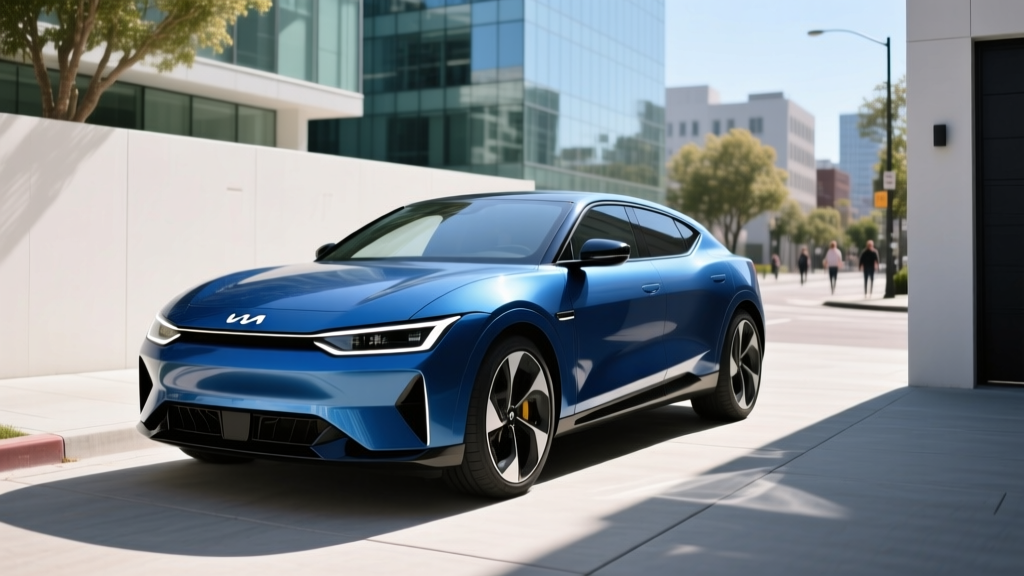
The Kia EV6 remains one of the most compelling electric crossovers on the market, pairing an 800-volt architecture with striking design and genuine long-range capability. But the sticker price is only half the story. Whether you're eyeing the Light, Wind, or GT-Line trim, the real question is how much you'll actually spend — and save — over five years of ownership, and whether the elusive Kia EV6 rebate in the form of the federal §30D tax credit is still within reach.
This guide dissects every layer of EV6 ownership economics for the 2026 model year: federal credit eligibility, state and utility incentives, real-world charging costs, maintenance savings, insurance premiums, and depreciation trends. We'll use hard numbers, not marketing promises.
2026 Kia EV6: Pricing and Trim Overview
Before we calculate savings, we need the starting numbers. The 2026 Kia EV6 lineup (based on the current-generation platform carried forward) spans three core trims, all built on the E-GMP architecture with an 800V electrical system that enables class-leading DC fast charging.
| Trim | Drivetrain | Battery (usable kWh) | EPA Range | 0-60 mph | Peak DC Charge | Base MSRP |
|---|---|---|---|---|---|---|
| Light RWD | RWD, 167 kW motor | 77.4 kWh (NMC) | ~310 mi | 7.2 sec | 240 kW (10-80% ~18 min) | ~$42,600 |
| Wind AWD | AWD, 239 kW combined | 77.4 kWh (NMC) | ~282 mi | 5.1 sec | 240 kW (10-80% ~18 min) | ~$48,200 |
| GT-Line AWD | AWD, 239 kW combined | 77.4 kWh (NMC) | ~274 mi | 5.0 sec | 240 kW (10-80% ~18 min) | ~$53,500 |
Federal Tax Credit: Is the Kia EV6 Eligible for $7,500?
The federal EV tax credit under IRS §30D can reduce your tax burden by up to $7,500 — but eligibility hinges on a web of requirements that have tightened significantly since the Inflation Reduction Act reshaped the rules. As of 2026, the Kia EV6's credit status depends on battery sourcing compliance, your income, and the vehicle's MSRP.
The EV6 is assembled in West Point, Georgia (since late 2024), which resolved the earlier North American assembly disqualification. However, the critical minerals and battery component sourcing requirements remain the moving target. Kia has worked to localize its supply chain, but the exact credit amount — whether the full $7,500, a partial $3,750, or $0 — can shift as Treasury Department guidance updates.
- Income caps: Modified AGI must not exceed $150,000 (single), $225,000 (head of household), or $300,000 (joint filers)
- MSRP caps: Vehicle base price must be ≤ $55,000 for sedans; ≤ $80,000 for SUVs, vans, and pickups. The EV6 is classified as an SUV, so all trims qualify on price.
- Battery sourcing: At least 60% of critical minerals must be extracted/processed in the U.S. or a free-trade-agreement country, AND 85% of battery components must be manufactured/assembled in North America (thresholds increase annually)
- Point-of-sale transfer: You can now transfer the credit to the dealer at purchase, applying it as an immediate down-payment reduction rather than waiting to claim it on your tax return
- New vehicle only: Must be purchased new; used EVs fall under a separate §25E credit (up to $4,000)
Source: IRS §30D Clean Vehicle Credit. Consult a tax professional — rules are subject to change and individual circumstances vary.
Bottom line on the Kia EV6 rebate: The Light RWD and Wind AWD trims (both under $50K) are strong candidates for the full or partial credit, assuming Kia's 2026 battery sourcing meets the threshold. The GT-Line, at ~$53,500, still clears the $80,000 SUV cap but you should verify current sourcing compliance on fueleconomy.gov before signing.
State, Local, and Utility Incentives
Federal credits are only one layer. Depending on where you live, the total incentive stack can push well past $10,000.
- California: Clean Vehicle Rebate Project (CVRP) — up to $2,000 for income-qualified buyers; plus potential CARB clean fuel rebate
- Colorado: State EV tax credit — up to $5,000 for vehicles under $80,000 MSRP
- New York: Drive Clean Rebate — up to $2,000 point-of-sale
- Utility rebates: Many utilities (PG&E, ConEd, Xcel Energy, etc.) offer $500–$1,500 for EV purchase and/or Level 2 home charger installation
- HOV lane access: Available in CA, CO, FL, GA, MD, MN, NJ, NY, VA, and others — check your state DMV
These programs change frequently. Check your state energy office and local utility for current availability.
5-Year Total Cost of Ownership: EV6 vs. Gas Crossover Baseline
To understand the EV6's real financial picture, we'll compare it against a typical gas-powered compact SUV averaging 28 MPG combined (a reasonable baseline like a Toyota RAV4 AWD or Honda CR-V AWD). We assume 15,000 miles/year, $3.50/gallon gas, $0.14/kWh home charging, and current national insurance averages.
| Cost Category | Kia EV6 Wind AWD | Gas Crossover (28 MPG) |
|---|---|---|
| Purchase price (MSRP) | $48,200 | $36,500 |
| Federal tax credit (§30D) | –$7,500 (if eligible) | $0 |
| State/utility incentives (est.) | –$1,500 | $0 |
| Net purchase cost | $39,200 | $36,500 |
| Fuel/energy (75,000 mi total) | $3,675 (home charging) | $9,375 |
| Maintenance (5 years) | $1,800 | $4,200 |
| Insurance (5 years) | $11,500 | $9,250 |
| Depreciation (est. 5-yr) | $22,000 | $16,500 |
| Total 5-Year Cost | $78,175 | $75,825 |
Charging Cost vs. Gasoline: The Per-Mile Math
The EV6 Wind AWD achieves approximately 117 MPGe combined (fueleconomy.gov), which translates to roughly 29 kWh per 100 miles. Here's what that means in real dollars:
| Scenario | Cost per Mile | Annual Cost (15K mi) |
|---|---|---|
| EV6 — Home charging @ $0.14/kWh | $0.041 | $615 |
| EV6 — Home charging @ $0.10/kWh (off-peak) | $0.029 | $435 |
| EV6 — Public DC fast charging @ $0.40/kWh | $0.116 | $1,740 |
| Gas crossover @ $3.50/gal, 28 MPG | $0.125 | $1,875 |
| Gas crossover @ $4.50/gal, 28 MPG | $0.161 | $2,415 |
The takeaway: home charging is where the EV6 delivers massive savings — roughly $0.03–$0.04 per mile versus $0.12–$0.16 for gas. But if you rely primarily on public DC fast charging, your per-mile cost nearly triples and can approach or exceed gasoline costs. This is why home Level 2 charging access is the single biggest financial variable in EV ownership.
The EV6's 800V architecture means DC fast charging peaks at 240 kW, delivering a 10–80% charge in roughly 18 minutes — but only at compatible 350 kW chargers (Electrify America, select Tesla Superchargers with NACS adapter). At a typical 150 kW station, expect 10–80% in about 25 minutes, and the charge curve tapers significantly above 80% SoC to protect the NMC battery.
Maintenance Savings: Where EVs Quietly Win
EVs don't eliminate maintenance, but they radically simplify it. The EV6 has no engine oil, no transmission fluid, no spark plugs, no timing belt, and no exhaust system. Regenerative braking dramatically extends pad and rotor life — many EV owners report original brake pads at 80,000+ miles.
| Item | EV6 | Gas Crossover |
|---|---|---|
| Oil changes | $0 | $600–$900 |
| Brake pads/rotors | $0–$200 (regen extends life) | $800–$1,500 |
| Transmission fluid | $0 (single-speed reducer) | $150–$300 |
| Cabin air filter | $100–$150 | $100–$150 |
| Tire rotation/replacement | $1,200–$1,600 (EVs wear tires faster due to torque + weight) | $800–$1,200 |
| Coolant flush | $100–$150 | $100–$200 |
| Total (est.) | $1,400–$2,100 | $2,550–$4,250 |
Caveat: EVs tend to consume tires 15–25% faster than comparable gas vehicles due to instant torque delivery and higher curb weight (the EV6 Wind AWD weighs ~4,700 lbs). Budget for a tire set replacement around year 3–4. The EV6's battery and drive unit carry a 10-year/100,000-mile warranty, with capacity retention guaranteed above 70% — a critical long-term protection.
Insurance Costs: The Uncomfortable Truth
EV insurance premiums are typically 15–25% higher than equivalent gas vehicles, and the EV6 is no exception. National average full-coverage premiums for the EV6 run approximately $2,200–$2,400/year versus $1,800–$1,950 for a comparably priced gas crossover.
Why the premium?
- Repair costs: Battery pack replacement ($15,000–$20,000+ out of warranty), specialized high-voltage training for body shops, and limited structural repair options after collision
- Higher vehicle values: Insurers price based on replacement cost, and EVs generally carry higher MSRPs
- Parts scarcity: EV-specific body panels and components can have longer lead times
- Total-loss thresholds: Even minor battery enclosure damage can trigger a total-loss declaration
What to do: Shop at least 4–5 insurers before purchase. Companies like Geico, Progressive, and State Farm now offer EV-specific policies, and some offer discounts for garaging near a fire station or completing a defensive driving course. Bundling home and auto can shave 10–15% off premiums.
Depreciation and Resale Value Trends
This is where EV ownership economics have been most volatile. After a brutal 2023–2024 depreciation cycle driven by Tesla's aggressive price cuts, rising interest rates, and early-adopter lease returns flooding the used market, EV resale values stabilized somewhat in 2025–2026.
The EV6 specifically holds an advantage over some competitors thanks to:
- Strong brand reputation and Kia's 10-year/100,000-mile powertrain warranty (partially transferable to second owner)
- 800V charging architecture that won't feel outdated as 350 kW infrastructure expands
- EPA range figures (274–310 miles) that remain competitive in 2026
However, expect roughly 45–55% depreciation over five years on the EV6 — steeper than the 40–48% typical for a mainstream gas crossover like the RAV4. Key depreciation risks include battery degradation anxiety among used buyers, potential future price cuts on new models, and evolving federal/state incentive structures that can compress used-EV demand.
The best hedge: buy a trim and color with broad appeal (Wind AWD in a neutral color), maintain meticulous service records, and keep mileage moderate. If you plan to own for 8–10 years, depreciation matters far less since you'll ride out the steepest initial drop.
Kia EV6 Rebate & Ownership FAQ
Does the 2026 Kia EV6 qualify for the full $7,500 federal tax credit?
It depends on current battery-sourcing compliance at the time of purchase. The EV6 is assembled in Georgia (meeting North American assembly rules) and all trims fall under the $80,000 SUV MSRP cap. However, the critical-minerals and battery-component sourcing thresholds increase annually. Check fueleconomy.gov for the latest eligibility status and consult a tax professional. You must also meet income caps ($150K single / $300K joint).
Can I get the Kia EV6 rebate as a point-of-sale discount?
Yes. Under current §30D rules, you can transfer the credit to the dealership at purchase, applying it directly as a down-payment reduction. This means you don't need to wait until tax season to benefit, and you don't need sufficient tax liability to claim the full amount — the transfer converts it to an upfront discount regardless of your tax situation.
How much does it cost to charge the EV6 at home per month?
At the national average electricity rate of ~$0.14/kWh and driving 1,250 miles/month (15,000/year), expect roughly $50–$65/month for home charging. With a time-of-use plan and off-peak charging at $0.10/kWh, that drops to $35–$45/month. This compares to $150–$200/month for gasoline at $3.50–$4.50/gallon in a 28 MPG crossover.
Is the Kia EV6 more expensive to insure than a gas car?
Yes, typically 15–25% more. Expect $2,200–$2,400/year for full coverage versus ~$1,850–$1,950 for a comparable gas crossover. Higher repair costs (especially battery-related), elevated vehicle values, and specialized parts contribute. Always get insurance quotes before committing to a purchase — premiums vary dramatically by insurer, ZIP code, and driving record.
What is the EV6's battery warranty, and what does it cover?
Kia covers the EV6's high-voltage battery for 10 years or 100,000 miles, whichever comes first. The warranty guarantees the battery will retain at least 70% of its original capacity. If it degrades below that threshold within the warranty period, Kia will repair or replace it at no cost. The drive unit (motor, inverter) carries the same 10-year/100,000-mile coverage.
Will the EV6's resale value improve as EV adoption grows?
Possibly, but don't count on it as a financial strategy. Broader adoption normalizes used-EV demand, but ongoing battery technology improvements and new-model competition continuously pressure used prices. The EV6's 800V architecture and strong warranty provide better-than-average resale protection, but gas vehicles still hold a modest depreciation edge in 2026. If resale value is your top priority, consider a 3-year lease to transfer the depreciation risk to the lessor.