Verdict: Efficiency Meets 800-Volt Performance
The 2026 Kia EV6 remains one of the most efficient and technologically compelling electric crossovers on the market. Built on Hyundai Motor Group's E-GMP platform with its class-leading 800-volt architecture, the EV6 delivers impressive MPGe figures that rival smaller sedans while offering crossover practicality. But EPA stickers only tell part of the story — real-world efficiency depends heavily on your driving style, climate, and charging habits.
EPA Range vs. Real-World Expectations
EPA Estimated: Up to 310 miles (Light Long Range RWD)
Real-World Highway (70-75 mph): Expect 240-270 miles
Cold Weather (below 32°F): Range drops 20-30%, yielding 215-250 miles
City/Mixed Driving: Closer to EPA, often 280-300 miles with regen braking
The EV6's efficiency shines in stop-and-go traffic where regenerative braking recaptures energy, but highway cruising at 75+ mph significantly reduces range. If your commute is mostly urban or suburban, you'll see numbers much closer to the EPA estimate. Road trippers should plan conservatively — especially in winter or mountainous terrain.
2026 Kia EV6 Specifications & Efficiency
| Specification | Light Long Range RWD | Wind AWD | GT |
|---|---|---|---|
| EPA Range | 310 miles | 282 miles | 206 miles |
| MPGe (City/Hwy/Combined) | 134/115/125 | 117/101/109 | 85/74/80 |
| kWh/100 miles | 27 | 31 | 42 |
| Battery Capacity | 77.4 kWh (NMC) | 77.4 kWh (NMC) | 77.4 kWh (NMC) |
| Horsepower | 225 hp | 320 hp | 576 hp |
| 0-60 mph | 7.2 seconds | 5.1 seconds | 3.4 seconds |
| Drivetrain | RWD | AWD (Dual Motor) | AWD (Dual Motor) |
| Base MSRP | $42,900 | $48,900 | $61,900 |
The Light Long Range RWD is the efficiency champion, achieving 125 MPGe combined — competitive with the Tesla Model Y Long Range and Hyundai Ioniq 5. The dual-motor AWD trims sacrifice some efficiency for all-weather traction and faster acceleration, while the GT prioritizes performance over range.
Charging Speed: The 800-Volt Advantage
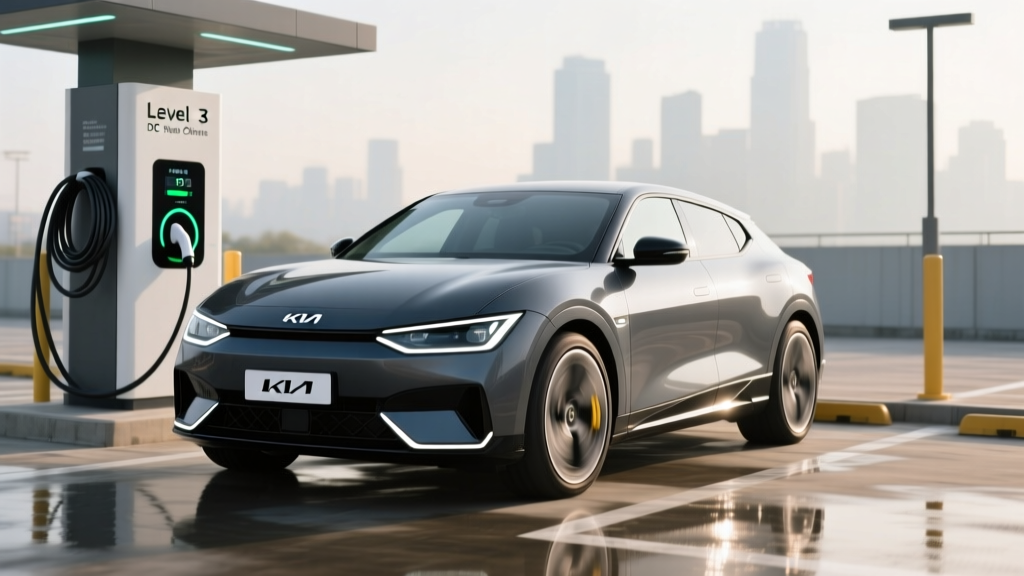
The EV6's 800-volt architecture is its standout feature, enabling DC fast-charging speeds that outpace most competitors in this price range. Here's what you can expect:
| Charging Method | Power Output | Time/Rate |
|---|---|---|
| DC Fast Charging (Peak) | 240 kW | 10-80% in ~18 minutes |
| DC Fast Charging (Sustained) | ~150-180 kW average | Actual 10-80% session time |
| Level 2 Home Charging (240V) | 10.9 kW | ~7 hours (0-100%) |
| Level 1 (120V Standard Outlet) | 1.4 kW | ~3-4 miles per hour |
Real-World Charging Insight: The 240 kW peak is impressive, but charging curves taper significantly above 80% state of charge. For optimal road-trip efficiency, charge from 10-80% and skip the final 20% unless absolutely necessary — that last chunk can take as long as the first 70%. At home, a Level 2 charger adds roughly 30-35 miles of range per hour, easily replenishing a full day's driving overnight.
The EV6 uses the NACS (Tesla-style) connector for 2026, granting native access to Tesla Superchargers without an adapter — a major advantage over CCS-only competitors. For older CCS chargers, Kia includes an adapter.
Pricing, Trims & Federal Tax Credit Eligibility
The 2026 EV6 lineup starts at $42,900 and climbs to nearly $62,000 for the GT. But the real question for many buyers: does it qualify for the federal EV tax credit under IRS §30D?
| Trim | MSRP | Est. Tax Credit | Effective Price |
|---|---|---|---|
| Light Long Range RWD | $42,900 | Up to $7,500* | ~$35,400 |
| Wind AWD | $48,900 | Up to $7,500* | ~$41,400 |
| GT-Line AWD | $53,900 | Up to $7,500* | ~$46,400 |
| GT | $61,900 | $0 (MSRP cap) | $61,900 |
*Tax Credit Caveats: The full $7,500 credit is not guaranteed. Eligibility depends on:
- MSRP Cap: SUVs/crossovers must be under $80,000 (all EV6 trims qualify except GT, which is classified as a sedan and must be under $55,000 — thus ineligible)
- Income Limits: Modified AGI must not exceed $150,000 (single), $225,000 (head of household), or $300,000 (joint filers)
- Battery Sourcing: Critical minerals and battery components must meet North American sourcing requirements that tighten annually through 2030
- Point-of-Sale Transfer: You can transfer the credit to the dealer for an immediate price reduction at purchase
Check the latest IRS qualifying vehicle list before purchasing, as battery sourcing rules change frequently and can disqualify previously eligible models mid-year.
Interior Space, Cargo & Practicality
The EV6's low-slung crossover design prioritizes style over maximum cargo volume, but it remains practical for most families:
- Cargo (behind rear seats): 24.4 cubic feet
- Cargo (rear seats folded): 50.2 cubic feet
- Frunk (front trunk): 0.7 cubic feet (limited due to electronics)
- Rear Legroom: 39.5 inches
- Front Legroom: 41.5 inches
Compared to the Hyundai Ioniq 5 (which shares the E-GMP platform), the EV6 sacrifices about 2 cubic feet of cargo space for its sleeker roofline. The frunk is disappointingly small — essentially a cubby for charging cables — because Kia prioritized the 800-volt power electronics up front.
The flat floor and generous rear legroom make the EV6 comfortable for four adults, though the sloping roofline cuts into headroom for taller passengers. If maximum cargo capacity is your priority, the Ioniq 5 or Tesla Model Y offer more utility.
Technology, Safety & Driver Assistance
The EV6 comes well-equipped with modern tech, though some features feel dated compared to Tesla's minimalist approach:
Infotainment:
- 12.3-inch dual curved displays (instrument cluster + touchscreen)
- Wireless Apple CarPlay and Android Auto
- Over-the-air (OTA) software updates
- Augmented reality head-up display (GT-Line and GT)
Driver Assistance (Highway Driving Assist 2):
- Adaptive cruise control with stop-and-go
- Lane centering and lane-keeping assist
- Automatic lane change on highways (with turn signal)
- Blind-spot monitoring with rear cross-traffic alert
SAE Level 2 Clarification: Highway Driving Assist 2 is a Level 2 driver-assistance system, meaning the driver must remain engaged with hands on the wheel and eyes on the road at all times. It is not autonomous driving.
The EV6 earned a 5-star overall safety rating from NHTSA and Top Safety Pick+ from IIHS, with standard automatic emergency braking, pedestrian detection, and rear occupant alert.
Battery Warranty, Degradation & Longevity
Kia backs the EV6's 77.4 kWh NMC (nickel-manganese-cobalt) battery with a 10-year/100,000-mile warranty — one of the best in the industry. The warranty covers capacity loss below 70% state of health, though real-world degradation data suggests most EV6 batteries will retain 85-90% capacity after 100,000 miles.
NMC chemistry offers higher energy density than LFP (lithium iron phosphate), enabling the EV6's 310-mile range in a relatively compact pack. However, NMC degrades slightly faster than LFP over thousands of charge cycles. To maximize longevity:
- Avoid frequent DC fast charging above 80% SoC
- Use the built-in charge limit feature (set to 80% for daily driving)
- Minimize exposure to extreme heat (park in shade/garage when possible)
- Precondition the battery before fast charging in cold weather
Battery replacement costs, if needed out of warranty, are estimated at $15,000-$20,000 — a significant expense, though rare within the first decade of ownership.
Who Should Buy the 2026 Kia EV6?
Choose the EV6 If:
- You prioritize fast charging for road trips (18-minute 10-80% stops)
- You want a stylish crossover that doesn't scream "EV"
- You value the 10-year battery warranty and Kia's reliability reputation
- You need NACS compatibility for Tesla Supercharger access
- Your daily commute is under 200 miles round-trip
Consider Alternatives If:
- Maximum cargo space is critical (choose Ioniq 5 or Model Y)
- You need 3-row seating (choose Kia EV9)
- You want the longest possible range (choose Tesla Model Y Long Range at 330+ miles)
- Budget is under $35,000 (consider used EV market or Chevrolet Equinox EV)
Pros & Cons: The Bottom Line
Pros
- 800-volt architecture enables 240 kW DC fast charging
- NACS connector grants native Tesla Supercharger access
- 10-year/100,000-mile battery warranty
- Strong efficiency (125 MPGe combined on RWD)
- Refined ride quality and quiet cabin
- Competitive pricing with tax credit eligibility
Cons
- Limited cargo space vs. Ioniq 5 and Model Y
- Tiny frunk (0.7 cu ft)
- GT trim loses tax credit due to MSRP cap
- Real-world highway range falls short of EPA by 15-20%
- Rear visibility hampered by sloping roofline
- Infotainment lacks Tesla's app ecosystem
FAQ: 2026 Kia EV6 Efficiency & Ownership
What is the real-world range of the Kia EV6?
While the EPA rates the Light Long Range RWD at 310 miles, expect 240-270 miles on highway road trips at 70-75 mph. City driving with regenerative braking gets you closer to the EPA number, often 280-300 miles. Cold weather (below freezing) reduces range by 20-30%.
How fast does the EV6 charge at home and on the road?
At a 240 kW DC fast charger, the EV6 can charge from 10-80% in about 18 minutes. At home on a Level 2 charger (10.9 kW), a full charge takes roughly 7 hours, adding about 30-35 miles of range per hour.
Does the 2026 Kia EV6 qualify for the $7,500 federal tax credit?
Most trims qualify, but eligibility depends on your income (under $150K single/$300K joint), the vehicle's MSRP (under $80K for SUVs), and battery sourcing requirements. The GT trim ($61,900) is classified as a sedan and exceeds the $55K sedan cap, making it ineligible. Always verify current eligibility on the IRS website before purchasing.
Is the Kia EV6 worth buying vs. the Hyundai Ioniq 5 or Tesla Model Y?
The EV6 offers the fastest charging in its class and a sportier design, but the Ioniq 5 provides more cargo space and the Model Y offers longer range and access to Tesla's Supercharger network (though the EV6 now has native NACS). If charging speed is your priority, the EV6 wins. For cargo utility, choose the Ioniq 5. For range and software, the Model Y leads.
How long will the EV6 battery last?
Kia's 10-year/100,000-mile warranty covers capacity loss below 70%. Real-world data suggests NMC batteries like the EV6's retain 85-90% capacity after 100,000 miles with proper care (avoiding frequent 100% charges and extreme heat).
What's the difference between MPGe and kWh/100 miles?
MPGe (miles per gallon equivalent) converts electricity consumption into a gasoline-equivalent metric for easy comparison. The EV6's 125 MPGe combined means it uses energy equivalent to a gas car getting 125 mpg. kWh/100 miles is more direct — the EV6 uses 27 kWh per 100 miles, which you can multiply by your local electricity rate to calculate cost per mile.