Quick Verdict: The EV6 GT-Line Is a Driver's Electric Crossover
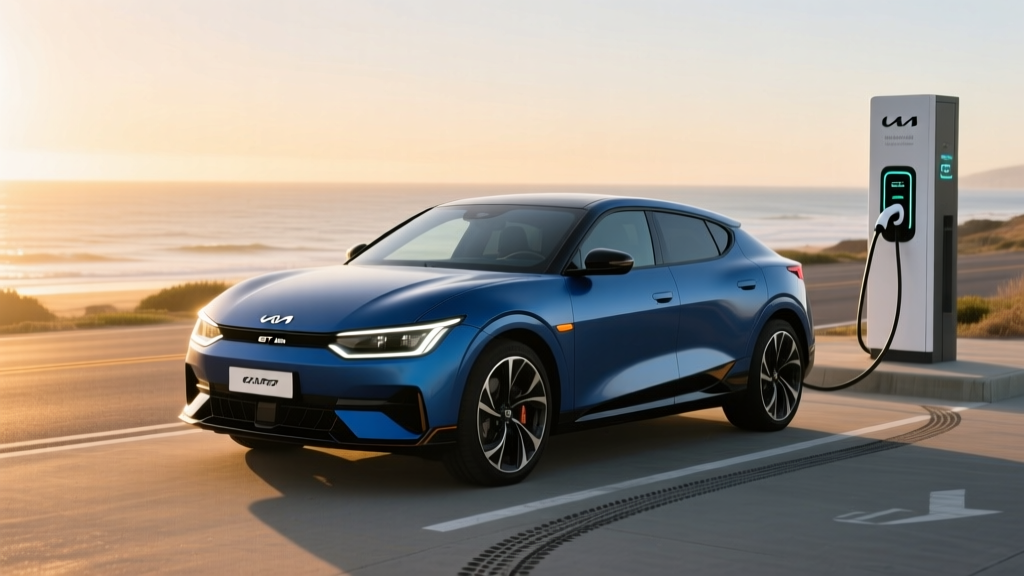
The 2026 Kia EV6 GT-Line occupies a specific niche in the midsize EV crossover segment: it's the variant that prioritizes driving engagement and visual aggression without stepping into the full-blown GT's 576-horsepower excess. With the refreshed E-GMP platform, an updated 84.0 kWh NMC battery, and Kia's latest infotainment stack, the GT-Line delivers a compelling mix of 310 miles of EPA-estimated range, sub-5-second acceleration, and one of the fastest DC fast-charging architectures available in its class.
But the GT-Line badge also carries a price premium over the base Wind and GT-Line RWD trims, and real-world range on highway road trips tells a slightly different story than the sticker. Here's everything you need to know before configuring one.
Range, Efficiency, and the Real-World Reality
The 2026 EV6 GT-Line AWD pairs a 84.0 kWh (usable) nickel-manganese-cobalt (NMC) lithium-ion battery with dual motors producing a combined 320 horsepower and 446 lb-ft of torque. The EPA rates the GT-Line AWD at 310 miles of combined range, with an efficiency rating of 117 MPGe combined (29 kWh/100 miles).
EPA sticker: 310 miles (combined city/highway)
Real-world highway (70-75 mph, moderate temps): ~255–275 miles
Real-world city/suburban mixed driving: ~285–305 miles
Cold weather (below 30°F, highway): ~210–240 miles
The EV6's heat pump (standard on GT-Line trims) mitigates some cold-weather losses compared to EVs without active thermal management, but expect a 20–30% range reduction in sustained sub-freezing conditions. Highway driving at 75+ mph consistently yields the lowest efficiency — plan road-trip charging stops around the 230-mile mark for a comfortable buffer.
The GT-Line RWD variant, which sends all 225 horsepower to the rear wheels, achieves a slightly higher EPA estimate of 310 miles as well, though its real-world efficiency on the highway tends to edge out the AWD by roughly 5–8% thanks to reduced drivetrain losses.
Charging: 800V Architecture Still Sets the Pace
The EV6 GT-Line retains Kia's 800V electrical architecture, which remains one of the defining advantages of the E-GMP platform. This enables significantly faster DC fast-charging speeds than the 400V systems found in competitors like the Volkswagen ID.4 and Subaru Solterra.
| Charging Level | Power / Rate | Time / Speed | Notes |
|---|---|---|---|
| DC Fast Charge (peak) | 239 kW (peak) | 10–80% in ~18 minutes | Requires 350 kW CCS/NACS station; peak rate tapers above 60% SoC |
| DC Fast Charge (sustained avg.) | ~165 kW avg (10-80%) | ~18 min (10-80%) | Excellent charge curve; sustains >150 kW through 55% SoC |
| Level 2 (home/public AC) | 10.9 kW onboard charger | ~34 miles per hour of charging; 0–100% in ~8.5 hrs | Standard J1772/NACS connector; ideal for overnight home charging |
| Level 1 (120V household) | ~1.4 kW | ~4 miles per hour | Emergency/trickle only; not practical for daily use |
Charging-curve reality check: The EV6 peaks at 239 kW but does not sustain that rate for the entire session. In testing on 350 kW chargers, the EV6 typically holds 180–239 kW from 10% to roughly 55% state of charge, then tapers progressively through 80%. The 18-minute 10–80% claim holds up in favorable conditions (warm battery, preconditioned), but cold-soaked batteries will charge noticeably slower until the thermal management system warms the pack. Always use the navigation-based battery preconditioning feature when routing to a DC fast charger.
For the 2026 model year, Kia has adopted the NACS (Tesla-style) charge port as standard on new EV6 models, with CCS1 adapters available for backward compatibility at Electrify America and other legacy CCS networks. This opens access to Tesla Supercharger stalls (now open to non-Tesla EVs via the NACS standard), substantially expanding the fast-charging network available to EV6 owners.
Performance and Driving Dynamics
| Specification | GT-Line RWD | GT-Line AWD |
|---|---|---|
| Horsepower | 225 hp | 320 hp |
| Torque | 258 lb-ft | 446 lb-ft |
| Drivetrain | Rear-wheel drive (single motor) | Dual-motor AWD |
| 0–60 mph | 7.2 seconds | 4.5 seconds |
| Top Speed | 115 mph | 117 mph |
| Towing Capacity | 2,700 lbs (braked) | 2,700 lbs (braked) |
The GT-Line AWD's 4.5-second 0–60 mph time places it squarely in performance-crossover territory — quicker than a Tesla Model Y Long Range (5.0 sec) and the Hyundai Ioniq 5 Limited AWD (5.1 sec), though the Ford Mustang Mach-E Premium AWD ER (5.1 sec) is close. The GT-Line isn't the full GT (which hits 60 in 3.4 seconds with 576 hp), but for daily driving and highway merging, 320 hp and 446 lb-ft of instant torque is more than sufficient.
What separates the GT-Line from lesser EV6 trims is the suspension tuning. Kia equips the GT-Line with a sport-tuned adaptive damping system that firms up noticeably in Sport mode while remaining compliant in Normal. The steering ratio is slightly quicker than the Wind trim, and the regenerative braking paddles behind the wheel offer six levels of regen intensity — including a true one-pedal driving mode (i-Pedal) that brings the car to a complete stop without touching the brake pedal.
Interior, Cargo, and Technology
The GT-Line interior distinguishes itself with suede-and-leatherette sport seats, a flat-bottom steering wheel, aluminum pedal covers, and GT-Line-specific ambient lighting. The dual 12.3-inch curved panoramic display runs Kia's latest Connect infotainment system with wireless Apple CarPlay and Android Auto, over-the-air updates, and an integrated EV route planner that accounts for charging stops and battery preconditioning.
Passenger and cargo dimensions:
- Front headroom: 39.4 inches
- Front legroom: 41.7 inches
- Rear headroom: 38.0 inches
- Rear legroom: 39.4 inches
- Cargo volume (rear seats up): 24.4 cu ft
- Cargo volume (rear seats folded): 50.2 cu ft
- Front trunk (frunk): 1.8 cu ft (AWD) / 3.2 cu ft (RWD)
The rear seat is genuinely comfortable for adults on longer trips — a notable advantage over the Tesla Model Y, whose rear seat cushion height and headroom draw frequent complaints from taller passengers. However, the EV6's 24.4 cu ft of cargo space behind the rear seats trails the Model Y (30.2 cu ft) and the Ioniq 5 (27.2 cu ft). If maximum cargo volume is a priority, the EV6 asks you to trade some utility for its sleeker roofline.
Driver-assistance technology: The GT-Line comes standard with Kia's Highway Driving Assist 2 (HDA2), a Level 2 SAE driver-assist system combining adaptive cruise control with stop-and-go, lane-centering steering, and lane-change assist. HDA2 is competent on divided highways but requires continuous driver supervision — it is not a self-driving system and will disengage if hands are not detected on the wheel. Remote Smart Parking Assist allows the EV6 to pull in and out of tight spaces via the key fob, a useful feature in narrow garages.
Pricing, Trims, and Federal Tax Credit Eligibility
| Trim | MSRP (incl. destination) | Est. After §30D Credit* |
|---|---|---|
| GT-Line RWD | $50,290 | ~$42,790 |
| GT-Line AWD | $54,290 | ~$46,790 |
| GT-Line AWD w/ Sun & Sound Pkg | $56,590 | ~$49,090 |
*Estimated prices assume full $7,500 federal tax credit eligibility. Actual credit depends on individual tax liability, income limits, battery sourcing compliance, and point-of-sale transfer rules under IRS §30D. Consult a tax professional.
Under current IRS §30D rules, the EV6 GT-Line's eligibility is nuanced:
- MSRP cap: SUVs/crossovers must be under $80,000 — the EV6 GT-Line clears this easily (max ~$56,590).
- Buyer income cap: Modified AGI must not exceed $150,000 (single), $225,000 (head of household), or $300,000 (joint filers).
- Battery sourcing (critical minerals & components): The EV6's battery is manufactured in the U.S. (Kia's Georgia plant as of late 2024), but critical-mineral sourcing requirements tighten annually. The full $7,500 credit requires both the critical-minerals and battery-components thresholds to be met. For the most current sourcing compliance status, check fueleconomy.gov before purchasing.
- Point-of-sale transfer: As of 2024, the credit can be transferred to the dealer at purchase, reducing your out-of-pocket cost immediately rather than waiting until tax filing. This is available for the EV6 if the dealer is registered with the IRS Energy Credits portal.
Important: Credit amounts and sourcing rules change. Always verify current eligibility on irs.gov and with your tax advisor before relying on the credit in your purchase budget.
Ownership Costs, Warranty, and Long-Term Outlook
Kia backs the 2026 EV6 with one of the strongest warranty packages in the segment:
- Battery & drive unit warranty: 10 years / 100,000 miles (capacity retention guaranteed above 70% State of Health)
- Limited vehicle warranty: 5 years / 60,000 miles
- Powertrain warranty: 10 years / 100,000 miles
- Roadside assistance: 5 years / 60,000 miles
The 10-year battery warranty is a significant ownership advantage, particularly for buyers planning to keep the vehicle beyond the typical lease cycle. The 70% SoH threshold is industry-standard, though some competitors (like Tesla) use the same benchmark. Real-world degradation data from early E-GMP vehicles (2022–2024 EV6 and Ioniq 5) suggests most packs retain 92–95% capacity after 50,000 miles — well within the warranty threshold.
Estimated 5-year cost of ownership (AWD GT-Line, 15,000 mi/yr, national avg. electricity rate of $0.16/kWh):
- Electricity cost: ~$3,480 total ($696/yr at 29 kWh/100 mi)
- Comparable gas vehicle fuel cost: ~$8,250 total (at 25 MPG combined, $3.50/gal)
- Estimated fuel savings vs. gas: ~$4,770 over 5 years
- Insurance: Expect premiums 15–25% higher than a comparable gas crossover — EV insurance averages ~$2,100–$2,600/year for the EV6 depending on state and driving record
- Maintenance: Minimal — no oil changes, minimal brake wear (regen handles most deceleration). Budget ~$400–$600 over 5 years for cabin air filters, wiper fluid, and tire rotations
How the EV6 GT-Line Stacks Up Against Key Rivals
| Spec | Kia EV6 GT-Line AWD | Tesla Model Y LR AWD | Hyundai Ioniq 5 Limited AWD | Ford Mach-E Premium AWD ER |
|---|---|---|---|---|
| EPA Range | 310 mi | 320 mi | 290 mi | 290 mi |
| Battery (usable) | 84.0 kWh (NMC) | 78.1 kWh (NMC) | 84.0 kWh (NMC) | 91.0 kWh (NMC) |
| Peak DC Charge | 239 kW | 250 kW | 239 kW | 150 kW |
| 10–80% DC Time | ~18 min | ~20 min | ~18 min | ~36 min |
| 0–60 mph | 4.5 sec | 5.0 sec | 5.1 sec | 5.1 sec |
| Horsepower | 320 hp | 384 hp | 320 hp | 346 hp |
| Cargo (seats up) | 24.4 cu ft | 30.2 cu ft | 27.2 cu ft | 29.7 cu ft |
| Base MSRP | $54,290 | $48,990 | $54,600 | $51,995 |
| Battery Warranty | 10 yr/100k mi | 8 yr/120k mi | 10 yr/100k mi | 8 yr/100k mi |
The EV6 GT-Line AWD trades cargo volume for faster charging and sharper driving dynamics than the Model Y. Against the Ioniq 5 Limited — its E-GMP sibling — the EV6's lower roofline and sportier tuning are the key differentiators, as the powertrains are nearly identical. The Mach-E Premium offers more cargo space but charges at roughly half the DC speed, which matters significantly on road trips.
Pros and Cons
- 800V architecture delivers class-leading 18-min 10–80% DC fast charging
- 4.5-sec 0–60 mph with composed, sporty handling uncommon in the segment
- 10-year/100,000-mile battery warranty exceeds most competitors
- Heat pump standard — better cold-weather range retention than many rivals
- NACS charge port opens access to Tesla Supercharger network
- Comfortable rear seat with adult-friendly legroom
- HDA2 is a competent, predictable Level 2 highway assist
- 24.4 cu ft cargo space trails Model Y, Ioniq 5, and Mach-E
- GT-Line pricing starts above $50K before options — premium over base Wind trim
- Small frunk (1.8 cu ft AWD) limits front storage utility
- Real-world highway range closer to 255–275 mi, not the 310-mi EPA sticker
- Touch-capacitive climate controls lack physical buttons — distracting while driving
- No hands-free Level 2+ driving feature comparable to GM Super Cruise or Ford BlueCruise
Who Should Buy the 2026 EV6 GT-Line?
Choose the EV6 GT-Line AWD if: You want a sporty, quick-charging electric crossover for daily commuting and regular road trips; you value driving engagement over maximum cargo volume; you have access to 350 kW DC fast chargers to exploit the 800V architecture; and you plan to own the vehicle long-term (the 10-year warranty rewards patience).
Choose the EV6 GT-Line RWD if: You live in a mild climate where AWD is unnecessary, you prioritize maximum range efficiency, and you want the GT-Line aesthetic at the lowest possible price point.
Look elsewhere if: You need maximum cargo capacity (consider the Model Y or Ioniq 5); you frequently drive in extreme cold and need 300+ real-world miles (consider the Rivian R1S or a larger-battery option); or you want a true hands-free highway driving system (consider GM's Super Cruise-equipped vehicles).
Frequently Asked Questions
What is the real-world range of the 2026 Kia EV6 GT-Line?
The EPA rates the GT-Line AWD at 310 miles combined. In real-world highway driving at 70–75 mph in moderate temperatures, expect 255–275 miles. City and suburban driving gets you closer to the EPA figure at 285–305 miles. In sustained cold weather below 30°F, highway range drops to approximately 210–240 miles, even with the standard heat pump.
How fast does the EV6 GT-Line charge at home and on the road?
On a DC fast charger rated at 350 kW, the EV6 GT-Line peaks at 239 kW and charges from 10–80% in approximately 18 minutes under ideal conditions. At home on a Level 2 charger (240V, 48A circuit), the 10.9 kW onboard charger adds roughly 34 miles of range per hour, fully replenishing the 84.0 kWh battery in about 8.5 hours. Level 1 (120V) charging is impractical for daily use at roughly 4 miles per hour.
Does the 2026 EV6 GT-Line qualify for the $7,500 federal EV tax credit?
Eligibility under IRS §30D depends on your income (capped at $150K single / $300K joint), the vehicle's MSRP (the EV6 clears the $80K SUV cap), and battery-component and critical-mineral sourcing compliance, which tightens annually. The EV6's U.S.-built battery improves its sourcing score, but you should verify current-year compliance on fueleconomy.gov before purchasing. The credit can be transferred to the dealer at point of sale, reducing your upfront cost.
Is the EV6 GT-Line worth buying over the Tesla Model Y or Ioniq 5?
The EV6 GT-Line AWD wins on driving dynamics, DC charging speed (matched only by the Ioniq 5), and warranty length. The Model Y offers more cargo space, a lower starting price, and a more mature software ecosystem but charges slightly slower and has a firmer ride. The Ioniq 5 shares the same E-GMP platform and powertrain but has a more retro design, slightly more cargo room, and a more comfortable ride at the expense of the GT-Line's sporty edge. Your choice depends on whether you prioritize cargo utility (Model Y, Ioniq 5) or driving engagement and road-trip charging speed (EV6 GT-Line).
What is the biggest drawback of the EV6 GT-Line?
Cargo space is the most common complaint. At 24.4 cu ft behind the rear seats, the EV6 gives up 5–6 cu ft to the Model Y and Ioniq 5. The frunk is also small (1.8 cu ft on AWD), limiting its usefulness for charging cables or groceries. Secondary complaints include the touch-sensitive climate control panel (prone to accidental inputs) and the lack of a hands-free Level 2+ driving mode for long highway stretches.
How long will the EV6 battery last?
Kia warrants the battery for 10 years or 100,000 miles against degradation below 70% State of Health. Early E-GMP vehicles (2022–2024) show 92–95% capacity retention after 50,000 miles in real-world use, suggesting most packs will remain well above the warranty threshold. For long-term health, Kia recommends keeping daily charging between 20–80% SoC for NMC chemistry and using DC fast charging primarily for road trips rather than daily top-ups.