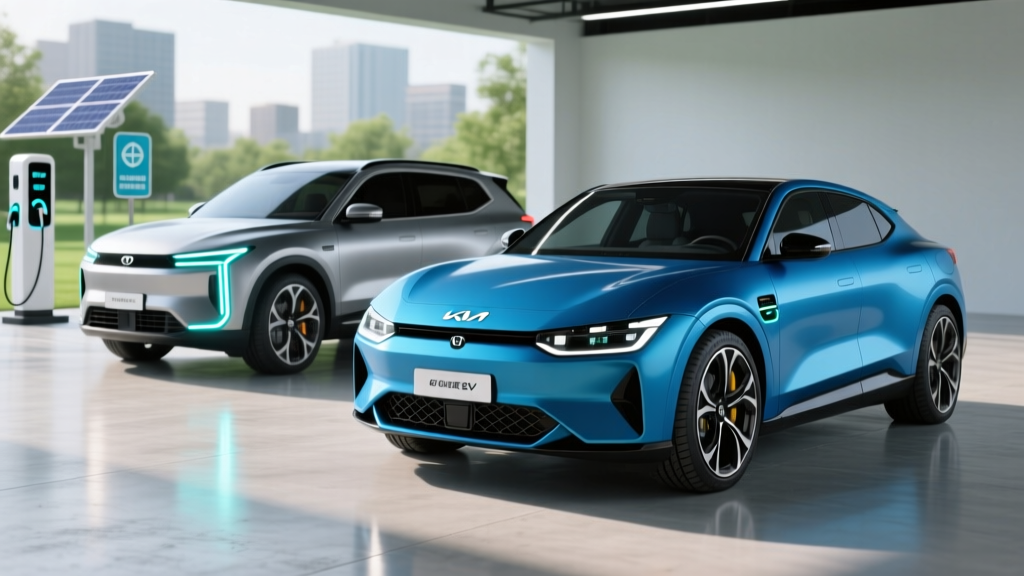
Kia's 800-volt E-GMP platform remains one of the most capable architectures in the mainstream EV market heading into 2026. Both the EV6 crossover and the three-row EV9 SUV support Plug & Charge across major networks, eliminating the app-and-RFID friction that still plagues public charging. This review breaks down the exact specs, real-world range expectations, charging performance, and federal tax credit eligibility for both models so you can decide which — if either — fits your garage.
Quick Verdict: EV6 vs EV9 at a Glance
The EV6 targets drivers who prioritize efficiency and fast charging in a midsize crossover footprint. The EV9 trades some range and efficiency for three-row seating and genuine family-hauler practicality. Both share the E-GMP 800V architecture, meaning DC fast-charge speeds that rival or exceed vehicles costing significantly more.
| Spec | 2026 Kia EV6 (Wind RWD) | 2026 Kia EV9 (Light LR RWD) |
|---|---|---|
| EPA Range | 310 miles | 304 miles |
| Battery (usable) | 77.4 kWh (NMC) | 99.8 kWh (NMC) |
| Max DC Fast Charge | ~240 kW peak | ~210 kW peak |
| 10–80% DCFC Time | ~18 minutes | ~24 minutes |
| Level 2 Home Rate | 10.9 kW (~36 mi/hr) | 10.9 kW (~30 mi/hr) |
| 0–60 mph | 7.2 sec (RWD) / 4.5 sec (GT-Line AWD) | 8.2 sec (RWD) / 4.9 sec (GT-Line AWD) |
| Horsepower | 225 hp (RWD) / 320 hp (AWD) | 215 hp (RWD) / 379 hp (AWD) |
| MPGe (combined) | 134 MPGe | 88 MPGe |
| kWh/100 mi | 25 kWh | 38 kWh |
| Base MSRP | $42,900 (Light) / $47,000 (Wind) | $54,900 (Light SR) / $59,900 (Light LR) |
| Battery Warranty | 10 yr / 100,000 mi | 10 yr / 100,000 mi |
Real-World Range: What the EPA Sticker Doesn't Tell You
EV9 Light Long Range RWD: EPA 304 miles. Expect ~250–270 miles highway. Cold weather drops this to roughly 210–235 miles. The EV9's larger frontal area and 4,800+ lb curb weight penalize highway efficiency more than the EV6.
Both vehicles use EPA-estimated range figures, which blend city and highway driving. In practice, the EV6's efficiency advantage shows most clearly at sustained highway speeds, where its lower drag coefficient (0.28 Cd vs the EV9's boxier 0.32 Cd) matters. The EV9's 99.8 kWh battery is substantially larger, but it's pushing significantly more mass and air.
For daily commuting under 80 miles round-trip with home charging, neither vehicle's real-world range reduction matters. For road trips, plan charging stops around 200–220 miles to keep the battery in its fastest-charging SoC window (10–80%) and avoid the steep taper above 80%.
Charging Performance: 800V Architecture and Plug & Charge
The headline feature of the E-GMP platform is its 800-volt electrical architecture, which allows both the EV6 and EV9 to accept DC fast-charge rates that peak well above what most 400V competitors manage. On a 350 kW-capable Electrify America or IONITY station, the EV6 peaks near 240 kW and the EV9 near 210 kW.
| Charging Level | EV6 Rate | EV6 Speed | EV9 Rate | EV9 Speed |
|---|---|---|---|---|
| Level 1 (120V, 12A) | ~1.4 kW | ~5 mi/hr | ~1.4 kW | ~4 mi/hr |
| Level 2 (240V, 48A) | 10.9 kW | ~36 mi/hr | 10.9 kW | ~30 mi/hr |
| DC Fast (peak) | ~240 kW | 10–80% in ~18 min | ~210 kW | 10–80% in ~24 min |
Charge curve reality check: Neither vehicle sustains peak kW for the full session. The EV6 holds above 200 kW roughly from 10–40% SoC, then tapers to ~150 kW through 60%, and drops further above 80%. The EV9's curve is similar but stretched across its larger battery. This is why manufacturers quote 10–80% times rather than 0–100% — charging from 80–100% can take nearly as long as 10–80%.
Plug & Charge: How It Works on Kia
Plug & Charge (ISO 15118) lets the vehicle authenticate automatically when you plug into a compatible DC fast charger — no app, no RFID card, no screen prompts. Kia supports Plug & Charge on Electrify America, EVgo, and select ChargePoint stations. You link your Kia account to the charging network beforehand, and billing happens automatically.
In practice, Plug & Charge works reliably on Electrify America's newer 350 kW dispensers. Older stations and some ChargePoint hardware may still require app initiation. The convenience is meaningful on road trips: pull up, plug in, walk away for coffee. It's the closest the public charging experience gets to the gas-station simplicity that EV skeptics cite.
Preconditioning matters: Both vehicles will precondition the battery when you navigate to a DC fast charger via the built-in navigation. This warms the battery to optimal temperature for accepting peak charge rates. In cold weather, preconditioning can shave 5–8 minutes off a 10–80% session. Always route through the nav system rather than entering the charger address manually in a phone app.
Performance and Drivetrain
The EV6 RWD models use a single rear motor producing 225 hp (Light/Standard Range) or 225 hp with the larger battery (Wind). The dual-motor AWD GT-Line bumps output to 320 hp and drops the 0–60 time to approximately 4.5 seconds. The GT variant (not covered here) produces 576 hp with a 3.4-second 0–60.
The EV9's single-motor RWD produces 215 hp — adequate but not quick for a vehicle this size. The dual-motor AWD models deliver 379 hp and a 4.9-second 0–60, which is genuinely fast for a three-row SUV. Both vehicles feature regenerative braking with adjustable levels via steering-wheel paddles, including an i-Pedal one-pedal driving mode that brings the vehicle to a full stop.
Towing capacity: the EV9 AWD is rated for up to 5,000 lbs (braked trailer), making it viable for light boat or utility trailers. The EV6 is rated at 2,700 lbs AWD — enough for a small cargo trailer but not much more. Towing reduces range by 30–50% depending on trailer weight and aerodynamics.
Interior, Cargo, and Technology
EV6 Interior and Cargo
The EV6 offers 103.0 cu ft of passenger volume and 24.4 cu ft of cargo space behind the second row (50.2 cu ft with the rear seats folded). The flat floor and long wheelbase (114.2 in) create genuinely comfortable rear-seat legroom (39.4 in). The frunk (front trunk) adds 0.7 cu ft on AWD models — enough for charging cables, not much else.
Tech highlights: dual 12.3-inch curved displays (instrument cluster and infotainment), wireless Apple CarPlay and Android Auto, augmented-reality head-up display (GT-Line and above), and Kia's Highway Driving Assist 2 (HDA2) — a Level 2 driver-assist system with lane-centering, adaptive cruise, and lane-change assist. HDA2 requires hands-on-wheel supervision at all times; this is not autonomous driving.
EV9 Interior and Cargo
The EV9 provides 159.3 cu ft of passenger volume and 20.2 cu ft behind the third row, 43.5 cu ft behind the second row, and 81.7 cu ft with both rear rows folded. Third-row legroom is 32.0 in — usable for children or short-trip adults but tight for long hauls. Second-row captain's chairs (available on higher trims) improve access and comfort significantly.
The EV9 shares the same dual 12.3-inch display setup and HDA2 system. Higher trims add a digital rearview mirror, remote smart parking assist (the vehicle can park itself while you stand outside), and a fingerprint authentication system for driver profiles. The EV9 also offers Vehicle-to-Load (V2L) capability via an interior outlet and an exterior adapter, allowing you to power devices or appliances up to 3.6 kW — useful for camping or emergency backup.
Pricing, Trims, and Federal Tax Credit Eligibility
| Model / Trim | Base MSRP | §30D Credit (est.) | Effective Price |
|---|---|---|---|
| EV6 Light RWD | $42,900 | $3,750–$7,500* | $35,400–$39,150 |
| EV6 Wind RWD | $47,000 | $3,750–$7,500* | $39,500–$43,250 |
| EV6 GT-Line AWD | $53,200 | $3,750–$7,500* | $45,700–$49,450 |
| EV9 Light SR RWD | $54,900 | $3,750–$7,500* | $47,400–$51,150 |
| EV9 Light LR RWD | $59,900 | $3,750–$7,500* | $52,400–$56,150 |
| EV9 Land AWD | $63,900 | $3,750–$7,500* | $56,400–$60,150 |
*Credit amount depends on battery component and critical-mineral sourcing requirements under IRS §30D rules. As of 2026, the credit is split: $3,750 for meeting the critical-minerals requirement and $3,750 for meeting the battery-components requirement. Kia's supply chain has progressively increased qualifying content, but exact eligibility varies by build date and battery batch. Verify with your dealer and a tax professional before purchase.
Key §30D eligibility requirements for 2026:
- MSRP cap: SUVs (EV9) must be under $80,000; cars/crossovers (EV6) under $55,000. Some EV6 trims (GT-Line AWD at $53,200) qualify; the GT at ~$61,000 does not.
- Buyer income cap: AGI must not exceed $300,000 (joint), $225,000 (head of household), or $150,000 (single).
- Point-of-sale transfer: You can transfer the credit to the dealer at purchase, reducing your out-of-pocket cost immediately rather than waiting to claim it on your tax return.
- Battery sourcing: Critical minerals and battery components must meet escalating domestic/free-trade-agreement thresholds. Check the specific VIN with your dealer.
Efficiency and Ownership Economics
The EV6 Wind RWD achieves an EPA-rated 134 MPGe combined (25 kWh/100 mi), making it one of the most efficient midsize electric crossovers available. The EV9 Light LR RWD rates at 88 MPGe combined (38 kWh/100 mi) — respectable for a 4,800-lb three-row SUV but meaningfully thirstier than the EV6.
At a national average electricity rate of $0.17/kWh (EIA, 2025), the EV6 costs roughly $4.25 to drive 100 miles; the EV9 costs about $6.46. Compare this to a gas-powered Kia Telluride at ~21 MPG combined and $3.40/gal: $16.19 per 100 miles. The per-mile fuel savings are substantial for both Kias, with the EV6 delivering the stronger economic case.
Home charging on Level 2 adds roughly 36 miles of range per hour for the EV6 and 30 miles per hour for the EV9. An overnight session (8–10 hours) fully replenishes either vehicle from a typical daily commute. Installation of a 48-amp Level 2 home charger typically costs $800–$2,500 including equipment and electrician labor, depending on panel capacity and conduit run distance.
Pros, Cons, and Who Should Buy
- Class-leading DC fast-charge speed (18 min 10–80%)
- 134 MPGe combined — excellent efficiency
- Plug & Charge on major networks
- 10-year/100,000-mile battery warranty
- Comfortable ride, low cabin noise
- Modest 24.4 cu ft cargo space (crossover, not SUV)
- Rear visibility limited by thick C-pillars
- Infotainment touch-capacitive buttons can be finicky
- GT-Line AWD price pushes near §30D MSRP cap
- Genuine three-row seating with usable third row
- V2L capability (3.6 kW) for camping/backup power
- 5,000-lb towing capacity (AWD)
- 800V fast charging in a large SUV (rare)
- Spacious cabin with flat floor
- 88 MPGe — high energy consumption
- $54,900+ starting price before credits
- Large footprint can be challenging in tight garages
- RWD base model feels underpowered for its weight
Who Each Model Suits Best
EV6: Ideal for commuters, couples, and small families who want fast charging on road trips, low running costs, and a car-like driving experience. If you drive under 300 miles daily and have home charging, the EV6 covers nearly every use case with minimal compromise.
EV9: Built for families needing three rows who refuse to sacrifice DC fast-charge capability. If you regularly carry 5+ passengers, tow a light trailer, or want V2L for outdoor adventures, the EV9 fills a gap that very few electric SUVs address. Budget-conscious buyers should note the higher purchase price and energy costs.
Competitor Comparison: Is It Worth Buying?
EV6 vs Hyundai Ioniq 5: The Ioniq 5 shares the E-GMP platform and nearly identical powertrain specs. The EV6 is slightly more efficient and has a more conventional crossover silhouette; the Ioniq 5 offers a more spacious rear seat and retro-modern styling. Both support Plug & Charge. Choose based on design preference and dealer proximity.
EV6 vs Tesla Model Y: The Model Y offers Supercharger network access (though NACS adapters are now widely available for Kia), more cargo space, and over-the-air updates. The EV6 charges faster on third-party networks, offers a longer warranty, and avoids Tesla's polarizing brand dynamics. The Model Y's price advantage after credits can be significant.
EV9 vs Kia Telluride (PHEV/gas): The gas Telluride starts lower and has no range anxiety, but costs $12,000+ more in fuel over five years. The EV9 wins on per-mile cost, cabin quietness, and instant torque — but loses on upfront price and third-row cargo flexibility when both rows are in use.
EV9 vs Rivian R1S: The R1S offers superior off-road capability, more power, and a premium interior — at $75,000+. The EV9 undercuts it by $15,000–$20,000 while still providing 800V charging and three-row practicality. If you don't need serious off-road chops, the EV9 is the value play.
Frequently Asked Questions
What is the real-world range of the Kia EV6 and EV9?
The EV6 Wind RWD delivers approximately 265–280 miles on highway-heavy trips and 220–250 miles in freezing weather. The EV9 Light LR RWD manages roughly 250–270 miles highway and 210–235 miles in cold conditions. Both are lower than EPA estimates, which blend city and highway driving.
How fast do the EV6 and EV9 charge at home and on DC fast chargers?
On a 350 kW DC fast charger, the EV6 peaks near 240 kW and charges 10–80% in about 18 minutes. The EV9 peaks near 210 kW with a 10–80% time of approximately 24 minutes. At home on a 48-amp Level 2 charger (10.9 kW), the EV6 adds ~36 miles per hour and the EV9 adds ~30 miles per hour.
Does the Kia EV6 or EV9 qualify for the $7,500 federal EV tax credit?
Both may qualify for up to $7,500 under IRS §30D, but the credit is split into two $3,750 halves based on battery-component and critical-mineral sourcing requirements. The EV6 must stay under the $55,000 MSRP cap for non-SUVs (the GT trim exceeds this). The EV9 qualifies under the $80,000 SUV cap. Buyer income limits apply: $300K joint, $150K single. Verify your specific VIN's eligibility with your dealer and consult a tax professional.
Does Plug & Charge work everywhere?
No. Plug & Charge requires compatible hardware and network support. Kia's Plug & Charge works on Electrify America, EVgo, and select ChargePoint stations. Older chargers and some networks still require app-based authentication. Coverage is expanding but not universal.
What is the battery warranty on the EV6 and EV9?
Kia provides a 10-year/100,000-mile warranty on the high-voltage battery and electric powertrain components. The warranty covers defects and capacity loss below a specified threshold (typically 70% state of health). The basic vehicle warranty is 5 years/60,000 miles.
Can the EV9 tow, and how does towing affect range?
The EV9 AWD is rated for 5,000 lbs of braked towing. Expect range to decrease by 30–50% when towing near maximum capacity, depending on trailer aerodynamics and terrain. For a 304-mile EPA range, plan for 150–210 miles when towing heavy.
Is the EV6 or EV9 better for road trips?
The EV6 is more efficient and charges slightly faster, making it the better road-trip vehicle for two-row households. The EV9's larger battery provides similar total range but consumes more energy per mile. If you need three rows on road trips, the EV9's 800V charging still makes it far more practical than most competing three-row EVs.