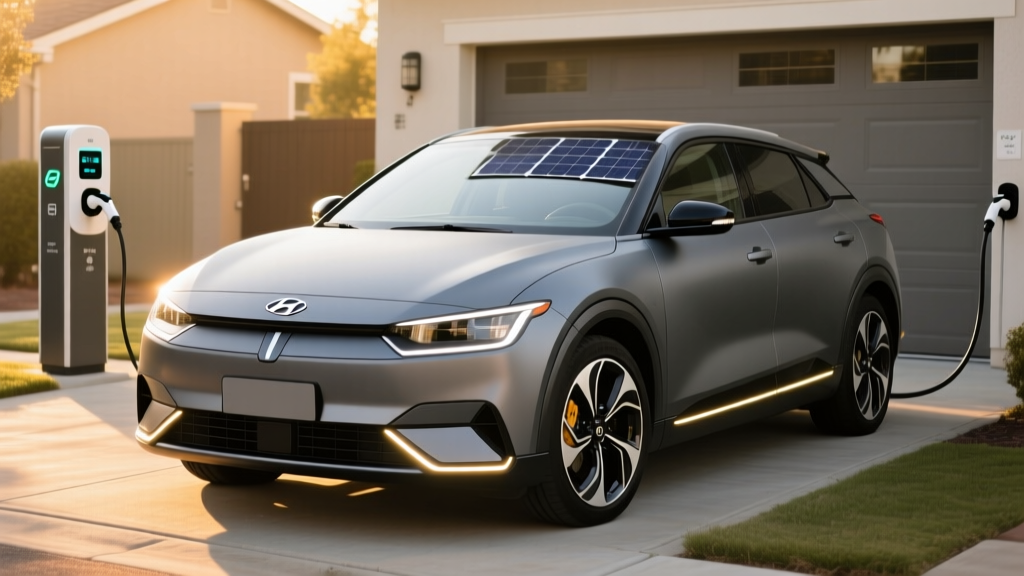
The 2024 Hyundai Ioniq 5 Limited sits at the top of one of the most capable EV lineups on the market. Built on Hyundai's E-GMP (Electric Global Modular Platform) with an 800V electrical architecture, it delivers class-leading DC fast-charging speeds, a spacious flat-floor cabin, and a design that still stands out three years after its US debut. But the Limited trim also pushes the MSRP well above $50,000, which complicates federal tax credit eligibility. Here's the full data-driven breakdown.
2024 Hyundai Ioniq 5 Limited at a Glance: Key Specs
| Spec | AWD Limited (As Reviewed) | RWD Limited |
|---|---|---|
| EPA Range | 260 miles | 303 miles |
| Battery (Usable / Gross) | 74.0 kWh / 77.4 kWh | 74.0 kWh / 77.4 kWh |
| Chemistry | NMC (Nickel Manganese Cobalt) | |
| Drivetrain | Dual-Motor AWD | Single-Motor RWD |
| Horsepower / Torque | 320 hp / 446 lb-ft | 225 hp / 258 lb-ft |
| 0-60 mph | 4.5 seconds | 7.0 seconds |
| Peak DC Fast Charge | ~240 kW (800V architecture) | |
| 10-80% DC Charge Time | ~18 minutes (ideal conditions) | |
| Level 2 Home Charge Rate | 10.9 kW (48A) | |
| MPGe (Combined) | 98 MPGe | 114 MPGe |
| Base MSRP (Limited) | $58,200 | $54,600 |
| Battery Warranty | 8 years / 100,000 miles | |
Real-World Range: What to Actually Expect
The AWD Limited carries a 260-mile EPA estimate, while the RWD Limited achieves 303 miles EPA. In real-world mixed driving at 65-75 mph highway speeds, expect roughly 230-245 miles from the AWD and 270-285 miles from the RWD. In cold weather (below 30°F), plan for a 15-25% reduction, which can drop the AWD to around 195-210 miles on the highway. The Ioniq 5's heat pump (standard on Limited) helps mitigate cabin energy draw in winter, but battery chemistry limitations still apply.
The 77.4 kWh gross battery pack uses NMC chemistry, which offers higher energy density than LFP but is more sensitive to sustained 100% state-of-charge storage. Hyundai recommends daily charging to 80% for longevity, reserving full charges for road trips. The usable capacity of approximately 74.0 kWh provides a buffer that protects the pack from deep discharge damage.
Efficiency for the AWD Limited is rated at 98 MPGe combined (approximately 34 kWh/100 miles). That's competitive but trails the single-motor RWD's 114 MPGe (about 29 kWh/100 miles). For buyers in mild climates with mostly city and suburban driving, the RWD Limited offers a meaningful range and efficiency advantage.
Charging Speed: The 800V Advantage in Practice
The Ioniq 5's 800V electrical architecture remains one of its strongest selling points. Most mainstream EVs use 400V systems; the higher voltage allows the Ioniq 5 to accept significantly more power at compatible DC fast chargers without requiring excessive current.
| Charging Level | Power / Voltage | Speed (Approx.) | Typical Use Case |
|---|---|---|---|
| Level 1 (120V) | ~1.4 kW | ~3-4 miles/hour | Emergency / overnight trickle |
| Level 2 (240V, 48A) | 10.9 kW | ~32-36 miles/hour | Home daily charging (~7-8 hrs for full) |
| DC Fast (350 kW station) | Peak ~240 kW | 10-80% in ~18 min | Road-trip stops |
| DC Fast (150 kW station) | Peak ~130-150 kW | 10-80% in ~25-30 min | Common public charging |
A few real-world caveats on the charging curve: the ~240 kW peak only sustains briefly (typically between 10-40% SoC) before tapering. From 60-80%, speeds drop to roughly 100-120 kW, and above 80% they fall sharply — as with all lithium-ion packs. Still, the 10-80% time of approximately 18 minutes at a 350 kW Electrify America or EVgo station is among the fastest in the segment. The Ioniq 5 uses the CCS1 connector for 2024; Hyundai has since transitioned to NACS (Tesla-style) for 2025+ models, but CCS adapters are widely available for Supercharger access.
For home Level 2 charging, the 10.9 kW onboard charger means a full 0-100% charge takes roughly 7-8 hours on a properly installed 48-amp circuit. Most owners charging from 20-80% overnight will replenish the battery in about 4 hours — more than sufficient for daily use.
Performance and Driving Dynamics
The AWD Limited's dual-motor setup produces 320 horsepower and 446 lb-ft of torque, launching the Ioniq 5 to 60 mph in approximately 4.5 seconds. That's brisk and confidence-inspiring for highway merging, though it won't challenge a Tesla Model Y Performance. The RWD Limited's 225 hp gets to 60 in about 7.0 seconds — adequate but noticeably more relaxed.
Ride quality is a highlight. The Ioniq 5's long 118.1-inch wheelbase and well-tuned suspension absorb highway expansion joints and rough pavement with composure that exceeds many crossover competitors. Steering is light but direct, and the low center of gravity from the floor-mounted battery pack keeps body roll minimal through corners. Regenerative braking offers four levels adjustable via steering-wheel paddles, including an i-Pedal mode for full one-pedal driving that brings the car to a complete stop.
Interior, Cargo, and Technology
The Limited trim brings the full feature set: dual 12.3-inch displays (instrument cluster and infotainment), a head-up display with augmented-reality navigation, heated and ventilated front seats, heated rear seats, a panoramic fixed glass roof, and a center console that slides fore and aft by up to 5.5 inches — a clever feature Hyundai calls the "Universal Island."
Passenger space is generous thanks to the flat-floor E-GMP architecture:
- Front legroom: 41.7 inches
- Rear legroom: 39.4 inches
- Cargo (behind rear seats): 27.2 cu ft
- Cargo (rear seats folded): 59.3 cu ft
- Front trunk (frunk): 0.85 cu ft (AWD) — small, useful for charging cables
On the ADAS front, the Limited includes Hyundai's Highway Driving Assist 2 (HDA2), which combines adaptive cruise control with lane-centering and automatic lane-change assist. This is an SAE Level 2 driver-assistance system — the driver must keep hands on the wheel and eyes on the road at all times. It's competent on interstate drives but is not autonomous. Remote Smart Parking Assist lets you move the car in and out of tight spaces via the key fob — a genuinely useful party trick.
One drawback: the 2024 Ioniq 5 still relies on a capacitive-touch climate control panel that's harder to use while driving than physical buttons. Wireless Apple CarPlay and Android Auto are standard, but only on the smaller-screen trims; the Limited's larger navigation unit requires a wired connection — an odd omission at this price point.
Pricing, Tax Credits, and Ownership Cost
| Trim | Base MSRP | Destination | Total Before Incentives | Est. After §30D Credit* |
|---|---|---|---|---|
| Limited RWD | $54,600 | $1,495 | $56,095 | See eligibility notes below |
| Limited AWD | $58,200 | $1,495 | $59,695 | See eligibility notes below |
*Federal §30D tax credit eligibility for the 2024 Ioniq 5 is complex. The vehicle is assembled in Ulsan, South Korea (not in North America), which disqualifies it from the full $7,500 new-vehicle credit under standard purchase rules. However, if leased through a qualifying dealer, the commercial clean vehicle credit (§45W) may allow the leasing company to claim a $7,500 credit and pass savings to the lessee as a capitalized cost reduction. Always verify current rules at IRS.gov and consult a tax professional.
Key §30D eligibility requirements to understand:
- Final assembly: Must occur in North America (the 2024 Ioniq 5 does not qualify on this basis for purchase)
- MSRP cap: SUVs/crossovers must be under $80,000 (Ioniq 5 passes)
- Buyer income cap: AGI must not exceed $150,000 single / $300,000 joint
- Battery sourcing: Critical mineral and battery component requirements phase in annually
On the ownership-cost side, Hyundai's warranty is a standout: the battery pack is covered for 8 years or 100,000 miles (whichever comes first) against capacity loss below 70%. The powertrain carries the same coverage, and the vehicle limited warranty runs 5 years / 60,000 miles. According to fueleconomy.gov, the AWD Limited's annual electricity cost is approximately $700 based on 15,000 miles of driving — roughly one-third the fuel cost of a comparable gasoline crossover.
How It Compares: Ioniq 5 Limited vs. Key Rivals
| Attribute | 2024 Ioniq 5 Limited AWD | 2024 Tesla Model Y LR | 2024 Ford Mustang Mach-E Premium AWD |
|---|---|---|---|
| EPA Range | 260 mi | 308 mi | 290 mi (Ext. Range) |
| Battery | 77.4 kWh (NMC) | ~75 kWh (NMC) | 91 kWh (NMC, Ext. Range) |
| Peak DC Charge | ~240 kW | ~250 kW | ~150 kW |
| 10-80% DC Time | ~18 min | ~20 min | ~35 min |
| 0-60 mph | 4.5 sec | 4.8 sec | 4.8 sec (Ext. Range) |
| MSRP (Comparable Trim) | $59,695 | ~$52,490 | ~$55,590 |
| NACS Connector | No (CCS1) | Yes (native) | No (CCS1) |
| Battery Warranty | 8 yr / 100k mi | 8 yr / 120k mi | 8 yr / 100k mi |
The Ioniq 5 Limited trades some range for faster charging and a more distinctive interior. The Tesla Model Y Long Range delivers more range, access to the Supercharger network natively, and over-the-air updates that continuously improve the vehicle — but its minimalist interior and panel-gap inconsistency are ongoing complaints. The Mach-E offers a sportier driving feel and a larger extended-range battery, but its slower DC charging is a notable disadvantage for road trips. According to IIHS, the Ioniq 5 earned top marks in crash testing, securing a Top Safety Pick+ designation.
Pros and Cons
Pros
- Class-leading 800V DC fast charging (~18 min 10-80%)
- Spacious, flat-floor cabin with premium materials on Limited
- Composed ride quality and strong AWD acceleration
- Generous 8-year/100,000-mile battery warranty
- IIHS Top Safety Pick+ rating
- Vehicle-to-load (V2L) capability powers devices at up to 3.6 kW
Cons
- Limited AWD range (260 mi EPA) trails key rivals
- Does not qualify for §30D purchase credit (non-NA assembly)
- Wired-only Apple CarPlay/Android Auto on Limited's nav screen
- Capacitive-touch climate controls are distracting while driving
- CCS1 connector requires adapter for Tesla Supercharger access
- Small frunk (0.85 cu ft AWD) limits front storage
Who Should Buy the 2024 Ioniq 5 Limited?
Choose the Ioniq 5 Limited if: You prioritize fast road-trip charging over maximum range, value a distinctive and well-built interior, want strong safety ratings, and can charge reliably at home. It's ideal for suburban commuters who take occasional road trips and have access to 350 kW DC fast chargers along their routes.
Look elsewhere if: You need maximum range for long rural commutes (consider the Model Y Long Range), you want native NACS/Supercharger access without an adapter (2025+ Ioniq 5 or Tesla), or you require the full $7,500 federal credit on a purchase rather than a lease (look at US-assembled options like the VW ID.4 or Tesla Model Y).
Frequently Asked Questions
What is the real-world range of the 2024 Hyundai Ioniq 5 Limited?
The AWD Limited is EPA-rated at 260 miles, but expect roughly 230-245 miles in real-world highway driving and as low as 195-210 miles in cold weather. The RWD Limited (303 miles EPA) will deliver around 270-285 miles in mixed real-world conditions.
How fast does the Ioniq 5 Limited charge at home and on the road?
At home on a Level 2 (240V, 48A) charger, the Ioniq 5 adds approximately 32-36 miles of range per hour, with a full charge taking 7-8 hours. On a 350 kW DC fast charger, it can go from 10-80% in about 18 minutes — one of the fastest times in its class thanks to the 800V architecture.
Does the 2024 Ioniq 5 qualify for the federal EV tax credit?
Not for purchase — the 2024 Ioniq 5 is assembled in South Korea, failing the North American final assembly requirement of §30D. However, leasing may allow the dealer to apply a $7,500 commercial credit as a lease incentive. Verify current rules at IRS.gov.
Is the Ioniq 5 Limited worth it over the Tesla Model Y?
The Ioniq 5 Limited offers a more premium interior, faster DC charging at compatible stations, and a quieter ride. The Model Y wins on range, Supercharger network access, and cargo space. If charging speed and interior quality matter more than maximum range, the Ioniq 5 is the stronger pick.
What is the battery warranty on the Ioniq 5?
Hyundai covers the Ioniq 5's high-voltage battery for 8 years or 100,000 miles against degradation below 70% of original capacity. The powertrain warranty matches this term, and the vehicle limited warranty is 5 years / 60,000 miles.
Does the 2024 Ioniq 5 have a NACS (Tesla) connector?
No. The 2024 model uses CCS1. Hyundai switched to the NACS connector starting with the 2025 model year. CCS-to-NACS adapters are available for Supercharger access, and Hyundai has provided adapters to qualifying owners.