Quick Answer: Are Kia Electric Cars Worth It?
Kia's 2026 EV lineup spans three core models: the Niro EV (239 mi EPA, ~$40k), the EV6 (up to 310 mi EPA, 800V architecture, ~$43k), and the three-row EV9 (up to 304 mi EPA, ~$55k). The EV6 and EV9 qualify for the $7,500 federal tax credit when assembled in the US and meeting IRS §30D sourcing requirements, and both support peak DC charging at 240+ kW. The Niro EV remains a budget-friendly commuter but lacks 800V fast charging. If you need family hauling, the EV9 is the segment's best value three-row EV. If you want a sporty crossover with class-leading charge speed, the EV6 wins. If budget is paramount and daily driving is under 50 miles, the Niro EV delivers.
Kia's 2026 Electric Lineup at a Glance
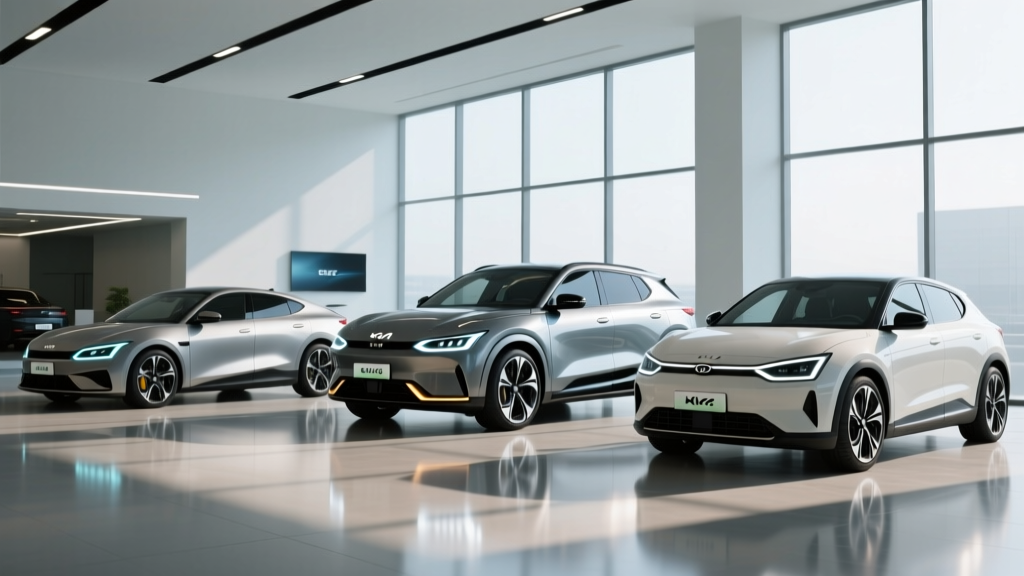
Kia has aggressively expanded its EV portfolio, and as of the 2026 model year, buyers have three distinct battery-electric options with a fourth (the compact EV4 sedan) announced for late 2026 delivery. Each model targets a different buyer profile, and the specs vary significantly in battery chemistry, charging architecture, and pricing.
| Spec | 2026 Niro EV | 2026 EV6 (Light RWD) | 2026 EV6 GT-Line AWD | 2026 EV9 (Land AWD) |
|---|---|---|---|---|
| EPA Range | 239 mi | 310 mi | 274 mi | 280 mi |
| Battery (usable) | 64.8 kWh (NMC) | 77.4 kWh (NMC) | 77.4 kWh (NMC) | 100.0 kWh (NMC) |
| Peak DC Charge Rate | ~85 kW | ~240 kW | ~260 kW | ~210 kW |
| 10–80% DC Fast Charge | ~44 min | ~18 min | ~18 min | ~24 min |
| Level 2 Rate (240V) | 7.2 kW | 10.9 kW | 10.9 kW | 10.9 kW |
| Horsepower | 201 hp | 225 hp | 320 hp | 379 hp |
| 0–60 mph | 7.2 sec | 7.3 sec | 4.5 sec | 5.0 sec |
| MPGe (combined) | 113 MPGe | 134 MPGe | 106 MPGe | 89 MPGe |
| Starting MSRP | $40,975 | $43,990 | $53,990 | $59,990 |
| Federal Tax Credit (§30D) | Up to $7,500* | Up to $7,500* | Up to $7,500* | Up to $7,500* |
| Battery Warranty | 10 yr / 100,000 mi | 10 yr / 100,000 mi | 10 yr / 100,000 mi | 10 yr / 100,000 mi |
*§30D credit eligibility depends on buyer AGI limits, MSRP caps ($80k SUV / $55k sedan), and battery critical-mineral & component sourcing. The EV6 and EV9 are assembled at Kia's West Point, Georgia plant. Verify current eligibility at IRS.gov before purchase.
Real-World Range: What the EPA Sticker Doesn't Tell You
EPA vs. Reality: The EV6 Light RWD's 310-mile EPA estimate is measured under controlled conditions. In real-world highway driving at 70–75 mph, expect 255–275 miles. In freezing temperatures (below 30°F), range can drop 20–30%, meaning a winter road trip might yield 200–230 miles before you need a charger. The EV9's larger battery and boxier shape mean more highway energy consumption — plan for 240–260 miles in moderate weather, 180–210 miles in deep cold.
Kia equips the EV6 and EV9 with a heat pump (standard on most trims), which mitigates cold-weather cabin-heating losses compared to resistive heaters. The Niro EV also includes a heat pump on 2026 models, improving winter efficiency over earlier model years. Still, no heat pump fully eliminates cold-weather degradation — battery chemistry itself is less efficient at low temperatures.
The EV6 and EV9's 800V electrical architecture is the standout engineering feature. While peak kW numbers (240–260 kW) are only sustained briefly, the charge curve on these vehicles is notably flat — meaning they maintain high charge rates longer before tapering above 80% SoC. In testing at 350 kW Electrify America stations, the EV6 typically sustains 180–220 kW from 10–55% SoC, then gradually tapers. The Niro EV's 400V architecture and ~85 kW peak means it spends considerably more time at public chargers — a critical factor if you road-trip more than a few times a year.
Charging at Home and on the Road
Most Kia EV owners do the majority of charging at home on a Level 2 (240V) circuit. Here's what to expect:
| Charging Level | Power (kW) | Niro EV (mi/hr) | EV6 / EV9 (mi/hr) | Typical Use |
|---|---|---|---|---|
| Level 1 (120V) | ~1.4 kW | ~5 mi/hr | ~5–6 mi/hr | Emergency / trickle |
| Level 2 (240V, 32A) | 7.7 kW | ~26 mi/hr | ~28 mi/hr | Standard home install |
| Level 2 (240V, 48A) | 10.9–11.5 kW | ~35 mi/hr | ~38–40 mi/hr | Upgraded home / workplace |
| DC Fast (Niro EV peak) | ~85 kW | ~280 mi/hr (peak) | Public stations (limited) | |
| DC Fast (EV6/EV9 peak) | 210–260 kW | ~700–900 mi/hr (peak) | 350 kW public stations | |
Home installation cost: A Level 2 charger on a 240V/50A circuit (NEMA 14-50 outlet or hardwired) typically costs $800–$2,500 installed, depending on panel proximity and local permit fees. If your electrical panel needs a 200A upgrade, budget an additional $1,500–$3,500. Always get a quote from a licensed electrician — panel capacity, wire gauge, and conduit runs vary by home.
For public charging, Kia provides access to the Tesla Supercharger network via a NACS adapter (included with 2026 models) alongside the native CCS1 port. The EV6 and EV9 can also use Electrify America, EVgo, and ChargePoint networks natively. The NACS adapter enables access to over 20,000 Supercharger stalls, though peak charge speeds via adapter may be slightly lower than native CCS on 350 kW stations.
Cost Breakdown: EV vs. Gas — What You'll Actually Spend
The purchase price of a Kia EV is higher than a comparable gas-powered Kia (a gas Sorento starts around $38,000), but total cost of ownership often favors the EV over a 5-year horizon. Here's a realistic comparison:
| Cost Factor (5-Year / 75,000 mi) | 2026 EV6 Light RWD | 2026 Kia Sportage Gas (AWD, ~28 MPG) |
|---|---|---|
| Base MSRP | $43,990 | $33,490 |
| Federal Tax Credit (§30D) | −$7,500 (if eligible) | $0 |
| Effective Purchase Price | $36,490 | $33,490 |
| Fuel / Electricity (75k mi) | $3,600 (home L2 at $0.14/kWh) | $8,850 (at $3.30/gal) |
| Maintenance (est.) | $1,200 | $3,800 |
| Insurance (est. avg.) | $9,500 | $7,200 |
| 5-Year Total (excl. depreciation) | $50,790 | $53,340 |
Key takeaways:
- Fuel savings are massive: ~$5,250 less spent on electricity vs. gasoline over 5 years, assuming predominantly home charging. Public DC fast charging at $0.35–$0.50/kWh narrows this gap significantly.
- Maintenance is roughly 65% cheaper: No oil changes, no transmission fluid, no spark plugs, and regenerative braking extends pad life substantially.
- Insurance is 20–30% higher: EV repair costs and parts pricing drive premiums up. Get quotes before purchasing — rates vary widely by ZIP code and insurer.
- Tax credit is not guaranteed: Income caps ($150k single / $300k joint AGI), MSRP caps, and battery-sourcing rules all apply. Use the IRS clean vehicle credit tool and confirm with a tax professional.
Common Misconceptions About Kia EVs
| Myth | Fact |
|---|---|
| "The battery will need replacing in 5 years." | Kia warranties the battery for 10 years/100,000 miles against capacity loss below 70%. Industry data shows NMC packs typically retain 85–90% capacity at 100k miles under normal use. |
| "EVs are worse in winter." | Range drops 20–30% in freezing weather — real, but manageable with preconditioning and route planning. EVs start instantly in cold (no cranking), and heat pumps reduce cabin-heating energy draw. |
| "I can't road-trip in an EV." | The EV6's 18-minute 10–80% charge time at a 350 kW station means a typical 300-mile road trip requires one 20-minute stop — comparable to a gas-and-restroom break. |
| "Kia EVs can't use Tesla Superchargers." | 2026 Kia EVs ship with a NACS adapter for Supercharger access. Native CCS remains available for Electrify America and other networks. |
| "The tax credit is $7,500 for everyone." | §30D has AGI income limits, MSRP caps, and battery critical-mineral sourcing requirements. Not every buyer or every trim qualifies. Confirm at IRS.gov. |
Who Should Buy Which Kia EV?
Choose the Niro EV if:
- Your daily commute is under 50 miles round-trip
- Budget is the top priority (lowest MSRP in the lineup)
- You rarely road-trip more than 150 miles one-way
- You value cargo versatility (hatchback with 53 cu ft max)
Choose the EV6 if:
- You want the fastest public charging in Kia's lineup (18 min 10–80%)
- You road-trip 4+ times per year and need 280+ miles of real range
- You want sporty handling with available 320 hp AWD
- V2L (vehicle-to-load) capability matters for camping or backup power
Choose the EV9 if:
- You need three rows and seating for 6–7 passengers
- You tow occasionally (up to 5,000 lbs rated)
- You want flagship interior tech with dual 12.3-inch displays and available massage seats
- You're replacing a gas SUV like the Telluride and want zero tailpipe emissions
First-Time EV Buyer Checklist
If this is your first electric vehicle, these practical steps will prevent costly surprises:
- Audit your home electrical panel. You need a 200A panel with at least two open breaker slots for a Level 2 charger. If your panel is 100A or full, budget for an upgrade.
- Verify your daily driving pattern. If 90%+ of your driving is under 60 miles, even the Niro EV's 239-mile range provides a 3x buffer — range anxiety is largely a road-trip concern.
- Check public charging near your frequent routes. Use apps like PlugShare or A Better Routeplanner to confirm DC fast-charger density along your most common highway corridors.
- Get insurance quotes before purchasing. EV premiums are higher — sometimes $200–$400/year more than the gas equivalent. Shop multiple insurers.
- Confirm §30D eligibility. The point-of-sale transfer option lets you apply the $7,500 credit directly at the dealership as a down payment reduction, but only if you meet all IRS criteria. Check the DOE/EPA credit lookup tool for your specific trim.
- Understand preconditioning. Navigate to a DC fast charger using the Kia's built-in nav, and the car will warm the battery en route for faster charging. Skipping this in cold weather can double your charge time.
Frequently Asked Questions
Do Kia electric cars qualify for the $7,500 federal tax credit?
The EV6 and EV9 are assembled in West Point, Georgia, which satisfies the North American final-assembly requirement. However, the full §30D credit also depends on your adjusted gross income (under $150k single / $300k joint), the vehicle's MSRP (under $80k for SUVs, $55k for sedans), and battery sourcing requirements for critical minerals and components. Some trims may qualify for a partial credit ($3,750) if only one of the two sourcing thresholds is met. Always verify current rules at IRS.gov and consult a tax professional.
How long does it take to charge a Kia EV at home?
On a Level 2 (240V, 48A) home charger delivering 10.9 kW, the EV6 (77.4 kWh battery) charges from 10% to 100% in approximately 7.5 hours — easily overnight. The EV9 (100 kWh battery) takes about 9.5 hours. The Niro EV at 7.2 kW takes roughly 9 hours for a full charge.
Is the Kia EV9 too big for daily driving?
At 197 inches long, the EV9 is comparable to a Kia Telluride. In daily suburban and city driving, the 360-degree camera and parking sensors make it manageable. The turning radius is larger than the EV6, so tight urban parking can require extra attention. Most owners report it drives smaller than it looks, thanks to the low center of gravity and instant torque.
What happens if the battery degrades?
Kia's 10-year/100,000-mile battery warranty covers capacity loss below 70% of original. Real-world degradation data from Recurrent Auto shows that most modern NMC packs retain 88–93% capacity at 100,000 miles. Complete battery replacement outside warranty for a 77–100 kWh pack currently costs $12,000–$20,000 — rare, but worth knowing for long-term ownership planning.
Can I tow with a Kia electric vehicle?
The EV9 AWD is rated to tow up to 5,000 lbs (braked trailer). The EV6 AWD is rated for 2,700 lbs. The Niro EV is rated for 1,500 lbs. Note that towing significantly reduces range — expect a 30–50% reduction depending on trailer weight and speed.