Quick Verdict: The EV6 Still Sets the Pace for Practical Electric Crossovers
The Kia EV6 remains one of the most well-rounded electric vehicles you can buy in 2026, balancing genuine daily-driver practicality with one of the fastest charging architectures in its class. Built on Hyundai Motor Group's E-GMP platform with an 800-volt electrical system, the EV6 delivers DC fast-charging speeds that still embarrass rivals costing $20,000 more. For buyers specifically researching Kia EV6 cargo space, the crossover offers 24.4 cubic feet behind the second row and up to 50.2 cubic feet with the rear seats folded — competitive with the Hyundai Ioniq 5 and notably more usable than the Tesla Model Y's sloping hatch area thanks to a wider, more squared-off load floor.
This review covers every trim available for the 2026 model year, including the updated infotainment system, revised battery chemistry details, real-world range observations, and current federal tax-credit eligibility under IRS §30D rules.
Range, Battery, and Efficiency: What You'll Actually Get
The 2026 Kia EV6 continues with a 77.4 kWh usable battery pack (84.0 kWh gross) using NMC (nickel-manganese-cobalt) lithium-ion chemistry. Kia has not switched to LFP for the EV6 — that chemistry remains reserved for lower-cost models where energy density is less critical.
| Spec | Light RWD (Std Range) | Wind/Land/GT-Line RWD | GT-Line AWD | EV6 GT | |
|---|---|---|---|---|---|
| Usable Battery | 58.0 kWh | 77.4 kWh | 77.4 kWh | 77.4 kWh | |
| Chemistry | NMC | NMC | NMC | NMC | |
| EPA Range | 232 mi | 310 mi | 282 mi | 206 mi | |
| MPGe (Combined) | 117 MPGe | 134 MPGe | 120 MPGe | 85 MPGe | |
| kWh/100 mi | 29 | 25 | 28 | 40 | |
| Horsepower | 167 hp | 225 hp | 320 hp | 576 hp | |
| 0–60 mph | 7.3 sec | 6.2 sec | 4.5 sec | 3.4 sec | |
| Drivetrain | RWD | RWD | AWD (Dual-Motor) | AWD (Dual-Motor) | |
| Max DC Fast Charge | 180 kW | 240 kW | 240 kW | 240 kW | |
| 10–80% DC Time | ~22 min | ~18 min | ~18 min | ~18 min | |
| Level 2 Home Charge | 10.9 kW | 10.9 kW | 10.9 kW | 10.9 kW | |
| Base MSRP | $41,900 | $47,700 | $52,100 | $61,600 |
The EPA rates the EV6 Wind RWD at 310 miles, but plan on roughly 260–280 miles in sustained highway driving at 70–75 mph, where aerodynamic drag hits efficiency harder than in city regen-heavy driving. In cold weather (below 30°F), expect a 20–30% reduction — so a 310-mile EPA sticker becomes closer to 215–250 miles on a freezing January road trip. The EV6's standard heat pump (on Long Range trims) helps mitigate cabin-heating energy drain, but physics is physics: cold lithium-ion cells have higher internal resistance, and cold air is denser.
For efficiency, the Wind RWD at 134 MPGe combined (25 kWh/100 mi) remains one of the most efficient electric crossovers in its weight class. That translates to roughly $4.50–$5.50 per 100 miles of driving at the national average residential electricity rate of ~$0.17/kWh — a fraction of what a comparable gasoline crossover costs in fuel.
Charging Speed: The 800-Volt Advantage Still Matters
The EV6's 800-volt architecture — shared with the Hyundai Ioniq 5, Ioniq 6, and Genesis Electrified GV70 — remains a genuine competitive edge in 2026. While many rivals still use 400-volt systems that peak around 150 kW, the EV6 Long Range models accept up to 240 kW at a compatible DC fast charger.
| Charging Level | Power | Connector | Speed | Notes |
|---|---|---|---|---|
| Level 1 (120V) | ~1.4 kW | NACS (J3400) | ~4–5 mi/hr | Emergency/trickle only |
| Level 2 (240V home) | 10.9 kW | NACS (J3400) | ~34–37 mi/hr | Full charge in ~7.5 hrs (Long Range) |
| DC Fast (50 kW) | 50 kW | NACS (J3400) | ~150 mi/hr | Older stations; 10–80% in ~60 min |
| DC Fast (150 kW) | 150 kW | NACS (J3400) | ~400+ mi/hr | Common EA/ChargePoint; 10–80% in ~25 min |
| DC Fast (240 kW+) | 240 kW peak | NACS (J3400) | ~600+ mi/hr | 10–80% in ~18 min; requires 350 kW station |
A critical note on charge curves: the EV6 peaks at 240 kW only between roughly 10–40% state of charge. From 40–60%, power tapers to approximately 170–190 kW, and from 60–80% it drops further to around 100–130 kW. The 10–80% time of ~18 minutes assumes you arrive at the charger with a preconditioned battery (the EV6 does this automatically when a DC fast charger is set as your navigation destination) and are at a station capable of delivering 350 kW. At a 150 kW Electrify America or ChargePoint stall — still the most common public DC option — expect 10–80% in closer to 25 minutes.
For the 2026 model year, Kia has adopted the North American Charging Standard (NACS / J3400) connector natively on all EV6 trims, eliminating the need for the CCS-to-NACS adapter that was required on 2024 and earlier models. This gives the EV6 direct access to Tesla's Supercharger network, which remains the most reliable and extensive DC fast-charging infrastructure in the U.S.
Kia EV6 Cargo Space and Interior Dimensions
Let's get into the core of what many shoppers are searching for. The EV6 is classified as a midsize crossover, but its fastback-inspired roofline creates some trade-offs versus boxier competitors.
| Measurement | EV6 | Hyundai Ioniq 5 | Tesla Model Y | Ford Mustang Mach-E |
|---|---|---|---|---|
| Cargo (rear seats up) | 24.4 cu ft | 27.2 cu ft | 30.2 cu ft | 29.7 cu ft |
| Cargo (rear seats folded) | 50.2 cu ft | 59.3 cu ft | 72.0 cu ft | 59.7 cu ft |
| Front trunk (frunk) | 0.7 cu ft | 0.85 cu ft (AWD) | 4.1 cu ft | 4.7 cu ft |
| Rear legroom | 39.4 in | 41.7 in | 41.6 in | 38.1 in |
| Front headroom | 39.5 in | 39.8 in | 41.0 in | 40.4 in |
| Rear headroom | 37.8 in | 38.7 in | 39.2 in | 38.2 in |
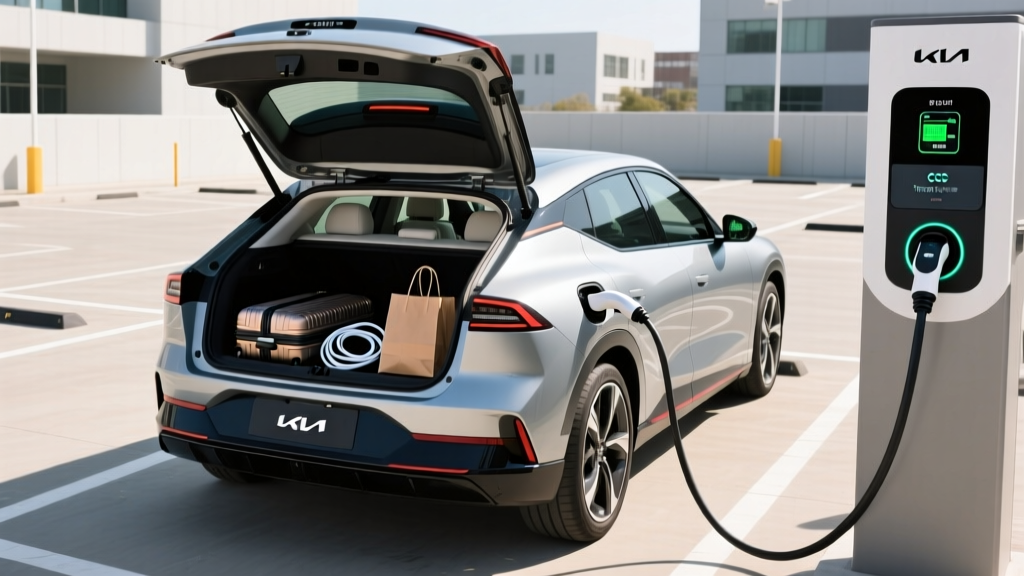
The Kia EV6 cargo space of 24.4 cubic feet behind the second row is adequate for a week's worth of groceries, two large suitcases, or a full-size stroller. Fold the 60/40 split rear seats and the 50.2-cubic-foot maximum handles a weekend camping trip for two, several large boxes from a home-improvement store, or a pair of mountain bikes with front wheels removed.
Where the EV6 falls short is against the Model Y and Ioniq 5, both of which offer meaningfully more cargo volume — particularly with seats folded. The EV6's sloping rear hatch, while stylish, cuts into vertical space for tall items. If you regularly haul large furniture, dog crates, or need maximum flat-load capability, the Ioniq 5's boxier profile or the Model Y's taller hatch are more practical choices.
The EV6's frunk is essentially a token — at just 0.7 cubic feet, it fits a charging cable and little else. This is an E-GMP platform limitation shared with the Ioniq 5; neither was designed with significant front-trunk storage in mind. Tesla's Model Y, with its 4.1-cubic-foot frunk, wins this comparison easily.
On the positive side, rear-seat passenger comfort is excellent. The EV6's 39.4 inches of rear legroom is generous for the segment, and the flat floor (no transmission tunnel) makes the middle seat genuinely usable for short trips. The available reclining rear seatbacks add comfort on long drives.
Technology, Driver Assistance, and Notable Drawbacks
The 2026 EV6 features Kia's latest ccNC (Connected Car Navigation Cockpit) infotainment system with a curved 12.3-inch digital instrument cluster and 12.3-inch center touchscreen running wireless Apple CarPlay and Android Auto. The system is responsive, the tile-based interface is logical, and Kia has wisely retained physical shortcut buttons for climate and volume — a detail many EV competitors have regrettably abandoned in touchscreen-only purges.
Standard driver-assistance features under the Highway Driving Assist 2 (HDA2) suite include:
- Adaptive cruise control with stop-and-go and curve speed reduction
- Lane-centering assist (hands-on-wheel required — this is SAE Level 2, not autonomous driving)
- Automatic emergency braking with pedestrian/cyclist detection
- Blind-spot collision avoidance assist
- Rear cross-traffic collision avoidance
- Navigation-based smart cruise control (slows for upcoming curves and toll gates)
Kia's Highway Driving Assist 2 is an SAE Level 2 driver-assistance system. You must keep your hands on the steering wheel and remain fully engaged at all times. The system does not make the EV6 self-driving. It reduces fatigue on long highway trips but will not navigate complex urban environments, construction zones, or unmapped roads autonomously.
The available Digital Key 2 lets you use a compatible smartphone or smartwatch as your key fob via NFC and UWB (ultra-wideband), and the EV6 supports vehicle-to-load (V2L) power output — up to 3.6 kW through the interior outlet or the external V2L adapter — letting you power laptops, a small refrigerator, or even a CPAP machine during a camping trip.
Notable drawbacks:
- Capacitive-touch climate controls: The flush-touch panel below the main screen is frustrating to use while driving — haptic feedback is minimal, and button sizes are small.
- Rear visibility: The thick C-pillars and high rear beltline create significant blind spots. The surround-view camera helps, but the physical sightlines are a genuine concern.
- Ride firmness on GT-Line: The 20-inch wheels on GT-Line trims transmit more road imperfections than the 19-inch wheels on Wind trims. If comfort is a priority, choose Wind.
- No rear wiper: The EV6 lacks a rear window wiper, and the sloping hatch collects road spray in rain. Visibility degrades quickly in wet conditions.
Pricing, Tax Credits, and Ownership Costs
The 2026 Kia EV6 starts at $41,900 for the Light RWD standard-range trim and climbs to $61,600 for the performance-oriented GT. Most buyers target the Wind RWD ($47,700) or GT-Line AWD ($52,100) trims for the best combination of range, features, and value.
| Trim | MSRP | Destination | Est. §30D Credit* | Effective Price |
|---|---|---|---|---|
| Light RWD (Std Range) | $41,900 | $1,375 | $0–$3,750 | $39,525–$43,275 |
| Wind RWD | $47,700 | $1,375 | $3,750–$7,500 | $41,575–$49,075 |
| GT-Line RWD | $51,100 | $1,375 | $3,750–$7,500 | $44,975–$52,475 |
| GT-Line AWD | $52,100 | $1,375 | $3,750–$7,500 | $45,975–$53,475 |
| GT AWD | $61,600 | $1,375 | $0–$7,500 | $55,475–$62,975 |
*Federal tax-credit amounts depend on battery component and critical-mineral sourcing requirements under IRS §30D rules. The credit is now available as a point-of-sale transfer to the dealer, reducing your purchase price at signing. Eligibility also requires meeting adjusted gross income caps ($150,000 single / $300,000 joint) and the vehicle must be under the $80,000 MSRP cap for SUVs/crossovers. Consult a tax professional for your specific situation.
Kia's battery-sourcing compliance has been in flux as the automaker shifts production to its Georgia plant. As of early 2026, many EV6 trims qualify for at least the $3,750 critical-minerals half of the credit, with full $7,500 eligibility varying by build month and battery supplier. Always verify current eligibility on fueleconomy.gov before purchasing.
- Vehicle MSRP must be ≤ $80,000 (SUV/crossover classification)
- Buyer AGI: ≤ $150,000 (single) or ≤ $300,000 (married filing jointly)
- Battery components must meet North American manufacturing thresholds
- Critical minerals must meet sourcing requirements (free-trade-agreement nations)
- Credit can be transferred to dealer at point of sale as a purchase-price reduction
- Vehicle must be new, purchased for personal use, primarily driven in the U.S.
Warranty and Long-Term Ownership
Kia backs the EV6 with one of the strongest warranty packages in the EV segment:
- Battery: 10 years / 100,000 miles (capacity retention threshold: 70%)
- Powertrain: 10 years / 100,000 miles
- Bumper-to-bumper: 5 years / 60,000 miles
- Roadside assistance: 5 years / 60,000 miles
The 10-year battery warranty exceeds Tesla's 8-year/120,000-mile coverage and matches Hyundai's terms. The 70% capacity-retention threshold is industry-standard; in practice, NMC packs in E-GMP vehicles have shown degradation of roughly 8–12% over the first 100,000 miles based on fleet data, meaning most owners will never approach the warranty claim threshold.
Insurance costs for the EV6 are moderate for the EV segment — expect $1,600–$2,200 annually depending on your state, driving record, and trim. The GT model, with its 576-hp output, commands a significant insurance premium over the Wind and GT-Line trims.
Who Should Buy the 2026 Kia EV6?
- Best-in-class DC fast-charging speed (240 kW peak, ~18 min 10–80%)
- NACS connector for native Tesla Supercharger access
- Strong efficiency (134 MPGe combined, Wind RWD)
- 10-year/100,000-mile battery and powertrain warranty
- V2L capability (3.6 kW) for camping and emergencies
- Comfortable, well-appointed interior with physical shortcut buttons
- Competitive starting price with available federal tax credit
- Cargo space (24.4 cu ft) trails Ioniq 5, Model Y, and Mach-E
- Tiny frunk (0.7 cu ft) is barely usable
- No rear wiper — poor wet-weather rear visibility
- Capacitive-touch climate controls are distracting while driving
- GT-Line 20-inch wheels degrade ride quality
- Real-world highway range falls ~30–50 miles below EPA sticker
Choose the EV6 if: You prioritize fast charging above all else, commute 30–80 miles daily with access to home Level 2 charging, want native Supercharger access without an adapter, and value Kia's long warranty. The Wind RWD trim is the sweet spot — 310 miles EPA, 134 MPGe, and the best feature-to-price ratio in the lineup.
Look elsewhere if: Maximum cargo capacity is your top priority (Ioniq 5 or Model Y), you need three rows of seating (Kia EV9), you want LFP chemistry for maximum cycle life and daily 100% charging flexibility, or you frequently drive in extreme cold where the EV6's NMC pack loses more range than LFP competitors.
Frequently Asked Questions
What is the real-world range of the Kia EV6?
The EPA rates the EV6 Wind RWD at 310 miles, but real-world highway driving at 70+ mph typically yields 260–280 miles. In cold weather below 30°F, expect 215–250 miles. The AWD GT-Line averages around 240–260 miles in mixed real-world conditions.
How fast does the Kia EV6 charge?
Long Range EV6 trims peak at 240 kW on a 350 kW-capable DC fast charger, achieving 10–80% in approximately 18 minutes with a preconditioned battery. At home on a Level 2 (240V/48A) charger, the onboard 10.9 kW charger adds roughly 34–37 miles per hour, fully recharging the 77.4 kWh battery in about 7.5 hours.
Does the 2026 Kia EV6 qualify for the federal EV tax credit?
Eligibility varies by trim and build date. Under current IRS §30D rules, the EV6 must meet battery-component and critical-mineral sourcing thresholds, the buyer must be under income caps, and the MSRP must be ≤ $80,000. Check fueleconomy.gov for the latest eligibility by VIN before purchasing.
Is the Kia EV6 worth buying vs. the Hyundai Ioniq 5 or Tesla Model Y?
The EV6 trades cargo volume for a sportier driving feel and slightly better efficiency than the Ioniq 5, its platform sibling. Against the Model Y, the EV6 offers a more premium interior, better ride quality, and stronger warranty, but less cargo space and no access to Tesla's proprietary service infrastructure. If cargo space is your top priority, the Model Y or Ioniq 5 wins. If charging speed, interior quality, and warranty matter most, the EV6 is the stronger pick.
How much Kia EV6 cargo space is there with seats folded?
With the 60/40 split rear seats folded flat, the EV6 provides 50.2 cubic feet of cargo space. That's enough for two mountain bikes (front wheels off), several large suitcases, or a week's worth of camping gear for two. It trails the Ioniq 5's 59.3 cu ft and the Model Y's 72.0 cu ft, however.
Does the EV6 have a heat pump for cold weather?
Yes, Long Range trims (Wind, GT-Line, GT) include a standard heat pump that significantly reduces the energy cost of cabin heating in cold weather compared to resistive heating. This helps preserve range in winter, though you should still expect a 20–30% range reduction in sub-freezing temperatures.