Quick Verdict: Where the Kia EV5 Fits in 2026
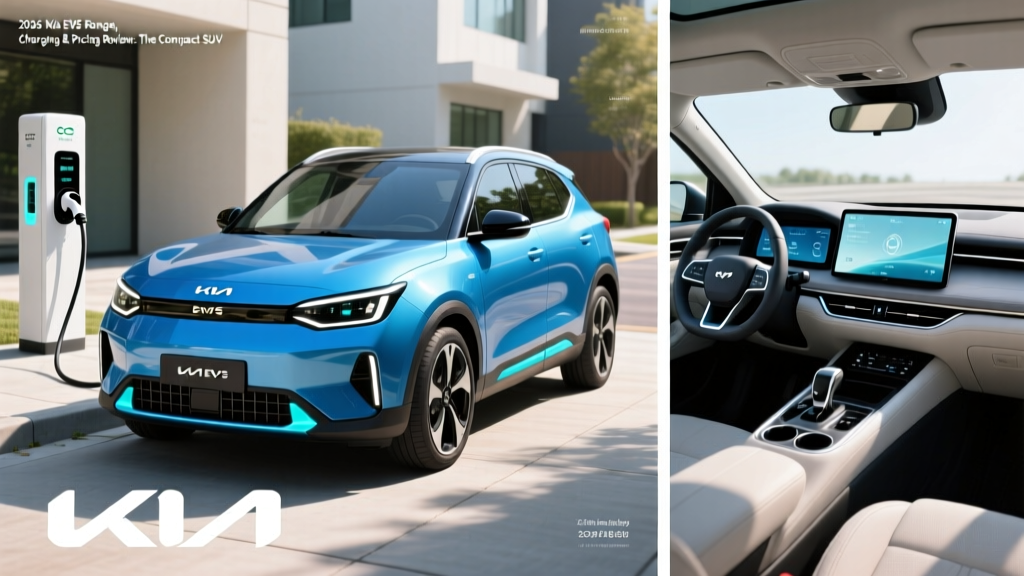
The Kia EV5 is the automaker's compact electric SUV slotting between the smaller Niro EV and the mid-size EV9 three-row. For 2026, Kia positions the EV5 as a practical daily driver with competitive range, respectable DC fast-charging speeds, and a starting price designed to undercut rivals like the Hyundai Ioniq 5, Ford Mustang Mach-E, and Tesla Model Y. It shares the Hyundai Motor Group's E-GMP (Electric Global Modular Platform) architecture, meaning 800V charging capability is standard — a genuine advantage at this price point.
The EV5 is not a performance SUV, nor is it a road-trip champion. It is a commuter-first, family-capable electric crossover that prioritizes interior space, straightforward controls, and predictable range. If you want a sub-$45,000 EV with over 280 miles of EPA range and a well-packaged cabin, the EV5 belongs on your shortlist.
Range, Battery & Real-World Efficiency
The 2026 Kia EV5 comes with two battery options depending on trim. The base Wind trim uses a 58.3 kWh usable lithium-ion NMC (nickel-manganese-cobalt) pack, while the higher Land and GT-Line trims step up to a 77.4 kWh NMC battery. Neither trim currently offers an LFP (lithium iron phosphate) option, which means the EV5 prioritizes energy density and cold-weather performance over the longer cycle life that LFP provides.
| Trim | Drivetrain | Usable Battery (kWh) | Chemistry | EPA Range (mi) | MPGe (combined) | kWh/100 mi |
|---|---|---|---|---|---|---|
| Wind (RWD) | RWD | 58.3 | NMC | 240 | 125 | 27 |
| Land (RWD) | RWD | 77.4 | NMC | 305 | 117 | 29 |
| Land (AWD) | Dual-motor AWD | 77.4 | NMC | 280 | 108 | 31 |
| GT-Line (AWD) | Dual-motor AWD | 77.4 | NMC | 275 | 106 | 32 |
Efficiency-wise, the EV5 Land RWD at 29 kWh/100 mi is competitive with the Ioniq 5 (28–30 kWh/100 mi) but trails the Tesla Model Y Long Range RWD, which achieves roughly 26 kWh/100 mi thanks to superior aerodynamics and heat-pump standardization. The EV5 does include a standard heat pump on all trims, which helps mitigate winter range loss compared to EVs without one.
Charging Speed: DC Fast Charge & Home Level 2
One of the EV5's strongest selling points is its 800V architecture, inherited from the E-GMP platform. This allows peak DC fast-charging rates that outperform most competitors still running on 400V systems.
| Charging Type | Max Rate | Time / Rate | Notes |
|---|---|---|---|
| DC Fast Charge (10–80%) | 235 kW (peak) | ~18 minutes (77.4 kWh) ~15 minutes (58.3 kWh) | Requires 350 kW+ station; curve tapers sharply above 80% |
| DC Fast Charge (sustained avg) | ~160 kW avg | 10–80% real avg | Peak kW is not sustained; average matters more |
| Level 2 Home (240V) | 10.9 kW | ~7 hours (77.4 kWh, 0–100%) | Requires 48-amp circuit; adds ~32 mi/hr |
| Level 1 (120V) | 1.4 kW | ~55 hours (77.4 kWh, 0–100%) | Emergency/trickle only; adds ~4 mi/hr |
The 235 kW peak rate is impressive, but real-world charging follows a curve. On a 350 kW Electrify America or EVgo stall, the EV5 will pull close to peak power between 10% and 40% state of charge, then step down progressively. By 80%, the rate drops to roughly 60–70 kW. This means a 10–80% session genuinely takes about 18 minutes for the larger battery, but a 10–90% session will stretch past 30 minutes. If you regularly charge to 90%+ for road trips, budget the extra time.
For home charging, the 10.9 kW onboard charger is standard across all trims. You will need a NEMA 14-50 outlet or hardwired Level 2 wallbox on a dedicated 50–60 amp circuit. Expect $500–$1,500 for a professional Level 2 installation depending on your panel capacity and run distance — more if your home needs a 200-amp panel upgrade.
The EV5 ships with the NACS (North American Charging Standard) connector for 2026, giving it native access to the Tesla Supercharger network without an adapter — a significant convenience advantage over CCS-only rivals.
Performance & Drivetrain
| Trim | Motor Config | Horsepower | Torque (lb-ft) | 0–60 mph | Top Speed |
|---|---|---|---|---|---|
| Wind (RWD) | Single rear motor | 215 hp | 258 | 7.3 sec | 115 mph |
| Land (RWD) | Single rear motor | 225 hp | 258 | 7.0 sec | 115 mph |
| Land (AWD) | Dual motor | 320 hp | 446 | 5.1 sec | 124 mph |
| GT-Line (AWD) | Dual motor | 320 hp | 446 | 5.0 sec | 124 mph |
The RWD trims deliver adequate acceleration for merging and passing but won't thrill anyone coming from a performance sedan. The AWD variants, with 320 hp and 446 lb-ft of torque, transform the EV5 into a genuinely quick crossover. The 5.0-second 0–60 time in the GT-Line puts it in the same territory as the Ford Mustang Mach-E Premium AWD and notably ahead of the base Tesla Model Y Long Range.
Ride quality is compliant rather than sporty. Kia tuned the EV5's suspension for comfort over rough pavement, and the cabin stays well-isolated from road noise. Regenerative braking offers four levels adjustable via steering-wheel paddles, including a true one-pedal driving mode (i-Pedal) that brings the EV5 to a complete stop without touching the brake pedal.
Interior, Cargo & Technology
The EV5's interior is where Kia's packaging expertise shows. Despite its compact-SUV footprint, the flat floor enabled by the E-GMP platform creates generous rear-seat legroom and a usable front trunk (frunk).
| Measurement | Value |
|---|---|
| Front headroom | 40.2 in |
| Front legroom | 41.5 in |
| Rear headroom | 39.1 in |
| Rear legroom | 38.7 in |
| Cargo (behind 2nd row) | 28.5 cu ft |
| Cargo (2nd row folded) | 62.0 cu ft |
| Frunk | 1.8 cu ft |
| Wheelbase | 109.1 in |
| Curb weight (Land AWD) | 4,650 lbs |
On the technology front, the EV5 features a standard 12.3-inch digital instrument cluster paired with a 12.3-inch center touchscreen running Kia's latest Connect infotainment system. Wireless Apple CarPlay and Android Auto are standard on all trims. The GT-Line adds a head-up display with augmented-reality navigation overlays and a digital key via smartphone.
Driver assistance is comprehensive: Kia's Highway Driving Assist 2 (HDA2) is standard and includes adaptive cruise control with stop-and-go, lane-centering, and lane-change assist. This is an SAE Level 2 system — meaning you must keep your hands on the wheel and eyes on the road at all times. It is not autonomous driving.
Notable drawbacks include the absence of a front trunk large enough for a charging cable bag (the 1.8 cu ft frunk is best for small items), and the EV5's towing capacity is limited to 1,500 lbs — adequate for a small utility trailer but not a camper. There is also no V2L (vehicle-to-load) adapter included standard; it is a $300 accessory.
Pricing, Trims & Federal Tax Credit Eligibility
| Trim | Drivetrain | Base MSRP | As-Tested (w/ packages) | Destination |
|---|---|---|---|---|
| Wind | RWD | $39,900 | $40,590 | $1,390 |
| Land | RWD | $44,500 | $47,200 | $1,390 |
| Land | AWD | $47,500 | $50,800 | $1,390 |
| GT-Line | AWD | $51,900 | $55,400 | $1,390 |
Does the EV5 Qualify for the Federal §30D Tax Credit?
Eligibility for the federal EV tax credit (up to $7,500 under IRS §30D) depends on several factors that shift annually:
- MSRP cap: SUVs must have a base MSRP at or below $80,000. All EV5 trims clear this threshold.
- Buyer income cap: Modified AGI must not exceed $150,000 (single), $225,000 (head of household), or $300,000 (joint). Check your tax situation with a professional.
- Battery sourcing requirements: The credit is split into two halves — $3,750 for critical-mineral sourcing and $3,750 for battery-component manufacturing. Kia's E-GMP batteries for US-market vehicles have progressively shifted sourcing to comply, but the exact credit amount ($3,750 or $7,500) depends on the model year's supply-chain certification. Confirm current eligibility on fueleconomy.gov before purchasing.
- Point-of-sale transfer: If eligible, you can transfer the credit to the dealer at purchase, reducing your out-of-pocket cost immediately rather than waiting for a tax refund.
| Trim | MSRP + Dest. | After $7,500 Credit | After $3,750 Credit |
|---|---|---|---|
| Wind RWD | $41,290 | $33,790 | $37,540 |
| Land RWD | $45,890 | $38,390 | $42,140 |
| Land AWD | $48,890 | $41,390 | $45,140 |
| GT-Line AWD | $53,290 | $45,790 | $49,540 |
State and local incentives may stack on top — check AFDC's incentive database for your jurisdiction. Some states offer additional rebates of $1,000–$5,000.
Warranty & Ownership Costs
Kia backs the EV5 with one of the strongest warranty packages in the segment:
- Battery: 10 years / 100,000 miles (capacity retention guaranteed above 70%)
- Powertrain: 10 years / 100,000 miles
- Bumper-to-bumper: 5 years / 60,000 miles
- Roadside assistance: 5 years / 60,000 miles
- Complimentary maintenance: 3 years / 36,000 miles (scheduled service)
The 10-year battery warranty is a significant confidence signal, especially for buyers concerned about long-term degradation. Based on data from the Ioniq 5 and EV6 (both E-GMP), expect roughly 8–12% degradation over 100,000 miles under normal use — well within the 70% retention floor.
Insurance costs for the EV5 are moderate for the segment. Expect annual premiums of $1,600–$2,200 depending on trim, location, and driving record — slightly higher than a comparably priced gas crossover but in line with other EVs in this class.
Pros & Cons: The Honest Assessment
Pros
- 800V fast-charging at a sub-$45K starting price
- NACS connector standard — native Supercharger access
- Generous rear-seat legroom for a compact SUV
- 10-year/100,000-mi battery warranty
- Standard heat pump for cold-climate efficiency
- HDA2 driver assist is well-calibrated and smooth
Cons
- Tiny 1.8 cu ft frunk — barely fits a charging cable
- 1,500-lb towing limit rules out most campers
- No LFP battery option for buyers who want maximum cycle life
- V2L adapter is a paid accessory, not standard
- AWD range penalty of ~25 miles is noticeable
- Rear visibility is compromised by thick C-pillars
Who Should Buy the 2026 Kia EV5?
Choose the EV5 Wind RWD if: You want the lowest entry price, your daily commute is under 80 miles round-trip, and you have reliable home Level 2 charging. At ~$33,790 after the full federal credit, it is one of the most affordable 240-mile EVs on the market.
Choose the EV5 Land RWD if: You need 300+ miles of EPA range for occasional road trips but don't want to pay for AWD. This is the efficiency sweet spot of the lineup.
Choose the EV5 Land AWD if: You live in a snowy climate, want the security of dual-motor traction, and can accept a 25-mile range trade-off. The 320 hp makes it genuinely fun when you want it to be.
Choose the EV5 GT-Line AWD if: You want the sport-tuned suspension, premium interior materials, and AR head-up display — and you're willing to pay a $4,400 premium over the Land AWD for the upgrades.
Look elsewhere if: You need to tow more than 1,500 lbs (consider the EV9 or Rivian R1S), you want an LFP battery for 300,000+ mile longevity (check Tesla Model Y), or you need three rows of seating.
Frequently Asked Questions
What is the real-world range of the 2026 Kia EV5?
The EPA rates the Land RWD at 305 miles, but expect 250–270 miles on sustained highway driving and 210–230 miles in freezing temperatures. The AWD trims deliver 240–260 real-world highway miles. Always plan trips around 80% of the EPA figure for a comfortable buffer.
How fast does the EV5 charge at home and on the road?
On a 350 kW DC fast charger, the EV5 peaks at 235 kW and charges from 10–80% in roughly 18 minutes (77.4 kWh battery). At home on a Level 2 wallbox (10.9 kW), a full charge takes about 7 hours — easily done overnight. Level 1 (120V) is impractical for daily use at just 4 miles per hour of charging.
How much does the EV5 cost after tax credits?
If you qualify for the full $7,500 federal credit under IRS §30D, the Wind RWD drops to roughly $33,790 and the Land RWD to $38,390. Eligibility depends on your income, the vehicle's battery sourcing certification, and MSRP caps. Confirm on fueleconomy.gov before purchasing and consult a tax professional.
Is the EV5 worth buying vs the Ioniq 5 or Model Y?
The EV5 competes closely with the Hyundai Ioniq 5 (its platform sibling) and undercuts the Tesla Model Y on price. It offers comparable range and faster charging than most rivals but has less cargo space than the Model Y and a smaller frunk than the Ioniq 5. If NACS Supercharger access, Kia's 10-year warranty, and a lower starting price matter to you, the EV5 is a strong pick. If maximum cargo volume or a proven LFP battery option is your priority, the Model Y may edge it out.
Does the EV5 have one-pedal driving?
Yes. Kia's i-Pedal mode provides full regenerative braking down to a complete stop. You can also select from four regen levels via the steering-wheel paddles, including a coasting mode for highway efficiency.
What is the EV5's safety rating?
As of early 2026, the EV5 has not yet been rated by the NHTSA or IIHS. However, E-GMP-based vehicles (EV6, Ioniq 5) have consistently earned IIHS Top Safety Pick+ ratings and 5-star NHTSA scores. We expect similar results for the EV5 once testing is complete.