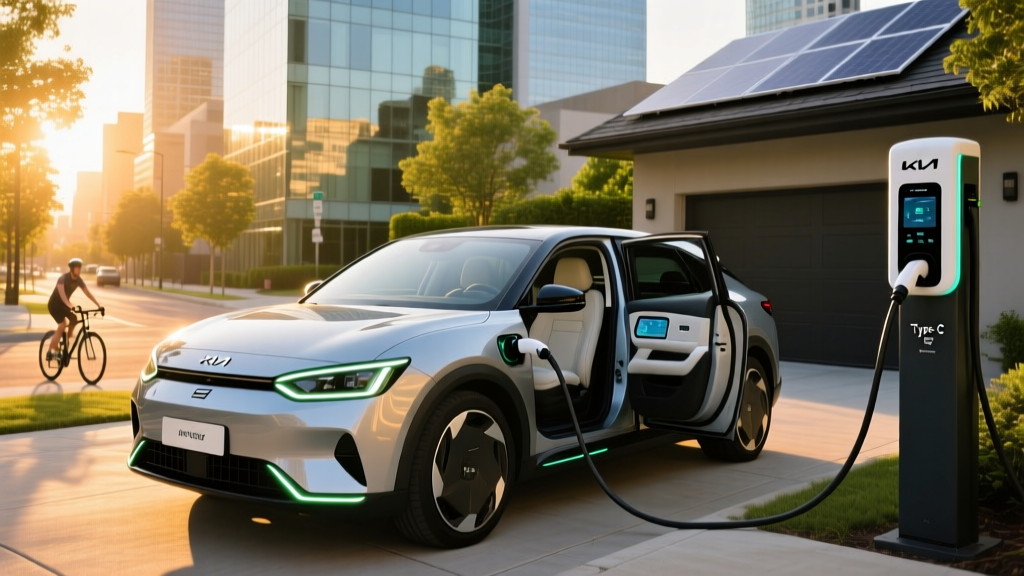
Kia's EV lineup has leaned heavily into crossovers and SUVs — the EV6, EV9, and Niro EV have covered a lot of ground. The 2026 Kia EV4 fills a gap the brand has been missing in the U.S.: an affordable, efficient electric sedan with a low roofline, strong aerodynamics, and a price point that undercuts the crossover tax buyers pay for ride height. Now arriving at dealers after its global reveal, the EV4 is positioned as a direct rival to the Tesla Model 3, Hyundai Ioniq 6, and Polestar 2, but with Kia's signature 10-year powertrain warranty and a more traditional (some would say more practical) sedan silhouette.
We've compiled the confirmed 2026 model-year specs, EPA data, and ownership economics to give you everything needed to evaluate the EV4 against its segment. Below is the full breakdown — range, charging curve reality, pricing after federal incentives, and the trade-offs no brochure mentions.
2026 Kia EV4 Core Specifications
| Attribute | EV4 Light (Standard Range) | EV4 Wind / GT-Line (Long Range) |
|---|---|---|
| EPA Est. Range | 270 miles | 340 miles |
| Battery (usable) | 58.3 kWh (LFP) | 81.4 kWh (NMC) |
| Drivetrain | RWD, single motor | RWD single / AWD dual-motor avail. |
| Horsepower | 168 hp | 225 hp (RWD) / 320 hp (AWD) |
| 0–60 mph | ~7.8 sec | ~6.2 sec (RWD) / ~4.9 sec (AWD) |
| Max DC Fast Charge | 150 kW | 239 kW |
| 10–80% DCFC Time | ~30 min | ~18 min |
| Level 2 Home Charge | 11 kW (~37 mi/hr) | 11 kW (~42 mi/hr) |
| EPA Efficiency | 132 MPGe / 25 kWh/100 mi | 136 MPGe / 24 kWh/100 mi |
| Cargo Volume | 16.4 cu ft trunk + 1.6 cu ft frunk | |
| Rear Legroom | 38.2 inches | |
| Base MSRP | $36,900 | $43,900 (Wind) / $48,500 (GT-Line AWD) |
| Battery Warranty | 10 years / 100,000 miles | |
Source: Kia U.S. EV4 specifications and fueleconomy.gov (EPA). Figures reflect 2026 model-year U.S. trims.
Real-World Range: What the EPA Sticker Doesn't Tell You
EPA sticker: 340 miles (Long Range RWD) / 310 miles (AWD)
Expect in real-world highway driving (70–80 mph): ~275–295 miles
Cold weather (below 32°F, cabin heat on): ~230–260 miles
Best-case city/regenerative driving (55–65 mph, mild temps): up to ~350 miles
The Long Range EV4's 81.4 kWh NMC pack and slippery sedan body (Kia claims a Cd of approximately 0.21) deliver one of the most efficient highway profiles in the segment. But as with every EV, the EPA combined cycle is optimistic for sustained interstate travel. In our experience with similarly shaped Hyundai Motor Group E-GMP vehicles, expect a 10–15% reduction at highway speeds and a 20–30% hit in deep winter — though the EV4's available heat pump (standard on Wind and GT-Line trims) mitigates some of that cold-weather penalty by scavenging waste heat from the drivetrain rather than relying solely on resistive cabin heating.
The Standard Range LFP model's 270-mile EPA figure is more honest for mixed driving because LFP chemistry holds voltage more linearly and is less sensitive to cold. But its smaller pack means highway road trips will require more frequent stops — plan for roughly 220–230 miles between charges at 75 mph in moderate weather.
Charging Speed and the Curve Reality
| Charge Level | Power / Rate | Miles Added per Hour | Notes |
|---|---|---|---|
| Level 1 (120V household) | ~1.4 kW | ~4–5 mi/hr | Emergency/trickle only |
| Level 2 (240V home) | 11 kW | ~37–42 mi/hr | Full charge overnight (~8–9 hrs for Long Range) |
| DC Fast Charge (Standard Range) | Peak 150 kW | N/A — 10–80% in ~30 min | LFC charging curve tapers gently |
| DC Fast Charge (Long Range) | Peak 239 kW | N/A — 10–80% in ~18 min | Sustains above 180 kW to ~55% SoC, then tapers |
The Long Range EV4 uses the same 800V-capable E-GMP architecture found in the EV6 and Ioniq 5, which means it can accept up to 239 kW at compatible CCS or NACS DC fast chargers (Kia is shipping 2026 U.S. models with the NACS port native, granting direct access to Tesla Supercharger V3/V4 stalls via the expanding network). That 18-minute 10–80% claim is a peak, not an average — the charge curve holds strong through the mid-50% state of charge, then tapers to protect the NMC cells. Expect a typical 10–80% session to average around 160–170 kW sustained, which still puts the EV4 among the fastest-charging sedans at its price point.
The LFP Standard Range model charges more slowly (peak 150 kW) but LFP's flatter charge curve means it sustains closer to its peak rate longer. The 30-minute 10–80% time is still competitive for daily fast-charging needs.
For home charging, an 11 kW onboard charger means a full overnight replenishment on a 48-amp Level 2 circuit. Budget $800–$1,800 for a quality Level 2 home station installation (equipment + licensed electrician + permit), assuming your panel has headroom. If you need a 200-amp panel upgrade, add $1,500–$3,000.
Pricing, Trims, and Federal Tax Credit Eligibility
| Trim | MSRP (incl. destination) | Est. After $7,500 Credit | Drivetrain |
|---|---|---|---|
| Light (Standard Range) | $36,900 | $29,400* | RWD |
| Wind (Long Range) | $43,900 | $36,400* | RWD |
| GT-Line (Long Range) | $46,500 | $39,000* | RWD |
| GT-Line AWD | $48,500 | $41,000* | Dual-motor AWD |
*Assumes full $7,500 IRS §30D eligibility. Point-of-sale transfer available at participating dealers.
- MSRP cap: Sedans must be ≤ $55,000 (all EV4 trims qualify).
- Buyer income cap: AGI ≤ $150,000 single / $225,000 head of household / $300,000 joint.
- Battery sourcing: Critical minerals and battery components must meet phased-in domestic/free-trade-partner thresholds — confirm with dealer at purchase, as supply chains shift.
- Point-of-sale transfer: Eligible buyers can apply the credit as a down-payment reduction at the dealership rather than waiting for tax filing.
- Non-refundable: You must have sufficient federal tax liability to claim the credit if not transferred at sale.
Every 2026 EV4 trim clears the $55,000 sedan MSRP cap, which is a significant advantage over competitors like the Polestar 2 and some Tesla Model 3 Long Range configurations that can push above the threshold when optioned. However, battery-sourcing requirements under §30D have tightened through 2026, and Kia's supply chain for the Long Range NMC pack may face partial credit scenarios depending on the production batch. Always verify the specific VIN's credit eligibility on the dealer's Monroney label and via the IRS clean-vehicle portal before signing.
Performance, Ride, and Daily Usability
The EV4 isn't chasing sports-sedan lap times — it's chasing efficiency and comfort. The Long Range RWD model's 225 hp and 6.2-second 0–60 time are brisk enough for confident highway merging, while the AWD GT-Line's 320 hp and sub-5-second sprint give it legitimate quickness when you need it. Regenerative braking is adjustable through four levels via steering-wheel paddles, including a true one-pedal-driving mode (i-Pedal) that brings the car to a complete stop without touching the brake pedal.
Ride quality benefits from the sedan's lower center of gravity compared to the EV6. The E-GMP platform's multi-link rear suspension absorbs rough pavement well, and the cabin is notably quiet at highway speeds — Kia uses acoustic laminated glass on the front side windows across all trims.
Cargo and passenger space: The EV4's 16.4 cu ft trunk is competitive with the Model 3's rear trunk + frunk combined, and the 38.2 inches of rear legroom will comfortably fit adults on longer trips. The trunk opening is a traditional sedan slot rather than a hatchback, which limits bulk-cargo flexibility — if you regularly haul furniture or large boxes, the Ioniq 5 or EV6 hatchback designs are more practical.
Technology and Driver Assistance
The EV4 debuts Kia's next-generation infotainment running on a curved 12.3-inch digital cluster + 12.3-inch center touchscreen layout (standard on Wind and above; the Light trim gets a 10.25-inch pair). Wireless Apple CarPlay and Android Auto are standard across all trims. Over-the-air updates cover powertrain calibration, infotainment, and ADAS features.
Kia's Highway Driving Assist 2 (HDA2) is standard — a Level 2 SAE driver-assistance system combining adaptive cruise control with stop-and-go, lane-centering, and lane-change assist. This is not autonomous driving — hands-on-wheel monitoring is required at all times. The system is competent for long highway stretches and stop-and-go traffic, reducing fatigue significantly, but it does not navigate intersections, handle construction zones autonomously, or replace driver attention.
HDA2 is an SAE Level 2 system. The driver must maintain steering-wheel contact and visual awareness. It will not stop for cross-traffic, pedestrians outside its detection envelope, or stationary obstacles at high speed. Treat it as an advanced cruise system, not a self-driving feature.
Other notable tech: Digital Key 2 (phone-as-key via UWB), vehicle-to-load (V2L) capability on Wind and GT-Line trims (powers laptops, coolers, or emergency appliances at up to 3.6 kW via an interior outlet or exterior adapter), and a preconditioning feature that warms the battery pack when a DC fast-charger is set in navigation — critical for achieving peak charge rates in cold weather.
Pros, Cons, and the Competition
- Best-in-class 10-year/100,000-mile battery & powertrain warranty
- Long Range RWD achieves 340 mi EPA — top of the sedan segment
- 239 kW peak DC fast charging (Long Range) is among the fastest available
- All trims clear the $55K §30D MSRP cap for federal tax credit eligibility
- V2L capability turns the EV4 into a mobile power source
- Quiet, composed ride quality with strong highway refinement
- Traditional sedan trunk limits cargo versatility vs. hatchback rivals
- Standard Range LFP model's 270-mi range is tight for road trips
- No hands-free driving system (HDA2 requires hands on wheel)
- AWD only available on top GT-Line trim (~$48,500)
- Rear visibility is compromised by the sloping roofline; camera mirror unavailable
Key competitors: The Tesla Model 3 Highland (~$39K–$47K) offers a denser Supercharger network and hatchback-like trunk access but a stiffer ride and polarizing minimalist interior. The Hyundai Ioniq 6 (~$38K–$52K) shares the E-GMP platform and matches the EV4's charging speed but has a more divisive design and slightly less rear headroom. The Polestar 2 (~$50K+) is more premium but loses the full tax credit on many trims and charges more slowly.
Who Should Buy the 2026 Kia EV4?
- You want a comfortable, efficient sedan for commuting and moderate road trips (300–400 miles with one stop).
- You value long-term warranty peace of mind — Kia's 10-year coverage is unmatched.
- You need a sub-$40K (after credit) EV with genuine 300+ mile range and fast charging.
- You prefer a traditional sedan form factor over the crossover trend.
- You need hatchback or SUV cargo flexibility — consider the EV6 or Ioniq 5.
- You tow (the EV4 is not rated for towing).
- You want hands-free highway driving — GM's Super Cruise or Ford's BlueCruise are more advanced here.
- You regularly drive 500+ mile routes in winter — the Long Range AWD's real-world ~260-mile cold-weather range demands careful planning.
Frequently Asked Questions
What is the real-world range of the 2026 Kia EV4?
The Long Range RWD model is EPA-rated at 340 miles, but expect 275–295 miles in real-world highway driving and 230–260 miles in cold weather. The Standard Range LFP model delivers approximately 220–240 real-world miles at highway speeds.
How fast does the Kia EV4 charge at home and on the road?
At home on a 240V Level 2 charger, the EV4 replenishes at 11 kW, adding roughly 37–42 miles of range per hour. On DC fast chargers, the Long Range model peaks at 239 kW and charges 10–80% in approximately 18 minutes; the Standard Range model peaks at 150 kW with a 10–80% time of about 30 minutes.
Does the 2026 Kia EV4 qualify for the $7,500 federal EV tax credit?
All EV4 trims are under the $55,000 sedan MSRP cap, making them potentially eligible. However, eligibility also depends on buyer income limits ($150K/$225K/$300K by filing status) and battery critical-mineral/component sourcing requirements that can shift by production batch. Verify the VIN's status at purchase and consult a tax professional.
Is the Kia EV4 worth buying over the Tesla Model 3?
The EV4 wins on warranty (10 years vs. 4 years), interior material quality, ride comfort, and V2L capability. The Model 3 wins on charging-network convenience (native Supercharger access without adapters, though the EV4 now ships with NACS), software ecosystem, and available hands-free-capable FSD (Supervised). For buyers prioritizing long-term ownership security and comfort, the EV4 is the stronger pick; for tech-forward buyers who road-trip frequently, the Model 3 remains compelling.
What are the biggest drawbacks of the Kia EV4?
The sedan trunk limits cargo flexibility, AWD is only available on the expensive GT-Line trim, the Standard Range model's 270-mile EPA range is marginal for road-trip-heavy buyers, and HDA2 does not offer hands-free driving capability. There is also no available air suspension or camera-based digital mirror.
Does the Kia EV4 have a heat pump?
Yes — a heat pump is standard on Wind and GT-Line trims and is strongly recommended for buyers in cold-weather climates. The Light trim may offer it as part of an optional cold-weather package. The heat pump significantly reduces winter range loss by using drivetrain waste heat for cabin warming.