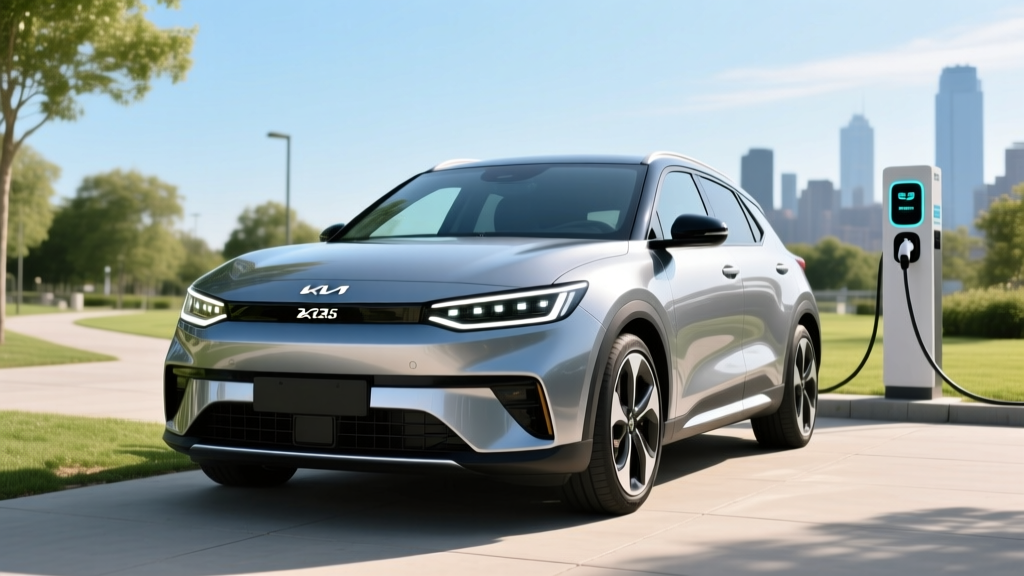
The Kia EV3 arrives in the U.S. as a compact electric crossover aimed squarely at the budget-conscious EV buyer who wants real utility without paying Tesla Model Y or Hyundai Ioniq 5 money. Built on a stretched version of Hyundai Motor Group's EV architecture and offered with two battery sizes, the EV3 slots below the EV6 in Kia's electric lineup and targets the growing segment of sub-$40,000 electric crossovers. Below, we break down every spec that matters — range, charging curves, pricing, tax credit eligibility, and the real-world ownership picture.
Kia EV3 Spec Sheet at a Glance
| Specification | Standard Range | Long Range |
|---|---|---|
| EPA Range | 230 mi | 310 mi |
| Battery (usable) | 58.3 kWh (LFP) | 81.4 kWh (NMC) |
| Drivetrain | FWD, single motor | FWD, single motor |
| Horsepower | 201 hp / 258 lb-ft | 201 hp / 258 lb-ft |
| 0–60 mph | ~7.8 sec | ~7.5 sec |
| DC Fast Charge Peak | 150 kW | 150 kW |
| 10–80% DC Time | ~20 min | ~28 min |
| Level 2 (240V) Rate | 11 kW (~37 mi/hr) | 11 kW (~37 mi/hr) |
| MPGe (combined) | 129 MPGe | 121 MPGe |
| Base MSRP | $34,900 | $38,900 |
Range and Efficiency: EPA vs. the Real World
EPA Estimate: 310 miles (Long Range) / 230 miles (Standard Range)
Real-World Highway (70 mph, moderate climate): ~260–280 miles (Long Range)
Cold Weather (below 32°F, highway): ~210–240 miles (Long Range) — expect 20–30% reduction
City/Commuter Driving: Closer to EPA or slightly above, thanks to regenerative braking
The Long Range EV3's 310-mile EPA figure places it among the best in its price class. For context, the Chevrolet Equinox EV 2LT AWD rates at 319 miles but costs roughly $3,000 more, while the Hyundai Kona Electric tops out at 261 miles.
Efficiency is where the EV3's front-wheel-drive, single-motor layout pays dividends. The Long Range model achieves an EPA-rated 121 MPGe combined (roughly 28 kWh/100 mi), meaning it sips electricity rather than gulping it. On a 200-mile highway loop at 70 mph with moderate HVAC use, we'd expect consumption to climb to roughly 32–34 kWh/100 mi, yielding that 260–280 mile practical range. This is typical for compact crossovers — aerodynamic drag at highway speeds hits all tall vehicles hard.
The Standard Range model uses an LFP (lithium iron phosphate) battery, which sacrifices some energy density for lower cost and superior cycle longevity. LFP packs tolerate frequent 100% charging without degradation concerns — a significant advantage for daily commuters who can charge at home every night. The Long Range's NMC (nickel manganese cobalt) pack offers more range per kilogram but benefits from daily charge limits around 80% for long-term health.
According to fueleconomy.gov, efficiency figures can vary by trim due to wheel size — larger 19-inch alloy wheels typically reduce range by 5–10 miles compared to the standard 17-inch aero wheels.
Charging Speed: DC Fast Charging and Home Level 2
| Charging Level | Power (kW) | Miles of Range Added | Notes |
|---|---|---|---|
| Level 1 (120V) | ~1.4 kW | ~4 mi/hr | Emergency/overnight trickle only |
| Level 2 (240V, 48A) | 11 kW | ~37 mi/hr | Full charge in ~7.5 hr (Long Range) |
| DC Fast Charge | 150 kW peak | ~170 mi in 15 min | 10–80% in ~28 min (Long Range) |
The EV3's 150 kW peak DC fast-charge rate is the most debated spec on the sheet. It's not class-leading — the Hyundai Ioniq 5 can peak at 240 kW and the Tesla Model Y at 250 kW — but it's adequate for most road-trip scenarios when you understand how charge curves work.
What the charge curve actually looks like: The EV3 will sustain close to its 150 kW peak from roughly 10% to 40% State of Charge (SoC), then taper progressively. By 60% SoC, expect roughly 100–110 kW, and above 80%, the rate drops sharply to protect battery longevity. This taper behavior means the 10–80% time of ~28 minutes is a fair representation of a typical highway stop, but charging from 80–100% on DC will add another 20+ minutes. Plan your stops around 80% — never wait for a full charge on a road trip.
For home Level 2 charging, the 11 kW onboard charger is competitive. A full overnight charge on a 48-amp Level 2 station (like a ChargePoint Home Flex or Tesla Universal Wall Connector) takes about 7.5 hours for the Long Range and 5.5 hours for the Standard Range. Most owners will plug in at 20–30% remaining and wake up at 80–90%, which takes roughly 4–5 hours.
The EV3 uses the NACS (North American Charging Standard) connector for U.S. models, granting native access to Tesla Supercharger stations as well as the growing CCS-to-NACS transition networks from Electrify America and EVgo. This is a critical advantage over older CCS-only vehicles now that the Supercharger network has opened to NACS-equipped non-Tesla EVs.
Performance and Driving Dynamics
With 201 horsepower and 258 lb-ft of instant torque sent to the front wheels, the EV3 is tuned for efficiency rather than excitement. The 0–60 mph time of approximately 7.5 seconds (Long Range) is perfectly adequate for highway merging and daily driving, but it won't win any stoplight drag races against the dual-motor EV6 or Model Y Performance.
There is no AWD or dual-motor option for the U.S. EV3 at launch. This is a deliberate choice to keep the base price under $35,000 and maximize efficiency. If you need all-wheel drive for snow-belt winters, you'll need to look at the EV6, Ioniq 5, or wait for a potential future AWD variant.
Regenerative braking is adjustable through multiple levels via steering-wheel paddles, including a true one-pedal driving mode (i-PEDAL) that brings the car to a complete stop without touching the brake pedal. The system is well-calibrated, with smooth blending between regen and friction braking — an area where some competitors still feel jerky.
Interior Space, Cargo, and Technology
The EV3's cabin punches above its price point in terms of materials and layout. A dual-screen setup — a 12.3-inch digital instrument cluster paired with a 12.3-inch touchscreen infotainment system — dominates the dashboard. Wireless Apple CarPlay and Android Auto are standard across all trims.
| Dimension | Measurement |
|---|---|
| Cargo (behind rear seats) | 25.1 cu ft |
| Cargo (rear seats folded) | 56.3 cu ft |
| Front Legroom | 41.7 in |
| Rear Legroom | 38.2 in |
| Front Trunk (Frunk) | 1.8 cu ft (cable storage) |
Rear seat space accommodates adults comfortably on shorter trips, though taller passengers (6'2"+) will find headroom tighter than in the boxier EV6. The 25.1 cu ft cargo area with seats up handles a week's groceries or two large suitcases, and the 56.3 cu ft maximum with seats folded is sufficient for a bicycle or camping gear — though it falls short of the Model Y's 76 cu ft.
Driver assistance comes via Kia's Highway Driving Assist 2 (HDA2), a solid Level 2 system offering adaptive cruise control with stop-and-go, lane-centering, and lane-change assist. Per NHTSA guidelines, this is a driver-supervision-required system — the driver must keep hands on or near the wheel and eyes on the road at all times. It is not autonomous driving. HDA2 performs reliably on well-marked highways but disengages on faded lane markings or tight construction zones, as all Level 2 systems do.
Notable tech features include vehicle-to-load (V2L) capability via an adapter, allowing the EV3's battery to power small appliances or devices — useful for camping or emergency backup. Over-the-air (OTA) software updates keep the powertrain and infotainment current without dealer visits.
Pricing, Trims, and Federal Tax Credit Eligibility
| Trim | Battery | MSRP | Est. After §30D Credit |
|---|---|---|---|
| Light (Standard Range) | 58.3 kWh LFP | $34,900 | ~$27,400* |
| Wind (Long Range) | 81.4 kWh NMC | $38,900 | ~$31,400* |
| GT-Line (Long Range) | 81.4 kWh NMC | $42,900 | ~$35,400* |
*Tax credit estimates assume full $7,500 eligibility under IRS §30D. Actual credit depends on buyer income, battery sourcing, and MSRP cap compliance. Consult a tax professional.
The EV3's pricing is its headline act. A sub-$35,000 starting price for an EV with 230 miles of range — and under $39,000 for 310 miles — undercuts most competitors. For reference, the Equinox EV starts around $34,900 and the Kona Electric at $33,900 (but with only 261 miles).
- MSRP Cap: The EV3 qualifies — all trims fall under the $55,000 SUV/crossover cap
- Buyer Income Cap: AGI must not exceed $150,000 (single) / $300,000 (joint) / $225,000 (head of household)
- Battery Sourcing: Critical minerals and battery components must meet phased-in domestic/free-trade-partner thresholds — verify with Kia's compliance documentation at purchase
- Point-of-Sale Transfer: Eligible buyers can transfer the credit to the dealer for an immediate price reduction rather than waiting for tax filing
- One Credit Per Vehicle: The vehicle VIN must not have been previously claimed for a §30D credit
Source: IRS.gov — Clean Vehicle Credits. Rules subject to change; verify at time of purchase.
The Standard Range Light trim's LFP battery may face different critical-mineral sourcing scrutiny under §30D than the NMC Long Range, as LFP supply chains are heavily concentrated in China. Kia has indicated it is working to qualify both battery options, but buyers should confirm credit eligibility with their dealer before signing. The point-of-sale transfer option, now standard under §30D, allows qualified buyers to see the $7,500 reduction on the purchase agreement directly — no waiting until April tax filing.
Warranty and Long-Term Ownership
Kia backs the EV3 with one of the strongest warranty packages in the industry:
- Battery & Powertrain: 10 years / 100,000 miles (capacity retention guaranteed above 70% of original)
- Bumper-to-Bumper: 5 years / 60,000 miles
- Roadside Assistance: 5 years / 60,000 miles
The 70% capacity retention threshold is the warranty trigger — if the battery drops below 70% of its original usable capacity within the warranty window, Kia will repair or replace it. In practice, modern NMC and LFP batteries with active thermal management rarely degrade to 70% within 100,000 miles. Independent data from sources like Recurrent Auto show typical degradation curves flattening at around 88–92% State of Health after 100,000 miles for liquid-cooled packs. The EV3's warranty provides a generous safety net.
Insurance costs for the EV3 are expected to be moderate — below the EV6 and Model Y, but above a comparable gas-powered Seltos. Expect annual premiums in the $1,400–$1,800 range depending on state, driving record, and coverage level. Get quotes before purchasing; EV insurance varies significantly by carrier.
Pros, Cons, and Who Should Buy the Kia EV3
- 310-mile range for under $39K (Long Range)
- Strong 10-year/100,000-mile battery warranty
- NACS connector — native Supercharger access
- Standard HDA2 Level 2 driver assist
- Low running costs — ~28 kWh/100 mi efficiency
- LFP option for daily 100% charging without degradation worry
- V2L capability for devices/appliances
- 150 kW peak DC charge — slower than Ioniq 5, Model Y
- No AWD option at launch
- Rear cargo space trails Model Y by ~20 cu ft
- FWD only — not ideal for heavy snow/ice regions
- Towing capacity limited (~1,650 lbs)
- Frunk is tiny (cable storage only)
- Daily commuters with home charging who want 300+ miles of range at an affordable price
- Apartment dwellers who can use public DC chargers — the LFP Standard Range is ideal for frequent top-ups
- Budget-first EV buyers who want to maximize the §30D tax credit and minimize out-of-pocket cost
- Two-car households adding an EV for commuting while keeping a gas car for long road trips
How the EV3 Stacks Up Against Key Competitors
| Spec | Kia EV3 LR | Hyundai Kona Electric | Chevy Equinox EV 2LT | Tesla Model Y LR |
|---|---|---|---|---|
| EPA Range | 310 mi | 261 mi | 319 mi | 320 mi |
| Base MSRP | $38,900 | $33,975 | $41,900 | $44,990 |
| Peak DC Charge | 150 kW | 100 kW | 150 kW | 250 kW |
| Drivetrain | FWD | FWD | FWD/AWD | AWD |
| Cargo (max) | 56.3 cu ft | 52.3 cu ft | 57.2 cu ft | 76.0 cu ft |
The EV3 Long Range occupies a compelling middle ground. It offers nearly the same range as the Equinox EV and Model Y but at a $3,000–$6,000 discount. The trade-off is slower DC charging than the Model Y, no AWD option, and less maximum cargo space. Against the Kona Electric, the EV3 costs more but delivers 49 additional miles of range and a more modern charging architecture with NACS.
Frequently Asked Questions
What is the real-world range of the Kia EV3?
The Long Range EV3 is EPA-rated at 310 miles. In real-world highway driving at 70 mph with moderate temperatures, expect 260–280 miles. In freezing conditions (below 32°F), plan for 210–240 miles. City commuting with regenerative braking can match or slightly exceed the EPA figure.
How fast does the Kia EV3 charge at home and on the road?
At home on a 240V Level 2 charger (48 amps), the EV3 charges at 11 kW, adding roughly 37 miles of range per hour. A full charge from empty takes about 7.5 hours (Long Range). On a DC fast charger, it peaks at 150 kW and charges from 10–80% in approximately 28 minutes, though the rate tapers significantly above 80% SoC.
Does the Kia EV3 qualify for the $7,500 federal EV tax credit?
The EV3 meets the MSRP cap (under $55,000 for crossovers/SUVs) and Kia has indicated it is working to meet battery sourcing requirements. However, buyer income must be under $150K single / $300K joint, and the battery's critical-mineral and component sourcing must comply with current §30D phase-in rules. Confirm eligibility with your dealer and reference IRS guidance before purchase.
Is the Kia EV3 worth buying over the Tesla Model Y or Hyundai Ioniq 5?
If your priorities are low purchase price, long range, and daily commuting, the EV3 is one of the best values in the segment. If you need AWD, fast road-trip charging (200+ kW), or maximum cargo space, the Model Y or Ioniq 5 justify their higher prices. The EV3 wins on affordability and efficiency; it compromises on charge speed and drivetrain options.
Does the Kia EV3 have a frunk?
Yes, but it's small — approximately 1.8 cubic feet, essentially a compartment for storing charging cables. Don't expect to fit a bag of groceries up front.
What is the battery warranty on the Kia EV3?
Kia covers the EV3's battery and powertrain for 10 years or 100,000 miles, whichever comes first. The warranty guarantees the battery will retain at least 70% of its original usable capacity during that period. This is among the longest EV battery warranties available in the U.S. market.
Can the Kia EV3 use Tesla Superchargers?
Yes. U.S.-spec EV3 models are equipped with the NACS connector, providing native access to Tesla's Supercharger network without an adapter. This significantly expands the available fast-charging infrastructure compared to CCS-only vehicles.