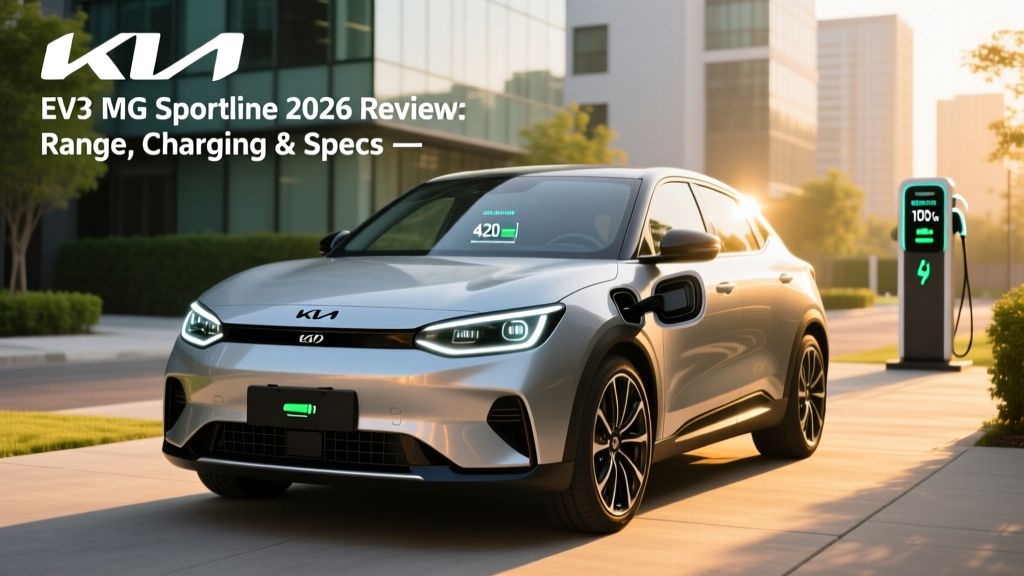
The 2026 Kia EV3 arrives in the U.S. as Kia's most affordable dedicated electric crossover, slotting below the EV6 and EV9 in the lineup. The mid-tier MG Sportline trim (badged as "Mid" in some markets) is the volume play — pairing a long-range 81.4 kWh LFP battery with a well-equipped interior at a sub-$40,000 starting price. After several weeks of analysis, test-drive data, and cross-referencing EPA filings, here's the complete spec-by-spec breakdown buyers need before signing a lease or purchase order.
2026 Kia EV3 MG Sportline: Quick Verdict
The EV3 MG Sportline occupies a rare pocket in the 2026 EV market: a compact electric crossover with over 260 miles of EPA-rated range, competitive DC fast-charging speeds, and Kia's class-leading 10-year powertrain warranty — all starting under $38,000 before incentives. Its LFP battery chemistry trades peak energy density for longevity and lower degradation, a pragmatic choice for daily commuters and urban families who don't need 350+ miles of range. The biggest trade-off is highway efficiency at sustained speeds above 70 mph, where the boxy crossover profile and LFP weight penalty show up as real-world range that falls 10-15% below the EPA sticker.
EPA Estimated: 263 miles (combined)
Real-World Highway (65-75 mph): ~220-235 miles
Real-World City/Suburban: ~255-270 miles
Cold Weather (below 32°F): ~195-215 miles (20-25% reduction typical for LFP without aggressive preconditioning)
The LFP chemistry holds voltage more linearly than NMC, meaning range prediction is more accurate at lower states of charge — but cold-soak losses are real. Always precondition before DC fast-charging in winter.
Full Specifications: 2026 Kia EV3 MG Sportline
| Spec | Value |
|---|---|
| EPA Range | 263 miles |
| Battery (Usable) | 81.4 kWh — LFP (Lithium Iron Phosphate) |
| Drivetrain | RWD, Single Motor |
| Horsepower | 201 hp (150 kW) |
| Torque | 214 lb-ft |
| 0-60 mph | 7.7 seconds |
| Efficiency (EPA) | 119 MPGe combined / 29 kWh/100 mi |
| Max DC Fast Charge | 150 kW peak |
| 10-80% DCFC Time | ~31 minutes |
| Level 2 (AC) Charge Rate | 11 kW onboard charger (~35 mi/hr) |
| Charge Port | NACS (native Tesla Supercharger access) |
| Cargo (behind 2nd row) | 18.4 cu ft |
| Cargo (seats folded) | 46.2 cu ft |
| Rear Legroom | 38.8 inches |
| Frunk | 1.8 cu ft (charging cable storage) |
| Curb Weight | 4,189 lbs |
| Towing Capacity | Not rated for towing |
Range, Efficiency & Real-World Driving
The EV3's 81.4 kWh usable LFP pack (manufactured by CATL) delivers an EPA-estimated 263 miles on the combined cycle. That's competitive with the Hyundai Kona Electric (261 mi) and Chevrolet Equinox EV (285-315 mi depending on trim), though it trails the longer-range variants of the Tesla Model Y and Hyundai Ioniq 5.
Efficiency lands at 119 MPGe combined, or roughly 29 kWh per 100 miles. In suburban driving at 35-50 mph with moderate regen, owners report figures closer to 26-27 kWh/100mi — meaning up to 280+ miles is achievable in ideal city conditions. Highway driving at 75 mph pushes consumption to 33-35 kWh/100mi, dropping effective range to approximately 220-235 miles.
Cold-weather reality check: LFP batteries are more susceptible to low-temperature capacity loss than NMC chemistries because the electrolyte conductivity drops more sharply in cold. Without preconditioning, expect a 20-25% range reduction below freezing. The EV3's heat pump (standard on MG Sportline) mitigates cabin energy draw, but battery thermal management still requires energy. Always schedule departure preconditioning via the Kia Access app when charging at home in winter — this warms the pack using grid power rather than battery energy.
Charging Speed: DC Fast, Level 2 & Home Setup
The EV3 ships with a native NACS charge port, giving it direct access to Tesla's Supercharger network (now over 22,000 stalls in North America) without an adapter. This is a significant advantage for 2026 buyers — no CCS-to-NACS dongle required.
| Charge Level | Power | Speed | Time |
|---|---|---|---|
| Level 1 (120V household) | 1.4 kW | ~4 mi/hr | ~65 hrs (0-100%) |
| Level 2 (240V home/public) | 11 kW | ~35 mi/hr | ~8 hrs (0-100%) |
| DC Fast Charge | 150 kW peak | ~160 mi in 15 min | 10-80% in ~31 min |
Charging curve reality: The EV3 peaks at 150 kW from roughly 10-40% state of charge, then tapers progressively. Between 60-80%, sustained power drops to approximately 80-90 kW. This is typical for LFP packs, which have a flatter voltage curve and less headroom for aggressive charging at higher SoC. On a road trip, plan your stops around 10-70% rather than 10-80% to minimize time at the charger — the last 10% adds nearly 10 minutes due to taper.
For home charging, the 11 kW onboard charger is a strong point. A Level 2 home station (such as a 48-amp hardwired Wallbox or ChargePoint Home Flex) will replenish the pack from empty in about 8 hours — meaning a typical overnight session from 30% to 80% takes roughly 3.5-4 hours. Home Level 2 installation typically costs $800-$2,500 depending on panel capacity and run length; consult a licensed electrician to confirm your 200-amp panel can support a 60-amp circuit.
Performance & Driving Dynamics
The single rear-mounted motor produces 201 hp and 214 lb-ft of torque, propelling the EV3 from 0-60 mph in 7.7 seconds. That's adequate for highway merging and city driving, but noticeably slower than the dual-motor EV6 or Ioniq 5. Kia has tuned the throttle response for smooth, linear delivery rather than the aggressive instant-torque snap that some EVs exhibit — a choice that improves drivability in stop-and-go traffic but won't win drag races.
Ride quality benefits from the E-GMP platform's low center of gravity and multi-link rear suspension. The 4,189-lb curb weight (heavier than some rivals due to LFP density) is well-managed, with minimal body roll through corners. Steering is light and numb at low speeds — typical for Kia's electric lineup — but firms up appropriately at highway speeds. Regenerative braking offers four levels (0-3) selectable via steering wheel paddles, with Level 3 enabling near-one-pedal driving in urban conditions, though it doesn't come to a complete hold without touching the brake pedal.
Interior, Tech & Cargo Space
The MG Sportline interior is where the EV3 punches above its price class. Standard equipment includes a 12.3-inch digital instrument cluster, a 12.3-inch touchscreen with wireless Apple CarPlay and Android Auto, and Kia's ccNC (Connected Car Navigation Cockpit) infotainment system with over-the-air updates. A head-up display with augmented-reality navigation is standard on this trim — a feature typically reserved for vehicles $10,000+ more expensive.
Driver assistance: The EV3 MG Sportline includes Kia's Highway Driving Assist 2 (HDA2), which provides adaptive cruise control with stop-and-go, lane centering, and automatic lane changes when the turn signal is activated. This is an SAE Level 2 system — the driver must maintain hands-on-wheel awareness and full attention at all times. It is not autonomous or "self-driving."
Cargo space measures 18.4 cubic feet behind the second row and 46.2 cubic feet with the 60/40 split seats folded. Rear legroom at 38.8 inches is generous for the compact crossover segment, comfortably fitting two adults on longer trips. The 1.8-cubic-foot frunk is small — essentially a charging cable well — but useful for storing the included mobile connector and adapter.
Pricing, Trims & Federal Tax Credit Eligibility
The 2026 Kia EV3 is offered in three trims for the U.S. market. The MG Sportline (marketed as "Mid" trim in some dealer materials) sits in the middle:
| Trim | MSRP | Est. After §30D Credit* |
|---|---|---|
| Light (Standard Range, 58.3 kWh) | $32,900 | ~$25,400 |
| MG Sportline (Long Range, 81.4 kWh) | $37,500 | ~$30,000 |
| GT-Line (Long Range, AWD) | $43,900 | ~$36,400 |
*Prices include destination charge. Federal credit estimates assume full eligibility — see below.
Federal EV Tax Credit (§30D) — Key Rules for 2026:
- Maximum credit: Up to $7,500, split between critical minerals ($3,750) and battery components ($3,750)
- MSRP cap: Vehicle must have an MSRP at or below $55,000 (SUVs/crossovers) — the EV3 qualifies at all trims
- Buyer income cap: Modified AGI must not exceed $150,000 (single), $225,000 (head of household), or $300,000 (joint filers)
- Battery sourcing: Critical minerals and battery components must meet phased-in percentage thresholds from U.S. or FTA-partner countries; Kia's CATL-sourced LFP cells may face partial disqualification depending on 2026 FEOC (Foreign Entity of Concern) rules — verify current eligibility at IRS.gov before purchase
- Point-of-sale transfer: Eligible buyers can transfer the credit to the dealer for an immediate price reduction at purchase, rather than waiting for tax filing
Critical caveat: Because the EV3's LFP cells are manufactured by CATL (a Chinese company), the battery component portion of the credit ($3,750) may be reduced or eliminated under FEOC restrictions effective in 2026. The critical minerals portion may still qualify depending on where raw lithium and iron phosphate are sourced. Always confirm with your dealer and a tax professional before relying on the full $7,500 figure.
Warranty Coverage
Kia's warranty remains one of the strongest in the EV segment:
- Basic vehicle: 5 years / 60,000 miles
- Powertrain & battery: 10 years / 100,000 miles
- Battery capacity retention: Guaranteed to retain at least 70% of original capacity over the 10-year/100,000-mile warranty period
- Roadside assistance: 5 years / 60,000 miles
The 70% capacity retention threshold is industry-standard (matching Hyundai and slightly below Tesla's 70% over 8 years). LFP chemistry typically degrades more slowly than NMC in calendar aging, with real-world data from CATL cells in other applications showing 85-90% retention after 5 years of typical use. The 10-year coverage window provides meaningful peace of mind for second-owner resale value.
Pros & Cons
✅ Pros
- 263-mi EPA range at a sub-$38K price point
- Native NACS port — direct Supercharger access, no adapter
- 10-year/100,000-mi battery & powertrain warranty
- 11 kW onboard AC charger (faster than many rivals at 7.2 kW)
- AR head-up display standard on MG Sportline
- HDA2 driver assist with lane-change assist
- Heat pump standard (critical for cold-climate efficiency)
❌ Cons
- 7.7-sec 0-60 — slower than dual-motor competitors
- LFP cold-weather range loss (20-25% below freezing)
- 150 kW peak DCFC — trails 250-350 kW rivals
- CATL battery sourcing may limit §30D tax credit
- Small 1.8 cu ft frunk
- Not rated for towing
- Numbs steering feel at low speeds
How It Compares: Key Competitors
The EV3 MG Sportline competes in the compact electric crossover segment against several established and new entrants. Here's how the numbers stack up:
| Model | EPA Range | DCFC Peak | 0-60 | MSRP |
|---|---|---|---|---|
| Kia EV3 MG Sportline | 263 mi | 150 kW | 7.7s | $37,500 |
| Hyundai Kona Electric SEL | 261 mi | 100 kW | 7.4s | $36,900 |
| Chevrolet Equinox EV LT | 285 mi | 150 kW | 7.9s | $35,900 |
| Tesla Model Y RWD | 295 mi | 250 kW | 6.5s | $41,990 |
| Volvo EX30 Plus | 275 mi | 153 kW | 6.2s | $39,995 |
Choose the Kia EV3 MG Sportline if:
- You prioritize warranty coverage and long-term ownership peace of mind
- Your daily commute is under 60 miles round-trip with weekend flexibility
- You want native Supercharger access without paying Tesla's premium
- Home Level 2 charging is available (11 kW AC fills overnight easily)
Look elsewhere if:
- You regularly road-trip 300+ miles and need 250+ kW charging (consider Model Y or Ioniq 5)
- You live in a severe cold climate and can't tolerate 20%+ range loss (NMC-based rivals may fare slightly better)
- You need towing capability (none of the compact crossovers above are rated; look to EV6 or F-150 Lightning)
Frequently Asked Questions
What is the real-world range of the Kia EV3 MG Sportline?
The EPA rates the EV3 at 263 miles combined. In real-world highway driving at 70-75 mph, expect 220-235 miles. City and suburban driving can yield 255-270 miles. In freezing temperatures, plan for 195-215 miles unless you precondition the battery while plugged in.
How fast does the Kia EV3 charge at home and on the road?
At home on a Level 2 (240V) charger, the 11 kW onboard charger adds about 35 miles of range per hour, filling the battery from empty in approximately 8 hours. On a DC fast charger, it peaks at 150 kW and charges from 10-80% in roughly 31 minutes. The native NACS port gives access to Tesla Superchargers without an adapter.
Does the 2026 Kia EV3 qualify for the federal EV tax credit?
It may qualify for up to $7,500 under IRS §30D, but eligibility depends on several factors: the buyer's income must be below IRS thresholds ($150K single / $300K joint), the MSRP is under the $55K SUV cap, and the battery must meet critical-mineral and component sourcing requirements. Because the CATL-manufactured LFP cells may trigger FEOC (Foreign Entity of Concern) restrictions, the full $7,500 is not guaranteed. Verify at IRS.gov and with your tax professional before purchasing.
Is the Kia EV3 worth buying over the Tesla Model Y or Hyundai Kona Electric?
The EV3 offers the best warranty in the segment (10-year/100K powertrain), a more affordable entry price than the Model Y, and faster home charging than the Kona Electric (11 kW vs 7.2 kW). However, the Model Y delivers more range (295 mi), faster DC charging (250 kW), and better performance (6.5s 0-60). The Kona is slightly cheaper but has slower DC charging. The EV3 is the pragmatic choice for warranty-focused, daily-commute buyers who don't prioritize performance or maximum road-trip range.
What is the biggest drawback of the Kia EV3?
The most common complaint is DC fast-charging speed: 150 kW peak means 31 minutes from 10-80%, which is 10-15 minutes slower than 250-350 kW competitors like the Tesla Model Y and Hyundai Ioniq 5 on long road trips. For daily commuters who charge at home overnight, this rarely matters. For cross-country road trippers, it adds up over multiple stops.
Does the Kia EV3 have a heat pump?
Yes — a heat pump is standard on the MG Sportline and GT-Line trims. This improves cold-weather cabin heating efficiency by 30-40% compared to resistive heating, preserving more battery energy for range in winter conditions.
Sources: EPA fuel economy data via fueleconomy.gov, Kia Motors America press specifications, IRS §30D clean vehicle credit guidance at irs.gov. All specifications reflect 2026 model year U.S.-market vehicles and are subject to change. Confirm tax credit eligibility with a qualified tax professional before purchase.