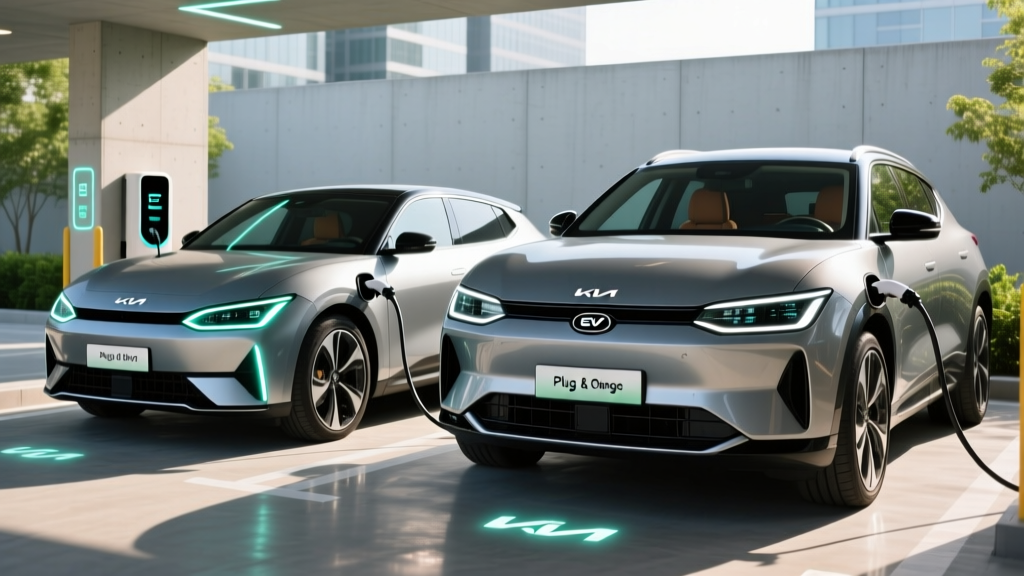
If you have ever pulled up to a public DC fast charger, swiped a credit card, opened an app, waited for a handshake, and then discovered the stall was offline — you already understand why Kia EV Plug & Charge matters. Plug & Charge (ISO 15118) eliminates the app-and-RFID dance: you plug the connector into your car, the vehicle authenticates itself on the network, and charging begins automatically, billed to your Kia account. In 2026, Kia supports this feature across its core BEV lineup, most notably the refreshed EV6 and the three-row EV9, at participating Electrify America, EVgo, and Shell Recharge stations.
This review profiles both models through the lens of a real owner: what the Plug & Charge experience actually looks like, what you sacrifice in range or charging speed, and whether the math works after federal tax credits.
What Is Kia EV Plug & Charge and How Does It Work?
Plug & Charge uses the ISO 15118 communication protocol embedded in the vehicle's onboard charger and the DC fast-charging station. When you connect a CCS1 or NACS connector, the car transmits a secure digital certificate to the network operator. Kia's backend links that certificate to your Kia Connect account and the payment method on file. The entire handshake takes roughly 3–5 seconds, and the session starts without you touching a screen.
For 2026, Kia has expanded Plug & Charge compatibility to include the growing NACS (Tesla-style) connector on newer builds, in addition to the legacy CCS1 port on 2022–2024 models. This matters because Tesla Supercharger access — via Kia's included NACS adapter or native port on 2025+ builds — increasingly relies on Plug & Charge for non-Tesla vehicles.
2026 Kia EV6: Range, Battery, and Charging Specs
The 2026 EV6 carries over the E-GMP platform's 800-volt architecture, which remains one of the fastest-charging setups in its class. Kia offers a Standard Range (58 kWh usable, LFP chemistry) and a Long Range (77.4 kWh usable, NMC chemistry) battery.
| Spec | Standard Range RWD | Long Range RWD | Long Range AWD (GT-Line) |
|---|---|---|---|
| Battery (usable) | 58 kWh (LFP) | 77.4 kWh (NMC) | 77.4 kWh (NMC) |
| EPA Range | 232 mi | 310 mi | 282 mi |
| MPGe (combined) | 117 MPGe | 117 MPGe | 106 MPGe |
| kWh/100 mi | 29 | 29 | 32 |
| Peak DC Charge Rate | 175 kW | 240 kW | 240 kW |
| 10–80% DC Time | ~22 min | ~18 min | ~18 min |
| Level 2 (10.9 kW onboard) | ~22 mi/hr | ~29 mi/hr | ~29 mi/hr |
| 0–60 mph | 7.2 sec | 6.7 sec | 4.5 sec |
| Horsepower | 167 hp | 225 hp | 320 hp |
| Drivetrain | RWD | RWD | AWD (dual-motor) |
EV6 Charging Curve Reality
The headline 240 kW peak on the Long Range models is legitimate but brief. On a 350 kW Electrify America stall with a preconditioned battery (use the "Charge Prep" navigation routing), the EV6 sustains approximately 220–235 kW from 10% to about 45% SoC. From 45–65%, it tapers to roughly 170 kW, and above 80%, it drops to under 60 kW. That 10–80% sprint in 18 minutes is accurate under ideal conditions, but a 10–90% fill will take closer to 32 minutes. This is still best-in-class for the crossover segment.
2026 Kia EV9: The Three-Row Plug & Charge Contender
The EV9 is the largest Kia BEV and one of the few three-row electric SUVs under $60,000. It shares the E-GMP 800V platform but uses a larger 99.8 kWh usable NMC battery.
| Spec | Standard Range RWD | Long Range RWD | Long Range AWD |
|---|---|---|---|
| Battery (usable) | 76.1 kWh (NMC) | 99.8 kWh (NMC) | 99.8 kWh (NMC) |
| EPA Range | 230 mi | 304 mi | 270 mi |
| MPGe (combined) | 88 MPGe | 89 MPGe | 83 MPGe |
| kWh/100 mi | 38 | 38 | 41 |
| Peak DC Charge Rate | 200 kW | 236 kW | 236 kW |
| 10–80% DC Time | ~24 min | ~20 min | ~20 min |
| Level 2 (10.9 kW onboard) | ~22 mi/hr | ~28 mi/hr | ~28 mi/hr |
| 0–60 mph | 7.8 sec | 7.8 sec | 5.0 sec |
| Horsepower | 215 hp | 201 hp | 379 hp |
| Drivetrain | RWD | RWD | AWD (dual-motor) |
The EV9's larger battery means longer charge sessions in absolute terms, but the 800V architecture keeps the 10–80% time competitive with smaller crossovers. Plug & Charge works identically on the EV9 — plug in, authenticate, charge. For families on road trips, this seamlessness at highway-adjacent Electrify America stations is a meaningful quality-of-life upgrade over juggling network apps with kids in the car.
Pricing, Trims, and Federal Tax Credit Eligibility
Kia's pricing has climbed modestly for 2026, but both models remain value leaders in their segments. The critical question for most buyers is whether they qualify for the IRS §30D federal EV tax credit, which provides up to $7,500 — and since 2024, can be transferred to the dealer as a point-of-sale discount.
| Model / Trim | Base MSRP | As-Tested (typical) | §30D Eligible? |
|---|---|---|---|
| EV6 Light LR RWD | $43,200 | $44,500 | Partial ($3,750)* |
| EV6 GT-Line AWD | $52,400 | $55,800 | Partial ($3,750)* |
| EV9 Light LR RWD | $54,900 | $56,200 | Partial ($3,750)* |
| EV9 GT-Line AWD | $63,900 | $68,500 | Partial ($3,750)* |
*Eligibility depends on battery-sourcing and critical-mineral requirements. As of 2026, most Kia E-GMP vehicles built for the US market meet the critical-minerals half ($3,750) but not the full battery-component sourcing requirement for the other $3,750 half, due to Korean-manufactured cells. Always verify current eligibility on the IRS clean vehicle credit page. Buyer income caps apply: $150K single / $300K joint MAGI. MSRP caps: $55K for sedans (EV6 qualifies), $80K for SUVs/trucks (EV9 qualifies).
After a $3,750 point-of-sale credit, an EV6 Light LR RWD effectively starts near $39,450 — undercutting the Tesla Model Y Long Range and Hyundai Ioniq 5 on price while offering comparable range and faster peak charging.
Cargo, Passenger Space, and Daily Livability
The EV6's fastback crossover shape yields 24.4 cubic feet behind the second row and 50.2 cubic feet with the rear seats folded. Rear legroom is generous at 39.0 inches. The front trunk (frunk) adds 0.7 cubic feet on AWD models — enough for a charging cable bag but not a grocery run.
The EV9 is substantially larger: 20.2 cu ft behind the third row, 43.5 cu ft behind the second, and 81.7 cu ft with both rows folded. Third-row legroom measures 32.0 inches — tight for adults on long trips but adequate for children. Second-row captain's chairs (available on Land and GT-Line trims) offer 41.5 inches of legroom and a walk-through gap to the rear.
Standout Tech and Notable Drawbacks
Both models feature Kia's dual 12.3-inch panoramic display, wireless Apple CarPlay/Android Auto, and Highway Driving Assist 2 (HDA2) — a competent Level 2 system with lane-centering, adaptive cruise, and lane-change assist. The EV6 GT-Line and EV9 GT-Line add a head-up display with augmented-reality navigation prompts, a 360-degree camera, and remote smart parking assist.
Drawbacks worth noting: the EV6's rear visibility is compromised by the thick C-pillar and small rear window; the EV9's efficiency (83–89 MPGe) is mediocre for a BEV, meaning higher electricity costs on road trips; and neither model offers a front trunk large enough for practical use. Additionally, Kia's infotainment, while responsive, still uses a mix of touch-capacitive and physical buttons that can be distracting while driving.
Pros and Cons at a Glance
- Class-leading 800V DC charging (18–20 min 10–80%)
- Plug & Charge at EA, EVgo, Shell Recharge, and Tesla Superchargers (with adapter)
- Competitive EPA range (310 mi EV6 / 304 mi EV9)
- 10-year/100,000-mile battery & powertrain warranty
- Strong value after point-of-sale tax credit
- Only partial $3,750 federal credit (not full $7,500)
- EV9 efficiency is below segment average (83 MPGe AWD)
- EV6 rear visibility and small frunk
- Real-world highway range drops 15–20% vs. EPA
- Touch-capacitive climate controls can distract
Warranty and Long-Term Ownership
Kia's warranty remains one of the strongest in the industry. Both the EV6 and EV9 carry a 10-year/100,000-mile battery and powertrain warranty, with a capacity-retention threshold of 70% State of Health (SoH). If the battery degrades below 70% within that window, Kia will repair or replace it. The basic vehicle warranty is 5 years/60,000 miles, and roadside assistance covers 5 years/100,000 miles.
For Plug & Charge specifically, Kia includes 3 years of complimentary charging credits at Electrify America (typically 1,000 kWh or a dollar equivalent) on new 2026 purchases, which effectively covers 3,000–4,000 miles of free DC fast charging.
Who Should Buy the Kia EV6 or EV9 with Plug & Charge?
The EV6 Long Range RWD is the sweet spot for commuters and couples who road-trip 2–4 times per year. Its 310-mile EPA range, 18-minute fast-charge capability, and sub-$45K price (after credit) make it one of the most practical BEVs on the market. Choose the AWD GT-Line if you need all-weather traction and value the 4.5-second 0–60 sprint.
The EV9 fits families who need three rows but refuse to compromise on BEV ownership. The 270-mile AWD range is adequate for daily use and manageable on road trips with Plug & Charge streamlining stops. If you regularly carry six passengers and cargo, the EV9 has no direct BEV rival under $65K.
Choose the EV6 if: You prioritize range and charging speed, commute solo or with one passenger, and want the lowest cost of entry.
Choose the EV9 if: You need three rows, tow occasionally (up to 5,000 lbs on AWD), and accept the efficiency trade-off for space.
Look elsewhere if: You need the full $7,500 federal credit (consider the Ford F-150 Lightning or VW ID.4, which may qualify for more depending on sourcing), or you want a larger frunk (Hyundai Ioniq 5 offers 0.85 cu ft more).
Frequently Asked Questions
What is the real-world range of the Kia EV6 and EV9?
The EV6 Long Range RWD delivers approximately 255–275 miles on the highway and 220–240 miles in freezing weather, against its 310-mile EPA rating. The EV9 Long Range AWD averages 225–245 miles highway and 195–215 miles in cold conditions versus its 270-mile EPA estimate. City driving with regenerative braking can match or slightly exceed EPA numbers in both models.
How fast does Kia EV Plug & Charge actually work?
Plug & Charge itself is a handshake protocol — it takes 3–5 seconds to authenticate and begin charging. The actual charging speed depends on the vehicle: the EV6 Long Range peaks at 240 kW (10–80% in ~18 min), and the EV9 Long Range peaks at 236 kW (10–80% in ~20 min). Plug & Charge does not increase charging speed; it eliminates the app/RFID step before charging begins.
Which networks support Kia Plug & Charge in 2026?
Electrify America, EVgo, and Shell Recharge all support ISO 15118 Plug & Charge for Kia vehicles. Tesla Superchargers (open to non-Tesla vehicles via NACS adapter or native port) also support Plug & Charge through the Kia Connect app integration. Not all ChargePoint stations support the protocol — check the station details in the Kia Connect or network app before relying on it.
Does the 2026 Kia EV6 or EV9 qualify for the full $7,500 federal tax credit?
As of 2026, most Kia EV6 and EV9 configurations qualify for the $3,750 critical-minerals half of the §30D credit, but not the battery-component half, because the cells are manufactured in South Korea. Buyer income must not exceed $150K (single) or $300K (joint). The EV6 must be under the $55K sedan MSRP cap; the EV9 falls under the $80K SUV cap. Always confirm current eligibility with your dealer and tax professional before purchasing.
Is the Kia EV6 worth buying over the Tesla Model Y or Hyundai Ioniq 5?
The EV6 wins on peak charging speed (240 kW vs. the Model Y's ~250 kW on V3 Superchargers, but with broader non-Tesla network compatibility via Plug & Charge) and interior material quality. The Model Y offers more cargo space and access to the densest fast-charging network. The Ioniq 5 is mechanically similar (same E-GMP platform) but has slightly more rear headroom and a larger frunk. If Plug & Charge convenience on Electrify America and EVgo is a priority, the EV6 is the strongest pick in this trio.
What is the Kia EV battery warranty coverage?
Kia covers the high-voltage battery and electric powertrain for 10 years or 100,000 miles, whichever comes first. The warranty guarantees at least 70% State of Health (capacity retention). If degradation exceeds 30% within that period, Kia will repair or replace the battery at no cost. This is transferable to subsequent owners, which supports strong resale values.