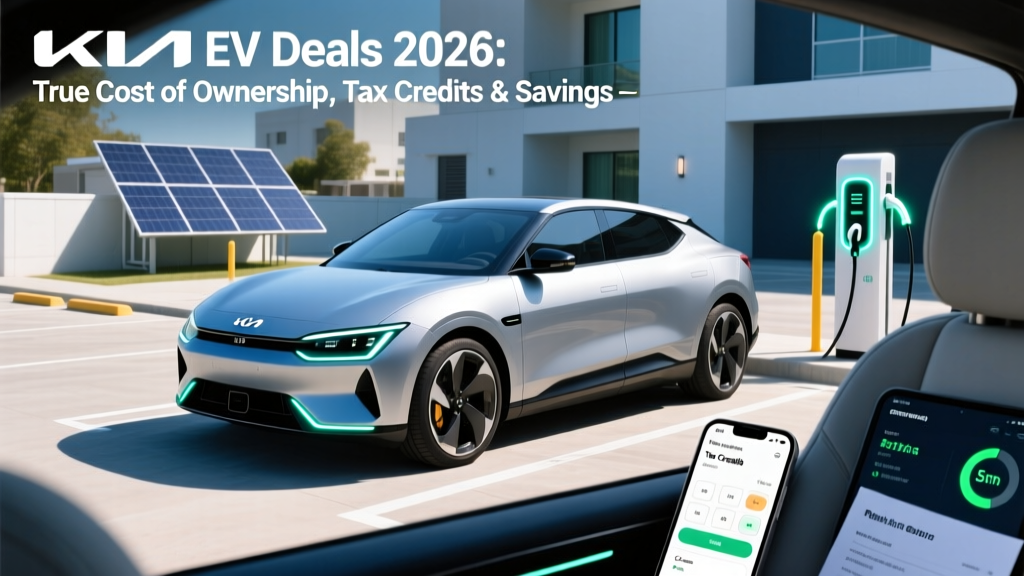
Shoppers hunting for Kia EV deals in 2026 are navigating a shifting landscape of federal incentives, fluctuating electricity rates, and aggressive manufacturer discounts. The Kia EV6 and three-row EV9 remain two of the most compelling electric vehicles on the market — but whether a "deal" actually saves you money depends on the math behind the sticker price.
This guide breaks down the real total cost of ownership for Kia's electric lineup, explains exactly who qualifies for the federal §30D tax credit (and who doesn't), and compares per-mile fueling costs against gas-powered rivals like the Hyundai Tucson and Kia Telluride. If you're weighing a Kia EV against a hybrid or ICE alternative, these are the numbers that matter.
2026 Kia EV Lineup: Price, Range, and the Current Deal Landscape
Kia's 2026 EV portfolio centers on two models built on the Hyundai Motor Group's E-GMP platform with 800V architecture, enabling some of the fastest DC fast-charging speeds in the segment.
| Spec | 2026 Kia EV6 (Light Wind RWD) | 2026 Kia EV6 GT-Line AWD | 2026 Kia EV9 (Light RWD) | 2026 Kia EV9 GT-Line AWD |
|---|---|---|---|---|
| Base MSRP | $43,200 | $54,900 | $56,900 | $67,900 |
| Battery (usable kWh) | 77.4 kWh (NMC) | 77.4 kWh (NMC) | 100.0 kWh (NMC) | 100.0 kWh (NMC) |
| EPA Range | 310 mi | 282 mi | 304 mi | 270 mi |
| Real-World Range (highway/cold) | ~250–275 mi | ~230–250 mi | ~245–270 mi | ~220–240 mi |
| Peak DC Fast Charge | 239 kW | 239 kW | 210 kW | 210 kW |
| 10–80% DC Fast Charge | ~18 min | ~18 min | ~24 min | ~24 min |
| Level 2 Charge Rate | 10.9 kW | 10.9 kW | 10.9 kW | 10.9 kW |
| Horsepower | 225 hp | 320 hp | 215 hp | 379 hp |
| 0–60 mph | 7.2 sec | 4.5 sec | 8.2 sec | 5.0 sec |
| MPGe (combined) | 134 MPGe | 106 MPGe | 88 MPGe | 83 MPGe |
| Battery/Powertrain Warranty | 10 yr / 100,000 mi | 10 yr / 100,000 mi | 10 yr / 100,000 mi | 10 yr / 100,000 mi |
As of early 2026, Kia is offering competitive lease incentives on the EV6 (often $2,000–$4,000 in bonus cash through Kia Finance), and some dealers are discounting 2025 carryover EV9 inventory by $5,000–$8,000. But the biggest "deal" factor remains the federal tax credit — if you qualify.
Federal Tax Credit: Who Qualifies for §30D on a Kia EV?
The IRS §30D Clean Vehicle Credit offers up to $7,500 for qualifying new EVs, but eligibility is anything but automatic. The rules have tightened significantly since the Inflation Reduction Act reshaped the program, and battery-sourcing requirements have disqualified many previously eligible vehicles.
- Income caps (modified AGI): $150,000 single / $225,000 head of household / $300,000 joint filers
- MSRP caps: $55,000 for sedans/wagons (EV6 qualifies); $80,000 for SUVs/pickups/vans (EV9 qualifies)
- Battery sourcing: Critical minerals and battery components must meet escalating domestic/free-trade-partner thresholds — percentages increase each year through 2029
- Point-of-sale transfer: You can transfer the credit to the dealer at purchase, reducing your out-of-pocket cost immediately (even if you owe less than $7,500 in taxes)
- Assembly: Vehicle must undergo final assembly in North America — both EV6 and EV9 are assembled at Kia's West Point, Georgia plant
- FEOC exclusion: Vehicles with battery components from a "foreign entity of concern" (primarily Chinese-linked suppliers) are disqualified
Source: IRS Clean Vehicle Credits. Eligibility rules change annually — always verify current-year requirements before purchasing.
The Kia EV6 and EV9 situation in 2026: Both models are assembled in Georgia, satisfying the North American final-assembly requirement. However, the critical-minerals and battery-component sourcing thresholds have continued to tighten. As of 2026, battery components must be 90% manufactured or assembled in North America or a free-trade-agreement country, and critical minerals must be 80% extracted or processed in the US or an FTA partner. Kia has worked to localize its supply chain, but buyers should verify current §30D eligibility on fueleconomy.gov before signing paperwork — the credit status can shift mid-year as sourcing percentages are audited.
If you qualify and use the point-of-sale transfer, a $43,200 EV6 Light Wind RWD effectively becomes a ~$35,700 vehicle at the dealer lot. That's the single most impactful "Kia EV deal" available — but only if you clear every requirement.
5-Year Total Cost of Ownership: EV6 vs. Gas-Powered Rival
To understand whether a Kia EV deal translates to long-term savings, we compared a 2026 Kia EV6 Light Wind RWD against a comparably priced 2026 Kia Sportage EX AWD (2.5L gas, ~$35,500 MSRP) over 5 years and 75,000 miles (15,000 miles/year).
| Category | 2026 Kia EV6 Light Wind RWD | 2026 Kia Sportage EX AWD (Gas) |
|---|---|---|
| Purchase Price (MSRP) | $43,200 | $35,500 |
| Federal Tax Credit (§30D) | −$7,500 | $0 |
| Effective Purchase Price | $35,700 | $35,500 |
| 5-Year Fuel/Energy Cost | $4,125 (home charging at $0.14/kWh) | $9,375 (28 MPG avg at $3.50/gal) |
| 5-Year Maintenance | $1,800 | $4,200 |
| 5-Year Insurance (est.) | $10,500 | $7,800 |
| Estimated 5-Year Depreciation | $16,500 (~46%) | $14,200 (~40%) |
| Total 5-Year Cost | $68,625 | $71,075 |
| Cost Per Mile | $0.915 | $0.948 |
Assumptions: 15,000 miles/year; EV charged 85% at home ($0.14/kWh national average), 15% on DC fast chargers ($0.40/kWh); gas at $3.50/gallon; insurance based on national EV average premiums; depreciation based on 2024–2025 EV resale trends from Kelley Blue Book and iSeeCars data.
The EV6 edges ahead on total cost by roughly $2,450 over five years, but the margin is narrow — and it flips if you don't qualify for the full $7,500 credit, if your electricity rates are above $0.20/kWh, or if you live in a state with high EV insurance premiums.
Charging vs. Gas: The Per-Mile Cost Math
The single largest ongoing savings of owning a Kia EV comes from energy costs. Here's the concrete math:
- Kia EV6 efficiency: 3.1 miles/kWh (134 MPGe combined, per fueleconomy.gov)
- Home charging cost: $0.14/kWh (US residential average) → $0.045/mile
- DC fast charging cost: $0.40/kWh (national average for Electrify America, EVgo) → $0.129/mile
- Blended average (85% home / 15% DCFC): $0.055/mile
- Kia Sportage (28 MPG combined, $3.50/gal): $0.125/mile
- Annual savings at 15,000 mi: ~$1,050/year fueling the EV6 at home
At 15,000 miles per year, home charging the EV6 costs approximately $825 annually versus $1,875 for gasoline in the Sportage — a savings of roughly $1,050 per year or $5,250 over five years. If you rely heavily on DC fast charging (apartment dwellers without home charging access), the savings shrink to about $350/year. This is why home Level 2 charging access is the single most important variable in EV ownership economics.
Maintenance Savings: Where EVs Genuinely Cost Less
EVs eliminate several recurring maintenance items that gas vehicles require. Over five years, the EV6 saves approximately $2,400 in scheduled maintenance:
| Service Item | EV6 Cost | Gas Sportage Cost |
|---|---|---|
| Oil changes | $0 (none required) | $750 (5–7 changes) |
| Brake pad replacement | $0–$200 (regen braking extends pad life to 80,000+ mi) | $600–$900 (2 sets typical) |
| Transmission fluid | $0 (single-speed reduction gear, sealed) | $200–$350 |
| Engine air filter | $0 (no engine) | $150 |
| Cabin air filter | $200 | $200 |
| Tire rotation & replacement | $1,200 (EVs wear tires ~15% faster due to weight and instant torque) | $900 |
| Coolant & misc. fluids | $200 | $350 |
| Total Estimated Maintenance | $1,800 | $4,200 |
Regenerative braking is the unsung hero here: one-pedal driving and aggressive regen settings can extend brake pad life to 100,000+ miles. The trade-off is tire wear — the EV6's 4,500-lb curb weight and instant torque delivery accelerate tire wear by roughly 15–20% compared to a gas crossover. Budget for a tire set replacement around year 4.
Insurance Costs: The Expense Most Buyers Overlook
EV insurance premiums remain 20–35% higher than equivalent gas vehicles in 2026. For the EV6, expect annual premiums of $1,900–$2,300 depending on your state, driving record, and coverage level — compared to $1,400–$1,700 for the gas Sportage.
Why EVs cost more to insure:
- Higher repair costs: Battery pack damage from even minor collisions can total a vehicle; body shops need specialized EV training and equipment
- Parts pricing: E-GMP platform components, 800V power electronics, and ADAS sensor arrays (radar, cameras) are expensive to replace
- Total-loss frequency: Insurers are more likely to declare an EV a total loss after battery-adjacent collision damage due to diagnostic uncertainty
- Claim severity: Average EV collision claims run 20–25% higher than ICE equivalents
Over five years, the EV6 insurance premium gap adds approximately $2,700 in additional cost. Shop quotes from EV-friendly insurers (Geico, Progressive, and State Farm have improved EV actuarial models) before purchasing — premiums vary dramatically by ZIP code and carrier.
Depreciation and Resale Value: What Kia EVs Are Worth After 5 Years
EV depreciation has been volatile since 2022, when Tesla's aggressive price cuts rippled through the used EV market and pulled down resale values across all brands. As of late 2025 data from iSeeCars and Kelley Blue Book:
- Average 5-year EV depreciation: 45–55% (vs. 35–42% for gas vehicles)
- Kia EV6 5-year projected depreciation: ~44–48%
- Kia EV9 5-year projected depreciation: ~40–45% (three-row EV SUVs hold value better due to limited competition)
The EV6's depreciation is slightly worse than a gas Sportage's (~40%), meaning you lose approximately $2,300 more in resale value over five years. However, the EV9's strong resale value — driven by the scarcity of three-row electric SUVs — partially offsets this trend.
Factors that help Kia EV resale: The industry-leading 10-year/100,000-mile battery warranty (transferable to second owners) provides confidence in the used market. The NMC battery chemistry in both models has shown strong State of Health (SoH) retention, with early EV6 owners reporting 93–96% capacity after 60,000 miles.
State, Local, and Utility Incentives Beyond the Federal Credit
Federal §30D gets the headlines, but regional incentives can stack on top to make a Kia EV deal significantly more attractive:
- California (CVRP): Up to $2,000 rebate for income-qualified buyers (under $150k single / $300k joint); additional $1,000 for low-income applicants. Check California Energy Commission for current funding status.
- Colorado: $5,000 state tax credit for EVs under $80,000 MSRP (one of the most generous in the country, stackable with federal §30D)
- New York (Drive Clean Rebate): Up to $2,000 point-of-sale rebate (currently paused/pending funding — check NYSERDA)
- Utility rebates: Many utilities offer $500–$1,500 for home Level 2 charger installation (e.g., PG&E, ConEdison, Xcel Energy). Some offer time-of-use rates that reduce home charging costs to $0.06–$0.08/kWh overnight.
- HOV lane access: California, Colorado, Virginia, and several other states grant solo HOV lane access to EVs — a significant commute-time savings worth hundreds in time value annually
These incentives vary enormously by jurisdiction and are subject to funding caps, expiration dates, and income requirements. Always check your state energy office and local utility before purchase.
Is a 2026 Kia EV Deal Worth It? The Decision Framework
- You qualify for the full $7,500 federal tax credit (income under caps, MSRP under caps, battery sourcing confirmed)
- You have access to home Level 2 charging (garage or driveway with a 240V circuit)
- You drive 12,000–20,000 miles/year (higher mileage = faster fuel savings payback)
- You live in a state with additional rebates (CO, CA, MA, NY, etc.)
- You value the 18-minute 10–80% DC fast charging for road trips
- You cannot charge at home and rely entirely on public DC fast charging
- Your income exceeds §30D caps (you'll pay full MSRP with no credit offset)
- You live in a region with electricity rates above $0.25/kWh and no utility EV rate plan
- You plan to own the vehicle less than 3 years (depreciation may outpace fuel savings)
- You need maximum towing capacity (the EV9 tows 5,000 lbs — less than a gas Telluride's 5,000–5,500 lbs, and towing cuts EV range by 30–40%)
The best Kia EV deals in 2026 combine the federal point-of-sale credit, manufacturer incentives (check Kia's current offers page for EV6/EV9 bonus cash), dealer negotiation on carryover inventory, and stacked state/utility rebates. In the best-case scenario (full §30D credit, $2,000 state rebate, $1,000 utility charger rebate, and a $3,000 dealer discount), an EV6 Light Wind RWD can effectively drop below $30,000 — making it one of the most affordable 300-mile-range EVs on the market.
Frequently Asked Questions
How much does it really cost to own a Kia EV6 over 5 years?
Approximately $68,600 over 5 years and 75,000 miles, including purchase (after $7,500 tax credit), home charging, maintenance, insurance, and depreciation. This works out to about $0.92 per mile — roughly $2,450 less than a comparably equipped gas Kia Sportage over the same period, assuming you qualify for the full federal tax credit.
Do I qualify for the $7,500 federal EV tax credit on a Kia EV6 or EV9?
You qualify if your modified AGI is under $150,000 (single) or $300,000 (joint), the vehicle MSRP is under $55,000 (EV6 sedan/wagon) or $80,000 (EV9 SUV), the battery meets 2026 critical-mineral and component sourcing thresholds, and the vehicle was assembled in North America (both are built in Georgia). Verify current eligibility at fueleconomy.gov before purchasing, as sourcing rules are audited and can change mid-year.
How much do I save on fuel and maintenance with a Kia EV?
Approximately $1,050/year on fuel (home charging at $0.14/kWh vs. gas at $3.50/gallon) and $480/year on maintenance (no oil changes, extended brake pad life from regen braking). Combined, that's roughly $1,530 in annual operating savings — or $7,650 over five years. Savings shrink if you rely on DC fast charging or live in a high-electricity-rate area.
Are Kia EVs more expensive to insure than gas cars?
Yes — typically 20–35% more expensive. Expect $1,900–$2,300/year for an EV6 versus $1,400–$1,700/year for a gas Sportage. Higher repair costs, battery-damage total-loss risk, and expensive ADAS sensor replacement drive the premium gap. Over five years, this adds approximately $2,700 in additional insurance costs.
How well do Kia EVs hold their resale value?
The EV6 is projected to depreciate 44–48% over 5 years, slightly worse than gas vehicles (~40%). The three-row EV9 holds value better at 40–45% depreciation due to limited three-row EV competition. Kia's transferable 10-year/100,000-mile battery warranty supports used-market confidence. Early EV6 battery data shows 93–96% capacity retention at 60,000 miles.