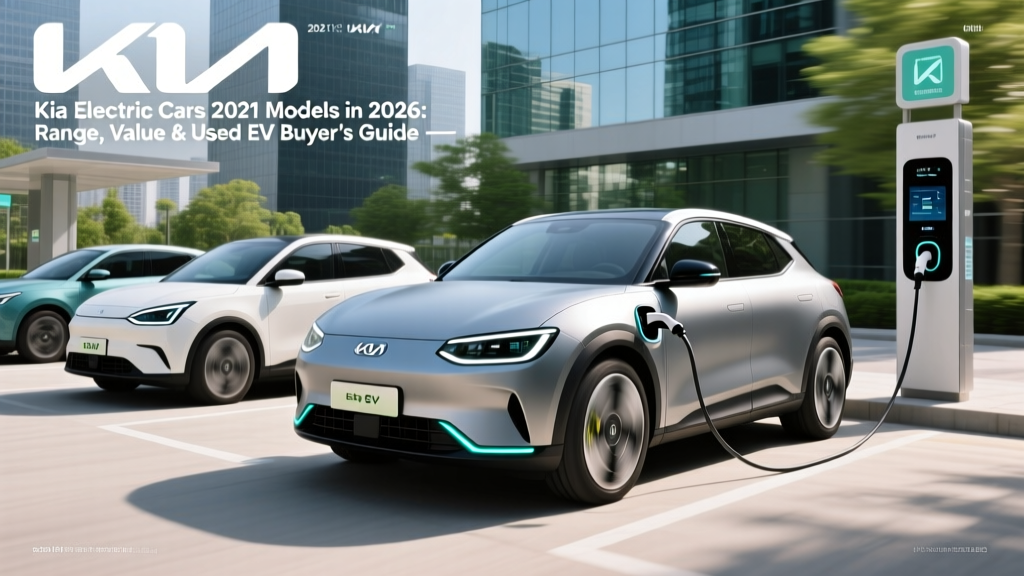
Quick Answer: Kia offered two fully electric models for the 2021 model year: the Niro EV (239 miles EPA range, 64 kWh battery) and the Soul EV (243 miles EPA range, 64 kWh battery). In 2026, these are available only on the used market, typically priced between $16,000–$26,000 depending on mileage and condition. Both use a 201-hp front-mounted motor and support DC fast charging up to roughly 77 kW (10–80% in approximately 45–50 minutes). They remain practical commuter EVs, but their charging speeds and battery management fall behind Kia's current E-GMP platform vehicles like the EV6 and EV9.
Which Kia Electric Cars Were Available in 2021?
Kia's 2021 all-electric lineup consisted of two vehicles built on the same underlying powertrain architecture. Both share the 64 kWh lithium-ion polymer (NMC chemistry) battery pack and the same permanent-magnet synchronous motor producing 201 horsepower and 291 lb-ft of torque.
| Specification | 2021 Kia Niro EV | 2021 Kia Soul EV |
|---|---|---|
| EPA Range | 239 miles | 243 miles |
| Battery (Usable) | 64 kWh (NMC) | 64 kWh (NMC) |
| Motor Output | 201 hp / 291 lb-ft | 201 hp / 291 lb-ft |
| 0–60 mph | ~6.5 sec | ~6.8 sec |
| Combined MPGe | 112 MPGe | 114 MPGe |
| Max DC Fast Charge | ~77 kW (CCS) | ~77 kW (CCS) |
| 10–80% DCFC Time | ~45–50 min | ~45–50 min |
| Level 2 (240V) Charge | 7.2 kW (~9.5 hrs 0–100%) | 7.2 kW (~9.5 hrs 0–100%) |
| Cargo Volume | 18.5 cu ft (53.0 rear seats folded) | 24.3 cu ft (62.1 rear seats folded) |
| Original MSRP (base) | $39,990 | $33,550 (S trim, limited markets) |
| Battery Warranty (original) | 10 yr / 100,000 mi | 10 yr / 100,000 mi |
Source: fueleconomy.gov (EPA estimates). Real-world range varies with temperature, speed, and terrain — see below.
Important note: The 2021 Soul EV was only sold in select U.S. states (primarily California and a handful of ZEV-mandate states), making it considerably harder to find on the used market compared to the Niro EV, which had broader national distribution.
Real-World Range: What the EPA Numbers Don't Tell You
EPA Sticker vs. Reality
2021 Niro EV: EPA 239 mi → Expect 200–220 mi highway (70 mph), 165–190 mi in cold weather (below 32°F).
2021 Soul EV: EPA 243 mi → Expect 205–225 mi highway, 170–195 mi in cold weather.
These vehicles lack a heat pump (standard on later Kia E-GMP models), meaning cabin heating draws directly from the traction battery, causing significant range loss in winter. Battery degradation of 5–10% is typical for a 4–5 year old NMC pack, further reducing usable range.
The 2021 Niro EV and Soul EV use an older-generation thermal management system. Unlike Kia's current EV6 or EV9, which employ a heat pump and battery preconditioning for efficient cold-weather operation and faster DC charging, the 2021 models rely on resistive cabin heating. In our experience and consistent with owner reports, this translates to a 25–35% range reduction in sustained sub-freezing temperatures.
At highway speeds (70–75 mph), both vehicles consume roughly 30–33 kWh/100 mi, compared to their EPA-rated ~28–30 kWh/100 mi combined. Plan road trips around a realistic 180–200 mile working range in moderate conditions to maintain a safety buffer.
Charging Speed: The Biggest Limitation in 2026
If there's one area where 2021 Kia EVs show their age, it's DC fast charging. The ~77 kW peak charge rate means these vehicles cannot take advantage of the 150–350 kW chargers now common on Electrify America, EVgo, and Tesla Supercharger (with CCS adapter) networks.
| Charging Level | Power (kW) | Miles Added per Hour | Typical Use Case |
|---|---|---|---|
| Level 1 (120V household) | ~1.4 kW | ~5 mi/hr | Emergency / overnight trickle |
| Level 2 (240V home/public) | 7.2 kW (max) | ~25–28 mi/hr | Daily home charging, workplace |
| DC Fast Charge (CCS) | ~77 kW peak | ~180–200 mi/hr (peak) | Road trips; tapers significantly above 60% |
Charge curve reality: The 77 kW peak only holds from roughly 10–40% State of Charge (SoC). From 40–60%, it drops to ~55 kW, and above 80%, it falls below 25 kW. A 10–80% session takes approximately 45–50 minutes at a 150 kW charger — but only because the car limits intake, not because the charger is slow. For comparison, the current Kia EV6 can do 10–80% in about 18 minutes on a 350 kW charger.
kW vs kWh reminder: kW (kilowatts) measures power — how fast energy flows into the battery. kWh (kilowatt-hours) measures energy capacity — the total "fuel tank" size. A 77 kW charge rate into a 64 kWh battery means a theoretical full charge in under an hour, but real-world charge curves and tapering make it longer.
Used Pricing, Tax Credits & Total Cost of Ownership
As of early 2026, here's what you can expect to pay for a 2021 Kia EV on the used market:
- 2021 Niro EV (EX trim): $17,000–$22,000 (30K–60K miles)
- 2021 Niro EV (EX Premium): $19,000–$24,000 (30K–50K miles)
- 2021 Soul EV (S/Designer): $16,000–$21,000 (limited availability)
Federal Used EV Tax Credit (§25E)
Under current IRS rules, the §25E Previously Owned Clean Vehicle Credit offers up to $4,000 (or 30% of the sale price, whichever is lower) for qualifying used EVs. Key requirements:
- Sale price must be $25,000 or below
- Buyer income cap: $75,000 single / $112,500 head of household / $150,000 joint
- Vehicle must be at least 2 model years old (2021 models qualify in 2026)
- Must purchase from a licensed dealer (private-party sales don't qualify)
- Credit is available at point of sale as a price reduction
Source: IRS §25E guidelines. Tax eligibility is complex — consult a tax professional.
This means a $22,000 used Niro EV could effectively cost $18,000 after the credit — a compelling entry point into EV ownership.
| Annual Cost (12,000 mi/yr) | 2021 Niro EV | 2021 Kia Forte (gas baseline) |
|---|---|---|
| Fuel / Electricity | ~$540 (home charging, $0.13/kWh avg) | ~$1,350 (30 MPG, $3.38/gal) |
| Maintenance | ~$300 (no oil changes, fewer wear items) | ~$650 (oil, filters, belts) |
| Insurance (avg) | ~$1,600 | ~$1,350 |
| Estimated Annual Total | ~$2,440 | ~$3,350 |
| 5-Year Operating Savings (EV) | ~$4,550 | |
Assumptions: 12,000 mi/year, national avg electricity rate $0.13/kWh, national avg gas price $3.38/gal (AAA, Jan 2026). Actual costs vary by region, utility rate, and driving habits. EV insurance premiums tend to run 10–20% higher.
Battery Health, Warranty & What to Check Before Buying
The 2021 Niro EV and Soul EV use NMC (nickel-manganese-cobalt) lithium-ion cells supplied primarily by SK Innovation (now SK On). NMC offers high energy density but is more sensitive to sustained high SoC and extreme heat than LFP (lithium iron phosphate) chemistry used in some newer EVs.
Kia's original battery warranty: 10 years / 100,000 miles, covering defects and capacity loss below 70% of original capacity. For a 2021 model, that warranty extends to approximately 2031 — a significant remaining safety net for used buyers.
Before purchasing a used 2021 Kia EV, request or verify:
- Battery State of Health (SoH): Ask the dealer to pull the BMS (Battery Management System) report. A SoH of 90–95% is typical for a 4–5 year old pack with moderate mileage. Below 85% warrants caution.
- Charging history: Frequent DC fast charging accelerates degradation. A Carfax or dealer diagnostic can reveal DCFC frequency.
- Warranty transferability: Kia's 10-year/100,000-mile battery warranty transfers to subsequent owners, but the 5-year/60,000-mile bumper-to-bumper warranty may have expired.
- Software updates: Ensure the vehicle has received Kia's latest BMS firmware updates, which can improve charge management and range estimation accuracy.
EV vs. Gas vs. Hybrid: Which 2021 Kia Makes Sense?
The 2021 model year also offered the Niro as a conventional hybrid (HEV) and a plug-in hybrid (PHEV). Here's how they compare for a buyer considering a used Kia:
| Metric | 2021 Niro EV | 2021 Niro PHEV | 2021 Niro HEV |
|---|---|---|---|
| EPA Combined Efficiency | 112 MPGe | 105 MPGe (elec) / 46 MPG (gas) | 50 MPG combined |
| Electric-Only Range | 239 mi | 26 mi | 0 mi |
| Total Range | 239 mi | ~560 mi | ~590 mi |
| Used Price Range (2026) | $17K–$24K | $18K–$24K | $16K–$21K |
| Home Charging Needed? | Strongly recommended | Recommended for EV benefit | No |
| Fed. Used EV Credit | Up to $4,000 | Up to $4,000 | Not eligible |
Decision Framework: Which 2021 Kia Niro Is Right for You?
Choose the Niro EV if: You have reliable home Level 2 charging, your daily commute is under 100 miles round-trip, you rarely drive more than 200 miles in a single day, and you want the lowest per-mile operating cost.
Choose the Niro PHEV if: You have home charging but also take regular road trips exceeding 250 miles, you live in an area with sparse DC fast-charging infrastructure, or you want EV commuting without range anxiety.
Choose the Niro HEV if: You cannot charge at home (apartment/street parking), you drive long distances frequently, or you want the simplest ownership experience with no charging logistics.
Common Misconceptions About 2021 Kia EVs
| Myth | Fact |
|---|---|
| "The battery will need replacing soon and cost $20,000." | NMC packs in these vehicles typically show 5–10% degradation at 5 years. Kia's 10-year/100,000-mile battery warranty remains in effect. A full replacement (rare) runs $8,000–$12,000, not $20,000. |
| "Used EVs aren't eligible for any tax credits." | The §25E credit provides up to $4,000 on used EVs sold for $25,000 or less through a dealer, with income limits. Many 2021 Niro EVs qualify. |
| "These cars charge as fast as modern EVs." | The ~77 kW peak charge rate is roughly one-third of what a 2026 Kia EV6 can accept (240 kW+). Road-trip charging stops take roughly twice as long. |
| "The Soul EV is easy to find nationwide." | The 2021 Soul EV was only sold in ~12 ZEV-mandate states. Availability outside California, Oregon, and the Northeast is extremely limited. |
First-Time EV Buyer Checklist for a Used 2021 Kia
If you're considering a 2021 Niro EV or Soul EV as your first electric vehicle, work through these practical steps before signing:
- Confirm home charging access. A Level 2 (240V, 32–40A) home charger is nearly essential for daily EV ownership. Installation typically costs $500–$2,000 depending on panel capacity and wiring distance. If your electrical panel is maxed out at 100A, a panel upgrade to 200A can add $1,500–$3,000. Always get a quote from a licensed electrician before purchasing the vehicle.
- Map your daily driving. If your round-trip commute plus errands totals under 120 miles, a 2021 Kia EV handles it easily — even with degradation and moderate cold. If you regularly exceed 180 miles, consider the PHEV or a longer-range EV.
- Check public charging near you. Use PlugShare or the EVgo/Electrify America apps to verify CCS-compatible chargers within 5–10 miles of your home and workplace. These 2021 models use the CCS1 connector (not NACS), though CCS-to-NACS adapters are available for Tesla Supercharger access.
- Factor in insurance. Get a quote before buying. EV insurance premiums average 10–20% higher than comparable gas vehicles due to higher repair costs and parts pricing.
- Verify the §25E credit. Confirm the dealer participates in point-of-sale credit transfers, the vehicle is priced at or below $25,000, and your income falls within IRS limits. Consult a tax professional for your specific situation.
Frequently Asked Questions
Is the 2021 Kia Niro EV still a good buy in 2026?
Yes, for the right buyer. At $17,000–$24,000 (potentially $4,000 less with the §25E credit), it's one of the most affordable ways into a 200+ mile EV with remaining factory battery warranty. Its main limitations — slow DC charging and lack of a heat pump — matter primarily for road trips and cold climates. As a daily commuter charged at home overnight, it's a strong value.
Can I charge a 2021 Kia EV at a Tesla Supercharger?
Not natively. The 2021 Niro EV and Soul EV use the CCS1 connector, while Tesla Superchargers use NACS. However, Kia has approved certain third-party CCS-to-NACS adapters (such as the official Kia adapter released in 2025) that enable Supercharger access. Check Kia's compatibility list before purchasing an adapter, as not all adapters support all charging protocols safely.
What happens if the battery degrades below 70%?
Kia's battery warranty covers replacement or repair if the pack falls below 70% of original capacity within 10 years or 100,000 miles. For a 2021 model, this coverage extends until approximately 2031. If you suspect excessive degradation, have a Kia dealer run a BMS diagnostic report to document the State of Health.
How does the 2021 Niro EV compare to the current Kia EV6?
The EV6 is a generational leap: 310 miles of range (Long Range RWD), 240+ kW DC fast charging (10–80% in ~18 min), heat pump, battery preconditioning, and an 800V architecture. However, a used EV6 starts around $30,000–$38,000 — significantly more than a used 2021 Niro EV. If budget is the primary constraint, the Niro EV delivers solid daily-driver EV capability at a fraction of the cost.
Do 2021 Kia EVs qualify for the $7,500 new EV tax credit?
No. The §30D New Clean Vehicle Credit applies only to new vehicle purchases. Since 2021 models are only available used, the relevant credit is the §25E Previously Owned Clean Vehicle Credit (up to $4,000, with a $25,000 sale price cap and income limits). See IRS §25E guidelines for current rules.
Sources consulted: EPA fueleconomy.gov for range and efficiency data; IRS.gov for §25E used EV credit rules; Kia America for original specifications and warranty terms.