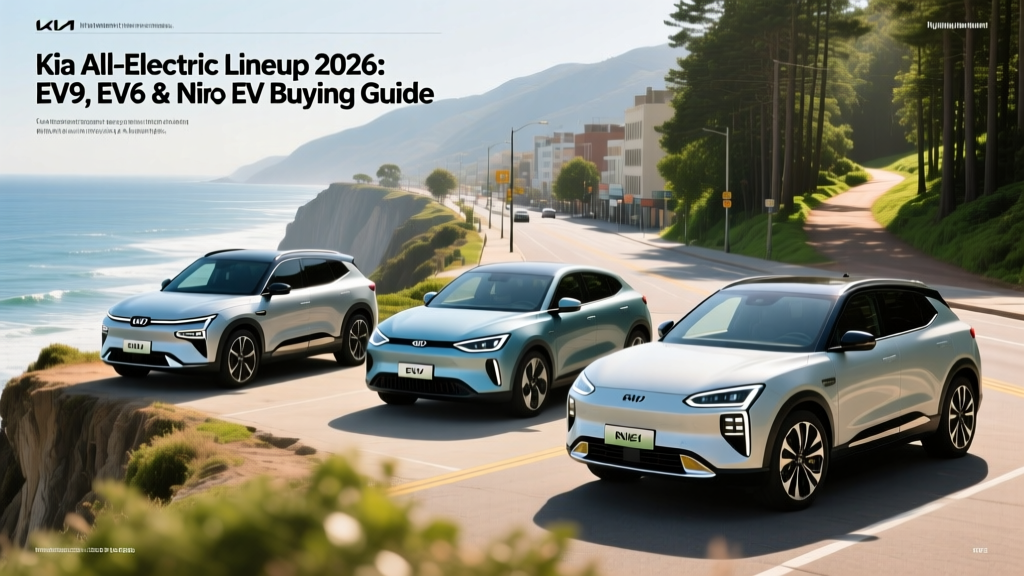
If you're researching Kia all-electric vehicles in 2026, you're looking at three distinct models: the EV6 (sporty crossover, ~310 miles EPA range, from ~$42,900), the EV9 (three-row SUV, ~304 miles EPA, from ~$54,900), and the Niro EV (compact crossover, ~239 miles EPA, from ~$39,600). All three ride on Hyundai Motor Group's E-GMP platform (EV6/EV9) or a dedicated EV architecture (Niro), feature 800V-capable fast charging on the EV6 and EV9, and qualify for varying levels of the federal §30D tax credit depending on battery sourcing and your income. The right pick depends on your passenger needs, budget, and whether you can charge at home.
Quick Answer: Which Kia All-Electric Model Fits You?
Niro EV — Best for budget-conscious commuters who need ~239 miles of range and don't require ultra-fast DC charging. Lowest entry price at ~$39,600.
EV6 — Best for drivers who want 300+ miles of range, 235 kW peak DC fast charging (10–80% in ~18 min), and sporty performance. The mainstream pick.
EV9 — Best for families needing three rows and 304 miles of range, with the same 800V fast-charging architecture as the EV6. Premium pricing but unique in its segment.
Kia's 2026 All-Electric Lineup at a Glance
Kia has committed heavily to electrification, and as of the 2026 model year, the brand offers three battery-electric vehicles (BEVs) in the U.S. market. Each targets a different buyer profile, but the EV6 and EV9 share the E-GMP (Electric-Global Modular Platform) architecture, which gives them structural and charging advantages over many competitors.
| Spec | Niro EV | EV6 | EV9 |
|---|---|---|---|
| EPA Range | 239 mi | 310 mi (LR RWD) | 304 mi (LR RWD) |
| Battery (usable) | 64.8 kWh (NMC) | 77.4 kWh (NMC) | 100.0 kWh (NMC) |
| Peak DC Fast Charge | ~85 kW | 235 kW | 235 kW |
| 10–80% DC Charge Time | ~45 min | ~18 min | ~20 min |
| Level 2 (240V) Rate | 10.9 kW | 10.9 kW | 10.9 kW |
| Horsepower | 201 hp | 225–576 hp | 215–379 hp |
| 0–60 mph | ~7.8 sec | 3.4–7.3 sec | 5.0–8.2 sec |
| Starting MSRP | ~$39,600 | ~$42,900 | ~$54,900 |
| MPGe (combined) | 113 MPGe | 117–134 MPGe | 89–97 MPGe |
| Battery/Powertrain Warranty | 10 yr / 100,000 mi | 10 yr / 100,000 mi | 10 yr / 100,000 mi |
Sources: fueleconomy.gov, Kia America press materials. Range figures are EPA estimates for Long Range RWD trims where applicable; AWD and GT trims have lower range ratings.
Real-World Range: What to Actually Expect
EPA range estimates are a useful baseline, but real-world results depend heavily on speed, temperature, terrain, and driving style. Here's how Kia's all-electric models perform outside the lab:
Real-World Range Expectations
EV6 Long Range RWD (310 mi EPA): Expect 260–280 miles on a mixed highway trip at 70 mph in moderate weather. In sub-freezing temperatures (20–30°F), plan for 210–240 miles. The heat pump (standard on most trims) helps, but cold still saps 15–25% of capacity.
EV9 Long Range RWD (304 mi EPA): The larger frontal area and heavier curb weight (~4,800 lbs) cut highway efficiency. Expect 245–270 miles real-world in good conditions; 195–225 miles in cold weather at highway speeds.
Niro EV (239 mi EPA): Around-town commuting plays to its strengths — expect 220–235 miles in city/suburban driving. Highway-heavy trips at 75 mph drop this to ~185–205 miles. Cold weather can push it below 170 miles.
The EV6 and EV9 benefit from preconditioning — when you navigate to a DC fast charger using the built-in navigation, the battery management system warms or cools the pack to optimize charge speed. Skip this step (for example, by entering the charger address into your phone and just driving there) and you may see peak charge rates cut in half, especially in cold weather.
Charging Speed and Infrastructure
The biggest differentiator between the Niro EV and the EV6/EV9 is the charging architecture. The EV6 and EV9 use an 800V electrical system, allowing them to accept up to 235 kW at compatible DC fast chargers. The Niro EV uses a conventional 400V system limited to roughly 85 kW.
| Level | Power (kW) | EV6 Miles Added/Hr | Best For |
|---|---|---|---|
| Level 1 (120V household) | ~1.4 kW | ~4 mi/hr | Emergency trickle; PHEVs overnight |
| Level 2 (240V home/public) | 10.9 kW | ~32 mi/hr | Daily home charging; full overnight refill |
| DC Fast (CCS/NACS) | Up to 235 kW (EV6/EV9) | N/A (10–80% in ~18 min) | Road trips; rapid top-ups |
Connector note: For 2026, Kia has adopted the NACS (North American Charging Standard) port on new EV6 and EV9 models, granting access to Tesla Supercharger stations via native plug. Older CCS-equipped models can use Superchargers with a Kia-provided adapter. The Niro EV still uses CCS1 as standard. Always verify connector type before planning a road trip around a specific network.
Charging curve reality: The "235 kW peak" figure for the EV6 and EV9 is exactly that — a peak, sustained only between roughly 10% and 35% State of Charge (SoC) at an adequately preconditioned battery on a 350 kW charger. From 35–60%, expect ~175–190 kW. Above 80%, the rate drops sharply to protect battery health, often below 50 kW. This is why manufacturers quote 10–80% times rather than 0–100%.
Cost of Ownership: Kia EV vs. Gas Equivalent
The sticker price of a Kia all-electric vehicle is typically higher than a comparable gas-powered Kia (a Telluride starts around $37,000 vs. the EV9 at $54,900), but total cost of ownership tells a different story over five years.
| Category | Kia EV6 LR RWD | Gas Crossover (25 MPG avg) |
|---|---|---|
| Purchase Price (base MSRP) | $42,900 | $35,000 |
| Federal Tax Credit (§30D)* | −$3,750 to $7,500 | $0 |
| Fuel/Energy (60,000 mi) | $2,400–$4,800 | $7,800 |
| Maintenance (5 yr) | ~$1,200 | ~$3,500 |
| Insurance (5 yr avg) | ~$9,500 | ~$7,800 |
| Estimated 5-Yr Total | ~$48,000–$53,000 | ~$54,100 |
*Federal §30D credit eligibility depends on MSRP caps ($55,000 for SUVs, $55,000 for sedans/crossovers per IRS guidelines), buyer income limits ($150K single / $300K joint), and battery component/critical mineral sourcing requirements. Credit amounts vary by model year and sourcing compliance. Consult a tax professional. Point-of-sale transfer is available.
Energy cost math: The EV6 LR RWD consumes roughly 28 kWh per 100 miles. At the U.S. average residential electricity rate of ~$0.16/kWh (per EIA data), home charging costs about $0.045 per mile. Public DC fast charging at $0.35–$0.48/kWh pushes that to $0.10–$0.14 per mile. A gas crossover at 25 MPG with fuel at $3.25/gallon costs $0.13 per mile. Home charging is the key to EV savings — if you rely exclusively on public fast chargers, the fuel cost advantage narrows substantially.
Federal Tax Credit Eligibility for Kia EVs
The §30D Clean Vehicle Credit remains one of the most confusing aspects of EV buying. Here's what applies to Kia's all-electric lineup in 2026:
§30D Tax Credit Checklist
- MSRP cap: Vehicle base MSRP must not exceed $55,000 for SUVs (EV9 qualifies on lower trims; EV6 and Niro EV are within limits).
- Buyer income cap: Modified AGI must not exceed $150,000 (single), $225,000 (head of household), or $300,000 (joint).
- Battery sourcing: Credit splits into two halves — $3,750 for battery components manufactured in North America, and $3,750 for critical minerals sourced from the U.S. or FTA partners. Kia's E-GMP vehicles use SK On battery cells, and sourcing compliance varies by model year.
- Point-of-sale transfer: You can transfer the credit to the dealer at purchase, reducing your out-of-pocket cost immediately rather than waiting for tax filing.
- Final assembly: Must occur in North America (EV6 and EV9 are assembled in South Korea, which has affected eligibility in prior years — verify current status on fueleconomy.gov).
Critical caveat: Because the EV6 and EV9 are assembled in South Korea (at Kia's Hwaseong and Gwangmyeong plants), they have historically faced challenges meeting the North American final assembly requirement. Some model years and trims have qualified via commercial vehicle credit pathways or sourcing updates, but you must verify the specific VIN's eligibility on the DOE/Fuel Economy website before relying on the credit in your purchase math.
Common Misconceptions About Kia EVs
| Myth | Fact |
|---|---|
| "The battery will need replacing in 5 years." | Kia warranties the battery for 10 years/100,000 miles against defects and excessive degradation (below 70% capacity). Real-world data from E-GMP vehicles shows ~5–8% degradation after 100,000 miles. Full battery replacement (rare) costs $12,000–$18,000. |
| "You can't road trip in an EV." | The EV6/EV9 add ~185 miles of range in 18 minutes at a 235 kW charger. With the growing NACS/Supercharger network and Electrify America's 350 kW stations, highway corridors are well-covered. Planning apps like A Better Routeplanner handle this automatically. |
| "EVs are worse in winter." | Range drops 15–25% in cold weather, but EVs start instantly (no cold-cranking), the heat pump provides cabin warmth efficiently, and preconditioning while plugged in means you leave with a full battery and warm cabin every morning. |
| "Home charging requires a panel upgrade." | Most homes with a 200-amp panel can support a 48-amp Level 2 charger (drawing 40A continuous) without an upgrade. A licensed electrician can confirm. Installation typically runs $500–$2,000 depending on run length and local permitting. Panel upgrades add $1,500–$3,500 when needed. |
| "EVs cost more to insure." | Partially true. EV insurance averages 15–25% higher than gas equivalents due to higher repair costs and parts pricing. Shop quotes from multiple carriers — some (like GEICO and Progressive) have narrowed the gap for mainstream EVs like the EV6. |
Home Charging Setup: What You Actually Need
For daily driving, Level 2 home charging is the backbone of Kia EV ownership. Here's a realistic breakdown:
| Item | Low Estimate | High Estimate |
|---|---|---|
| Level 2 charger (48A, hardwired) | $400 | $750 |
| Electrician labor (short run, <20 ft) | $300 | $800 |
| Electrician labor (long run, >50 ft) | $800 | $1,800 |
| Permit & inspection | $50 | $300 |
| Panel upgrade (if needed) | $1,500 | $3,500 |
| Total (no panel upgrade) | $750 | $2,850 |
| Total (with panel upgrade) | $2,250 | $6,350 |
Always hire a licensed electrician for the final installation and permit. Some utilities offer rebates of $250–$1,000 for Level 2 charger installation — check with your local provider.
At 10.9 kW, a Level 2 charger adds roughly 32 miles of range per hour to the EV6. That means a full charge from 10% to 100% takes about 7 hours — easily accomplished overnight. For most owners who arrive home with 40–60% remaining, a 3–4 hour session tops the battery up completely.
Decision Framework: Which Kia EV Is Right for You?
Choose Your Kia EV
Choose the Niro EV if: Your budget is under $42,000, your commute is under 60 miles round-trip, you rarely road-trip more than 200 miles without a stop, and you want the lowest cost of entry into Kia's electric lineup.
Choose the EV6 if: You want 300+ miles of EPA range, need ultra-fast 235 kW DC charging for road trips, value sporty handling and strong acceleration, and can spend $43,000–$62,000 depending on trim.
Choose the EV9 if: You need three-row seating for 6–7 passengers, want the same fast-charging E-GMP platform as the EV6, need towing capability (up to 5,000 lbs on AWD trims), and your budget accommodates $55,000–$75,000+.
Consider a Kia hybrid/PHEV instead if: You don't have reliable home charging access, regularly drive in areas with sparse public charging infrastructure, or need maximum range flexibility for frequent long rural trips.
Frequently Asked Questions
Does Kia offer a fully electric SUV with three rows?
Yes. The Kia EV9 is a three-row all-electric SUV with seating for up to seven, up to 304 miles of EPA range (Long Range RWD), and a starting MSRP of approximately $54,900. It's one of the only mainstream three-row EVs available in the U.S. market, competing with the Rivian R1S and Tesla Model X at significantly lower price points.
Can I charge a Kia EV at a Tesla Supercharger?
For 2026 model-year EV6 and EV9 vehicles equipped with the native NACS port, yes — you can plug directly into Tesla Superchargers without an adapter. Older CCS-equipped Kia EVs can access Superchargers using a Kia-approved CCS-to-NACS adapter. The Niro EV, which uses CCS1, requires an adapter and should be verified for Supercharger compatibility on Kia's website before relying on it.
How long will the battery last in a Kia EV?
Kia provides a 10-year/100,000-mile warranty on the high-voltage battery, covering defects and capacity loss below 70% of original capacity. Based on data from E-GMP platform vehicles in service since 2022, typical degradation is 5–8% over 100,000 miles with normal use. Many EV batteries remain functional well beyond 150,000–200,000 miles, though with gradually reduced range.
Is the Kia EV6 faster than the EV9?
In top performance trims, yes. The EV6 GT produces 576 hp and hits 0–60 mph in 3.4 seconds. The EV9 GT-Line AWD produces 379 hp with a 5.0-second 0–60 time. For standard trims, the EV6 Long Range RWD (225 hp, 7.3 sec) is quicker than the EV9 Long Range RWD (215 hp, 8.2 sec) simply due to lower weight.
What happens if I can't charge at home?
Public-only EV ownership is viable but more expensive and less convenient. DC fast charging costs $0.35–$0.48/kWh (vs. ~$0.16/kWh at home), and you'll spend 20–45 minutes per session depending on the charger and your model. If your workplace offers Level 2 charging, that can offset the gap. If neither home nor workplace charging is available, a Kia PHEV (like the Sportage PHEV) may be a more practical electrified option.