What Is Ken Block's Electric Audi?
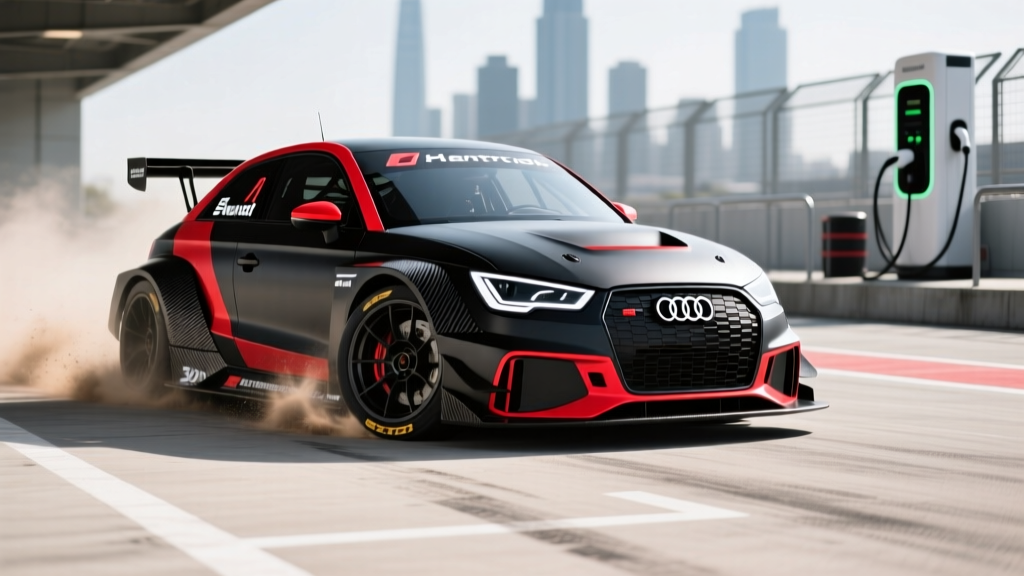
Ken Block's electric Audi is the Audi S1 e-tron quattro Hoonitrack, a one-off custom drift car built for Block's Hoonigan brand and featured in the 2023 Gymkhana video "Electrikhana II" in Las Vegas. It is not a production vehicle and cannot be purchased. The Hoonitrack produces 1,070 horsepower from a dual-motor all-wheel-drive powertrain, weighs approximately 2,900 lbs (1,315 kg), and was developed in collaboration with Audi Sport. Following Ken Block's tragic death in a snowmobile accident in January 2023, the car stands as his final Gymkhana machine — a purpose-built motorsport prototype, not a street-legal EV you can order from a dealer.
The Hoonitrack: Engineering a Custom Electric Drift Missile
To understand why this car generates search interest years later, you need to understand what Audi and Block's team actually built. The Hoonitrack isn't a modified production Audi. It's a tube-frame race chassis wearing Audi S1-inspired bodywork, powered by a bespoke dual-motor electric powertrain.
Key Specifications
Here are the confirmed numbers from Audi Sport and Hoonigan's technical releases:
| Specification | Value |
|---|---|
| Powertrain | Dual electric motor, AWD (quattro) |
| Power Output | 1,070 hp (798 kW) |
| Battery Capacity | ~60 kWh (custom pack, Swindon Powertrains) |
| Battery Chemistry | NMC (nickel manganese cobalt) — race-spec |
| Curb Weight | ~2,900 lbs (1,315 kg) |
| 0-60 mph | Under 2.0 seconds (estimated) |
| Chassis | Custom tubular space frame |
| Drivetrain | Individual motor per axle, torque vectoring |
| Street Legal | No — motorsport use only |
The 60 kWh pack is small by consumer EV standards (a 2026 Tesla Model Y carries ~75 kWh), but that's intentional. For Gymkhana runs lasting 2–4 minutes, energy density matters less than discharge rate — the battery must dump enormous current to two motors simultaneously during sustained drifts. The custom NMC cells prioritize C-rate (power delivery) over range.
For context on how this compares to production EVs you can buy: the 2026 Audi RS e-tron GT produces 646 hp from a 93.4 kWh battery and weighs 5,139 lbs. The Hoonitrack makes 65% more power at 43% less weight — a power-to-weight ratio that exists in no production car at any price.
How the Hoonitrack Compares to Production Performance EVs
Enthusiasts searching for "Ken Block's electric Audi" often want to know whether any road-legal EV delivers similar thrills. The honest answer: nothing matches a purpose-built drift car, but several 2026 production EVs push the performance envelope.
| Vehicle | HP | 0-60 mph | Weight (lbs) | Battery (kWh) | EPA Range | Base MSRP |
|---|---|---|---|---|---|---|
| Hoonitrack (custom) | 1,070 | ~2.0s | 2,900 | 60 | N/A | N/A |
| 2026 Audi RS e-tron GT | 646 | 3.1s | 5,139 | 93.4 | 246 mi | $149,800 |
| 2026 Tesla Model S Plaid | 1,020 | 1.99s | 4,766 | 100 | 359 mi | $89,990 |
| 2026 Porsche Taycan Turbo GT | 1,019 | 2.1s | 5,081 | 105 | 269 mi | $230,000 |
| 2026 Hyundai Ioniq 5 N | 641 | 3.25s | 4,861 | 84 | 221 mi | $67,500 |
The Hyundai Ioniq 5 N deserves specific mention as the production EV that most closely channels the Hoonitrack's spirit. It features simulated gear shifts, N Drift Optimizer mode, torque kick drift functionality, and a chassis tuned for track abuse. It won't match the Hoonitrack's power-to-weight, but at $67,500 it's the closest thing to a street-legal drift-focused EV currently on sale.
Real-World Ownership: What Performance EV Buyers Actually Face
If the Hoonitrack sparked your interest in a high-performance EV, here's what ownership actually looks like for the production cars listed above.
Charging Infrastructure
Performance EVs like the RS e-tron GT and Taycan Turbo GT use 800V architectures enabling peak DC fast charging at 270–320 kW. In practice:
- 10-80% charge: ~18-22 minutes at a compatible 350 kW station
- Real-world caveat: Sustained peak rate requires battery preconditioning and a non-degraded charger. Expect 22-28 minutes at most Electrify America or Tesla Supercharger V4 stations.
- Level 2 home charging: 11-19 kW onboard chargers mean 6-10 hours for a full charge overnight.
Cold-Weather and Track Use Range Loss
The EPA range sticker assumes moderate temperatures and mixed driving. For performance EV owners:
- Highway driving at 75+ mph: Expect 15-25% below EPA range
- Cold weather (below 32°F): Expect 20-35% range reduction without preconditioning
- Track sessions: A 20-minute hot lap session can consume 30-40 miles of range equivalent. The Ioniq 5 N's 221-mile EPA range drops to under 100 miles during aggressive track use.
Insurance and Maintenance Costs
Performance EVs carry steep insurance premiums. The RS e-tron GT averages $3,800-$4,500/year for a clean-record driver. The Model S Plaid runs $3,200-$4,000/year. These reflect high repair costs for carbon-ceramic brakes, air suspension, and battery-adjacent collision zones.
Maintenance savings over gas equivalents are real but narrower for performance models. You save on oil changes, spark plugs, and transmission fluid — but performance EV tires wear 30-50% faster than on ICE counterparts due to instant torque and heavy curb weight. Budget $1,200-$1,800/year for tires on any 4,800+ lb performance EV driven enthusiastically.
Cost Breakdown: Performance EV vs. Gas Sports Car
How does a production performance EV stack up against a gas equivalent over 5 years? Here's a comparison between the 2026 Audi RS e-tron GT and the 2026 BMW M5 (a natural cross-shop at similar price and performance):
| Cost Category | RS e-tron GT (EV) | BMW M5 (Gas) |
|---|---|---|
| Base MSRP | $149,800 | $124,900 |
| Federal Tax Credit (§30D) | $0 (MSRP exceeds $80K cap) | $0 |
| 5-Year Fuel/Energy | ~$4,200 (home charging) | ~$14,800 (premium gas, 15 MPG) |
| 5-Year Maintenance | ~$3,500 | ~$7,200 |
| 5-Year Insurance (est.) | ~$21,000 | ~$18,500 |
| 5-Year Tires | ~$8,000 | ~$6,500 |
| Estimated Depreciation | ~$65,000 | ~$55,000 |
| 5-Year Total Cost | ~$251,500 | ~$226,900 |
The EV's fuel savings (~$10,600 over 5 years) and maintenance savings (~$3,700) are significant, but higher insurance, tire costs, and steeper depreciation on the EV side largely erase the advantage. At this price tier, the financial case for EV performance is marginal — the decision comes down to driving experience, not economics.
Common Misconceptions About the Hoonitrack
| Myth | Fact |
|---|---|
| "You can buy Ken Block's electric Audi" | The Hoonitrack is a one-off race car owned by Audi Sport/Hoonigan. It has never been offered for sale and is not street-legal. |
| "It's just a modified Audi S1" | The Hoonitrack shares no production components with any Audi S1. It uses a custom tube-frame chassis, bespoke motors, and a race-spec battery pack. |
| "Electric drift cars have no soul" | Block himself championed EV torque for drifting — instant, controllable power at any RPM. The Hoonitrack's individual axle motors allow drift angles impossible in ICE cars. |
| "The Hoonitrack proves Audi is going all-electric for performance" | Audi's 2026 production performance lineup (RS e-tron GT, upcoming RS6 e-tron) is electric, but the Hoonitrack was a marketing prototype, not a product roadmap signal. |
| "Ken Block drove it after January 2023" | Block died on January 2, 2023. Electrikhana II (Las Vegas) was his final completed project, filmed in late 2022. |
Decision Framework: Which Performance EV Is Right for You?
Choose Based on Your Actual Use Case
If you want track-day capability with daily usability: The Hyundai Ioniq 5 N ($67,500) is the clear winner. N Drift Optimizer, simulated gear shifts, 800V charging (10-80% in ~18 min), and a usable 221-mile range make it the most engaging performance EV under $100K.
If you want maximum straight-line speed: The Tesla Model S Plaid ($89,990) hits 0-60 in 1.99 seconds with 1,020 hp and a 359-mile range. It lacks the chassis dynamics for serious track work, but nothing touches it in a stoplight-to-stoplight scenario.
If you want grand-touring luxury with performance: The Porsche Taycan Turbo GT ($230,000) delivers 1,019 hp, a Weissach-package weight reduction, and the best ride-handling balance in the segment. The 269-mile EPA range is its main compromise.
If you want the Audi badge with EV performance: The RS e-tron GT ($149,800) shares its J1 platform with the Taycan but wears distinctly Audi styling. The 646 hp and 246-mile range are solid, though it trails the Taycan Turbo GT on track.
If you want the Hoonitrack experience: You can't have it. But attending a Hoonigan event, watching Electrikhana II on YouTube, or booking a drift experience in a prepared EV (emerging offerings from companies like Hoonigan affiliates) is the closest available alternative.
What First-Time Performance EV Buyers Should Know
- Home charging is nearly mandatory. Public DC fast charging at 270-320 kW costs $0.40-$0.60/kWh. Home Level 2 at $0.13-$0.18/kWh cuts fueling cost by 60-70%. A 40-amp Level 2 home installation runs $800-$2,200 including electrician labor and permits.
- Preconditioning matters. Every production performance EV listed above can precondition its battery for optimal fast-charging speed. Use the car's navigation to route to a charger — this triggers thermal prep automatically. Without preconditioning, peak charge rates can drop 40-50%.
- Tax credits are unlikely at this price tier. The federal §30D credit caps vehicle MSRP at $80,000 for SUVs and $55,000 for sedans (source: IRS). None of the performance EVs above qualify. The Ioniq 5 N at $67,500 (SUV classification) is the only one that clears the MSRP cap, but buyer income limits ($300K joint / $150K single) and battery-sourcing requirements further restrict eligibility.
- Battery warranties protect you. Audi covers the RS e-tron GT battery for 8 years/100,000 miles against degradation below 70% capacity. Hyundai covers the Ioniq 5 N for 10 years/100,000 miles. Tesla covers the Model S Plaid for 8 years/150,000 miles.
- Plan for tire costs. Performance EVs are heavy and torque-rich. Michelin Pilot Sport 4S or Pirelli P Zero tires in 20-21 inch sizes cost $350-$500 per corner and last 12,000-18,000 miles under spirited driving.
The Hoonitrack's Lasting Impact on EV Culture
Ken Block's electric Audi matters less as a car and more as a cultural signal. When one of motorsport's most visible personalities chose an EV for his final Gymkhana film, it demonstrated that electric powertrains could deliver the precise, controllable, tire-shredding performance that enthusiasts demand. The Hoonitrack's dual-motor torque vectoring — independently controlling front and rear axle power — enables drift initiation and sustainment that no mechanical differential can match.
The production EV market has responded. Hyundai's N division has explicitly cited the drift-capability benchmark set by cars like the Hoonitrack. Porsche's Taycan Turbo GT includes a rear-biased torque mode. Even Audi's RS e-tron GT received a torque-vectoring rear differential in its 2025 refresh.
For buyers, the takeaway is practical: if you want an EV that can genuinely entertain on a closed course or empty road, the technology now exists in production form. It won't be a 2,900-lb tube-frame missile making 1,070 hp — but the gap between Ken Block's custom machine and a $67,500 Ioniq 5 N is far smaller than most enthusiasts expected in 2026.
Frequently Asked Questions
Can I buy Ken Block's electric Audi S1 Hoonitrack?
No. The Hoonitrack is a one-off prototype owned by Audi Sport and Hoonigan. It was never produced for sale, is not street-legal, and remains in Audi's motorsport collection.
How much horsepower did Ken Block's electric Audi make?
The Hoonitrack produces 1,070 hp (798 kW) from its dual-motor AWD powertrain, supplied by a custom race-spec 60 kWh NMC battery pack.
What Audi EV can I actually buy in 2026?
The 2026 Audi RS e-tron GT ($149,800, 646 hp, 246-mile EPA range) is Audi's top performance EV. The Audi Q8 e-tron ($74,400) and upcoming Audi A6 e-tron serve the luxury-SUV and sedan segments respectively. None are related to the Hoonitrack beyond branding.
Did Ken Block prefer electric cars for drifting?
Block publicly praised EV torque delivery for Gymkhana use — instant power without waiting for turbo spool or engine RPM. He called the Hoonitrack "the quickest-accelerating car I've ever driven" in interviews surrounding Electrikhana II.
What is the closest production EV to the Hoonitrack?
The Hyundai Ioniq 5 N is the closest in spirit: drift-optimized, track-capable, and enthusiast-focused. For raw power, the Tesla Model S Plaid (1,020 hp) comes closest to the Hoonitrack's 1,070 hp figure, though it weighs 1,800 lbs more and lacks dedicated drift hardware.