Quick Answer: Does John Deere Make an Electric Lawn Mower?
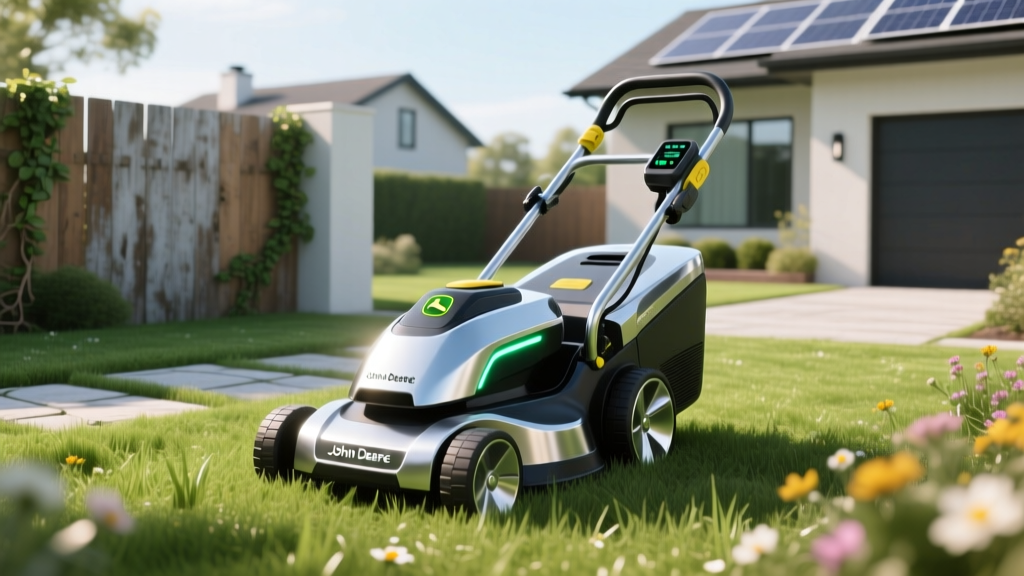
As of 2026, John Deere does not sell a battery-electric residential walk-behind or riding lawn mower under its consumer product line. The company's electrification efforts have focused on commercial turf equipment (such as battery-powered stand-on mowers for professional landscapers) and agricultural/industrial machinery. If you're searching for a "John Deere electric lawn mower" for home use, you'll likely need to look at competitors like EGO, Ryobi, Toro, or Craftsman — or consider a John Deere gas mower and evaluate whether a battery-electric alternative from another brand better suits your yard.
That said, the question of going electric in your garage and your yard is part of the same ownership decision. Below, we break down the battery-powered mower landscape, how electrified outdoor power equipment compares to gas, and what this means for buyers already evaluating EVs for their driveway.
John Deere's Electrification Strategy: Commercial, Not Consumer
John Deere has publicly committed to expanding electric and hybrid powertrains across its product portfolio, but the timeline and scope matter. The company's battery-electric offerings in the turf and landscaping space are aimed at commercial operators — municipal parks departments, golf courses, and professional landscaping companies — not suburban homeowners with a half-acre lot.
For the residential buyer, John Deere's current riding mower and tractor lineup (the S100, X300, and X500 series) remains powered by gasoline engines, typically Kawasaki or Briggs & Stratton V-twins ranging from 17 to 25 HP. Walk-behind mowers in the John Deere dealer network are similarly gas-powered.
If you've seen headlines about "John Deere electric" equipment, those typically reference:
- Commercial stand-on mowers with swappable lithium-ion battery packs (not sold at big-box retailers)
- Electric utility vehicles (UTVs) like the Gator TE, aimed at fleet and farm use
- Concept and prototype tractors shown at trade shows like CES and Agritechnica
None of these are direct competitors to the $400–$800 battery-electric push mowers or $2,000–$5,000 electric riding mowers that residential buyers are shopping for.
The Real Electric Mower Market: What's Actually Available in 2026
If your goal is a battery-powered mower — whether or not you had your heart set on the John Deere brand — the 2026 market is robust. Here's how the major residential electric mower categories break down:
| Category | Top Brands (2026) | Battery Voltage | Typical Run Time | Price Range (MSRP) |
|---|---|---|---|---|
| Push mower (21" deck) | EGO, Ryobi, Toro, Greenworks | 40V–56V | 40–60 min (single battery) | $350–$650 |
| Self-propelled (21"–22" deck) | EGO, Ryobi, Milwaukee M18 | 56V–80V | 45–70 min | $500–$850 |
| Riding mower / lawn tractor | Ryobi, Craftsman, EGO (announced) | 48V–80V | 1–2 hours per charge | $2,500–$5,500 |
| Zero-turn (residential) | Ryobi 42" ZT, EGO Z6 | 56V–80V | 1.5–2.5 acres per charge | $4,000–$7,000 |
The dominant battery chemistries in this space are NMC (nickel manganese cobalt) lithium-ion packs, which offer high energy density in a lightweight form factor — the same chemistry used in most EV traction batteries. Unlike EVs, however, these packs are typically 2.5–12 kWh in total capacity, and they charge on standard 120V household outlets in 1–4 hours.
Electric vs. Gas Mower: Cost and Ownership Comparison
Whether you're cross-shopping a John Deere gas tractor against a Ryobi electric rider, or comparing an EGO push mower to a Honda gas walk-behind, the math follows a familiar pattern for anyone who's done an EV vs. ICE vehicle analysis:
| Factor | Gas Mower (Riding) | Electric Mower (Riding) |
|---|---|---|
| Purchase Price (MSRP) | $2,200–$4,000 | $3,000–$5,500 |
| Fuel / Energy Cost per Hour | $3.50–$5.00 (gasoline) | $0.25–$0.60 (electricity at $0.16/kWh) |
| Annual Fuel Cost (40 hrs/yr) | $140–$200 | $10–$24 |
| Oil Changes per Season | 1–2 ($30–$60 each) | None |
| Air/Spark Plug/Fuel Filter | $25–$50/year | None |
| Belt/Blade Maintenance | $40–$80/year | $40–$80/year (same) |
| Battery Replacement (Year 5–8) | N/A | $400–$1,200 |
| Noise Level | 90–100 dB | 65–75 dB |
| Emissions at Point of Use | CO₂, NOx, unburned hydrocarbons | None |
The upfront premium for electric riding mowers is typically $800–$1,500 higher than a comparable gas model, but annual operating savings of $150–$250 can close that gap in 4–6 years for a homeowner mowing weekly during a 6-month season. For push mowers, the premium is smaller ($50–$200) and the payback is faster.
This mirrors the EV ownership curve almost exactly: higher sticker price, lower running costs, and a break-even point that depends heavily on your usage patterns and local electricity rates.
What EV Buyers Should Know About Battery Lawn Equipment
If you already own an EV or are shopping for one, adding electric outdoor power equipment to your household creates a few synergies — and a few new considerations:
Battery Ecosystem Lock-In
Most electric mower brands use proprietary battery platforms that extend across their outdoor power equipment lines (trimmers, blowers, chainsaws, snow blowers). EGO's 56V ARC Lithium system, Ryobi's 40V/80V platforms, and Milwaukee's M18 system each lock you into one brand's ecosystem — similar to how NACS vs. CCS charging connectors create network dependencies for EVs. If you're already invested in a particular battery platform for power tools, that may drive your mower decision.
Charging Infrastructure at Home
Electric mowers charge on standard 120V outlets and draw 300W–800W during charging. This is trivial compared to a Level 2 EV charger pulling 7.2–11.5 kW. However, if you're already planning a 200-amp electrical panel upgrade to support EV home charging, it's worth mapping out outdoor outlet placement for mower and equipment charging. A dedicated 20A GFCI outlet in your garage or shed is the minimum requirement.
Seasonal Battery Storage
Unlike EV batteries with active thermal management, lawn equipment batteries sit in unconditioned garages and sheds. Lithium-ion packs degrade faster when stored at extreme temperatures or at 100% state of charge for extended periods. Best practice: store at 40–60% SoC in a climate-controlled space during winter, and never charge a cold battery immediately after bringing it in from freezing temperatures.
Decision Framework: Should You Go Electric on Your Lawn?
Use this if-then framework to decide whether a battery-electric mower makes sense for your situation — the same analytical approach you'd apply to an EV purchase decision:
- IF your lot is under 1 acre and relatively flat → THEN a 56V–80V self-propelled push mower ($500–$750) will handle it on a single charge with margin to spare.
- IF your lot is 1–3 acres with moderate terrain → THEN a battery-electric riding mower or zero-turn ($3,500–$6,000) is viable, but confirm the rated acre-per-charge spec matches your actual mowing area.
- IF your lot exceeds 3 acres or has steep hills → THEN gas or a commercial-grade electric system (like what John Deere offers its pro customers) is more practical for 2026.
- IF you already own tools on a specific battery platform (Ryobi 40V, EGO 56V, Milwaukee M18) → THEN stay within that ecosystem for battery interchangeability and cost savings on spare packs.
- IF noise restrictions or HOA rules limit gas equipment hours → THEN electric is a clear win; most battery mowers operate at conversation-level volume.
- IF you lack access to a grounded outdoor outlet within 25 feet of your mower storage → THEN solve the outlet problem first (budget $150–$400 for an electrician to run a dedicated GFCI circuit) before purchasing.
Common Misconceptions About Electric Mowers — Fact-Checked
| Myth | Fact |
|---|---|
| "Electric mowers can't cut thick or wet grass." | Modern 56V–80V brushless-motor mowers deliver torque comparable to 160–190cc gas engines. They handle damp grass well, though mowing in heavy rain is not recommended for any mower type. |
| "The battery will die in 2–3 years." | Quality lithium-ion packs from EGO, Ryobi, and similar brands carry 3–5 year warranties and typically deliver 800–1,000 charge cycles before reaching 80% capacity — equivalent to 10–15 years of weekly mowing-season use. |
| "You can't get a John Deere electric mower at all." | John Deere does manufacture electric turf equipment, but it's aimed at the commercial market. Residential electric options come from other brands as of 2026. |
| "Electric mowers are underpowered." | Battery-electric motors deliver instant peak torque with no rpm ramp-up. Blade tip speed on premium electric mowers matches or exceeds gas equivalents. The limitation is sustained run time under heavy load, not peak power. |
| "It's not really 'green' if your electricity comes from fossil fuels." | Even on a grid that's 60% natural gas, a battery mower's lifecycle emissions are significantly lower than a gas mower's — which burns fuel at roughly 2–3 gallons per hour with minimal emissions controls compared to modern automobiles. |
The EV Ownership Connection: Electrifying Your Whole Garage
For buyers evaluating an electric vehicle — whether it's a Tesla Model Y, Hyundai Ioniq 5, Ford F-150 Lightning, or a PHEV like the Toyota RAV4 Prime — adding electric lawn equipment is a natural extension of the same decision framework:
- Eliminate small-engine maintenance: No carburetor cleaning, no stale fuel, no winterizing with stabilizer. If you've already decided you don't want to deal with ICE maintenance in your car, the same logic applies to your mower.
- Reduce household fossil fuel purchases: A gas riding mower burning 2 gal/hr for 40 hours a year consumes ~80 gallons of gasoline annually. At $3.50/gal, that's $280/year in fuel you can redirect to your electricity bill for roughly $15–$25.
- Simplify fueling infrastructure: If you already have a Level 2 EV charger installed at home, your garage is already wired for electric "refueling." Adding a 120V outlet for mower charging is trivial by comparison.
One important caveat: electric lawn mowers do not qualify for the federal §30D clean vehicle tax credit, which applies only to on-road vehicles meeting specific MSRP, income, and battery-sourcing requirements per IRS guidelines. Some states and utilities offer rebates for electric outdoor power equipment — check your local utility's energy efficiency program or EPA resources on lawn care emissions for current programs.
Frequently Asked Questions
Will John Deere release a residential electric mower in the future?
John Deere has signaled continued investment in electrification across its product lines, and the company participates in industry working groups on battery-electric outdoor power equipment. However, as of 2026, no residential electric walk-behind or riding mower has been formally announced with a consumer release date. If and when one launches, expect it to leverage John Deere's dealer network rather than big-box retail.
What's the best electric mower brand if I can't get a John Deere?
For push and self-propelled mowers, EGO's 56V platform consistently earns top marks for cut quality, run time, and battery longevity. For riding mowers and zero-turns, Ryobi's 80V and 48V platforms offer the broadest selection in 2026. If you're already invested in Milwaukee power tools, the M18 FUEL outdoor equipment line is worth considering for battery compatibility.
How long does an electric mower battery last before replacement?
Most premium lithium-ion mower batteries retain usable capacity for 5–10 years of typical residential use (roughly 25–40 mows per season). Replacement packs cost $150–$500 depending on voltage and Ah rating. Store batteries at partial charge in moderate temperatures to maximize lifespan — the same principles that govern EV battery longevity.
Can I charge my electric mower with solar panels?
Yes, indirectly. If your home has a grid-tied solar system, your mower charges from the grid like any other device, but the energy is offset by your solar production. A typical riding mower charge cycle consumes 2–4 kWh — well within what a residential solar array produces in a single day. This parallels how EV owners with solar effectively "fuel" their cars from the sun.
Are electric mowers safe to use in wet conditions?
Modern battery mowers are sealed against moisture and meet UL safety standards for outdoor use. However, manufacturers recommend against mowing in rain or immediately after heavy dew, primarily for cut quality (wet grass clumps) and traction safety, not electrical hazard. The same common-sense approach you'd take with any powered outdoor equipment applies.