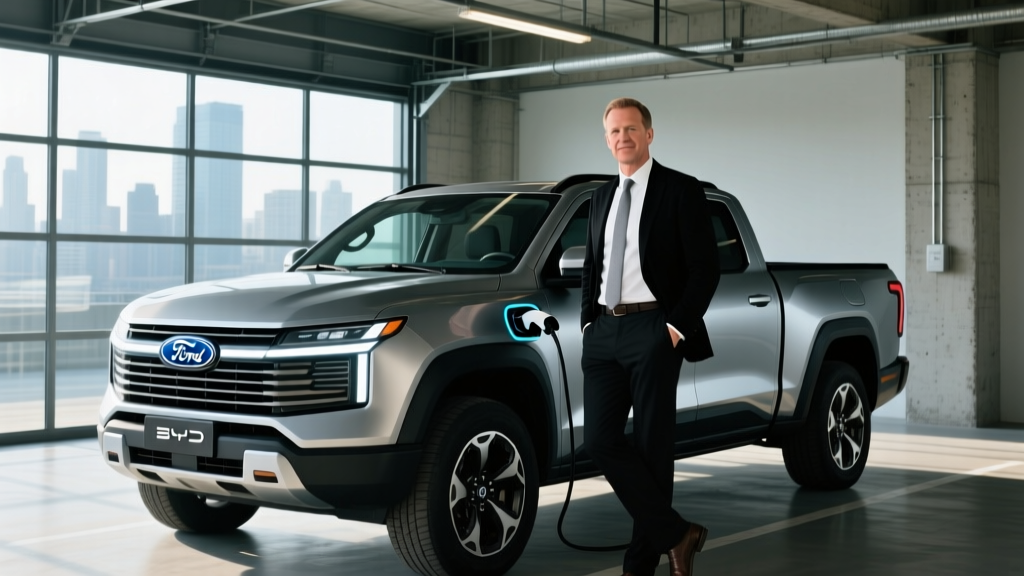
When Ford CEO Jim Farley speaks about a competitor, the auto industry listens — especially when that competitor is a Chinese automaker building a plug-in hybrid pickup truck aimed squarely at markets Ford wants to dominate. Farley's commentary on the BYD Shark has drawn attention from EV and PHEV shoppers alike, raising a key question: Is the BYD Shark a legitimate threat to trucks like the Ford Maverick, or is it a regional product with limited global relevance?
This profile breaks down everything we know about the BYD Shark PHEV pickup — its powertrain, electric-only range, charging capabilities, pricing, and how it stacks up against the compact truck competition — while contextualizing why Farley and Ford are paying close attention.
What Jim Farley Actually Said About the BYD Shark
Jim Farley has been candid about BYD's capabilities, calling the Chinese automaker Ford's "biggest competitor" in various interviews and earnings calls throughout 2024 and 2025. Regarding the BYD Shark specifically, Farley's position has been one of strategic acknowledgment: BYD's ability to engineer a plug-in hybrid pickup with competitive specs at an aggressive price point represents the kind of vertical integration that makes legacy automakers nervous.
The concern isn't just about one truck. BYD's DM-O (Dual Mode Off-Road) platform, which underpins the Shark, demonstrates a modular architecture strategy that can spawn multiple vehicle types. Farley has pointed to BYD's control over its entire supply chain — from battery cell production to semiconductor sourcing — as a structural advantage that Ford and other Western automakers are still working to match.
"BYD is a formidable competitor. Their vertical integration and cost structure require us to fundamentally rethink how we build vehicles." — Jim Farley, paraphrased from multiple public statements (2024–2025)
For buyers, this executive-level attention signals something important: the BYD Shark isn't being dismissed as a budget curiosity. It's being taken seriously enough to influence Ford's own compact truck strategy.
BYD Shark Powertrain and Electric-Only Range
The BYD Shark is built on BYD's DM-O super hybrid platform, pairing a turbocharged 1.5-liter four-cylinder engine with electric motors on both axles for a combined system output that BYD rates at approximately 430 horsepower. This makes it one of the most powerful vehicles in the compact/midsize PHEV truck segment.
| Specification | Value |
|---|---|
| Powertrain | 1.5L Turbo I4 + Dual Electric Motors (AWD) |
| Combined System Output | ~430 hp |
| 0–100 km/h (0–62 mph) | 5.7 seconds |
| Battery Chemistry | LFP (BYD Blade Battery) |
| Battery Capacity | ~26.7 kWh (usable, estimated) |
| Electric-Only Range (CLTC) | 100 km (~62 miles) |
| Electric-Only Range (EPA est.) | Not rated — expected ~45–55 miles |
| Combined Range (fuel + electric) | ~800+ km (CLTC) |
| Drivetrain | AWD (electric rear axle) |
| Towing Capacity | ~2,500 kg (~5,500 lbs, braked) |
| Payload | ~800 kg (~1,760 lbs) |
The LFP (lithium iron phosphate) Blade Battery is a signature BYD technology. LFP chemistry trades some energy density for superior thermal stability, longer cycle life, and lower cost. For a PHEV that will see frequent daily charge-discharge cycles, LFP is arguably the better chemistry choice — degradation is slower, and the battery can tolerate regular 100% charging without the longevity concerns associated with NMC cells.
Charging Capabilities: DC Fast and Home Level 2
PHEV charging is often an afterthought in manufacturer specs, but it matters enormously for owners who want to maximize electric-only driving. Here's what we know about the BYD Shark's charging profile:
| Charging Level | Rate | Time / Notes |
|---|---|---|
| Level 1 (120V AC) | ~1.4 kW | ~18–20 hours for full charge; adds ~3–4 mi/hr |
| Level 2 (240V AC) | ~6.6 kW (estimated) | ~4–5 hours for full charge; adds ~10–12 mi/hr |
| DC Fast Charge | Not widely available on PHEVs in this class | BYD has not published DC fast-charge specs for the Shark; most PHEVs in this segment rely on AC charging only |
The absence of DC fast charging is typical for PHEVs with batteries under 30 kWh. The smaller battery simply doesn't justify the added cost and weight of high-power DC charging hardware, and most PHEV owners charge overnight at home. For the BYD Shark's target buyer — someone with home charging access who drives 30–50 miles daily — a Level 2 home charger replenishes the battery fully overnight.
If you're installing a Level 2 charger at home, expect to pay $500–$1,500 for the charger unit and $800–$2,500 for professional electrical installation (including potential panel upgrades for older homes). A licensed electrician should evaluate your panel capacity before installation.
Pricing, Tax Credits, and Market Availability
The BYD Shark launched in Mexico in mid-2024 with a starting price equivalent to approximately $35,000–$40,000 USD, with BYD signaling expansion to other Latin American, Southeast Asian, and potentially Australian markets. As of early 2026, BYD has not announced plans to sell the Shark in the United States.
| Market | Starting Price (Local) | USD Equivalent (approx.) |
|---|---|---|
| Mexico (launch market) | ~899,990 MXN | ~$40,000–$45,000 |
| Australia (announced) | TBD | Expected ~$40,000–$50,000 AUD |
| United States | Not available | N/A |
Farley's concern about BYD's pricing isn't theoretical. A PHEV pickup at $35,000–$40,000 undercuts most body-on-frame midsize trucks and competes directly with the Ford Maverick Hybrid, which starts around $30,000 but offers less electric-only range and less total system power.
How the BYD Shark Compares to U.S. PHEV Trucks
Since the Shark isn't available in the U.S., the most useful comparison is against the closest domestic alternative: the Ford Maverick Hybrid (HEV, not PHEV). Let's also include the upcoming PHEV truck contenders for context.
| Attribute | BYD Shark (PHEV) | Ford Maverick Hybrid (HEV) |
|---|---|---|
| Powertrain Type | Plug-in Hybrid (PHEV) | Hybrid (HEV, no plug) |
| System Output | ~430 hp | 191 hp |
| Electric-Only Range | ~45–55 mi (EPA est.) | 0 mi (no EV mode) |
| EPA Combined MPG/MPGe | Not EPA rated | 42 MPG combined (FWD) |
| 0–60 mph | ~5.3 seconds (est.) | ~7.5 seconds |
| Drivetrain | AWD (dual motor) | FWD only (hybrid) |
| Towing (max) | ~5,500 lbs | 2,000 lbs (hybrid) |
| Bed Length | ~54 inches (est.) | 54.4 inches |
| Starting Price (USD equiv.) | ~$40,000 | ~$30,000 |
| U.S. Availability | Not available | Available now |
| Federal Tax Credit | Not eligible | Not eligible (HEV, not PHEV/BEV) |
The Shark dominates on power, towing, and electric-only capability. The Maverick Hybrid wins on price, fuel efficiency in hybrid mode, and the practical matter of actually being purchasable in the United States. For U.S. buyers, the Maverick remains the pragmatic choice — but the Shark shows what's possible when a manufacturer commits to PHEV truck architecture.
Tech, Interior, and Notable Features
BYD has equipped the Shark with a technology suite that reflects its positioning as a premium PHEV in its target markets:
- Infotainment: 12.8-inch rotating center touchscreen (a BYD signature), wireless Apple CarPlay and Android Auto
- Instrument Cluster: 10.25-inch digital driver display
- Driver Assistance: Adaptive cruise control, lane-keeping assist, blind-spot monitoring, 360-degree camera — SAE Level 1–2 driver-assist features (driver must remain fully engaged at all times)
- Utility: V2L (Vehicle-to-Load) capability, allowing the truck's battery to power external devices and tools — useful for job sites and camping
- Off-Road: Multiple terrain modes leveraging the dual-motor AWD system
The V2L feature is a standout for a PHEV truck. With ~26.7 kWh of battery capacity, the Shark can theoretically power typical job-site tools or camping equipment for extended periods — a practical advantage that pure gas trucks can't match without a separate generator.
Notable drawbacks include an unproven long-term reliability record outside of China, uncertain parts availability in export markets, and a brand that carries limited recognition among truck buyers in Western markets.
Who Should Buy the BYD Shark (And Who Shouldn't)
- Buyers in Mexico, Latin America, Southeast Asia, or Australia where the Shark is sold or announced
- Truck buyers who want PHEV capability — daily electric commuting with gas-engine range for longer trips
- Users who value high towing capacity (5,500 lbs) combined with electric-only driving
- Those who want V2L capability for work or recreation
- U.S. buyers — it's simply not available, and no timeline has been announced
- Buyers who prioritize long-term resale value and established dealer networks in Western markets
- Those who need DC fast charging for frequent road trips (the Shark relies on AC charging)
- Anyone expecting a full-size truck bed — this is a compact/midsize pickup
Warranty and Long-Term Ownership Outlook
BYD typically offers generous warranty coverage in its home and export markets, though specific terms vary by country:
- Vehicle Warranty: 6 years / 150,000 km (~93,000 miles) in most markets
- Battery Warranty: 8 years / 160,000 km (~100,000 miles), with capacity retention threshold typically set at 70% of original capacity
- LFP Advantage: BYD's Blade Battery (LFP chemistry) is rated for 3,000+ charge cycles before significant degradation, which translates to well over 300,000 miles of equivalent electric driving in PHEV use
For comparison, Ford's PHEV/HEV battery warranty on the Maverick Hybrid is 8 years / 100,000 miles on hybrid-specific components. BYD's coverage is competitive, though the real test will be long-term reliability data from export markets over the next 3–5 years.
Frequently Asked Questions
Is the BYD Shark available in the United States?
No. As of early 2026, BYD has not announced any plans to sell the Shark — or any vehicle — in the U.S. market. Tariffs on Chinese-made vehicles (currently 100% under Section 301) make U.S. import economically unfeasible. BYD is focusing on Mexico, Latin America, Australia, and Southeast Asia.
Why did Jim Farley comment on the BYD Shark?
Farley has identified BYD as Ford's most significant global competitor, citing BYD's vertical integration, cost structure, and rapid product development. The Shark specifically demonstrates BYD's ability to engineer compelling PHEV trucks at price points that challenge Western automakers.
What is the real-world electric range of the BYD Shark?
BYD rates the Shark at 100 km (62 miles) electric-only under CLTC testing. In real-world EPA-equivalent conditions, expect approximately 45–55 miles. Cold weather and sustained highway speeds will reduce this to 30–45 miles.
Does the BYD Shark have DC fast charging?
BYD has not published DC fast-charge specifications for the Shark. Most PHEVs with sub-30 kWh batteries do not include DC fast charging hardware. Expect AC Level 2 charging at approximately 6.6 kW, fully replenishing the battery in 4–5 hours.
How does the BYD Shark compare to the Ford Maverick?
The Shark offers significantly more power (~430 hp vs. 191 hp), AWD, electric-only range (~45–55 mi), and higher towing capacity (~5,500 lbs vs. 2,000 lbs). The Maverick Hybrid wins on price (~$30,000 vs. ~$40,000), proven U.S. availability, established dealer support, and excellent 42 MPG combined fuel economy.
Can I import a BYD Shark to the U.S.?
Practically, no. The 100% tariff on Chinese-manufactured vehicles, combined with NHTSA and EPA homologation requirements, makes individual import prohibitively expensive and legally complex. BYD would need to establish U.S.-compliant manufacturing or adjust sourcing to enter the market.
Sources: fueleconomy.gov (EPA ratings for comparison vehicles), irs.gov (§30D tax credit rules), BYD official press materials.