Quick Answer: The Jeep Wrangler Electric Car Status in 2026
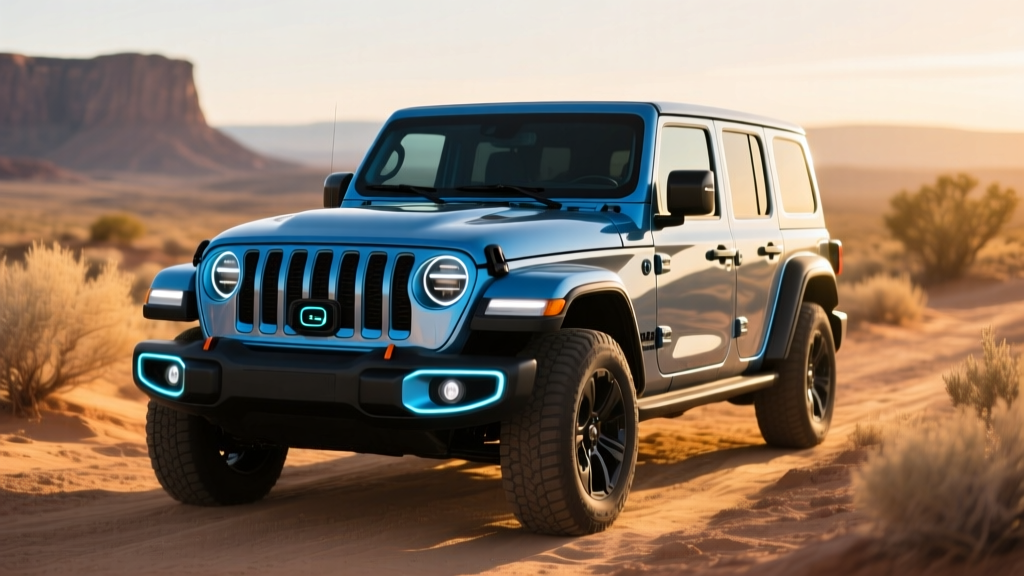
As of early 2026, there is no battery-electric Jeep Wrangler you can buy today. The Jeep Recon — Jeep's dedicated electric off-roader built on the STLA Large platform — was initially announced for a 2024 debut but has faced repeated production delays. Jeep parent company Stellantis confirmed in late 2025 that the Recon is now targeted for late 2026 or early 2027 as a 2027 model-year vehicle. It will be a standalone EV model, not a direct Wrangler replacement, though it inherits Wrangler-style removable doors, a fold-down windshield, and serious off-road hardware. If you want an electrified Wrangler right now, the Wrangler 4xe plug-in hybrid (PHEV) is the only option, offering 22 miles of electric-only range and 49 MPGe combined.
What Is the Jeep Recon EV? Understanding the 'Wrangler Electric Car'
When people search for a "Jeep Wrangler electric car," they're typically looking for one of two things: a fully electric version of the iconic Wrangler, or Jeep's answer to the electric off-roader segment. The answer to both is the Jeep Recon.
The Recon rides on Stellantis's STLA Large BEV platform, the same architecture underpinning the upcoming electric Dodge Charger and next-generation Jeep Grand Cherokee EV. Unlike the Wrangler 4xe, which pairs a 2.0L turbo-four with a 17.3 kWh battery and electric motor sandwiched into a conventional drivetrain, the Recon is a ground-up battery-electric vehicle.
Here's what Jeep has confirmed or previewed about the Recon:
- Battery capacity: Estimated ~100 kWh usable (NMC chemistry), targeting roughly 300+ miles of EPA range
- Powertrain: Dual-motor AWD with an estimated ~600 horsepower in top trims
- Off-road hardware: Selec-Terrain traction management, electronic locking axles, electronic sway-bar disconnect, underbody protection, and all-terrain tires from the factory
- Open-air design: Removable doors, fold-down windshield, and a power soft top — all Wrangler hallmarks retained
- Charging: Expected DC fast-charge capability of ~175-200 kW peak, with Level 2 home charging at up to 11 kW
Note: All specs above are preliminary and based on Jeep's announcements and STLA Large platform disclosures. Final EPA figures and MSRP will not be confirmed until production begins.
Jeep Wrangler 4xe vs. the Upcoming Recon EV: What You Can Buy Now
Since the Recon isn't available yet, the Wrangler 4xe is the electrified Jeep you can actually drive home today. It's critical to understand that the 4xe is a plug-in hybrid (PHEV), not a battery-electric vehicle. It has a gas engine, a fuel tank, and an exhaust pipe — along with a battery and electric motor.
| Spec | Wrangler 4xe (PHEV) | Wrangler Gas (3.6L V6) | Jeep Recon EV (Projected) |
|---|---|---|---|
| Powertrain | 2.0L turbo I-4 + electric motor | 3.6L Pentastar V6 | Dual-motor BEV |
| Combined Output | 375 hp / 470 lb-ft | 285 hp / 260 lb-ft | ~600 hp (est.) |
| EPA Electric-Only Range | 22 miles | N/A | ~300+ miles (est.) |
| EPA Combined MPGe / MPG | 49 MPGe (elec+gas) / 20 MPG (gas only) | 19-21 MPG combined | ~90-100 MPGe (est.) |
| Battery Capacity | 17.3 kWh (NMC) | N/A | ~100 kWh (est., NMC) |
| DC Fast Charging | Not supported | N/A | ~175-200 kW peak (est.) |
| Level 2 Charging | ~7 kW, 0-100% in ~2.5 hrs | N/A | ~11 kW (est.) |
| 0-60 mph | ~6.0 sec | ~7.5 sec | ~3.5-4.5 sec (est.) |
| Starting MSRP (2026) | ~$51,795 | ~$33,895 | ~$55,000-$65,000 (est.) |
| Federal Tax Credit (§30D) | $3,750 (partial) | $0 | TBD — up to $7,500 if eligible |
| Drivetrain | 4WD (part-time) | 4WD (part-time) | AWD (dual-motor) |
Sources: EPA fueleconomy.gov for Wrangler 4xe data; Jeep/Stellantis press releases for Recon projections.
Real Costs: Wrangler 4xe Ownership vs. Gas Wrangler
For buyers deciding between the 4xe PHEV and the conventional gas Wrangler, the math comes down to how you drive and whether you can charge at home.
| Cost Category | Wrangler 4xe PHEV | Gas Wrangler V6 |
|---|---|---|
| Purchase Price (Willys 4xe vs. Willys) | $51,795 | $33,895 |
| Federal Tax Credit (§30D) | -$3,750 | $0 |
| Net Purchase Price | $48,045 | $33,895 |
| Fuel/Energy (5 yrs, 75,000 mi) | ~$5,800 (mix of elec + gas) | ~$12,400 (gas at $3.50/gal, 20 MPG) |
| Maintenance (5 yrs) | ~$3,200 | ~$4,100 |
| Insurance (5 yrs, avg.) | ~$9,500 | ~$8,800 |
| Total 5-Year Cost | ~$66,545 | ~$59,195 |
| Cost Per Mile | ~$0.89/mi | ~$0.79/mi |
Key insight: The 4xe saves roughly $6,600 in fuel and $900 in maintenance over five years, but the higher purchase price and insurance premiums mean it still costs more to own overall — unless you drive mostly within electric range and charge at home on cheap utility rates. If 80% of your daily driving is under 22 miles and you charge overnight at $0.13/kWh, your fuel savings could jump to ~$8,500 over five years, narrowing the gap significantly.
For the Recon EV (when available), expect the calculus to shift further in favor of electricity: no oil changes, fewer moving parts, and ~$0.04-$0.05/mile for home charging vs. ~$0.17/mile for gas.
Off-Road Reality: Can an Electric Jeep Really Trail-Run?
This is the single biggest question from the Wrangler faithful. The honest answer: yes, but differently.
Where electric off-roading excels:
- Instant torque at zero RPM: Electric motors deliver maximum torque from a standstill — ideal for rock crawling where you need precise, low-speed control without revving. The Recon's projected ~600 hp and dual-motor setup should offer exceptional crawl ratios.
- No air intake to flood: BEVs don't need to breathe, making water fording potentially simpler (though battery and motor sealing still matters enormously).
- Lower center of gravity: The battery pack sits under the floor, reducing rollover risk on side slopes.
- Quiet operation: Less noise on trails means less wildlife disturbance and better communication with spotters.
Where real concerns remain:
- Range under load: Aggressive off-roading — low-range crawling, sand, deep mud — can consume energy at 2-3x the highway rate. A Recon with 300 miles of EPA range might deliver only 80-120 miles of equivalent trail range under heavy off-road use.
- No jerry can solution: If you run out of battery on a remote trail, there's no five-gallon rescue. Recovery charging (portable generators, solar) is slow and impractical for most backcountry scenarios.
- Weight: Large battery packs add 1,000+ lbs. More weight means more tire wear, more stress on suspension components, and deeper ruts on soft terrain.
- Underbody vulnerability: The battery pack is the most expensive component on the vehicle. Skid plate protection is essential, and any puncture could mean a $20,000+ replacement.
Jeep has stated the Recon will include substantial underbody armor, but real-world trail durability won't be proven until owners put these vehicles on Moab and Rubicon Trail routes.
Charging the Electric Jeep: What Home and Trail Charging Look Like
If you're considering the Recon (or the 4xe PHEV now), charging logistics are a core ownership factor.
Home Charging (Where 85%+ of EV Charging Happens)
For the Wrangler 4xe: The 17.3 kWh battery charges on a standard 120V outlet (Level 1) in about 12 hours — adequate for overnight replenishment of 22 electric miles. A 240V Level 2 home charger at 7 kW tops it off in roughly 2.5 hours.
For the Recon EV (projected): A ~100 kWh battery demands serious home infrastructure:
- Level 1 (120V, 12A): ~1.4 kW — adds roughly 3-4 miles per hour. A full charge would take 60+ hours. Not viable as primary charging.
- Level 2 (240V, 48A): ~11 kW — adds roughly 30-35 miles per hour. A full charge in ~9-10 hours. This is the practical home-charging target.
- Installation cost: Expect $1,200-$3,500 for a Level 2 home charger installation (equipment + licensed electrician + permit), assuming your electrical panel has capacity. A panel upgrade from 100A to 200A can add $1,500-$3,000.
Trail and Remote Charging
This is the Recon's biggest unknown. Jeep has not announced integrated solar charging, V2L (vehicle-to-load) trail accessories, or partnerships with off-grid charging networks. For serious backcountry use, owners may need to rely on:
- Portable solar generators (slow, weather-dependent)
- Gas-powered inverter generators as emergency range extenders (ironic, but practical)
- Careful route planning to ensure round-trip range within battery capacity
Tax Credits and Incentives: What Applies in 2026
The IRS §30D federal tax credit rules are complex and model-specific:
- Wrangler 4xe: Currently qualifies for a partial credit of $3,750 (meeting critical-mineral requirements but not full battery-component sourcing). The credit is available as a point-of-sale transfer to the dealer, reducing your purchase price directly.
- Jeep Recon EV: Credit eligibility will depend on final battery sourcing and assembly location at time of production. If Stellantis sources battery components and critical minerals per §30D requirements, and the Recon's MSRP stays under the $80,000 SUV cap, it could qualify for up to $7,500. This is not guaranteed and must be verified at launch.
Income caps apply: Modified adjusted gross income must not exceed $150,000 (single), $225,000 (head of household), or $300,000 (joint filers). Always consult a tax professional and check IRS.gov for current-year rules before relying on credit eligibility.
Decision Framework: Should You Wait for the Recon or Buy Now?
Choose the Wrangler 4xe PHEV Now If:
- You need a Jeep within the next 3-6 months
- Your daily commute is under 22 miles and you can charge at home (Level 1 is sufficient)
- You regularly drive to remote trailheads where charging infrastructure is nonexistent
- You want the proven Wrangler platform with decades of aftermarket support
- You're comfortable with ~$51,000+ MSRP minus the $3,750 credit
Wait for the Jeep Recon EV If:
- You have reliable home Level 2 charging (or can install it)
- Your daily driving is under 200 miles round-trip
- You want maximum torque and performance (est. ~600 hp vs. 375 hp in the 4xe)
- You're willing to wait until late 2026 or 2027 for availability and early-production unknowns
- You primarily do moderate off-roading (forest roads, light rock crawling) rather than extreme backcountry expeditions
- Lower running costs matter more to you than proven trail durability
Stick with the Gas Wrangler If:
- You can't install home charging and public charging isn't accessible
- You frequently overland in remote areas for multi-day trips
- You want the lowest purchase price (~$34,000 base) and simplest mechanicals
- You prioritize lightweight and aftermarket flexibility over fuel savings
Common Misconceptions About the Jeep Wrangler Electric Car
| Myth | Fact |
|---|---|
| "The electric Wrangler is already on sale." | No. The Jeep Recon is delayed to late 2026 or 2027. The only electrified Wrangler available now is the 4xe plug-in hybrid. |
| "The 4xe is an electric Wrangler." | The 4xe is a PHEV — it has a gas engine, a 16-gallon fuel tank, and only 22 miles of electric-only range. It's a bridge technology, not a BEV. |
| "An electric Jeep can't off-road." | Electric motors offer instant torque ideal for crawling, and a low battery floor improves stability. However, range under heavy load and remote recovery remain legitimate concerns. |
| "I'll get the full $7,500 tax credit on any electrified Jeep." | The 4xe currently qualifies for only $3,750. The Recon's eligibility won't be confirmed until production, and buyer income caps apply per IRS §30D rules. |
| "I can charge the Recon on any trail." | DC fast chargers are essentially nonexistent on off-road trails. You must plan routes within battery range or carry emergency power solutions. |
Frequently Asked Questions
Will Jeep make a fully electric Wrangler?
Jeep is not converting the Wrangler nameplate to electric. Instead, the Jeep Recon is a separate electric model designed to be the spiritual EV equivalent of the Wrangler — with similar open-air capability, off-road hardware, and styling cues, but on a dedicated EV platform. The gas and 4xe Wrangler will continue to be sold alongside it.
How much will the Jeep Recon EV cost?
Stellantis has not announced official pricing. Based on the STLA Large platform's positioning and competitor pricing (Ford Bronco EV, Rivian R1S), expect a starting MSRP between $55,000 and $65,000 for base trims, with fully loaded editions potentially reaching $75,000+. This remains within the §30D $80,000 MSRP cap for SUVs.
Can I charge the Wrangler 4xe at a DC fast charger?
No. The Wrangler 4xe only supports Level 1 (120V) and Level 2 (240V) AC charging. It does not have a DC fast-charging port. This is a common limitation among PHEVs — their smaller batteries (17.3 kWh) don't justify the cost and weight of DC fast-charge hardware.
What's the real-world range of the Wrangler 4xe on electric power?
The EPA rates the 4xe at 22 miles of electric-only range. In real-world conditions — particularly in cold weather (below 40°F), at highway speeds, or with aggressive acceleration — expect 15-18 miles of usable electric range before the gas engine engages. In warm, city-driving conditions, you may squeeze out 24-25 miles.
Is the Jeep Recon a good first EV for a new buyer?
It depends on your situation. If you have home charging, a predictable commute under 200 miles, and mostly moderate off-road needs, it could work well. However, as a first-production-year vehicle on a new platform, early adopters should expect potential software bugs, build-quality inconsistencies, and limited service-center familiarity. First-time EV buyers may be better served by a proven model (Tesla Model Y, Hyundai Ioniq 5, Ford Mustang Mach-E) for daily driving, keeping the Recon as a future second-vehicle purchase once production matures.
How does cold weather affect an electric Jeep?
Lithium-ion batteries lose 15-30% of their effective range in freezing temperatures (below 32°F), depending on cabin heating demands. A Recon with a projected 300-mile EPA range could deliver 210-255 miles in winter conditions. Heat pumps (expected on the Recon) mitigate this loss somewhat, but cold-weather range reduction is a physics reality that every EV buyer in northern climates must plan for. The 4xe PHEV sidesteps this issue: if the battery depletes, the gas engine takes over.