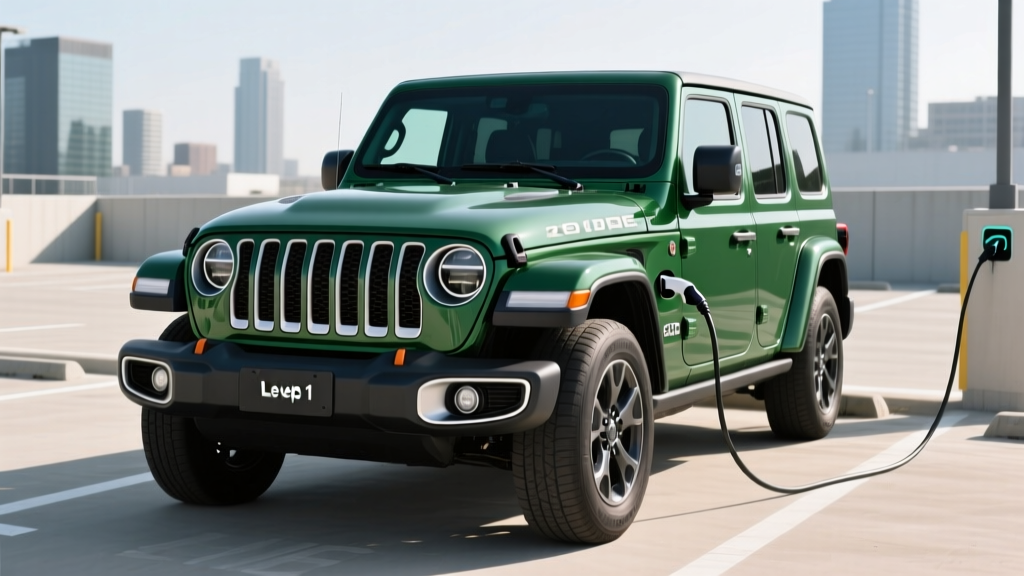
The 2021 Jeep Wrangler 4xe pairs legendary off-road capability with a plug-in hybrid powertrain, but its 17.3 kWh battery (15.0 kWh usable) raises an immediate ownership question: how long does a full charge actually take on a standard household outlet? If you're searching for the 2021 Jeep Wrangler 4xe Level 1 charging time full charge, the short answer is roughly 12 to 13 hours from a depleted state on a 120V/15A circuit. But that number only tells part of the story.
This guide breaks down exactly what Level 1, Level 2, and DC fast charging mean for your Wrangler 4xe — with real numbers for time, cost, and home installation — so you can decide whether a wall outlet is enough or whether a 240V home charger is worth the investment.
Understanding Charging Levels: What Each Adds Per Hour
Before we calculate exact times for the Wrangler 4xe, it's critical to understand the difference between kW (kilowatts — the rate of power delivery, like water pressure from a hose) and kWh (kilowatt-hours — the total energy stored, like gallons in a tank). Charging speed is measured in kW; battery capacity is measured in kWh. Confusing the two is the single most common mistake in EV ownership.
| Level | Voltage | Power (kW) | Miles of Electric Range Added/Hour | Typical Use Case |
|---|---|---|---|---|
| Level 1 | 120V AC | 1.2 – 1.4 kW | ~3 – 4 miles | Standard household outlet; overnight trickle |
| Level 2 | 240V AC | 3.3 – 7.2 kW | ~10 – 22 miles | Home wallbox, workplace, public AC stations |
| DC Fast | 400V+ DC | 50 – 350 kW | ~100 – 300+ miles | Highway travel; not applicable to 4xe |
Critical Wrangler 4xe note: The 4xe does not support DC fast charging. Its onboard charger maxes out at approximately 3.3 kW on Level 2 (some early 2021 models were rated up to 6.6 kW on later software updates, but 3.3 kW is the conservative baseline per Jeep's official specs). This means even if you plug into a 48A Level 2 wallbox capable of 11.5 kW, the 4xe will only draw about 3.3 kW.
2021 Jeep Wrangler 4xe Level 1 Charging Time: Full Charge Breakdown
The Wrangler 4xe's battery pack has a total capacity of 17.3 kWh, but the usable portion — what you actually charge and discharge in normal driving — is approximately 15.0 kWh. The battery management system reserves a buffer to protect long-term health.
On a standard 120V/15A household outlet (Level 1), the included portable charging cord delivers approximately 1.2 kW of continuous power (120V × 12A continuous draw, accounting for the 80% NEC continuous-load rule).
Level 1 Full Charge Calculation:
15.0 kWh ÷ 1.2 kW = ~12.5 hours from 0% to 100%
Real-world factors — charging inefficiency (typically 85-90% efficiency at Level 1), voltage sag on older wiring, and battery thermal management — can push this to 13-14 hours in practice.
The EPA rates the 4xe at 22 miles of electric-only range (fueleconomy.gov). So Level 1 charging adds roughly 3-4 miles of electric range per hour of charging. If you plug in at 7 PM after depleting the battery, you'll have a full charge by 7-8 AM — barely enough for an overnight top-up if you drove all 22 electric miles that day.
Level 2 Home Charging: Cutting That Time to Under 5 Hours
The practical upgrade for any Wrangler 4xe owner is a Level 2 home charger. At 3.3 kW (the 4xe's onboard charger limit), a full charge from 0% to 100% takes approximately 4.5 to 5 hours. That's a massive improvement — you can plug in after an evening commute and wake up fully charged with hours to spare.
Even though the 4xe can't take advantage of higher-power Level 2 chargers, installing a 40A or 48A circuit is still smart: it future-proofs your garage for your next EV, which will almost certainly accept 7.2 kW or more.
Electrical Requirements for a Level 2 Installation
A Level 2 home charger requires a 240V dedicated circuit, similar to what powers an electric dryer or oven. Here's what that entails:
- Voltage/Amperage: 240V, typically on a 40A or 50A breaker (providing 32A or 40A continuous charge current)
- Wiring: 6 AWG copper for 50A circuits; 8 AWG for 40A
- Dedicated circuit: The EV charger should not share a circuit with other major appliances
- Panel capacity: Your main electrical panel must have enough spare amperage to support the new circuit
Will You Need a Panel Upgrade?
This is where costs can escalate. Most modern homes have a 200A main panel, which typically supports a Level 2 charger without issue. But if you have an older home with a 100A panel, or if your panel is already near capacity (running electric heat, a dryer, an oven, and A/C simultaneously), you may need a panel upgrade to 200A — which can add $1,500 to $3,500 to your installation.
Some homeowners opt for a smart panel load-management system (like the Emporia VUE or Span smart panel) as an alternative to a full upgrade, which dynamically throttles the charger when other appliances draw heavy current. This can cost $500–$1,500 but avoids the full panel replacement.
Home Charger Installation Cost Breakdown
| Component | Low End | High End | Notes |
|---|---|---|---|
| Level 2 Charger (hardware) | $250 | $700 | 32A–48A smart charger; J1772 connector |
| Electrician labor | $500 | $2,000 | Depends on panel proximity, conduit run length |
| Electrical permit | $50 | $200 | Required by most local codes |
| Panel upgrade (if needed) | $1,500 | $3,500 | 100A → 200A service upgrade |
| Total (no panel upgrade) | $800 | $2,900 | Most common scenario for modern homes |
| Total (with panel upgrade) | $2,300 | $6,400 | Older homes with 100A service |
The federal government offers a 30% tax credit on charger hardware and installation costs (up to $1,000 for residential property) under the Alternative Fuel Vehicle Refueling Property Credit (§30C). This credit has specific census-tract eligibility requirements — check IRS guidelines to confirm your address qualifies.
Charging Connector Compatibility for the Wrangler 4xe
The 2021 Wrangler 4xe uses the standard J1772 connector for Level 1 and Level 2 AC charging. Since the 4xe does not support DC fast charging, you don't need to worry about CCS1, CHAdeMO, or NACS compatibility for this vehicle.
| Connector | Type | Used By | Wrangler 4xe Compatible? |
|---|---|---|---|
| J1772 | AC (Level 1 & 2) | All non-Tesla PHEVs and BEVs | ✅ Yes — native port |
| NACS (Tesla) | AC + DC | Tesla vehicles; Ford, GM, Rivian (2025+) | ❌ No — not needed for 4xe |
| CCS1 | DC Fast | Most non-Tesla BEVs | ❌ No — 4xe lacks DC fast capability |
| CHAdeMO | DC Fast | Nissan Leaf, Mitsubishi Outlander PHEV | ❌ No — legacy standard |
Adapter tip: If you install a Tesla Wall Connector (which now ships with a J1772 adapter option), it will work with your 4xe. But there's no advantage to the Tesla connector ecosystem unless you also own or plan to own a Tesla or NACS-equipped vehicle.
Cost to Charge: Level 1 vs. Level 2 vs. Gas
One of the strongest arguments for home charging — even slow Level 1 — is cost. Let's compare what it takes to "refuel" the Wrangler 4xe's 22 miles of electric range versus filling its 17.2-gallon tank with premium gas.
| Scenario | Energy Cost | Cost for 22 Electric Miles | Cost Per Mile |
|---|---|---|---|
| Level 1 (home, avg. $0.16/kWh) | $2.40 (15 kWh) | $2.40 | $0.11 |
| Level 1 (home, off-peak $0.09/kWh) | $1.35 (15 kWh) | $1.35 | $0.06 |
| Level 2 (home, avg. $0.16/kWh) | $2.55 (15 kWh + losses) | $2.55 | $0.12 |
| Public Level 2 ($0.35/kWh) | $5.25 | $5.25 | $0.24 |
| Gasoline (20 MPG combined, $3.50/gal) | — | $3.85 (22 mi) | $0.18 |
At home on off-peak rates, charging the 4xe's battery costs roughly $1.35 — about a third of what 22 miles on gasoline would cost. Even at average residential rates, you're saving money every time you drive on electric power.
The Wrangler 4xe's EPA combined fuel economy is 49 MPGe on electric power and 20 MPG combined on gas alone. The financial case for home charging is clear: every electric mile driven is cheaper than a gas mile, often by 40-65%.
Recommended Level 2 Chargers for the Wrangler 4xe
Since the 4xe caps at ~3.3 kW, you don't need a 48A powerhouse — but buying a higher-amperage unit is smart for future-proofing. Here are three proven options:
Emporia Vue Level 2 Charger
- Power output: Up to 48A / 11.5 kW (4xe will draw 3.3 kW)
- Connector: J1772 (NACS adapter available)
- Cable length: 24 feet
- Smart features: Wi-Fi, app scheduling, energy monitoring, solar integration
- Price: ~$399
- Best for: Budget-conscious buyers who want smart scheduling for off-peak rates
ChargePoint Home Flex
- Power output: Configurable 16A–50A / up to 12 kW
- Connector: J1772 (NACS version also available)
- Cable length: 23 feet
- Smart features: Wi-Fi, Alexa integration, charge scheduling, detailed app analytics
- Price: ~$699
- Best for: Owners wanting a premium, well-supported charger with flexible amperage
Wallbox Pulsar Plus
- Power output: Up to 40A / 9.6 kW
- Connector: J1772
- Cable length: 25 feet
- Smart features: Wi-Fi + Bluetooth, app control, load balancing accessory available
- Price: ~$599
- Best for: Compact design, excellent for tight garages; optional load-balancing avoids panel upgrades
Any of these units will fully charge the 4xe in approximately 4.5–5 hours. The ChargePoint Home Flex is our top pick for its configurability: you can set it to 20A on a 100A panel today and reconfigure to 40A if you upgrade your panel later.
Safety, Permits, and Code Considerations
EV charging involves sustained high-current draw — often for 8+ hours at a time. This is fundamentally different from running a dryer for 45 minutes. Here's what the National Electrical Code (NEC) and best practices require:
- Dedicated circuit: Your EV charger must have its own breaker — no sharing with other outlets or appliances.
- GFCI protection: NEC 2020 and later requires GFCI (ground-fault circuit interrupter) protection for outdoor receptacles and many jurisdictions now require it for indoor EV circuits as well. Most quality hardwired chargers include built-in GFCI.
- Outdoor rating: If your charger is installed outside or in an unenclosed carport, it must carry an NEMA 4 or IP55+ rating for weather resistance.
- Permit requirement: Nearly all jurisdictions require an electrical permit for a new 240V circuit. The permit fee is typically $50–$200, and the work will be inspected by a local code official. Do not skip this step — unpermitted electrical work can void home insurance and create fire risk.
- Hardwired vs. plug-in: Hardwired chargers (no plug, direct-wired to a junction box) are generally preferred for 40A+ circuits because they eliminate the NEMA 14-50 receptacle as a potential failure point. For the 4xe's 3.3 kW draw, a NEMA 14-50 plug-in setup is perfectly safe and offers portability.
Charging Time Comparison: Level 1 vs. Level 2 at a Glance
To put the 2021 Jeep Wrangler 4xe Level 1 charging time full charge into context against Level 2, here's a direct comparison for common charging scenarios:
| Scenario | Level 1 (120V / 1.2 kW) | Level 2 (240V / 3.3 kW) |
|---|---|---|
| 0% → 100% (full charge) | 12.5 – 14 hours | 4.5 – 5 hours |
| 20% → 80% (daily top-up) | ~7.5 hours | ~2.7 hours |
| 10 miles of range recovery | ~2.5 hours | ~55 minutes |
For owners who drive less than 15 miles round-trip on most days, Level 1 overnight charging is adequate — you'll recover your daily electric usage while you sleep. But if you regularly deplete the full 22 miles of electric range, Level 2 becomes essential to ensure the battery is replenished by morning.
Frequently Asked Questions
How much does it cost to install a home EV charger for the Wrangler 4xe?
For a typical Level 2 installation without a panel upgrade, expect to spend $800 to $2,900 total (charger hardware + electrician labor + permit). If your home needs a panel upgrade from 100A to 200A, add $1,500–$3,500. The federal §30C tax credit can offset 30% of hardware and installation costs (up to $1,000), provided your address is in an eligible census tract.
How fast will each charging level add range to the 4xe?
Level 1 (120V) adds approximately 3–4 miles of electric range per hour. Level 2 (240V at 3.3 kW) adds approximately 10–12 miles per hour. The 4xe does not support DC fast charging.
Which connector and charger is compatible with my 2021 Wrangler 4xe?
The 4xe uses the standard J1772 connector for all AC charging. Any Level 1 or Level 2 charger with a J1772 plug will work. You do not need NACS, CCS1, or CHAdeMO compatibility.
How much does charging cost per mile compared to gas?
At the national average residential electricity rate (~$0.16/kWh), the 4xe costs approximately $0.11–$0.12 per electric mile. On gasoline at $3.50/gallon and 20 MPG combined, it costs approximately $0.18 per mile. Off-peak home charging can drop the electric cost to as low as $0.06/mile.
What electrical upgrades might I need for a Level 2 charger?
If your home has a 200A electrical panel with available breaker slots, you likely need no upgrades — just a new 240V dedicated circuit. If you have a 100A panel or your panel is near capacity, you may need a panel upgrade ($1,500–$3,500) or a smart load-management system ($500–$1,500) to avoid overloading your service.
Can I use the included Level 1 cord indefinitely, or should I upgrade?
The included Level 1 cord is safe for indefinite use, but at 12.5+ hours for a full charge, it's impractical if you drive the full electric range daily. If your commute is under 10 miles and you can plug in for 10+ hours overnight, Level 1 is sufficient. For heavier daily use, Level 2 is a quality-of-life upgrade that pays for itself in convenience within months.
Does the 2021 Wrangler 4xe support DC fast charging at public stations?
No. The 4xe is limited to AC charging only — Level 1 (120V) and Level 2 (240V). It cannot use CCS, CHAdeMO, or Tesla Supercharger DC fast-charging stations. This is typical for plug-in hybrids, which prioritize smaller batteries and onboard AC charging over DC capability.
For the 2021 Wrangler 4xe, Level 1 charging is a viable entry point — especially for low-mileage commuters — but the 12.5-hour full-charge time makes Level 2 a worthwhile investment for anyone who wants to maximize daily electric driving. A $1,000–$2,500 home installation transforms the 4xe from a weekend trickle-charge PHEV into a daily electric commuter that starts every morning with a full 22-mile battery.