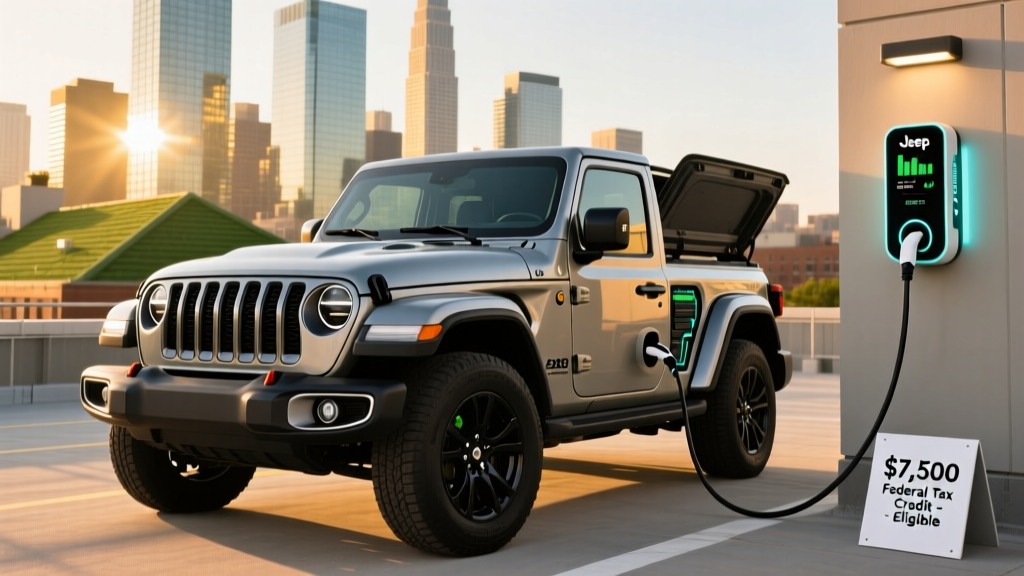
If you've been searching for a plug-in hybrid that can handle serious off-road duty while slashing your daily commute fuel bill, the 2026 Jeep Wrangler 4xe is the only vehicle in its class that fits the bill. Whether you've landed here researching bolt patterns on older models — like the 5x5.0 bolt pattern on a 2012 Jeep Wrangler — or you're upgrading to a modern electrified rig, this review covers every spec, cost, and real-world ownership detail you need before signing on the dotted line.
The Wrangler 4xe pairs a 2.0-liter turbocharged four-cylinder engine with two electric motors and a 17.3 kWh battery pack, producing a combined 375 horsepower and 470 lb-ft of torque. It delivers 22 miles of EPA-estimated electric-only range and 49 MPGe in hybrid mode. But sticker numbers only tell part of the story. Let's dig into what this PHEV actually delivers on the trail, at the charger, and on your tax return.
Range, Efficiency, and Real-World Expectations
Real-World Expectation: 16–19 miles on mixed highway driving; 12–15 miles in cold weather (below 32°F) with cabin heating active. Expect the full 22 miles primarily in stop-and-go city driving where regenerative braking recaptures energy effectively.
The 2026 Wrangler 4xe carries a 17.3 kWh lithium-ion battery (NMC chemistry — nickel manganese cobalt), of which approximately 14.5 kWh is usable. Jeep reserves a buffer to protect long-term battery health. Once the battery depletes, the 2.0L turbo engine takes over, delivering an EPA-estimated 20 MPG combined in hybrid mode — respectable for a 5,200-pound box-on-frame SUV with the aerodynamics of a brick.
| Metric | Value |
|---|---|
| EPA Electric Range | 22 miles |
| EPA MPGe (hybrid) | 49 MPGe |
| Gas-Only MPG (combined) | 20 MPG |
| Battery Capacity (gross) | 17.3 kWh (NMC) |
| Usable Battery | ~14.5 kWh |
| Fuel Tank | 17.2 gallons |
| Total Driving Range (est.) | ~370 miles |
For context, if your daily round-trip commute is under 20 miles and you charge nightly at home, you may go weeks without visiting a gas station. But plan a highway road trip and you'll be fueling like any conventional Wrangler — the electric range essentially disappears above 65 mph due to the vehicle's weight and frontal area.
Source: EPA Fueleconomy.gov — 2026 Jeep Wrangler 4xe
Charging Speed: DC Fast, Level 2, and Level 1
Charging speed is where PHEV buyers often face a reality check. The Wrangler 4xe is not a DC fast-charging vehicle — and understanding this upfront prevents disappointment.
| Charging Level | Power | 0–100% Time | Notes |
|---|---|---|---|
| Level 1 (120V household) | ~1.4 kW | ~12 hours | Standard outlet; overnight for partial refill |
| Level 2 (240V home/public) | 7.2 kW | ~2.5 hours | Full charge in a single session; ideal for daily use |
| DC Fast Charge | Not supported | N/A | No CCS/CHAdeMO port on 4xe |
The Wrangler 4xe uses a J1772 connector for Level 1 and Level 2 AC charging. There is no DC fast-charging capability — a limitation that matters if you were hoping to top up quickly on a road trip. For a PHEV with a 17.3 kWh pack, this isn't unusual: Toyota's RAV4 Prime and the Chrysler Pacifica Hybrid similarly lack DC fast charging. The small battery simply doesn't justify the added cost and weight of DC hardware.
Practical recommendation: Install a Level 2 home charger (240V, 32A minimum) for a full charge in roughly 2.5 hours. A licensed electrician will typically charge $500–$2,000 for installation depending on panel proximity and local permit costs. If you park in a garage or driveway with 240V access, this is a straightforward setup.
Performance and Powertrain
The 4xe powertrain is no efficiency-at-all-costs compromise. Two electric motors — one integrated into the transmission, one on the front accessory drive — work with the 2.0L turbo to deliver 375 combined horsepower and 470 lb-ft of torque. That's more torque than the 3.6L V6 mild-hybrid and enough to move this heavy SUV with genuine urgency.
| Performance Metric | Value |
|---|---|
| Combined Horsepower | 375 hp |
| Combined Torque | 470 lb-ft |
| 0–60 mph | 6.0 seconds (est.) |
| Drivetrain | 4WD (Selec-Trac or Rock-Trac depending on trim) |
| Transmission | 8-speed automatic (TorqueFlite) |
| Towing Capacity | 3,500 lbs |
| Curb Weight | ~5,200 lbs |
Electric torque fill is the 4xe's secret weapon off-road. In 4Lo mode with the electric motor providing instant torque at zero RPM, rock crawling becomes more precise — no need to spool up a gas engine. The eTorque system also enables a silent "EV mode" for trail sections where noise matters (or when you just want to creep through camp without waking anyone).
On pavement, the 6.0-second 0–60 time makes the 4xe one of the quickest Wranglers ever sold. The trade-off is weight: you'll feel those 5,200 pounds in corners and during emergency braking. This is a straight-line performer and off-road specialist, not a canyon carver.
Pricing, Trims, and Federal Tax Credit Eligibility
The Wrangler 4xe commands a premium over its gas-only siblings, but federal incentives narrow the gap significantly.
| Trim Level | Base MSRP | Est. After §30D Credit |
|---|---|---|
| Sport S 4xe | $51,790 | ~$44,290* |
| Willys 4xe | $53,790 | ~$46,290* |
| Sahara 4xe | $57,790 | ~$50,290* |
| Rubicon 4xe | $59,790 | ~$52,290* |
| High Altitude 4xe | $63,790 | ~$56,290* |
*Tax credit estimates assume full eligibility. Actual credit amount varies by buyer.
- MSRP Cap: SUVs/vans/pickups must have MSRP ≤ $80,000 (all 4xe trims qualify)
- Buyer Income Cap: AGI ≤ $150,000 (single), $225,000 (head of household), $300,000 (married filing jointly)
- Battery Sourcing: Critical minerals and battery components must meet phased-in domestic/FTA-country sourcing thresholds — confirm with dealer at purchase
- Point-of-Sale Transfer: Eligible buyers can transfer the credit to the dealer at purchase, reducing the sale price directly rather than waiting for a tax refund
- Credit Amount: Up to $7,500 ($3,750 for critical minerals + $3,750 for battery components)
Source: IRS.gov — Clean Vehicle Credit Eligibility
The point-of-sale transfer is a game-changer for cash flow: instead of waiting until tax season for a credit, you can apply up to $7,500 directly against the purchase price at the dealership. However, battery-sourcing requirements have tightened each year since 2023. Always confirm with your dealer that the specific VIN you're purchasing qualifies for the full credit amount before signing.
Cargo, Passenger Space, and Daily Practicality
The 4xe conversion eats into cargo space slightly compared to the gas Wrangler — the battery pack sits under the rear seats — but the impact is modest for most buyers.
| Dimension | 4-Door Unlimited |
|---|---|
| Cargo (behind rear seats) | 31.7 cu ft |
| Cargo (rear seats folded) | 72.4 cu ft |
| Rear Legroom | 38.3 inches |
| Front Legroom | 41.2 inches |
| Seating Capacity | 5 passengers |
The 2-door Wrangler is not available as a 4xe. If maximum cargo space is your priority, the gas-only 4-door offers slightly more room (31.7 vs ~33 cu ft for gas models), but the difference is small enough that it shouldn't drive your purchase decision unless you regularly haul bulky gear.
The removable roof panels and fold-down windshield remain intact on the 4xe — Jeep did not compromise the Wrangler's open-air identity for electrification. Doors-off driving is still fully supported.
Tech, Driver Assistance, and Interior
The 2026 Wrangler 4xe features Jeep's Uconnect 5 infotainment system on either an 8.4-inch or 12.3-inch touchscreen (depending on trim). Wireless Apple CarPlay and Android Auto are standard on most trims, and the 4xe-specific hybrid pages show real-time energy flow, battery state of charge, and regenerative braking statistics.
Standard driver-assistance features include:
- Adaptive cruise control (with stop-and-go)
- Forward collision warning with automatic emergency braking
- Lane departure warning with lane keep assist
- Blind-spot monitoring with rear cross-path detection
- ParkSense rear park assist
Notable tech drawbacks: The Wrangler still lacks GM's Super Cruise or Ford's BlueCruise hands-free highway driving. If you want true hands-off highway assist in an off-road-capable SUV, you'll need to look at the Ford Bronco with BlueCruise or wait for Jeep's next-generation ADAS rollout.
Warranty and Battery Longevity
Jeep backs the 4xe's hybrid components with one of the strongest warranties in the segment:
| Warranty Component | Coverage |
|---|---|
| High-Voltage Battery | 8 years / 100,000 miles |
| Electric Drive Components | 8 years / 100,000 miles |
| Powertrain (engine + transmission) | 5 years / 60,000 miles |
| Bumper-to-Bumper | 3 years / 36,000 miles |
| Corrosion (outer panels) | 5 years / unlimited miles |
The 8-year/100,000-mile battery warranty guarantees that the pack will retain at least 70% of its original capacity. NMC chemistry in a PHEV application typically sees less degradation than in a full BEV because the battery undergoes shallower charge/discharge cycles — you're using 14.5 kWh rather than draining a 75+ kWh pack daily. Real-world 4xe owners have reported minimal capacity loss at the 50,000-mile mark.
Source: Jeep Official Warranty Information
Pros, Cons, and Who Should Buy the Wrangler 4xe
- Only plug-in hybrid with serious off-road capability (locking differentials, disconnecting sway bar on Rubicon)
- 375 hp and 470 lb-ft torque — quickest Wrangler ever
- 22-mile electric range covers most daily commutes
- Eligible for up to $7,500 federal tax credit (point-of-sale transfer available)
- Silent EV mode for trails and neighborhoods
- Removable roof/doors and fold-down windshield retained
- 8-year/100,000-mile hybrid battery warranty
- No DC fast charging — Level 2 only
- Real-world electric range drops to 12–15 miles in cold weather
- $51,790+ starting MSRP is steep for a Wrangler
- 20 MPG gas-only is below rivals like the Bronco Sport Hybrid
- No hands-free highway driving assist
- Battery pack slightly reduces cargo space vs gas model
- Insurance premiums run 15–25% higher than gas Wrangler
- Choose the 4xe if: You commute under 20 miles daily, have home charging access, want off-road capability, and qualify for the federal tax credit.
- Choose the gas Wrangler if: You drive mostly highway miles, lack home charging, or want the lowest upfront price.
- Consider the Ford Bronco Sport PHEV if: You want a more refined on-road experience with similar trail capability and better fuel economy.
2026 Jeep Wrangler 4xe FAQ
What is the real-world electric range of the Wrangler 4xe?
The EPA rates it at 22 miles electric-only, but real-world results vary. Expect 16–19 miles in moderate weather on mixed roads, and 12–15 miles in freezing temperatures with the heater running. City driving with frequent regenerative braking gets you closest to the EPA number.
How fast does the Wrangler 4xe charge?
On a Level 2 (240V) home charger at 7.2 kW, a full charge takes approximately 2.5 hours. On a standard 120V household outlet (Level 1), expect about 12 hours. The 4xe does not support DC fast charging — there is no CCS or CHAdeMO port.
Does the 2026 Wrangler 4xe qualify for the federal EV tax credit?
It can qualify for up to $7,500 under IRS §30D, but eligibility depends on your income (AGI ≤ $300,000 for joint filers), the vehicle's MSRP (must be ≤ $80,000 for SUVs — all trims qualify), and battery component/critical mineral sourcing. The credit can be transferred to the dealer at point of sale. Confirm eligibility with your dealer and a tax professional before purchase.
How much does the Wrangler 4xe cost after incentives?
The Sport S 4xe starts at $51,790. With the full $7,500 federal credit, the effective price drops to approximately $44,290. State incentives may reduce this further — check your state's energy office for current programs. The Rubicon 4xe starts at $59,790, or roughly $52,290 after the federal credit.
Is the Wrangler 4xe worth it vs. the gas Wrangler?
If you can charge at home and your commute fits within the 22-mile electric range, the 4xe pays for its premium through fuel savings, instant torque, and the federal tax credit. The 0–60 time drops to 6.0 seconds vs. ~7.5 for the V6 gas model. If you lack charging access or drive mostly highway miles, the gas Wrangler is more practical.
What's the bolt pattern on the 2026 Wrangler 4xe?
The 2026 Wrangler 4xe uses a 5x127 mm (5x5.0 inch) bolt pattern — the same pattern Jeep has used since the JK generation. If you're upgrading from an older Wrangler (including the 2012 model, which shares this bolt pattern), many aftermarket wheels will carry over, but always verify offset and load rating for the 4xe's higher curb weight.
Can I tow with the Wrangler 4xe?
Yes. The 4xe is rated to tow 3,500 pounds — the same as the gas 4-door Wrangler. Note that towing will dramatically reduce electric-only range and fuel economy. Plan to use the hybrid powertrain mode when towing for best results.