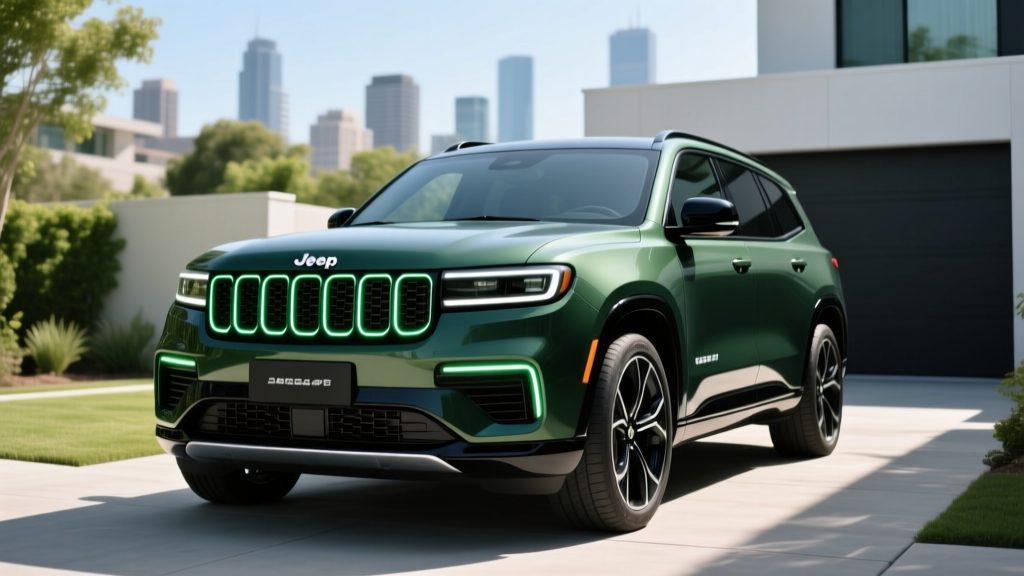
The 2026 Jeep Wagoneer S represents Stellantis's most ambitious electric push into the premium SUV segment, built on the STLA Large platform with a 100.5 kWh (usable) battery pack, dual-motor all-wheel drive, and a manufacturer-claimed 600 horsepower. But beyond the 0-60 mph time of roughly 3.4 seconds and the aggressive styling, the real question for buyers eyeing a Jeep Wagoneer S EV lease is what this electric SUV actually costs to put in your driveway and keep on the road over a typical ownership period.
This guide breaks down the total cost of ownership, federal and state incentives, fuel and maintenance savings, insurance realities, and depreciation trends — all anchored to the specific numbers of the Wagoneer S. If you're cross-shopping this against a BMW iX, Audi Q8 e-tron, or even the Tesla Model X, the math below will tell you whether the Wagoneer S pencil out.
Jeep Wagoneer S EV: Key Specs at a Glance
Before we get into costs, here's the spec foundation everything else is built on. These figures reflect the 2026 model year Launch Edition and base trims as currently published by Stellantis.
| Spec | Value |
|---|---|
| EPA-estimated range | ~300 miles (real-world highway: expect ~250–270 mi; cold weather: ~210–240 mi) |
| Battery capacity (usable) | 100.5 kWh, NMC chemistry |
| Drivetrain | Dual-motor AWD |
| Horsepower | 600 hp |
| 0–60 mph | ~3.4 seconds |
| Max DC fast charge rate | ~200 kW (10–80% in approximately 23 min, tapering above 80%) |
| Level 2 (AC) charge rate | 11.5 kW (full charge in ~9 hours) |
| Connector | CCS (with NACS adapter planned for Supercharger access) |
| Base MSRP (before incentives) | ~$65,995 (base) / ~$71,995 (Launch Edition) |
| Battery/powertrain warranty | 8 years / 100,000 miles |
| EPA MPGe (combined, est.) | ~88 MPGe |
5-Year Total Cost of Ownership: The Full Picture
Leasing or buying an EV isn't just about the monthly payment. To understand what a Jeep Wagoneer S EV lease actually costs you, we need to model five years of ownership including depreciation, energy, insurance, maintenance, and incentives. The table below assumes a purchase scenario at the base MSRP with the full §30D credit applied (if eligible), driven 12,000 miles per year, charging primarily at home on a Level 2 setup.
| Cost Category | 5-Year Total | Notes |
|---|---|---|
| Purchase price (after $7,500 §30D credit) | $58,495 | Base MSRP $65,995 minus federal credit; varies by eligibility |
| Home charging energy (60,000 mi) | $4,320 | At $0.16/kWh avg, ~2.2 kWh/mi consumption |
| Public DC fast charging (road trips) | $1,080 | ~10% of miles at $0.40/kWh avg |
| Insurance (5 years) | $14,400 | ~$2,880/yr avg; EVs typically 15–25% more than gas equivalents |
| Maintenance & repairs | $1,800 | Tire rotations, cabin filter, wipers, brake fluid; no oil changes |
| Depreciation (est. 5-yr residual ~42%) | $27,718 | EV depreciation has improved but lags top ICE SUVs |
| State registration / fees | $1,250 | Varies widely; some states add EV-specific fees ($50–$200/yr) |
| Total 5-Year Cost | ~$109,063 | Before state/local incentives and utility rebates |
For comparison, a gas-powered luxury SUV in the $60K–$70K range (think BMW X5 xDrive40i or a loaded Grand Cherokee) running 22 MPG combined at $3.60/gallon would spend roughly $9,818 on fuel alone over 60,000 miles — more than double the Wagoneer S's total energy cost. But the gas SUV's insurance may run $2,200–$2,400/year, and maintenance (oil, filters, spark plugs, brake pads) typically totals $3,500–$4,500 over five years.
Federal Tax Credit: Do You Qualify for §30D?
The federal EV tax credit under IRS §30D can knock up to $7,500 off the effective price of a Wagoneer S — but eligibility in 2026 depends on a web of requirements that catch many buyers off guard. Here's the checklist you need to run through before signing a lease or purchase agreement:
- MSRP cap: SUVs must have a base MSRP at or below $80,000. The Wagoneer S base ($65,995) and Launch Edition ($71,995) both qualify.
- Buyer income limits: Modified AGI must not exceed $300,000 (joint filers), $225,000 (head of household), or $150,000 (single). The credit applies to the lesser of the current year or prior year AGI.
- Battery component sourcing: A percentage of battery components must be manufactured or assembled in North America (threshold increases yearly; 100% for 2026). Stellantis has indicated the Wagoneer S qualifies for the full $3,750 component portion.
- Critical minerals sourcing: A percentage of critical minerals must be sourced from the US or a free-trade-agreement country (80% threshold for 2026). This qualifies for the other $3,750.
- Point-of-sale transfer: As of 2024, you can transfer the credit to the dealer at purchase, effectively reducing the price upfront rather than waiting to claim it on your tax return. This also applies to leases through the commercial clean vehicle credit (§45W) — the leasing company claims the credit and may pass savings to you as a capitalized cost reduction. Always confirm with the dealer.
- One credit per vehicle, one transfer per buyer per year.
Lease-specific note: When you lease a Wagoneer S, the vehicle is technically purchased by the leasing company (e.g., Stellantis Financial Services). They claim the commercial clean vehicle credit under §45W, which has no MSRP cap and no buyer income limit. However, there is no legal requirement for them to pass the savings to you. Competitive lease markets generally do pass it through as a cap-cost reduction, but always verify the money factor and capitalized cost reflect the $7,500.
Charging vs. Gas: The Per-Mile Math
This is where the Wagoneer S EV's ownership economics diverge most dramatically from a gas-powered alternative. Let's run the real numbers.
| Metric | Wagoneer S EV | Gas SUV (22 MPG Combined) |
|---|---|---|
| Energy source | Electricity ($0.16/kWh home, $0.40/kWh DCFC) | Unleaded premium ($3.60/gal) |
| Consumption | ~2.2 kWh/mi (est. 45 kWh/100mi) | 22 MPG |
| Cost per mile | $0.07–$0.11/mi (blended) | $0.164/mi |
| 60,000-mile total energy cost | ~$5,400 | ~$9,818 |
| 5-year fuel/energy savings | ~$4,418 savings for the EV | |
The savings widen considerably if you have access to off-peak utility rates (some Time-of-Use plans drop to $0.08–$0.10/kWh overnight) or if your utility offers an EV-specific rate plan. In high-electricity-cost states like California or Massachusetts where residential rates can exceed $0.30/kWh, the per-mile advantage narrows but rarely disappears entirely because the Wagoneer S's efficiency is reasonable for its size and power output.
One critical caveat: DC fast charging on road trips at networks like Electrify America or EVgo can cost $0.40–$0.55/kWh in some metro areas, which temporarily pushes per-mile cost above gas. If more than 30% of your charging is public DCFC, recalculate your savings — home Level 2 charging is where the economics work.
Maintenance Savings: What You Actually Skip
EVs eliminate the entire internal-combustion maintenance schedule, but they aren't maintenance-free. Here's what a Wagoneer S owner can expect versus a gas equivalent:
| Service Item | Wagoneer S EV | Gas Luxury SUV |
|---|---|---|
| Oil changes | $0 (none required) | $600–$900 (6–8 changes) |
| Engine air filter | $0 | $150–$250 |
| Spark plugs | $0 | $400–$600 |
| Transmission fluid | $0 (single-speed reducer) | $200–$400 |
| Brake pads/rotors | $200–$400 (regen extends life 2–3x) | $800–$1,500 |
| Cabin air filter | $150–$250 | $150–$250 |
| Tire rotation/replacement | $1,200–$1,800 (heavier vehicle wears tires faster) | $800–$1,200 |
| Coolant / brake fluid | $200–$300 | $200–$400 |
| 5-Year Total | ~$1,750–$2,950 | ~$3,300–$5,500 |
The biggest surprise for first-time EV owners is tire cost. The Wagoneer S weighs over 5,800 pounds and produces 600 hp of instant torque — both are hard on rubber. Budget for a set of premium all-season or EV-specific tires (like the Michelin Pilot Sport EV or Hankook iON evo SUV) around the 30,000–40,000 mile mark, running $1,000–$1,400 for a set of four.
Regenerative braking, however, is a genuine long-term win. By using the electric motors to slow the vehicle and recapture energy, friction brakes see dramatically less use. Many EV owners report original brake pads at 80,000+ miles. Just be sure to periodically apply the friction brakes (most EVs have a maintenance mode that does this automatically) to prevent rotor corrosion.
Insurance Costs: The Uncomfortable Truth
This is where EV ownership costs sting compared to gas cars, and it's a line item that lease shoppers frequently underestimate. The Wagoneer S will likely carry an insurance premium 15–25% higher than a comparably priced gas SUV. Here's why:
- Higher repair costs: EV-specific components (battery pack, power electronics, electric motors) require specialized training and equipment to repair. Minor rear-end collisions that would be a $2,000 fix on a gas car can become $8,000+ claims if high-voltage components are in the crush zone.
- Total-loss thresholds: Insurers may declare an EV a total loss at lower damage thresholds if battery integrity is in question, because battery replacement on the Wagoneer S could exceed $20,000–$25,000 out of warranty.
- Vehicle value: The higher purchase price and repair complexity push premiums up.
- Limited actuarial data: Insurers are still building historical claims data for newer EV platforms, and conservative pricing fills the uncertainty gap.
Based on current rate modeling for a 40-year-old driver with a clean record in a suburban zip code, expect annual premiums in the $2,600–$3,200 range for the Wagoneer S, depending on your state and coverage levels. That's roughly $400–$800/year more than a gas Grand Cherokee or BMW X5. Get quotes from at least three insurers before committing — some carriers (like GEICO, Progressive, and Tesla's own insurance program where available) have started offering EV-specific discounts that narrow the gap.
Depreciation and Resale Value: What to Expect
EV depreciation has historically been steeper than gas vehicles, driven by rapid technology obsolescence, battery health concerns, and Tesla's aggressive price cuts that reset the entire market. The Wagoneer S enters a segment where this dynamic is still playing out.
Current industry data from sources like iSeeCars and Kelley Blue Book suggest that premium electric SUVs retain roughly 40–48% of their value after five years, compared to 50–58% for comparable gas luxury SUVs. For the Wagoneer S specifically, a few factors cut both ways:
- In its favor: The Jeep brand has strong loyalty in the US, the STLA Large platform is new enough to avoid immediate obsolescence, and the 8-year/100,000-mile battery warranty provides second-owner confidence.
- Working against it: Stellantis has limited EV track record compared to Tesla or Hyundai/Kia, the premium EV SUV segment is increasingly crowded (BMW iX, Audi Q8 e-tron, Cadillac Lyriq, Tesla Model X), and any future battery-chemistry breakthroughs could make current NMC packs feel dated.
If you're leasing, depreciation is the leasing company's problem — your monthly payment already bakes in the residual value projection. Just be aware that if you plan to purchase at lease-end, the residual may be set optimistically. Run the numbers before exercising a buyout option.
For buyers, plan on the Wagoneer S retaining approximately 40–45% of its transaction price after five years and 60,000 miles. That translates to a 5-year depreciation hit of roughly $26,000–$30,000 on a $65,995 base model (less if you captured the full $7,500 credit at purchase).
State, Local, and Utility Incentives
Beyond the federal §30D credit, a patchwork of state and utility incentives can further reduce the effective cost of a Wagoneer S EV lease or purchase:
- California: The Clean Fuel Rebate program has offered up to $1,000–$2,000 for qualifying EVs, though funding is intermittent. Check the California Energy Commission for current status.
- Colorado: The state EV tax credit offers up to $5,000 for vehicles with an MSRP under $80,000, stackable with the federal credit.
- New York: The Drive Clean Rebate provides up to $2,000 at point of sale for qualifying EVs.
- Utility rebates: Many investor-owned utilities (PG&E, Con Edison, Xcel Energy, National Grid) offer $500–$1,500 rebates for installing a Level 2 home charger, plus discounted Time-of-Use electricity rates for EV owners. Some co-ops and municipal utilities offer even more generous programs.
- HOV lane access: States including California, Colorado, Virginia, and Maryland offer single-occupant HOV lane access for EVs — a non-monetary incentive that can save significant commute time.
When stacking incentives, a buyer in Colorado with a qualifying utility could potentially reduce the Wagoneer S effective cost by $12,500–$14,000 ($7,500 federal + $5,000 state + $1,000 utility charger rebate). That transforms a $66K SUV into something closer to a $52K net cost — a dramatically more competitive proposition.
Lease vs. Buy: Which Makes Sense for the Wagoneer S?
The lease-vs-buy calculus for the Wagoneer S depends on your priorities and how the incentives interact with each option:
Choose a lease if:
- You want the lowest monthly payment and don't mind never owning the vehicle.
- You're uncertain about long-term EV battery health and want to offload depreciation risk.
- Your income exceeds the §30D income caps — the §45W commercial credit on leases has no income limit.
- You plan to upgrade every 3 years to get the latest charging tech and range improvements.
Choose to buy if:
- You qualify for the full §30D credit and can apply it at point of sale.
- You drive 15,000+ miles per year (lease mileage penalties add up fast).
- You want to keep the vehicle 7+ years and ride out the depreciation curve.
- You want to capture the full fuel savings over a longer horizon without a balloon payment or new lease every 36 months.
Frequently Asked Questions
How much does it really cost to own the Jeep Wagoneer S EV over 5 years?
Our model shows approximately $109,000 in total 5-year cost for a buyer who captures the full $7,500 federal credit, drives 12,000 miles per year, and charges primarily at home. That includes purchase price, energy, insurance, maintenance, depreciation, and fees. Without the tax credit, the figure rises to roughly $116,500. State incentives can further reduce this.
Do I qualify for the $7,500 federal EV tax credit on the Wagoneer S?
You likely qualify if your modified AGI is under $300,000 (joint), $225,000 (head of household), or $150,000 (single), and the vehicle meets battery-sourcing requirements — which Stellantis indicates the Wagoneer S does for 2026. The MSRP is under the $80,000 SUV cap. Check the IRS clean vehicle credit page and confirm with your tax professional before relying on the credit.
How much do I save on fuel and maintenance versus a gas SUV?
Over 5 years and 60,000 miles, expect roughly $4,400 in fuel savings and $1,500–$2,500 in maintenance savings compared to a gas luxury SUV getting 22 MPG combined. Total operating savings: approximately $5,900–$6,900. These savings increase if you have access to cheap off-peak electricity and decrease if you rely heavily on expensive public DC fast charging.
Are EVs more expensive to insure than gas cars?
Yes, typically 15–25% more for a vehicle in this price class. The Wagoneer S will likely cost $2,600–$3,200/year to insure, driven by higher repair costs for EV-specific components, higher total-loss exposure, and limited actuarial data. Shop quotes from multiple carriers and ask about EV-specific discounts.
How well does the Wagoneer S EV hold its value?
Premium electric SUVs currently retain roughly 40–48% of value after five years, below the 50–58% typical for gas luxury SUVs. The Wagoneer S should land in the 40–45% range, aided by the Jeep brand and strong battery warranty but challenged by a crowded segment and Stellantis's limited EV track record. Leasing transfers this risk to the lessor.
Can I charge the Wagoneer S at Tesla Superchargers?
Stellantis has announced that vehicles on the STLA Large platform will gain NACS (Tesla connector) access via adapter. For 2026 models shipping with CCS ports, a NACS adapter should enable Supercharger access, but confirm adapter availability and compatibility with the dealer before relying on the Tesla network for road trips.